NLN Pax RN Basic Chemistry Exam 93 Questions with Answers 2023,100% CORRECT
Document Content and Description Below
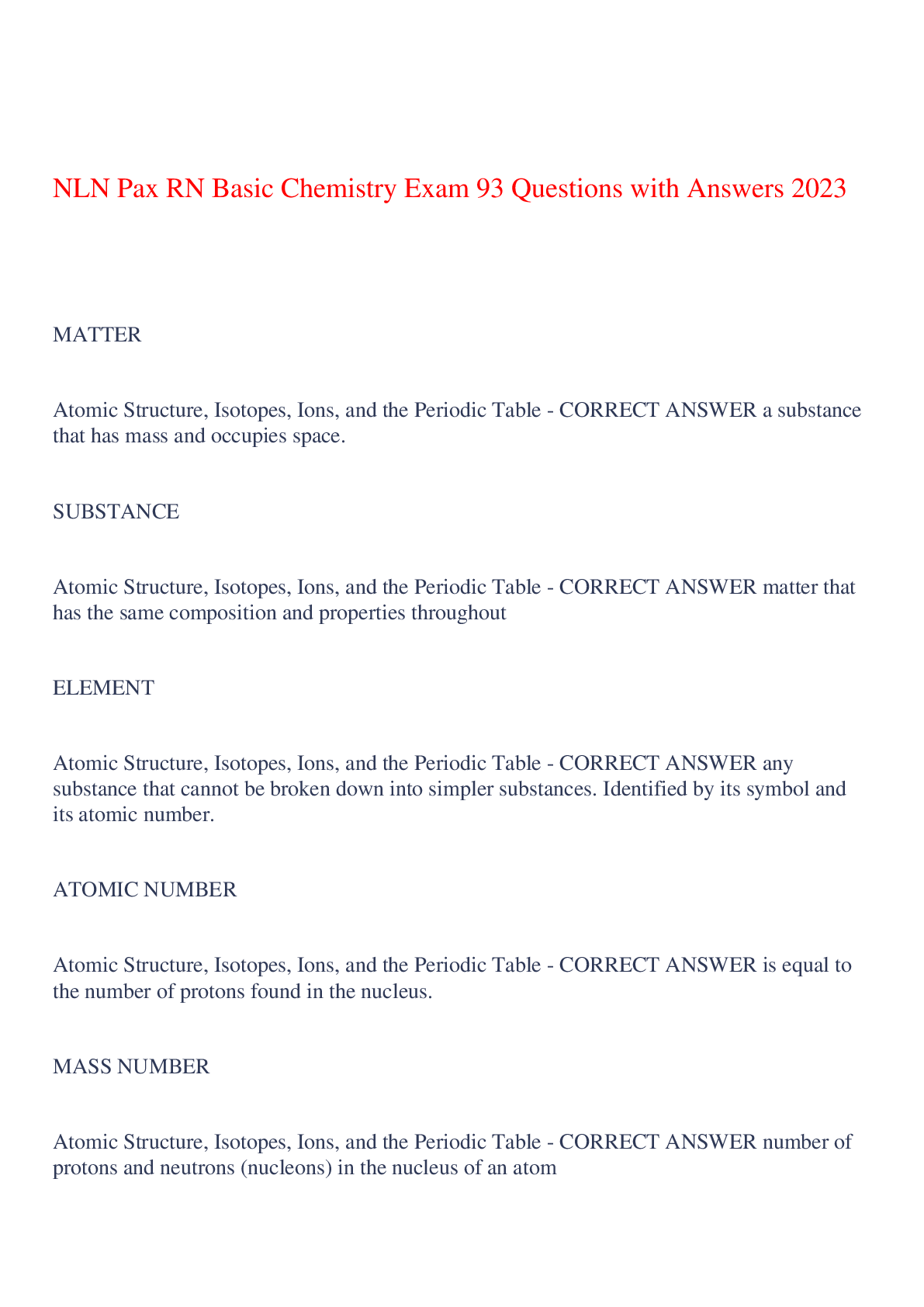
NLN Pax RN Basic Chemistry Exam 93 Questions with Answers 2023
MATTER
Atomic Structure, Isotopes, Ions, and the Periodic Table - CORRECT ANSWER a substance that has mass and occupies space.
...
SUBSTANCE
Atomic Structure, Isotopes, Ions, and the Periodic Table - CORRECT ANSWER matter that has the same composition and properties throughout
ELEMENT
Atomic Structure, Isotopes, Ions, and the Periodic Table - CORRECT ANSWER any substance that cannot be broken down into simpler substances. Identified by its symbol and its atomic number.
ATOMIC NUMBER
Atomic Structure, Isotopes, Ions, and the Periodic Table - CORRECT ANSWER is equal to the number of protons found in the nucleus.
MASS NUMBER
Atomic Structure, Isotopes, Ions, and the Periodic Table - CORRECT ANSWER number of protons and neutrons (nucleons) in the nucleus of an atom
ISOTOPE
Atomic Structure, Isotopes, Ions, and the Periodic Table - CORRECT ANSWER atoms of the same element with the same atomic number but with different numbers of neutrons
ATOMIC MASS
Atomic Structure, Isotopes, Ions, and the Periodic Table - CORRECT ANSWER The atomic mass may be considered to be the total mass of protons, neutrons and electrons in a single atom.
ION
Atomic Structure, Isotopes, Ions, and the Periodic Table - CORRECT ANSWER atom that has a positive or negative charge
ATOM
Atomic Structure, Isotopes, Ions, and the Periodic Table - CORRECT ANSWER smallest unit of an element that still retains the properties of that element consists of thre subatomic particles.
PROTON
Atomic Structure, Isotopes, Ions, and the Periodic Table - CORRECT ANSWER a subatomic particle that has a positive charge and that is found in the nucleus of an atom
CATION
Atomic Structure, Isotopes, Ions, and the Periodic Table - CORRECT ANSWER a positively charged ion
ANION
Atomic Structure, Isotopes, Ions, and the Periodic Table - CORRECT ANSWER a negatively charged ion
VALENCE ELECTRON
Atomic Structure, Isotopes, Ions, and the Periodic Table - CORRECT ANSWER Electrons found on the outer shell of an atom which can combine with other atoms to form molecules
PERIODIC TABLE
Atomic Structure, Isotopes, Ions, and the Periodic Table - CORRECT ANSWER A table that shows the elements, their atomic number, symbol, and average atomic mass; elements with similar chemical properties are grouped together.
PERIOD
Atomic Structure, Isotopes, Ions, and the Periodic Table - CORRECT ANSWER a horizontal row of elements in the periodic table
GROUP
Atomic Structure, Isotopes, Ions, and the Periodic Table - CORRECT ANSWER Vertical column of elements in the periodic table, Contains elements with similar properties because of their simlar electron configurations.
NEUTRON
Atomic Structure, Isotopes, Ions, and the Periodic Table - CORRECT ANSWER subatomic particle with no charge and a mass about equal to a proton and found in the nucleus
ELECTRON
Atomic Structure, Isotopes, Ions, and the Periodic Table - CORRECT ANSWER negatively charged particle and are found outside the nucleus and arranged according to their energy level
METAL
Atomic Structure, Isotopes, Ions, and the Periodic Table - CORRECT ANSWER a chemical element that is a good conductor of both electricity and heat and forms cations and ionic bonds with non-metals.
Found on the left side of the periodic table.
ex. gold
METALLOID
Atomic Structure, Isotopes, Ions, and the Periodic Table - CORRECT ANSWER an element that has some of the characteristics of metals and some characteristics of nonmetals, and are semiconductors, located in between the groups of metals and non-metals on the periodic table.
ex. arsenic
NONMETAL
Atomic Structure, Isotopes, Ions, and the Periodic Table - CORRECT ANSWER -an element that is a poor conductor of heat and electricity
-poor conductors of heat and electricity when compared to metals
-usually have lower densities than metals
non-metals have high electronegativity
ex. phosphorus
NOBLE GASES
Atomic Structure, Isotopes, Ions, and the Periodic Table - CORRECT ANSWER Have full valence shells and are inert. The last group on the right of the periodic table.
RADIO-ISOTOPE
Atomic Structure, Isotopes, Ions, and the Periodic Table - CORRECT ANSWER An isotope that has an unstable nucleus and undergoes radioactive decay
OCTET RULE
bonding - CORRECT ANSWER States that atoms lose, gain or share electrons in order to acquire a full set of eight valence electrons
IONIC BOND
bonding - CORRECT ANSWER a chemical bond in which one atom loses an electron to form a positive ion and the other atom gains to electron to form a negative ion
LEWIS ELECTRON DOT DIAGRAM
bonding - CORRECT ANSWER the representation of an atom, ion or molecule, in which the element symbols stand for the nucleus and all inner level electrons while dots stand for outer level electrons
COVALENT BOND
bonding - CORRECT ANSWER a chemical bond that involves sharing a pair of electrons between atoms in a molecule
NONPOLAR COVALENT BOND
bonding - CORRECT ANSWER when two identical non-metals equally share electrons between them. One well known exception to the identical atom rule is the combination of carbon and hydrogen in all organic compounds.
POLAR COVALENT BOND
bonding - CORRECT ANSWER the pair of electrons is shared however one atom has those electrons more than the other one does. An "unequal sharing."
DIPOLE
bonding - CORRECT ANSWER Is a polar covalent bond where the distribution of charges is unequal so that the molecule has a positive and negative end. they have a higher melting and boiling point.
ELEMENT
elements, compounds, and states of matter - CORRECT ANSWER any substance that cannot be broken down into simpler substances
COMPOUND
elements, compounds, and states of matter - CORRECT ANSWER is a substance of two or more different atoms bonded together, which can be broken down into elements.
GAS
elements, compounds, and states of matter - CORRECT ANSWER A state of matter with no definite shape or volume. Attractions between the atoms or molecules are weak, and the particles move around in a random and erratic manner.
LIQUID
elements, compounds, and states of matter - CORRECT ANSWER A state of matter where there is no definite shape, and does not vary in volume.
SOLID
elements, compounds, and states of matter - CORRECT ANSWER a form of matter that has a definite shape and volume, and its particles have very little movement.
MELTING
elements, compounds, and states of matter - CORRECT ANSWER the process where heat changes something from a solid to a liquid
EVAPORATION
elements, compounds, and states of matter - CORRECT ANSWER the process by which a liquid turns into a gas.
VAPOR PRESSURE
elements, compounds, and states of matter - CORRECT ANSWER a measure of the force exerted by a gas above a liquid in a sealed container, which is specific for each liquid and at each temperature.
CONDENSATION
elements, compounds, and states of matter - CORRECT ANSWER change of matter from a gas to a liquid state
FREEZING
elements, compounds, and states of matter - CORRECT ANSWER the withdrawal of heat to change something from a liquid to a solid
SUBLIMATION
elements, compounds, and states of matter - CORRECT ANSWER the change of a substance from a solid to a gas, without a liquid phase. Ex. dry ice
HOMOGENEOUS MIXTURE
mixtures, solutions, tinctures, and emulsions - CORRECT ANSWER a mixture in which the composition is uniform throughout, so there will be no variation found within the sample.
SOLUTION
mixtures, solutions, tinctures, and emulsions - CORRECT ANSWER a homogeneous mixture of two or more substances uniformly dispersed throughout, ex. sugar water, each sample of the water should contain an equal amount of dissolved sugar
FILTRATION
mixtures, solutions, tinctures, and emulsions - CORRECT ANSWER a process that separates a solid from the liquid or gas in a heterogeneous mixture, by means of a filter.
SOLVENT
mixtures, solutions, tinctures, and emulsions - CORRECT ANSWER a liquid substance capable of dissolving other substances
SOLUTE
mixtures, solutions, tinctures, and emulsions - CORRECT ANSWER the dissolved substance in a solution
TINCTURE
mixtures, solutions, tinctures, and emulsions - CORRECT ANSWER A solution where the solvent is alcohol.
CHROMATOGRAPHY
mixtures, solutions, tinctures, and emulsions - CORRECT ANSWER the process of seperating a chemical mixture into its individual substances, aka Any of various techniques for the separation of complex mixtures that rely on the differential affinities of substances for a gas or liquid mobile medium and for a stationary adsorbing medium through which they pass, such as paper, gelatin, or magnesia.
HETEROGENEOUS MIXTURE
mixtures, solutions, tinctures, and emulsions - CORRECT ANSWER composition may vary within a sample, particles may be able to be visibly seen.
EMULSION
mixtures, solutions, tinctures, and emulsions - CORRECT ANSWER A suspension of small globules of one liquid in a second liquid with which the first will not mix
SOLUBILITY
mixtures, solutions, tinctures, and emulsions - CORRECT ANSWER the ability of one substance to dissolve in another at a given temperature and pressure
DISTILLATION
mixtures, solutions, tinctures, and emulsions - CORRECT ANSWER the process of purifying a liquid by boiling it and condensing its vapors
CHEMICAL CHANGE
chemical versus physical changes - CORRECT ANSWER a type of change where a substance changes into a new and different substance
iron exposed to oxygen makes iron oxide.
PHYSICAL CHANGE
chemical versus physical changes - CORRECT ANSWER change a change from one state (solid or liquid or gas) to another without a change in chemical composition. Ice cubes that melt into liquid, both are the same substance, water but just in different forms.
REACTION
chemical versus physical changes - CORRECT ANSWER process that leads to the transformation of one set of chemical substances to another.
REACTANT
chemical versus physical changes - CORRECT ANSWER a chemical substance that is present at the start of a chemical reaction
PRODUCT
chemical versus physical changes - CORRECT ANSWER a chemical substance formed as a result of a chemical reaction, but nothing was created or destroyed.
SYNTHESIS (COMBINATION) REACTIONS
chemical versus physical changes - CORRECT ANSWER a chemical reaction in which two or more simple substances combine to form a new, more complex substance
SINGLE REPLACEMENT REACTIONS
chemical versus physical changes - CORRECT ANSWER involves an element reacting with a compound. During this reaction, and atom of the single element replaces and element in the compound.
DOUBLE DISPLACEMENT REACTIONS
chemical versus physical changes - CORRECT ANSWER displacement reactions where two ionic compounds react to form two new compounds, Happens a lot with acid-base reactions.
ACID BASE REACTION
chemical versus physical changes - CORRECT ANSWER When an acid and base mix together, neutralize one another's properties, and the products are salt and water.
NEUTRALIZATION REACTION
chemical versus physical changes - CORRECT ANSWER is a chemical reaction whereby an acid and a base react to form a salt.
ACID
chemical versus physical changes - CORRECT ANSWER Conduct electricity
Change blue litmus to red
Have a sour taste
React with bases to neutralize their properties
React with active metals to liberate hydrogen ions
BASE
chemical versus physical changes - CORRECT ANSWER Conduct electricity
Change red litmus to blue
Have a slippery feeling
React with acids to neutralize their properties.
Donates hydroxide ions.
pH SCALE
chemical versus physical changes - CORRECT ANSWER scale a range of numbers used to describe how acidic or basic a solution is; ranges from 0 (most acidic) to 14 (most basic)
INDICATOR
chemical versus physical changes - CORRECT ANSWER Acid base indicator such as litmus is a substance that changes color in an acid or base
DECOMPOSITION REACTIONS
chemical versus physical changes - CORRECT ANSWER one reactant that is broken down into two or more simpler products. Heat is often used to drive this type of reaction.
Ex. Heated carbonic acid decomposes into water and carbon dioxide.
ACTIVATION ENERGY
reaction rates and catalysis - CORRECT ANSWER energy needed to get a reaction started
CATALYST
reaction rates and catalysis - CORRECT ANSWER a substance that initiates or accelerates a chemical reaction, by lowering the activation energy needed. They affect the rate, and do not get used up
EXOTHERMIC
reaction rates and catalysis - CORRECT ANSWER chemical reaction in which energy is primarily given off in the form of heat, products contain less energy than its reactants.
ENDOTHERMIC
reaction rates and catalysis - CORRECT ANSWER describes a reaction that absorbs energy from the surroundings, its products contain more energy than its reactants.
EQUILIBRIUM
reaction rates and catalysis - CORRECT ANSWER When molecules are moving form greater to lesser concentration in an attempt to reach a balanced state or in terms or chemical reactions the rate of the forward reaction is equal to the rate of the reverse reaction.
ORGANIC COMPOUND
organic chemistry - CORRECT ANSWER compound that contains carbon, excluding carbonates and oxides
HYDROCARBON
organic chemistry - CORRECT ANSWER organic molecule composed of only carbon and hydrogen atoms
ALCOHOL
organic chemistry - CORRECT ANSWER A substituted hydrocarbon that contains one or more hydroxyl groups(-OH), such as methanol, or ethanol
ALDEHYDE
organic chemistry - CORRECT ANSWER An organic molecule with a carbonyl group with at least one hydrogen attached to it, located at the end of the carbon skeleton.
KETONE
organic chemistry - CORRECT ANSWER A compound containing a carbonyl group with two hydrocarbon groups attached to it
STRUCTURAL FORMULA
organic chemistry - CORRECT ANSWER used to represent organic compounds, similar to lewis diagrams, but use a dash in place of a colon to represent a bond.
CARBOHYDRATE
organic chemistry - CORRECT ANSWER contains carbon, hydrogen, and oxygen, and the ratio of hydrogen to oxygen is typically 2:1. The name carbohydrate means "watered carbon" or carbon with attached water molecules.
MONOSACCHARIDES
organic chemistry - CORRECT ANSWER single sugar molecule (monomer)
DISACCHARIDES
organic chemistry - CORRECT ANSWER A double sugar, consisting of two monosaccharides joined by dehydration synthesis.
POLYSACCHARIDES
organic chemistry - CORRECT ANSWER a complex molecule composed of three or more monosaccharides (sugar)
STARCH
organic chemistry - CORRECT ANSWER polysaccharide made up of a chain of glucose molecules; food storage molecule for plants
GLYCOGEN
organic chemistry - CORRECT ANSWER Polysaccharide that is found in animals.
LIPID
organic chemistry - CORRECT ANSWER macromolecule made mainly from carbon and hydrogen and oxygen atoms; includes fats, oils, and waxes, steroids. The molecules of such a lipid are made up of a glycerol molecule with three fatty acid molecules attached to it.
FATTY ACID
organic chemistry - CORRECT ANSWER Fatty acids are made up of a long-chain carbon skeleton that has a carboxylic acid functional group.
GLYCEROL
organic chemistry - CORRECT ANSWER Glycerol has a carbon skeleton of three carbon atoms with three alcohol groups attached to the carbons. At room temperature is has the appearance of a clear lightweight oil and is commonly used under the name glycerin
PROTEIN
organic chemistry - CORRECT ANSWER an organic compound that is made of one or more chains of amino acids and that is a principal component of all cells Common test for presence of proteins is the Biuret Solution
AMINO ACID
organic chemistry - CORRECT ANSWER are organic compounds which contain both an amino group and a carboxyl group.
DEHYDRATION SYNTHESIS
organic chemistry - CORRECT ANSWER synthesis a chemical reaction in which large molecules are formed by removing water from smaller molecules and joining them together
hydrolysis
organic chemistry - CORRECT ANSWER a chemical process in which a compound is broken down and changed into other compounds by taking up the elements of water
Lugol's
organic chemistry - CORRECT ANSWER solution used to test for starch (iodine)
Benedict's
organic chemistry - CORRECT ANSWER solution solution to test for glucose.
[Show More]
Last updated: 2 years ago
Preview 1 out of 15 pages