MATH 225N Week 4 Probability Questions and answers –
Chamberlain College of Nursing
Week 4 Homework Questions Probability
1. Which of the pairs of events below is dependent?
Select the correct answer below:
drawing
...
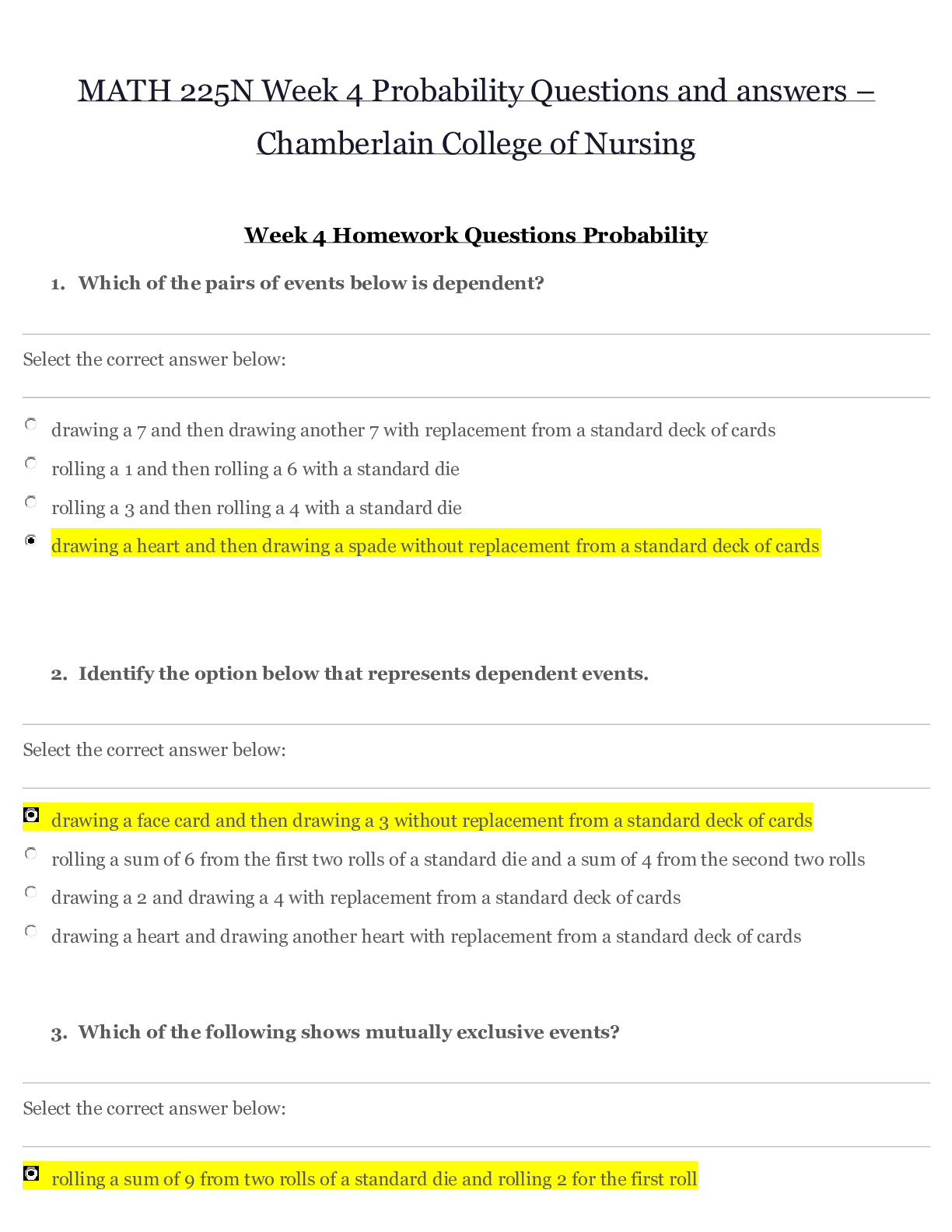
MATH 225N Week 4 Probability Questions and answers –
Chamberlain College of Nursing
Week 4 Homework Questions Probability
1. Which of the pairs of events below is dependent?
Select the correct answer below:
drawing a 7 and then drawing another 7 with replacement from a standard deck of cards
rolling a 1 and then rolling a 6 with a standard die
rolling a 3 and then rolling a 4 with a standard die
drawing a heart and then drawing a spade without replacement from a standard deck of cards
2. Identify the option below that represents dependent events.
Select the correct answer below:
drawing a face card and then drawing a 3 without replacement from a standard deck of cards
rolling a sum of 6 from the first two rolls of a standard die and a sum of 4 from the second two rolls
drawing a 2 and drawing a 4 with replacement from a standard deck of cards
drawing a heart and drawing another heart with replacement from a standard deck of cards
3. Which of the following shows mutually exclusive events?
Select the correct answer below:
rolling a sum of 9 from two rolls of a standard die and rolling 2 for the first rolldrawing a red card and then drawing a black card with replacement from a standard deck of cards
drawing a jack and then drawing a 7 without replacement from a standard deck of cards
drawing a 7 and then drawing another 7 with replacement from a standard deck of cards
4. Which of the pairs of events below is mutually exclusive?
Select the correct answer below:
drawing an ace of spades and then drawing another ace of spades without replacement from a standard
deck of cards
drawing a 2 and drawing a 4 with replacement from a standard deck of cards
drawing a heart and then drawing a spade without replacement from a standard deck of cards
drawing a jack and then drawing a 7 without replacement from a standard deck of cards
(Mutually exclusive events are events that cannot occur together. In this case, drawing an ace of spades and
then drawing another ace of spades without replacement from a standard deck of cards are two events that
cannot possibly occur together.)
5. A deck of cards contains RED cards numbered 1,2,3,4,5,6, BLUE cards
numbered 1,2,3,4,5, and GREEN cards numbered 1,2,3,4. If a single card is picked at
random, what is the probability that the card has an ODD number?
Select the correct answer below:
10/15
8/15
14/15
6/15
(By counting, we can see that there are 8 odd cards, and a total of 15 cards in the deck. So the probability
is 8/15).6. Hector is a baseball fan but wants to watch something different. There are 5 basketball
games, 2 football games, and 4hockey games that he can choose to watch. If Hector
randomly chooses a game, what is the probability that it is a basketball game?
•Give your answer as a fraction.
Provide your answer below: 5/11
7. There are 26 cards in a hat, each of them containing a different letter of the alphabet. If
one card is chosen at random, what is the probability that it is not between the letters L
and P, inclusive?
Provide your answer below: 21/26
8. A spinner contains the numbers 1 through 80. What is the probability that the spinner
will land on a number that is not a multiple of 12?
•Give your answer in fraction form.
Provide your answer below: 74/80
9. An art collector wants to purchase a new piece of art. She is interested
in 5 paintings, 6 vases, and 2 statues. If she chooses the piece at random, what is the
probability that she selects a painting?
•Give your answer as a fraction.
Provide your answer below: 5/13
10. Boris is taking a quiz for an online class. For the quiz, the system randomly
assigns 2 high-difficulty questions, 7 moderate-difficulty questions, and 6 low-difficulty
questions. What is the probability that Boris is assigned a moderate-difficulty question
first?
•Give your answer as a fraction.Provide your answer below: 7/15
11. A spinner contains the numbers 1 through 40. What is the probability that the spinner
will land on a number that is not a multiple of 6? Give your answer as a fraction.
Provide your answer below: 34/40
12.A spinner contains the numbers 1 through 50. What is the probability that the spinner
will land on a number that is not a multiple of 4?
Provide your answer below: 38/50
13.Identify the parameters p and n in the following binomial distribution scenario. The
probability of winning an arcade game is 0.718 and the probability of losing is 0.282. If
you play the arcade game 20 times, we want to know the probability of winning more
than 15 times. (Consider winning as a success in the binomial distribution.)
p=0.282, n=20
p=0.718, n=15
p=0.718, n=20
p=0.282, n=15
(The parameters p and n represent the probability of success on any given trial and the total number of trials,
respectively. In this case, success is winning a game, so p=0.718. The total number of trials, or games,
is n=20)
14.A weighted coin has a 0.55 probability of landing on heads. If you toss the coin 14 times,
what is the probability of getting heads exactly 9 times? (Round your answer
to 3 decimal places if necessary.)
Provide your answer below: 0.170(This probability can be found using the binomial distribution with success probability p=0.55 and 14 trials.
To find the probability that exactly 9 of the tosses are heads, use a calculator or
computer: P(X=9)=binompdf(14,0.55,9)≈0.170.
15. Identify the parameter p in the following binomial distribution scenario. The probability of
buying a movie ticket with a popcorn coupon is 0.546 and without a popcorn coupon is 0.454.
If you buy 27 movie tickets, we want to know the probability that exactly 15 of the tickets have
popcorn coupons. (Consider tickets with popcorn coupons as successes in the binomial
distribution.)
Select the correct answer below:
0.152
0.454
0.546
0.848
16.A softball pitcher has a 0.64 probability of throwing a strike for each pitch. If the
softball pitcher throws 20 pitches, what is the probability that exactly 13 of them
are strikes?
• Round your answer to three decimal places. 0.184
This probability can be found using the binomial distribution with success probability p=0.64 and 20 trials.
To find the probability that exactly 13 of the pitches are strikes, use a calculator or
computer: P(X=13)=binompdf(20,0.64,13)=0.184.
17.Identify the parameter n in the following binomial distribution scenario. A
basketball player has a 0.429 probability of making a free throw and
a 0.571 probability of missing. If the player shoots 20 free throws, we want to know
the probability that he makes no more than 12 of them. (Consider made free
throws as successes in the binomial distribution.)
Select the correct answer below:8
12
20
32
18. Give the numerical value of the parameter p in the following binomial distribution
scenario.
A softball pitcher has a 0.675 probability of throwing a strike for each pitch and
a 0.325 probability of throwing a ball. If the softball pitcher throws 29 pitches, we
want to know the probability that exactly 19 of them are strikes.
Consider strikes as successes in the binomial distribution. Do not include p= in
your answer.
Provide your answer below: 0.675
(The parameters p and n represent the probability of success on any given trial and the total number of trials,
respectively. In this case, success is a strike, so p=0.675)
19.Identify the parameters p and n in the following binomial distribution scenario.
Jack, a bowler, has a 0.38 probability of throwing a strike and a 0.62 probability of not
throwing a strike. Jack bowls 20times (Consider that throwing a strike is a success.)
Select the correct answer below:
p=0.38,n=0.62
p=0.38,n=10
p=0.38,n=20
p=0.62,n=10p=0.62,n=20
(In a binomial distribution, there are only two possible outcomes. p denotes the probability of the event or
trial resulting in a success. In this scenario, it would be the probability of Jack bowling a strike, which is 0.38.
The total number of repeated and identical events or trials is denoted by n. In this scenario, Jack bowls a total
of 20 times, so n=20).
20. The Stomping Elephants volleyball team plays 30 matches in a week-long
tournament. On average, they win 4 out of every 6matches. What is the mean for
the number of matches that they win in the tournament?
Select the correct answer below:
46
4
20
30
In this scenario, the number of trials is 30 (the total number of matches played), which is n. The probability of
a success (winning a match) is 46. So, the mean of the binomial distribution B(30,46) is:
μ=(30)(46)=20
21.Using the same scenario, what is the standard deviation for the number of matches
that they win in the tournament?
The Stomping Elephants volleyball team plays 30 matches in a week-long tournament. On
average, they win 4 out of every 6matches.
Select the correct answer below:
26
6.67−−−−√
6.6720−−√
20
40
The standard deviation of a binomial distribution is the square root of the variance. The variance is the
product of n, the total number of repeated trials or events, p, the probability of a success, and q, which
is (1−p).
variance = σ2=np(1−p)
standard deviation = variance−−−−−−−√
In this scenario, the number of trials is 30 (the total number of matches played), which is n. The probability of
a success (winning a match) is 46. So, the value for (1−p) is 26.
The variance is the product of these values.
variance = σ2=(30)(46)(26)
So the variance is approximately 6.67, and the standard deviation is the square root of that, 6.67−−−−√
22. Identify the parameter n in the following binomial distribution scenario. A weighted coin
has a 0.441 probability of landing on heads and a 0.559 probability of landing on tails. If you
toss the coin 19 times, we want to know the probability of getting heads more than 5 times.
(Consider a toss of heads as success in the binomial distribution.)
Select the correct answer below:
5
14
19
2423.Give the numerical value of the parameter n, the number of trials, in the following
binomial distribution scenario.
A weighted coin has a 0.486 probability of landing on heads and
a 0.514 probability of landing on tails. If you toss the coin 27 times, we want to
know the probability of getting heads exactly 11 times.
Consider a toss of heads as success in the binomial distribution.
Provide your answer below: 27
24. The probability of winning on an arcade game is 0.659. If you play the arcade
game 30 times, what is the probability of winning exactly 21 times?
•Round your answer to two decimal places.
Provide your answer below: .14
25. The probability of buying a movie ticket with a popcorn coupon is 0.526. If
you buy 26 movie tickets, what is the probability that exactly 15 of the tickets have
popcorn coupons?
•Round your answer to three decimal places.
Provide your answer below: .137
26. The probability of buying a movie ticket with a popcorn coupon is 0.608. If
you buy 10 movie tickets, what is the probability that more than 3 of the tickets
have popcorn coupons? (Round your answer to 3 decimal places if necessary.)
Provide your answer below: .95127. A softball pitcher has a 0.507 probability of throwing a strike for each pitch.
If the softball pitcher throws 15 pitches, what is the probability that more than 8 of
them are strikes? (Round your answer to 3 decimal places if necessary.)
Provide your answer below: .323
28. A 2014 study by researchers at the University College Antwerp and the
University of Leuven showed that e-cigarettes are effective at reducing cigarette
craving. Participants were separated into two groups. One group was given ecigarettes and the other was told to not smoke e-cigarettes. Two months later,
researchers observed how many participants had stopped smoking cigarettes.
The following table shows approximate numbers. According to the table, what is the probability that a
randomly chosen participant did not stop smoking, given that the participant received an e-cigarette?
Participants stopped smoking did not stop smoking Total
given e-cigarette 11 21 32
not given e-cigarette 0 16 16
Total 11 37 48
Select the correct answer below:
21/48
11/48
11/32
16/16
0/16
21/3229. Researchers wanted to study if having a long beak is related to flight in birds.
They surveyed a total of 34 birds. The data are shown in the contingency table
below. What is the relative risk of flying for those birds that have long beaks?
Round your answer to two decimal places.
Flies Does not fly Total
Long beak 11 3 14
Not a long beak 7 13 20
Total 18 16 34
Provide your answer below: 2.24
The probability that a bird with long beak flies is 11/14. The probability that a bird not having a long beak flies
is 7/20. The relative risk is then 11/14 / 7/20≈2.24. This means that in this survey, birds having long
beaks were 224% as likely to fly as birds not having long beaks.
30. Given the contingency table below, determine the marginal distribution of
breakfast and lunch. Round your answer(s) to the nearest whole number. Select all
that apply.
Food Bread Rice Total
Breakfast 122 189 311
Lunch 420 263 683
Total 542 452 994
Select all that apply:
• 55%
• •
45%
• •
31%
•• 69%
• 31%
• 69%
• Marginal distributions are the row and column percentages. Breakfast and lunch are in the rows, so use
the row totals to determine the percentages. The "Breakfast" percentage is 311/994≈0.31, and the
"Lunch" percentage is 683/994≈0.69. The marginal distribution is 31%, 69%.
31.155 fitness center members were asked if they run and if they lift weights. The
results are shown in the table below.
Does not Run Runs Total
Does not Lift
Weights
30 68 98
Lifts Weights 16 41 57
Total 46 109 155
Given that a randomly selected survey participant does not run, what is the probability that
the participant lifts weights?
•Enter the answer as a fraction.
Provide your answer below: 16/46 = 8/23
32. Fill in the following contingency table and find the number of students who
both have a cat AND have a dog.
Students Have a dog Do not have a dog Total
Have a cat 35 25 60
Do not have a cat 27 11 38
Total 62 36 98
Provide your answer below: 3533. Researchers wanted to study if having a long beak is related to flight in birds.
They surveyed a total of 34 birds. The data are shown in the contingency table
below. What is the odds ratio for birds that fly having long beaks against birds that
do not fly having long beaks? Round your answer to two decimal places.
Flies Does not fly Total
Long beak 11 3 14
Not a long beak 7 13 20
Total 18 16 34
Provide your answer below: 6.81
(The odds that a bird that flies also has long beak are 11 to 7. The odds that a bird that does not fly also has
long beak are 3to 13. The odds ratio is then 11/17 / 3/13≈6.81. In this study, birds that fly had almost 7 times
the odds of also having long beaks as the birds that do not fly.)
34. Fill in the following contingency table and find the number of students who
both watch comedies AND watch dramas.
Students Watch dramas Do not watch dramas Total
Watch comedies 16 25 41
Do not watch comedies 38 27 65
Total 54 52 106
Provide your answer below: 16
35. Researchers wanted to study if couples having children are married. They
surveyed a large group of people. The data are shown in the contingency table
below. What is the odds ratio for married people having children against
unmarried people having children? Round your answer to two decimal places.
Children No Children Total
Married 97 35 132Not Married 68 71 139
Total 165 106 271
The odds that a married couple has children are 97 to 35. The odds that an unmarried couple has children
are 68 to 71. The odds ratio is then 97/35 ÷ 68/71 ≈ 2.89. In this study, people who are married
had about 3 times the odds of having children as people who are not married.
36. Doctors are testing a new antidepressant. A group of patients, all with
similar characteristics, take part in the study. Some of the patients receive the new
drug, while others receive the traditional drug. During the study, a number of
patients complain about insomnia. The data are shown in the contingency table
below. What is the relative risk of insomnia for those who receive the new drug?
Round to two decimal places.
Insomnia No
Insomnia
Total
New Drug 52 226 278
Traditional
Drug
36 295 331
Total 88 521 609
Answer: 1.72
(The probability that a patient who receives the new drug develops insomnia is 52/278=26/139.
The probability that a patient who receives the traditional drug develops insomnia is 36/331. The relative risk
is then 26/139 ÷ 36/331≈1.72. This means that in this study, people who took the new drug were 172% more
likely to develop insomnia)37. A group of college freshman are targeted with a voter registration
advertisement. Another group of freshman are not targeted. The table below
shows how many of these freshman registered to vote. What is the odds ratio for
freshman targeted with the advertisement registering to vote against freshman not
targeted with the advertisement registering to vote? Does the advertisement
appear to have been successful? Round to two decimal places.
Registered to vote Did not register to vote Total
Targeted with
advertisement
103 36 139
Not targeted with
advertisement
78 64 142
Total 181 200 381
Select the correct answer below:
5.51; The advertisement was successful.
2.35; The advertisement was successful.
1.79; The advertisement was successful.
0.56; The advertisement was not successful.
0.43; The advertisement was not successful.
0.18; The advertisement was not successful.
(The odds that a student targeted by the advertisement registers to vote is 103 to 36. The odds that a student
not targeted by the advertisement registers to vote is 78 to 64, or 39 to 32. The odds ratio is then 103/36 ÷
39/32≈2.35. In this situation, students targeted by the advertisement had more than twice the odds of
registering to vote as students not targeted by the advertisement. It would appear that the advertisement was
successful)38. Researchers wanted to study if wearing cotton clothes is related to
depression. They surveyed a large group of people. The data are shown in the
contingency table below. What is the relative risk of wearing cotton clothes for
those who are depressed? Round your answer to two decimal places.
Depressed Not Depressed Total
Cotton 122 189 311
Not Cotton 420 263 683
Total 542 452 994
Answer: .54
(The probability that someone who is depressed wears cotton clothes is 122542. The probability that someone
who is not depressed wears cotton clothes is 189452. The relative risk is then 122542189452≈0.54. This
means that in this survey, depressed people were 54% as likely to wear cotton clothes as people who are not
depressed)
39. Researchers want to study whether or not a fear of flying is related to a fear
of heights. They surveyed a large group of people and asked them whether or not
they had a fear of flying and whether or not they had a fear of heights. The data are
shown in the contingency table below. What is the relative risk of being afraid of
flying for those who are afraid of heights? Round your answer to two decimal
places.
Afraid of heights Not afraid of heights Total
Afraid of flying
76 33 109
Not afraid of flying
82 370 452
Total
158 404 561
Provide your answer below: 5.87
(The probability that someone with a fear of heights is afraid of flying is 76/158=38/79. The probability
that someone who does not have a fear of heights is afraid of flying is 33/403. The relative risk is
then 38/79 /v 33/403≈5.87. This means that in this survey, people with a fear of heights were 587% as
likely to have a fear of flying as people without a fear of heights.40. A study of drivers with speeding violations in the last year and drivers who
use cell phones produced the following fictional data:
Violation No violation Total
Cell phone user 25 280 305
Not a cell phone user 45 405 450
Total 70 685 755
Find the probability that a driver received a violation, given that the driver is a cell phone user.
Select the correct answer below:
280/305
70/755
25/305
25/70
41.Find the probability that a randomly chosen person takes public transit to
work given that the person does not support the environmental bill.
People Drive to work Walk to work Public Transport to work Total
Support bill 5 30 20 55
Do not support bill 20 3 10 33
Total 25 33 30 88Give your answer as a fraction. 10/33
42. Fill in the following contingency table and find the number of students who
both do not go to the beach AND do not go to the mountains.
Students Go to the
mountains
do not go to the
mountains
Total
Go to the beach 32 22 54
Do not go to the beach 17 10 27
Total 49 32 81
Provide your answer below: 10
43. Fill in the following contingency table and find the number of students who
both have a cat AND have a dog.
Students Have a dog Do not have a dog Total
Have a cat 14 35 49
Do not have a cat 32 17 49
Total 46 52 98
Provide your answer below: 14
44. Researchers wanted to study if couples having children are married. They
surveyed a large group of people. The data are shown in the contingency table
below. What is the odds ratio for people having children to be married against
people not having children to be married? Round your answer to two decimal
places.
Children No Children Total
Married 97 35 132Not Married 68 71 139
Total 165 106 271
Provide your answer below: 2.89
(The odds that people having children are married are 97 to 68. The odds that people not having children are
married are 35to 71. The odds ratio is then 97/68 ÷ 35/71≈2.89. In this study, people who have children
had about 3 times the odds of being married as people who do not have children)
45. Researchers wanted to study if wearing cotton clothes is related to
depression. They surveyed a large group of people. The data are shown in the
contingency table below. What is the odds ratio for people wearing cotton clothes
being depressed against people not wearing cotton clothes being depressed?
Round your answer to two decimal places.
Depressed Not Depressed Total
Cotton 122 189 311
Not Cotton 420 263 683
Total 542 452 994
Provide your answer below: 0.40
(The odds that a person who wears cotton clothes is also depressed are 122 to 189. The odds that a person who
does not wear cotton clothes is depressed are 420 to 263. The odds ratio is then 122/189 ÷ 420/263≈0.40. In
this study, people who wear cotton clothes had over 0.4 times the odds of also being depressed as people who
are not wearing cotton clothes.
46. Review the flu vaccine data below. What is the odds ratio of not catching the
flu for those who receive the new vaccine?Caught flu Did not catch flu Total
New Vaccine 15 375 390
Traditional Vaccine 55 225 280
Total 70 600 670
Answer: 6.11
The odds that a person who receives the new vaccine does not catch the flu is 375 to 15, or 25 to 1. The odds
that a person who receives the traditional vaccine does not catch the flu is 225 to 55, or 45 to 11. The odds
ratio is then 25/1 ÷ 45/11≈6.11. In this experiment, people who took the new vaccine had just over 6 times the
odds of not catching the flu as people who did not take the new vaccine.
47. Doctors are testing a new antidepressant. A group of patients, all with
similar characteristics, take part in the study. Some of the patients receive the new
drug, while others receive the traditional drug. During the study, a number of
patients complain about insomnia. The data are shown in the contingency table
below. What is the relative risk of insomnia for those who receive the new drug?
Round to two decimal places.
Insomnia No insomnia Total
New drug 52 226 278
Traditional drug 36 295 331
Total 88 521 609
Answer: 1.72
(The probability that a patient who receives the new drug develops insomnia is 52/278=26/139.
The probability that a patient who receives the traditional drug develops insomnia is 36/331. The relative riskis then 26/139 ÷ 36/331≈1.72. This means that in this study, people who took the new drug were 172% more
likely to develop insomnia.
48. In a recent survey, a group of people were asked if they were happy or
unhappy with the state of the country. The data are shown in the contingency table
below, organized by political party. What is the odds ratio for people unhappy with
the state of the country to be republicans against people happy with the state of the
country to be republicans? Round your answer to two decimal places.
Unhappy Unhappy Total
Republican 152 98 250
Democrat 104 146 250
Total 256 244 500
Provide your answer below: 0.46
(The odds that a person unhappy with the state of the country is a republican are 98 to 146, or 49 to 73. The
odds that a person happy with the state of the country is a republican are 152 to 104, or 19 to 13. The odds
ratio is then 49/73 ÷ 19/13≈0.46. In this study, a person unhappy with the state of the country had about
half the odds of being a republican as a person happy with the state of the country.
• • •
49. Researchers wanted to study if couples having children are married. They
surveyed a large group of people. The data are shown in the contingency table
below. What is the relative risk of being married for those who have children?
Round your answer to two decimal places.
Children No Children Total
Married 97 35 132
Not Married 68 71 139
Total 165 106 271Answer: 1.78
(he probability that someone who has children is married is 97/165. The probability that someone who does
not have children is married is 35/106. The relative risk is then 97/165 ÷ 35/106≈1.78. This means that in this
survey, people who have children were 178%as likely to be married as people who do not have children.
50. Kelsey, a basketball player, hits 3-point shots on 38.1% of her attempts. If she
takes 14 attempts at 3-point shots in a game, what is the probability that she hits
exactly six of them? Use Excel to find the probability.
•Round your answer to three decimal places.
Provide your answer below: 0.198
51.A computer graphics card manufacturer is testing an improvement to its
production process. If a sample of 100 graphics cards manufactured using the new
process has a less than 10% chance of having 3 or more defective graphics cards,
then the manufacturer will switch to the new process. Otherwise, the
manufacturer will stay with its existing process. If the probability of a defective
graphics card using the new process is 0.9%, will the manufacturer switch to the
new production process?
Select the correct answer below:
Yes, because the probability of having 3 or more defective graphics cards is greater than 0.10.
Yes, because the probability of having 3 or more defective graphics cards is less than 0.10.
No, because the probability of having 3 or more defective graphics cards is less than 0.10.
No, because the probability of having 3 or more defective graphics cards is greater than 0.10.
(Note that this is a cumulative binomial probability. In this case, we want to find the probability of 3 or more
successes, inclusive, where a success is one of the graphics cards being defective. The probability ofhaving 2 or fewer defective graphics cards is the complement of the probability of having 3 or more defective
graphics cards. To determine the probability from a binomial distribution using Excel, follow the steps below.
1. First press FORMULAS and then INSERT FUNCTION.
2. Then select the BINOM.DIST function.
3. Next enter the values for the number of successes, the number of trials, the probability of a success, and the
number of successes. In this case, enter 2, 100, and 0.009, in that order. Enter 1 for Cumulative since this is
a cumulative probability.
4. Press OK. Excel should then display the probability. Here, the resulting probability is 0.937964, which
is 0.938 rounded to three decimal places.
To find the probability of having 3 or more defective graphics cards, subtract this probability from 1. The
probability of having 3 or more defective graphics cards is 1−0.938=0.062, which is less than 0.10. So, the
manufacturer will switch to the new process)
•
52. In a large city’s recent mayoral election, 126,519 out of 283,143 registered
voters actually turned out to vote. If 20 registered voters are randomly selected,
find the probability that exactly 8 of them voted in the mayoral election. Use Excel
to find the probability.
•Round your answer to three decimal places.
Provide your answer below: 0.165
P=.446 (126,519/283,143) N=20 X=8
53. Alex wants to test the reliability of “lie detector tests,” or polygraph tests. He
performs a polygraph test on a random sample of 12 individuals. If there is more
than a 50% chance that the tests result in no false positives (that is, the test does
not result in a true statement being recorded as a lie), Alex will conclude that the
tests are reliable. If the probability of a lie detector test resulting in a false positiveis 5.5%, what will Alex conclude? Use Excel to find the probability, rounding to
three decimal places.
Select the correct answer below:
Alex will conclude that the test is reliable since the probability of no false positives is less than 0.5.
Alex will conclude that the test is not reliable since the probability of no false positives is greater
than 0.5.
Alex will conclude that the test is not reliable since the probability of no false positives is less than 0.5.
Alex will conclude that the test is reliable since the probability of no false positives is greater than 0.5.
(Next enter the values for the number of successes, the number of trials, the probability of a success, and the
number of successes. In this case, enter 0, 12, and 0.055, in that order. Enter 0 for Cumulative since this is
not a cumulative probability)
54. A certain cold remedy has an 88% rate of success of reducing symptoms
within 24 hours. Find the probability that in a random sample of 45 people who
took the remedy, 40 of them had a reduction of symptoms within a day.
• Round your answer to three decimal places. 0.183
55. Kevin works for a company that manufactures solar panels. In a large batch
of solar panels, about 1 in 200 is defective. Suppose that Kevin selects a random
sample of six solar panels from this batch. What is the probability that none of the
solar panels are defective? Use Excel to find the probability.
•Round your answer to three decimal places. 0.970
56. A database system assigns a 32-character ID to each record, where each
character is either a number from 0 to 9 or a letter from A to F. Assume that each
number or letter being selected is equally likely. Find the probability that at
least 20characters in the ID are numbers. Use Excel to find the probability.
• Round your answer to three decimal places. 0.57857.A fair spinner contains the numbers 1, 2, 3, 4, and 5. For an experiment, the
spinner will be spun 5 times. If Event A = the spinner lands on numbers all less
than 3, what is an outcome of Event A?
a total sum less than 4
spinner lands on 1, 3, 1, 2, 1
a total sum of 11
spinner lands on 1, 2, 1, 2, 2
58. A poll is conducted to determine if political party has any association with
whether a person is for or against a certain bill. In the poll, 214 out
of 432 Democrats and 246 out of 421 Republicans are in favor of the bill. Assuming
political party has no association, the probability of these results being by chance
is calculated to be 0.01. Interpret the results of the calculation.
We can expect that 246 out of every 421 Republicans are in support of this bill.
We cannot say the results are statistically significant at the 0.05 level.
At the 0.01 level of significance, political party is associated with whether a person supports this bill.
At the 0.01 level of significance, political party determines whether a person supports this bill.
(Statistical significance of any level does not mean that there is a certain factor that affects the results of the
experiment)
59. Arianna will roll a standard die 10 times in which she will record the value of
each roll. What is a trial of this experiment?
one roll of the die
rolling at least one 5
ten rolls of the die
rolling a sum of 4060. A health survey determined the mean weight of a sample of 762 men between
the ages of 26 and 31 to be 173 pounds, while the mean weight of a sample
of 1,561 men between the ages of 67 and 72 was 162 pounds. The difference
between the mean weights is significant at the 0.05 level. Determine the meaning
of this significance level.
Select the correct answer below:
We expect that the mean weight of any sample of 762 men between the ages of 26 and 31 is 173 pounds.
It is not unusual to see the mean weight of 1,561 men between the ages of 67 and 72 to be 162 pounds
because the weight of men varies.
The results are statistically significant at the 0.01 level.
At the 0.05 level of significance, the age of men has an association with their mean weight.
(when a difference is significant at the 0.05 level, it means that we are confident in concluding that this
difference is not due to chance. If it is not due to chance, it must be due to the age of the men, because age is
the differentiator between the two groups. Thus the answer is, At the 0.05 level of significance, the age of men
has an association with their mean weight)
61.The mean body temperature of a human is accepted to be 98.6∘F. In a study, the
body temperatures of 127 individuals were measured. The mean body temperature
of the individuals was calculated to be 99.0∘F. Assuming the regular body
temperature of humans is actually 98.6∘F, the probability of these results
occurring by chance is less than 0.01. Interpret the results of the calculation.
Select the correct answer below:
We can expect that the mean body temperature of any 127 individuals is 99.0∘F.
The mean body temperature of humans is not 98.6∘F.
At the 0.01 level of significance, the mean body temperature of humans is not 98.6∘F.
Since human body temperature varies, the results of this study are not unusual.
(The results of the survey are significant at the 0.01 level. This means that the probability of the data being the
result of chance is 0.01 or less. Because of this, we can be fairly confident, but not certain, that the mean body
temperature of humans is not 98.6∘F)62. Which of the following events seem like they would be unlikely to occur by
chance?
Select all that apply:
• flipping a coin 100 times and having it land on heads 15 times
• •
rolling a 6-sided die 100 times and having a 6 land face-up 15 times
• •
picking 10 people out of a crowd and having them all have brown eyes
• •
guessing somebody's name correctly without having previously met the person
63. Before a college professor gave an exam, he held a review session,
where 30 of his 150 students attended the review. The mean score of the students
who attended was 86%, whereas the mean score of the students who didn’t attend
the review was 79%. The difference in the mean scores is significant at
the 0.05 level, assuming the review session does not associate with a higher exam
score. Determine the meaning of this significance level.
Select the correct answer below:
It is not unusual to see the mean exam score of 120 students be 79% because the testing abilities of
students vary.
We expect the mean score of a group of 30 students who attend a review session to be 86%.
At the 0.05 level of significance, attendance of the review session is associated with a higher exam score.
The review session is helpful to students at the 0.01 level of significance.
64. According to a recent poll, 40.5% of people aged 25 years or older in the state
of Massachusetts have a bachelor’s degree or higher. The poll also reported
that 30.0% of people aged 25 years or older in the state of Delaware have abachelor’s degree or higher. The poll sampled 354 residents of Massachusetts
and 210 residents of Delaware. The data was calculated to be significant at
the 0.013 level. Determine the meaning of this significance level.
Select the correct answer below:
At the 0.013 level of significance, a larger percentage of residents from Massachusetts have bachelor’s
degrees.
It is not unusual to see 30.0% of a sample of 210 residents of Delaware have bachelor’s degrees because
level of education varies.
It is certain that more residents of Massachusetts have bachelor’s degrees than do residents of Delaware.
We can expect about 40.5% of any group of 354 Massachusetts residents to have a bachelor’s degree or
higher.
65. A survey was conducted to see whether age has an association with the belief
that a master’s degree or higher provides an advantage in one’s career. Of
the 524 adults between the ages of 22 and 25 surveyed, 56% believed that a
master’s degree has value in a person’s career path. Of the 458 adults surveyed
between the ages of 40 and 45, 52% also believed that a master’s degree has value
in a person’s career path. Assuming age is not associated with this belief, the
probability of the data being the result of chance is calculated to be 0.21. Interpret
this calculation.
Select the correct answer below:
We can expect 56% of all adults between the ages of 22 and 25 to believe a master’s degree or higher
provides an advantage in one’s career.
The data is statistically significant at the 0.05 level of significance in showing that age has an association
with the belief that a master’s degree or higher provides an advantage in one’s career.
Age does not have any association with the belief that a master’s degree or higher provides an advantage in
one’s career.
The data are not statistically significant at the 0.05 level of significance in showing that age has an
association with the belief that a master’s degree or higher provides an advantage in one’s career.66. A farmer claims that the average mass of an apple grown in his orchard
is 100g. To test this claim, he measures the mass of 150 apples that are grown in his
orchard and determines the average mass per apple to be 98g. The results are
calculated to be statistically significant at the 0.01 level. What is the correct
interpretation of this calculation?
Select the correct answer below:
The data are not statistically significant at the 0.05 level.
The mean mass of any 150 apples grown in the farmer's orchard is 98g.
At the 0.01 level of significance, the mean mass of the apples grown in the farmer's orchard is different
from 100g.
At the 0.01 level of significance, the mean mass of the apples grown in the farmer's orchard is 98g.
67. Paul will roll two standard dice simultaneously. If Event A = both dice are
odd and Event B = at least one die is even, which of the following best describes
events A and B?
Select two answers.
Select all that apply:
• Mutually Exclusive
• •
Not Mutually Exclusive
• •
Independent
• •
Dependent
68. Patricia will draw 8 cards from a standard 52-card deck with replacement.
Which of the following are not events in this experiment?
Select all that apply:• drawing 8 hearts
• •
drawing 8 cards
• •
drawing 1 card
• •
drawing 3 kings
• (Events are any combinations of outcomes or particular results in an experiment. Drawing 8 cards is the
experiment and drawing 1 card is a trial of the experiment, neither of which specify a result or outcome)
69. Which of the following gives the definition of event?
Select the correct answer below:
the set of all possible outcomes of an experiment
a subset of the set of all outcomes of an experiment
a planned activity carried out under controlled conditions
one specific execution of an experiment
70. Which of the following gives the definition of trial?
Select the correct answer below:
a particular result of an experiment
one specific execution of an experiment
a planned activity carried out under controlled conditions
the set of all possible outcomes of an experiment
71.Beth is performing an experiment to check if a die is fair. She rolls the die 5 times
and records the sequence of numbers she gets.
Which of these is an outcome of this experiment? Select all correct answers.
Select all that apply:• Rolling a die
• •
Rolling a die five times
• •
Rolling the sequence 1,1,2,1,6
• •
Rolling five 4's
• •
Rolling the sequence 1,1,2
(An outcome is a specific result of an experiment. So the outcomes of this experiment are all the possible
sequences of five die rolls. So in this case, a particular sequence such as 1,1,2,1,6 is an outcome. So is rolling
five 4's, because this is a specific outcome (4,4,4,4,4)
72. Which of the following pairs of events are independent?
Select all that apply:
• You roll a die twice.
Event A is getting an even number on the first roll.
Event B is getting a 4 on the second roll.
• You roll a die twice.
Event A is getting a 6 on the first roll.
Event B is getting a total of more than 7.
• You flip a coin and roll a die.
Event A is getting heads on the coin.
Event B is getting a 3 or more on the die.
• You roll a die and flip a coin.
Event A is getting heads with the coin and getting 5 on the die.
Event B is getting 3 or more on the die.73. Is the statement below true or false?
Mutually exclusive is the property of events in which none can occur at the same
time.
Select the correct answer below:
True
False
74. Trial best fits which of the following descriptions?
Select the correct answer below:
a particular result of an experiment
a subset of the set of all outcomes of an experiment
one repetition or instance of an experiment
the set of all possible outcomes of an experiment
75.Jacqueline will spin a fair spinner with the numbers 0, 1, 2, 3, and 4 a total
of 3 times. If Event A = spinner lands on numbers all greater than 2 and Event B =
total sum of 9, which of the following best describes events A and B?
Select the correct answer below:
independent
dependent
mutually exclusive
complement•
[Show More]




.png)




 – Chamberlain College of Nursing.png)
 – Chamberlain College of Nursing.png)