HESI EXIT RN EXAM OVER 700 QUESTIONS, ANSWERS RATIONALE NEW1. The nurse is caring for a patient with inner ear problems. Which goal is
the priority?
a. Maintain balance.
b. Maintain proprioception.
c. Maintain muscle
...
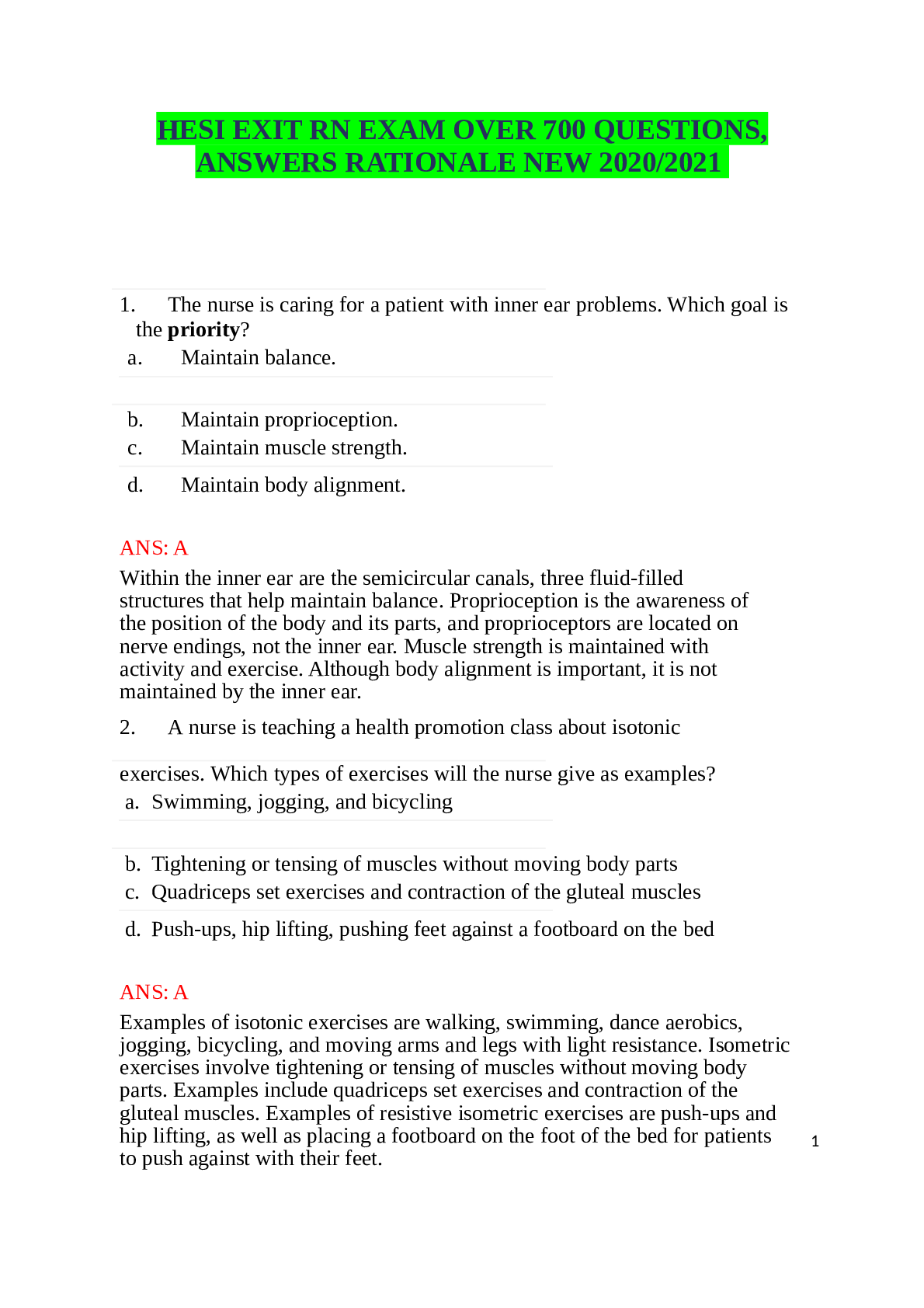
HESI EXIT RN EXAM OVER 700 QUESTIONS, ANSWERS RATIONALE NEW1. The nurse is caring for a patient with inner ear problems. Which goal is
the priority?
a. Maintain balance.
b. Maintain proprioception.
c. Maintain muscle strength.
d. Maintain body alignment.
ANS: A
Within the inner ear are the semicircular canals, three fluid-filled
structures that help maintain balance. Proprioception is the awareness of
the position of the body and its parts, and proprioceptors are located on
nerve endings, not the inner ear. Muscle strength is maintained with
activity and exercise. Although body alignment is important, it is not
maintained by the inner ear.
2. A nurse is teaching a health promotion class about isotonic
exercises. Which types of exercises will the nurse give as examples?
a. Swimming, jogging, and bicycling
b. Tightening or tensing of muscles without moving body parts
c. Quadriceps set exercises and contraction of the gluteal muscles
d. Push-ups, hip lifting, pushing feet against a footboard on the bed
ANS: A
Examples of isotonic exercises are walking, swimming, dance aerobics,
jogging, bicycling, and moving arms and legs with light resistance. Isometric
exercises involve tightening or tensing of muscles without moving body
parts. Examples include quadriceps set exercises and contraction of the
gluteal muscles. Examples of resistive isometric exercises are push-ups and
hip lifting, as well as placing a footboard on the foot of the bed for patients
to push against with their feet.
2
3. An adolescent tells the nurse that a health professional said the
fibrous tissue that connects bone and cartilage was strained in a
sporting accident. On which structure will the nurse focus an
assessment?
a. Tendon
b. Ligament
c. Synergistic muscle
d. Antagonistic muscle
ANS: B
Ligaments are white, shiny, and flexible bands of fibrous tissue that bind
joints and connect bones and cartilage. Tendons are strong, flexible, and
inelastic as they serve to connect muscle to bone. Muscles attach bone to
bone. Synergistic muscles contract to accomplish the same movement.
Antagonistic muscles cause movement at the joint.
4. A nurse is developing an exercise plan for a middle-aged patient. In which
order will the nurse instruct the patient to execute the plan, beginning with
the first step?
1. Design the fitness program.
2. Assemble equipment.
3. Assess fitness level.
4. Monitor progress.
5. Get started.
a. 5, 1, 3, 2, 4
b. 1, 2, 3, 5, 4
c. 2, 5, 3, 1, 4
d. 3, 1, 2, 5, 4
ANS: D
Five steps to beginning an exercise program are Step 1: Assess fitness level;
Step 2: Design the fitness program; Step 3: Assemble equipment; Step 4: Get
started; and Step 5: Monitor progress.
11. The nurse gives instructions to a nursing assistive personnel (NAP)
3
regarding exercise for a patient. Which action by the NAP indicates a correct
understanding of the directions?
a. Determines the patient’s ability to exercise
b. Teaches the patient how to do the exercises
c. Reports the patient got dizzy after exercising
d. Advises the patient to work through the pain
ANS: C
The NAP notifies the nurse if a patient reports increased fatigue, dizziness, or
light-headedness when obtaining preexercise and/or postexercise vital signs.
The nurse first must assess the patient’s ability and tolerance to exercise. The
nurse also teaches patients and their families how to implement exercise
programs. The NAP can prepare patients for exercise (e.g., putting on shoes
and clothing, providing hygiene needs, and obtaining preexercise and
postexercise vital signs). The NAP can help the patient exercise.
12. The nurse is starting an exercise program in a local community as a
health promotion project. W
[Show More]