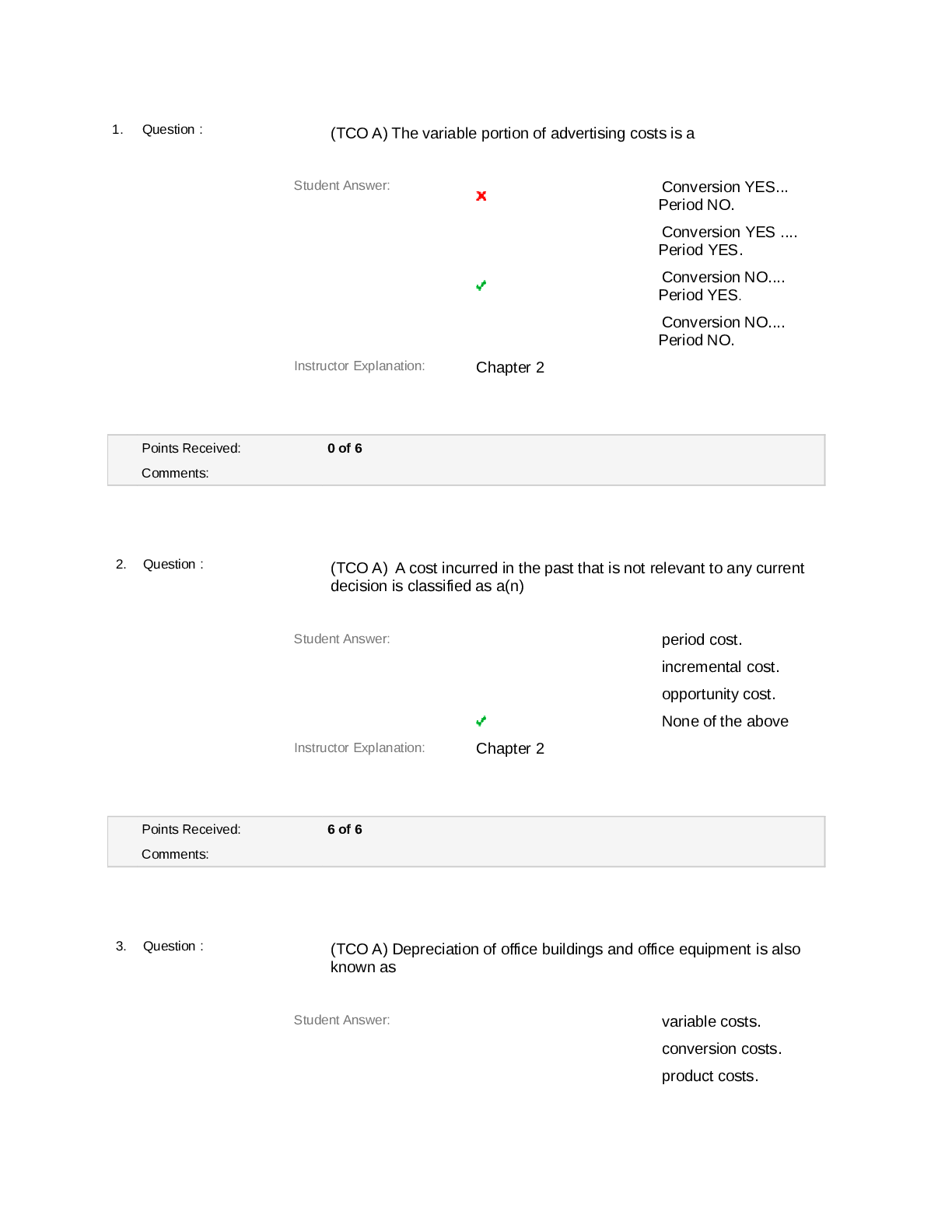
1. Question : (TCO A) Wages paid to an assembly line worker in a factory are a
: Prime Cost YES.....Conversion Cost NO.
Prime Cost YES.....Conversion Cost YES.
Prime Cost NO....Conversion Cost NO.
...
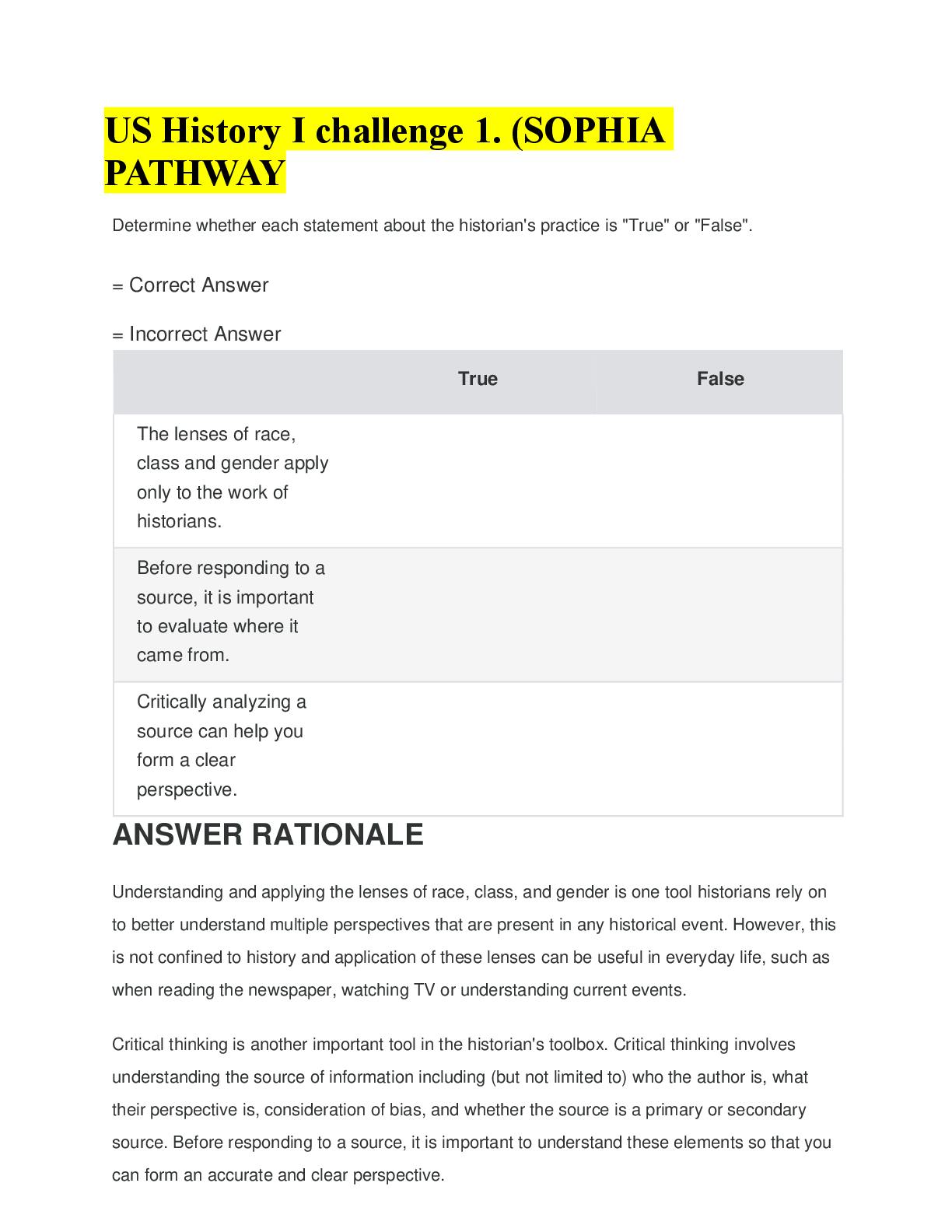
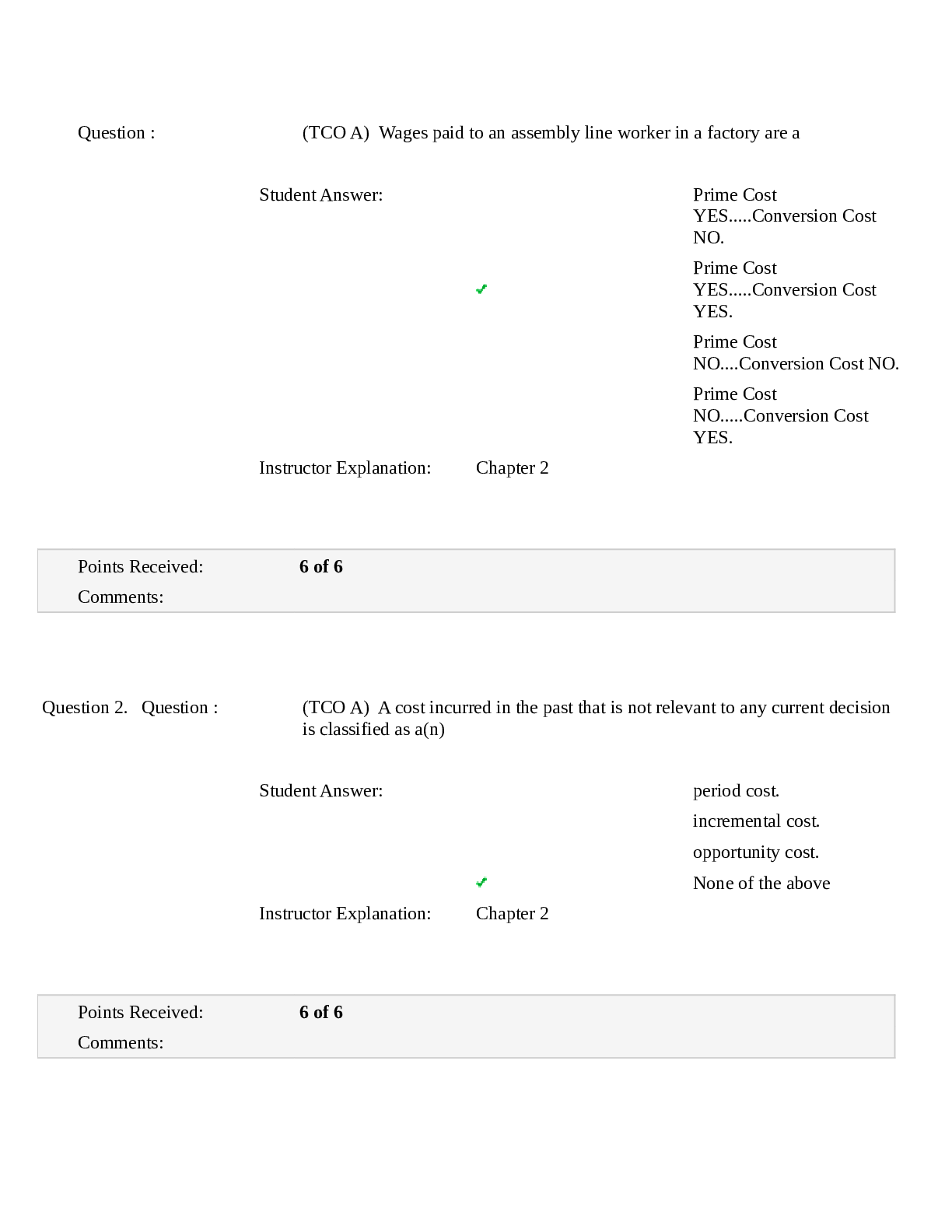
1. Question : (TCO A) Wages paid to an assembly line worker in a factory are a
: Prime Cost YES.....Conversion Cost NO.
Prime Cost YES.....Conversion Cost YES.
Prime Cost NO....Conversion Cost NO.
Prime Cost NO.....Conversion Cost YES.
: Chapter 2
2. Question : (TCO A) A cost incurred in the past that is not relevant to any current decision is classified as a(n)
: period cost.
incremental cost.
opportunity cost.
None of the above
: Chapter 2
3. Question : (TCO A) Depreciation of office buildings and office equipment is also known as
: variable costs.
conversion costs.
product costs.
period costs.
: Chapter 2
4. Question : (TCO A) When the activity level is expected to increase within the relevant range, what effects would be anticipated with respect to each of the following?
: Fixed costs per unit increase and variable costs per unit increase.
Fixed costs per unit decrease and variable costs per unit do not change.
Fixed costs per unit do not change and variable costs per unit do not change.
Fixed costs per unit do not change and variable costs per unit increase.
: Chapter 5
5. Question : (TCO F) Which of the following statements is true?
I. Overhead application may be made slowly as a job is worked on.
II. Overhead application may be made in a single application at the time of completion of the job.
III. Overhead application should be made to any job not completed at year end in order to properly value the work in process inventory.
: Only statement I is true.
Only statement II is true.
Both statements I and II are true.
Statements I, II, and III are all true.
: Chapter 3
6. Question : (TCO F) A job-order cost system is employed in those situations where
: many different products, jobs, or batches of production are being produced each period.
manufacturing involves a single, homogeneous product that flows evenly through the production process on a continuous basis.
the product moves from department to department before being completed.
the unit cost of production is computed by dividing the total production costs by the number of units produced.
: Chapter 4
7. Question : (TCO F) The FIFO method only provides a major advantage over the weighted-average method in that
: the calculation of equivalent units is less complex under the FIFO method.
the FIFO method treats units in the beginning inventory as if they were started and completed during the current period.
the FIFO method provides measurements of work done during the current period.
the weighted-average method ignores units in the beginning and ending work-in-process inventories.
: Chapter 4
8. Question : (TCO B) The contribution margin ratio always decreases when the
: break-even point increases.
break-even point decreases.
variable expenses as a percentage of net sales increase.
variable expenses as a percentage of net sales decrease.
: Chapter 6
9. Question : (TCO B) Which of the following would not affect the break-even point?
: Number of units sold
Variable expense per unit
Total fixed expenses
Selling price per unit
: Chapter 6
[Show More]


.png)

.png)

![Preview of [Solution] Acct 505 Discussion](https://scholarfriends.com/storage/Acct-505-Discussion.png)