NSG 3100 Exam 2 Practice Questions with Answers 1. A nurse is assessing a client’s bilateral pulses for symmetry. Which pulse site should not be assessed on both sides of the body at the same time? a. Radial b. Carotid c
...
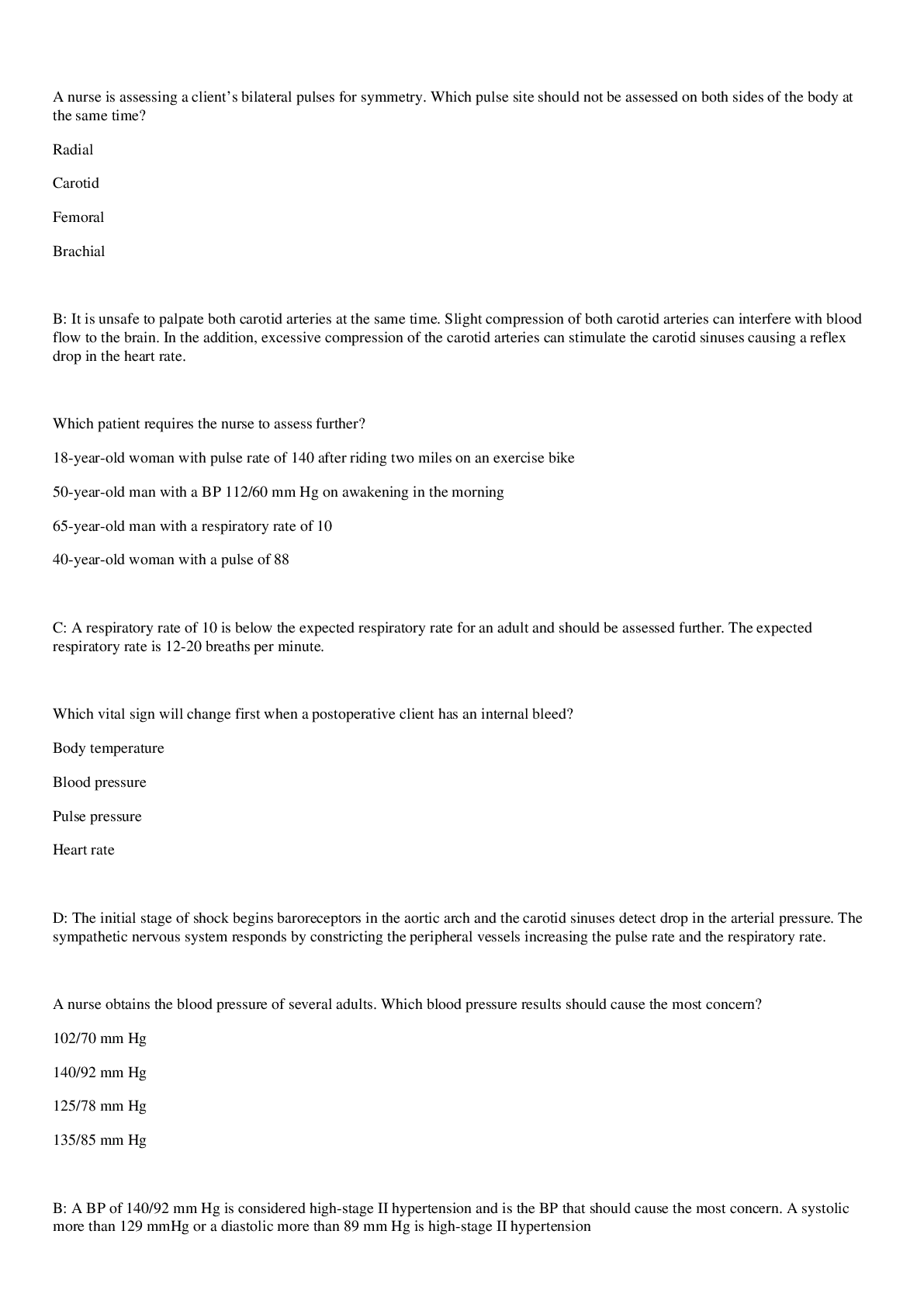
NSG 3100 Exam 2 Practice Questions with Answers 1. A nurse is assessing a client’s bilateral pulses for symmetry. Which pulse site should not be assessed on both sides of the body at the same time? a. Radial b. Carotid c. Femoral d. Brachial B: It is unsafe to palpate both carotid arteries at the same time. Slight compression of both carotid arteries can interfere with blood flow to the brain. In the addition, excessive compression of the carotid arteries can stimulate the carotid sinuses causing a reflex drop in the heart rate. 2. Which patient requires the nurse to assess further? a. 18-year-old woman with pulse rate of 140 after riding two miles on an exercise bike b. 50-year-old man with a BP 112/60 mm Hg on awakening in the morning c. 65-year-old man with a respiratory rate of 10 d. 40-year-old woman with a pulse of 88 C: A respiratory rate of 10 is below the expected respiratory rate for an adult and should be assessed further. The expected respiratory rate is 12-20 breaths per minute. 3. Which vital sign will change first when a postoperative client has an internal bleed? a. Body temperature b. Blood pressure c. Pulse pressure d. Heart rate D: The initial stage of shock begins baroreceptors in the aortic arch and the carotid sinuses detect drop in the arterial pressure. The sympathetic nervous system responds by constricting the peripheral vessels increasing the pulse rate and the respiratory rate. 4. A nurse obtains the blood pressure of several adults. Which blood pressure results should cause the most concern? a. 102/70 mm Hg b. 140/92 mm Hg c. 125/78 mm Hg d. 135/85 mm Hg B: A BP of 140/92 mm Hg is considered high-stage II hypertension and is the BP that should cause the most concern. A systolic more than 129 mmHg or a diastolic more than 89 mm Hg is high-stage II hypertension 1 NSG 3100 Exam 2 Practice Questions with Answers 5. A nurse is taking care of a patient in isolation and needs to take a rectal temperature with a plastic thermometer. Which should the nurse do? a. Take the temperature for 5 minutes b. Wear gloves throughout the procedure c. Place the patient in the right lateral position d. Insert the thermometer 2 inches into the client’s anus B: Gloves, personal protective pieces of equipment, are the best way the nurse is protected from contracting or transmitting a pathogen. 6. A nurse in the emergency department is caring for a client who is diagnosed with hypothermia. Which factor present in the client’s history may have precipitated this condition? a. Heatstroke b. Inability to sweat c. Excessive exercise d. High alcohol intake D: Excessive alcohol intake interferes with thermoregulation by providing a false sense of warmth, inhibiting shivering, and causing vasodilation which promotes heat loss. 7. The adult’s vital signs are: T: 99.0 (oral), pulse 88 beats per minute, respirations 16 breaths per minute and blood pressure of 182/100 mm Hg. Which sign should cause concern? a. Pulse b. Respirations c. Temperature d. Blood Pressure D: The blood pressure is more than the expected systolic value of less than 120 mm Hg and a diastolic value less than 80 mm Hg . 8. A client is admitted to the emergency department with difficulty breathing. Which client response identified by the nurse causes the most concern? a. Low pulse oximetry b. Wheezes on expiration c. Shortness of breath on exertion d. Use of accessory muscles of respiration A: Pulse oximeter is a non-invasive procedure to measure the oxygen saturation of the blood. /the expected value is 95% or more. If a client’s pulse oximetry result is low, the client is hypoxic and need medical intervention. 9. A nurse concluded that a client is experiencing pyrexia. Which client assessment precipitated this conclusion? a. Mental confusion b. Increased appetite 2 NSG 3100 Exam 2 Practice Questions with Answers c. Rectal temperature of 101.0 F d. Heart rate of 50 beats per minute C: A rectal temperature of 101.0 F or an oral temperature of 100.0 Fi is a common human response that indicates pyrexia (fever) 10. The nurse is obtaining the patient’s blood pressure. Which information is most5 important for the nurse to document? a. Staff member who took the blood pressure b. Client’s tolerance to having the blood pressure taken c. Client’s body position of the client is not in a sitting position d. Which head of a dual-head stethoscope was used to obtain the reading C: The client’s position when the blood pressure is measured may influence the results. Generally, systolic, and diastolic readings are lower in the horizontal than in the sitting position. 11. A nurse is assessing a client who states “I feel cold” Which mechanism that helps regulate body temperature will increase body heat? a. Vasodilation b. Evaporation c. Shivering d. Radiation C: Shivering generates heat by causing muscle contraction which increases the metabolic rate by 100% to 200% 12. Which characteristics indicates the need to take a rectal temperature rather than oral a. Mouth Breather b. History of vomiting c. Presence of confusion d. Intolerance of the semi-Fowler position e. Intelligence at the level of a seven-year-old child A: Mouth breathing allows environmental air to enter the mouth which nay result in an inaccurately low reading. C: Taking an oral temperature on someone who is confused is unsafe since they might bight on the thermometer causing damage to their mouth 13. The nurse is evaluating a family member taking the patient’s blood pressure as part of the discharge teaching plan. Which behavior indicates that the family member needs additional teaching? a. Positions the arm higher than the level of the heart b. Places the diaphragm of the stethoscope over the brachial artery c. Applies the center of the bladder of the cuff on the lateral aspect of ted arm 3 NSG 3100 Exam 2 Practice Questions with Answers d. Releases the valve on the manometer so that the gauge drops 10mmm Hg per heartbeat e. Insert the earpieces of the stethoscope into the ears so that they tilt slightly backward A: A blood pressure reading should be taken with the arm supported at the level of the heart. If the arm is above the level of the heart, the blood pressure reading will be inaccurately decreased and if the arm is below the level of the heart or not supported, the blood pressure reading will be inaccurately increased. C: The bladder of the cuff should be directory over the brachial artery. D: This may result in an accurate reading. The valve on the manometer should be opened to allow the gauge tlo drp 2-3 mm Hg per heart beat. E: The ear pieces of the stethoscope should be placed into the ears so that they tilt slightly forward, not backward. 14. The patient gets out of bed to go to the bathroom and tells the nurse that he ‘’feels dizzy.”What
[Show More]