HSA Exam 1|94 Questions with Verified Answers
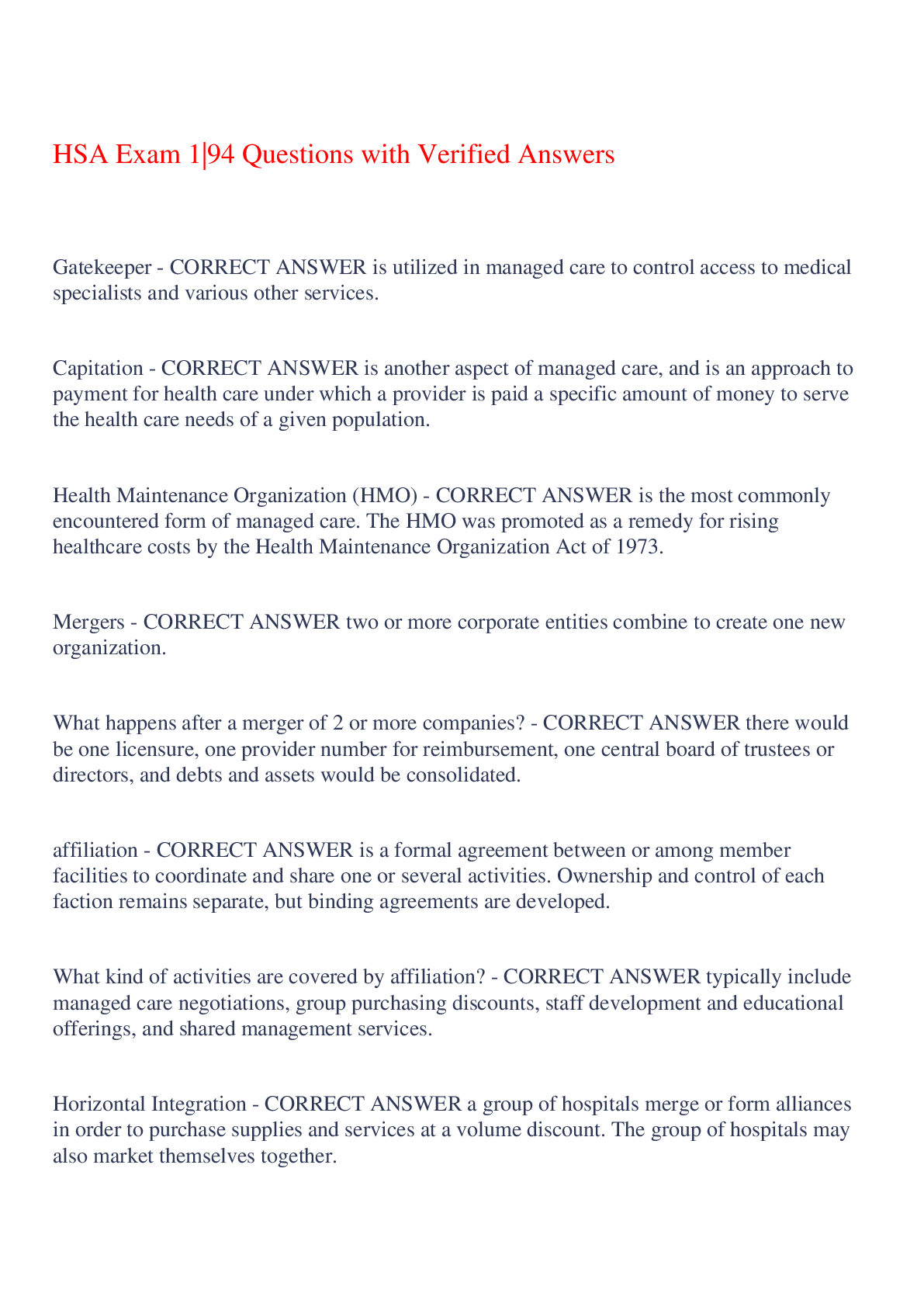
Gatekeeper - CORRECT ANSWER is utilized in managed care to control access to medical specialists and various other services.
Capitation - CORRECT ANSWER is another as
...
HSA Exam 1|94 Questions with Verified Answers
Gatekeeper - CORRECT ANSWER is utilized in managed care to control access to medical specialists and various other services.
Capitation - CORRECT ANSWER is another aspect of managed care, and is an approach to payment for health care under which a provider is paid a specific amount of money to serve the health care needs of a given population.
Health Maintenance Organization (HMO) - CORRECT ANSWER is the most commonly encountered form of managed care. The HMO was promoted as a remedy for rising healthcare costs by the Health Maintenance Organization Act of 1973.
Mergers - CORRECT ANSWER two or more corporate entities combine to create one new organization.
What happens after a merger of 2 or more companies? - CORRECT ANSWER there would be one licensure, one provider number for reimbursement, one central board of trustees or directors, and debts and assets would be consolidated.
affiliation - CORRECT ANSWER is a formal agreement between or among member facilities to coordinate and share one or several activities. Ownership and control of each faction remains separate, but binding agreements are developed.
What kind of activities are covered by affiliation? - CORRECT ANSWER typically include managed care negotiations, group purchasing discounts, staff development and educational offerings, and shared management services.
Horizontal Integration - CORRECT ANSWER a group of hospitals merge or form alliances in order to purchase supplies and services at a volume discount. The group of hospitals may also market themselves together.
Vertical Integration - CORRECT ANSWER includes several service components, with each addressing some dimension of the population's health care needs.
Virtual Enterprise - CORRECT ANSWER is a temporary partnership of independent companies that join together to take advantage of technology to provide virtual services or products. They often rely on outsourcing.
Technology
What are organizational survival strategies? - CORRECT ANSWER -Bureaucratic
-Imperialism
-Co-optation,
-Hibernation
-Adaptation.
bureaucratic imperialism - CORRECT ANSWER refers to the conflict that can occur when two or more organizations attempt to take control over a certain client group or territory.
Co-optation - CORRECT ANSWER is an adaptive response on the part of the organization in response to the social forces in its environment.
formal co-optation - CORRECT ANSWER the symbols of authority and administrative burdens are shared but no substantial power is transferred. However, the organization seeks to demonstrate its accessibility to the public.
informal co-optation - CORRECT ANSWER occurs when organizational leaders meet regularly with some groups, but there are no visible changes in the official leadership structures.
Hibernation - CORRECT ANSWER occurs when an organization chooses to cut its losses and enter a phase of economizing.
examples of hibernation in healthcare settings - CORRECT ANSWER -A hospital may choose to close a unit that is not productive and put those resources elsewhere.
-The hospital may also adapt by anticipating problems and trying to increase the productivity of the unit by investing in resources to improve the unit.
Goal succession - CORRECT ANSWER One goal is reached and is succeeded by a new one
Goal expansion - CORRECT ANSWER occurs when the original goal is retained and enlarged with variations. The new goals are closely related and are extensions of the original goal.
Goal multiplication - CORRECT ANSWER involves retention of the original goal and the addition of new goals. The new goals reflect the organization's efforts to diversify. Goal multiplication is a natural outgrowth of success.
Organizational life cycle - CORRECT ANSWER Gestation, Youth, Middle Age, Old Age
gestation - CORRECT ANSWER -The early formative stage in which there is a movement from informal to formal organization.
-Leadership tends to be strong and committed, and members are willing to work hard.
-The members strongly identify with the organizational goals because they helped to develop them. Innovation is encouraged and accepted.
Youth - CORRECT ANSWER -Includes continued enthusiasm, idealism, and high hopes.
Middle age - CORRECT ANSWER -Many activities have become routine and predictable.
-Roles are clear and communication is reliable.
-New ideas are considered, but there is not massive or rapid change.
-Planning and decision making are shared responsibilities, subject to several levels of review.
-Events may also occur to rejuvenate the organization.
Old Age - CORRECT ANSWER -An organization in decline
-There is resistance to change, and little or no innovation.
-Organizational energy is directed at efforts to survive.
-Resources may be guarded so that obligations to contracts and employees can be met if the end is inevitable.
-Clients may begin to look for other providers.
-Managers may find themselves in a caretaker role, and staff may be reduced.
Organizational Change - CORRECT ANSWER -A process by which a person or group of persons develops a strategy for effecting change in a social system.
What are the general guidelines for effective management of change? - CORRECT ANSWER -Plan thouroughly
-Communicate fully
-Convince employees
-Involve employees when possible
-Monitor implementation
Plan Throughly - CORRECT ANSWER The potential change must be thoroughly evaluated. The implications for the involved departments and the entire organization must be considered.
Communicate fully - CORRECT ANSWER Communicate the change as early as possible before the change occurs. Two way communication allows for employees to ask questions and get them involved in the change process.
Convince employees - CORRECT ANSWER Emphasis the benefits of the change, especially the benefits to the employees
Involve employees when possible - CORRECT ANSWER Employees have the best knowledge of the work they perform.
Monitor Implementation - CORRECT ANSWER It may take some time before the change is fully accepted.
What are strategies that can make change less threatening - CORRECT ANSWER -Education and Communication
-Participation and Involvement
-Facilitation and Support
-Negotiation and Agreement
-Manipulation of Co-optation
-Explicit and Implicit Concern
Management - CORRECT ANSWER the process of getting things done through and with people. It is the planning and directing of effort, and the organizing and employing of resources to accomplish some predetermined objective.
Scientific Management - CORRECT ANSWER refers to efficient and repeatable procedures, quantification of work elements, and standardization of processes.
- focus on work
Human Relations and Behaviorism - CORRECT ANSWER Stress the worker and the worker-manager relationship
Structuralism - CORRECT ANSWER Emphasizes organizational design
Management process theory - CORRECT ANSWER Focuses on the functions of the manager
Management science theory - CORRECT ANSWER adds computer technology to the scientific method
systems approach - CORRECT ANSWER an outlook on management that accounts for work, people, organizational design, management function, and management science jointly and inseparably, in considering the operation of a business entity.
Inputs - CORRECT ANSWER elements the system must accept because they are imposed by outside forces.
Outputs - CORRECT ANSWER are the goods and services that the organization (or subdivision or unit) must produce.
Throughputs - CORRECT ANSWER the structures or processes by which inputs are converted to outputs, and are contained within the organization.
Feedback - CORRECT ANSWER Managers need feedback on the acceptability and adequacy of the outputs, and it is through the feedback process that inputs and even throughputs are adjusted to produce new or improved outputs.
Open system - CORRECT ANSWER -in a constant state of flux as inputs are received and outputs produced.
-constantly seeks internal balance, or homeostasis, by means of adjustment to changes in the organizational environment.
Systematic monitoring of change - CORRECT ANSWER -major management function of decision making, leadership, and, particularly, correction of deviation from organizational goals are necessary for the detection, identification, and proper response to changes in the organization's environment.
The system approch - CORRECT ANSWER enables managers to focus on the organization as a whole and to view each division or unit in the organization in relation to the whole. Managers can cut across organizational lines to determine interrelationships and to assess complexities in the structure and in the environment of the organization.
Formal Organizations - CORRECT ANSWER have a pattern of authority and official reporting and working relationships describing an organization, as may be portrayed in an organization chart.
Features of a formal organization - CORRECT ANSWER -Common purpose or goal
-Shared values or common beliefs
-Continuity of goal orientation
-Specific division of labor
-A system of command or authority
Informal Organizations - CORRECT ANSWER consist of an alliance of individuals that functions by virtue of acquaintanceship and personality rather than formal authority. They may share a common purpose, or be characterized by some of the other features of formal organizations, but they lack one or more of those features.
what are organizational classifications based on? - CORRECT ANSWER -prime beneficiary
-Authority structure
-Genotypic characteristics
Prime beneficiary - CORRECT ANSWER refers to who benefits from the existence of the organization.
why 4 types of organizations can be classified based on prime beneficiary? - CORRECT ANSWER -mutual benefit associations
-business concerns
-service organizations
-commonweal organizations
Organizational characteristics - CORRECT ANSWER -Size
-Organizational climate
-Degree of bureaucracy
- Phase in the life Cycle
Size - CORRECT ANSWER The more layers in the hierarchy, the greater (potentially) the limits on managers' freedom in decision making.
Organizational Climate - CORRECT ANSWER The degree to which clients, workers, and other managers participate in planning and decision-making processes is determined in part by the authority climate.
Degree of Burearcracy - CORRECT ANSWER A highly bureaucratic organization may be associated with great predictability in routine practices but less innovation and more resistance to change. Communications may also be distorted
Phase in the Life cycle - CORRECT ANSWER Strategies (innovation, survival) differ based on the stage of the life cycle.
Total Quality Management (TQM) - CORRECT ANSWER a management philosophy that focuses on satisfying customers through empowering employees to be an active part of continuous quality improvement
Continuous Quality Improvement (CQI) - CORRECT ANSWER system of development in the workplace for daily improving performance at every level in every operational process by focusing on meeting or exceeding customer expectations
Top management Commitment - CORRECT ANSWER -essential to TQM
-a matter of degree, and it is the degree of commitment that is critical.
Clientele Network - CORRECT ANSWER is the network of relationships and interrelationships that includes all parties who are either directly or indirectly served by the organization, or are to some extent vested in the organization's mission and purposes. This includes individuals and groups both internal and external to the organization.
what is included in the clientele network? - CORRECT ANSWER Clients, Suppliers, Advisers, Controllers, and Adversaries
Clients - CORRECT ANSWER patients, other units within the organization, the community
Suppliers - CORRECT ANSWER resource suppliers, associates, and supporters
Advisers - CORRECT ANSWER tend to set trends for the industry through guidelines, position papers, data analysis, sample procedures and methods, or model legislation
Controllers - CORRECT ANSWER individuals or groups who have power over the organization
Adversaries - CORRECT ANSWER opponents, enemies, competitors, and rivals both outside and within the organization.
Power - CORRECT ANSWER is the ability to obtain compliance by coercion.
Influence - CORRECT ANSWER is also a means to obtain compliance from others, but unlike power, influence is accepted voluntarily. With influence consensus and agreement are also sought.
Formal Authority - CORRECT ANSWER comes from position in the organizational hierarchy. One's formal authority is embodied in the position, usually reflected in one's job description. It is the right given to a manager to use resources, make commitments, and exercise control.
What are the internal and external factors that restrict the use of authority. - CORRECT ANSWER -Organizational position
-Legal and contractual mandates
-social limitations
-Physical limits
-Technological constraints
-economic constraints
-zone of acceptance of organization members
Organizational Position - CORRECT ANSWER The delegation of authority is consistent with the position held in the organization. The individual has no legitimate authority beyond that.
Legal and contractual mandates - CORRECT ANSWER Authority is limited by federal, state and local laws and regulations relating to safety, work hours, licensure, and scope of practice.
Social limitations - CORRECT ANSWER The social codes and values of the overall society also place limits on the behavior of individuals, and authority holders are expected to act within the value system of society.
physical limits - CORRECT ANSWER An authority holder cannot force a person to do something that is beyond their physical capabilities or go beyond the limits of the physical environment.
Technological constraints - CORRECT ANSWER The limitations of the state of the art must be considered
Economical constraints - CORRECT ANSWER the lack of resources provides limits
Zone of acceptance of organization members - CORRECT ANSWER Authority and power have limits, especially in the presence of a strong employee group. Employees may also resist authority in subtle ways.
what is the one characteristic or condition that describes a successful leader? - CORRECT ANSWER Acceptance of the followers
What is a leader? - CORRECT ANSWER is someone who can organize tasks and make things happen, and inspire goal-directed behavior that is consistent and efficient.
what are personal characteristics of a leader? - CORRECT ANSWER strong self-image, a vision of the future, a firm believe in the goals of the organization, the ability to influence the behavior of subordinates, and the ability to relate to and influence individuals in equal or superior positions of authority.
what are the types of leadership styles? - CORRECT ANSWER -Autocratic
-Bureaucratic
-Participative
-Laissez-faire leadership
-Paternalistic
autocratic - CORRECT ANSWER -characterized by close supervision. Clear and direct directions are given to employees telling them what is to be done and how.
-This style usually does not work in the long run, and is the least effective and desirable method for motivating employees.
Bureaucratic - CORRECT ANSWER the leader tells the employees what to do and how to do it based almost exclusively on the institution's rules and regulations. Rules are strictly enforced and no departures or exceptions are permitted. There is little or no employee freedom.
Participative - CORRECT ANSWER the contribution of the group to the organizational effort is emphasized. Employees are involved in the decision making process, and are consulted concerning goals and objectives, work assignments, and problems.
Laissez-faire leadership - CORRECT ANSWER the assumption is made that individuals are self-motivated, and employees receive little or no supervision. Employees determine their own goals and make their own decisions. The manager's contribution is minimal and he or she primarily acts as a consultant, and only when asked. The usual end result is disorganization and chaos because different employees proceed in different directions.
Paternalistic leadership - CORRECT ANSWER employees are treated like children, and employees are told what to do but in a nice way. It is the manager's belief that the employees do not know what is good for them or how to make decisions for themselves. The employees become very dependent on the manager.
What factors influence leadership styles? - CORRECT ANSWER -Work assignments
-Personality and ability of employee
-Attitude of the employees towards the manager
-Personality and ability of the manager
Work assignments - CORRECT ANSWER Repetitive work and properly trained workers do not require constant or close supervision. New or complex assignments may require close supervision.
Personality and ability of the employee - CORRECT ANSWER Employees who are not self-starters react best to close supervision. Employees who can take on new and important responsibilities on their own react best to participative leadership.
Attitude of the employees towards the manager - CORRECT ANSWER Managers must be accepted by the group in order to lead or influence behavior. Employees give the manager authority only if they believe that the goals and objectives of the managers are consistent with their own personal and professional interests.
Personality and ability of the manager - CORRECT ANSWER The opinions and suggestions of the employees must be treated with respect, and employee participation must be sincerely encouraged.
What makes a good manager? - CORRECT ANSWER one who is able to shift from one styles of leadership to another depending on the work group and situational factors.
[Show More]