HSA Exam 3|39 Questions with Verified Answers
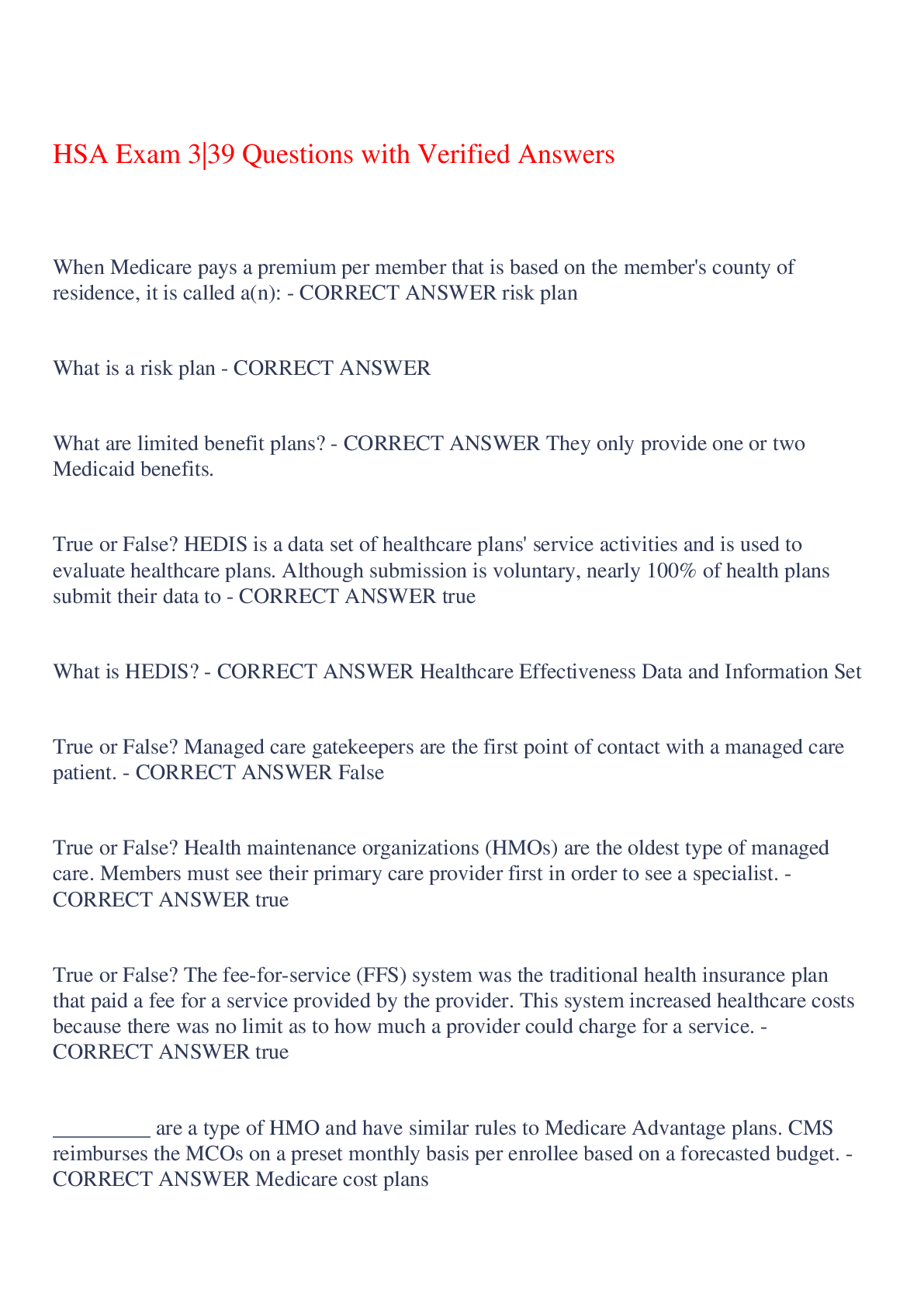
When Medicare pays a premium per member that is based on the member's county of residence, it is called a(n): - CORRECT ANSWER risk plan
What is a risk plan - CORRECT
...
HSA Exam 3|39 Questions with Verified Answers
When Medicare pays a premium per member that is based on the member's county of residence, it is called a(n): - CORRECT ANSWER risk plan
What is a risk plan - CORRECT ANSWER
What are limited benefit plans? - CORRECT ANSWER They only provide one or two Medicaid benefits.
True or False? HEDIS is a data set of healthcare plans' service activities and is used to evaluate healthcare plans. Although submission is voluntary, nearly 100% of health plans submit their data to - CORRECT ANSWER true
What is HEDIS? - CORRECT ANSWER Healthcare Effectiveness Data and Information Set
True or False? Managed care gatekeepers are the first point of contact with a managed care patient. - CORRECT ANSWER False
True or False? Health maintenance organizations (HMOs) are the oldest type of managed care. Members must see their primary care provider first in order to see a specialist. - CORRECT ANSWER true
True or False? The fee-for-service (FFS) system was the traditional health insurance plan that paid a fee for a service provided by the provider. This system increased healthcare costs because there was no limit as to how much a provider could charge for a service. - CORRECT ANSWER true
_________ are a type of HMO and have similar rules to Medicare Advantage plans. CMS reimburses the MCOs on a preset monthly basis per enrollee based on a forecasted budget. - CORRECT ANSWER Medicare cost plans
________ is an evaluation of services once the services have been provided. This may occur to assess treatment patterns of certain diseases. - CORRECT ANSWER Retrospective utilization review
Describe what a health maintenance organization (HMO) is and list the four different types of HMO models. - CORRECT ANSWER HMOs are the oldest type of managed care. Members must see their primary care provider first in order to see a specialist.
What are the five common characteristics of managed care organizations (MCOs)? - CORRECT ANSWER -They all establish relationships with organizations and providers to provide a designated set of services to their members.
-They all establish criteria for their members to utilize the MCO.
-They all establish measures to estimate cost control.
-They all provide incentives to encourage health service resources
.
-They all provide and encourage utilization of programs to improve the health status of their enrollees.
what are the four types of HMO MODELS - CORRECT ANSWER The four types of HMO models are staff, group, network, and independent practice association.
what is the staff model? - CORRECT ANSWER The staff model hires providers to work at a physical location.
what is the group model - CORRECT ANSWER The group model negotiates with a group of physicians exclusively to perform services.
what is the network model - CORRECT ANSWER The network model is similar to the group model but these providers may see other patients who are not members of the HMO. There is a negotiated rate for service for members to see providers who belong to the network.
What is the independence practice association? - CORRECT ANSWER The independent practice association (IPA) contracts with a group of physicians who are in private practice to see MCO members at a prepaid rate per visit. The physicians may sign contracts with many HMOs. The physicians may also see non-HMO patients. This type of HMO was a result of the HMO Act of 1973.
Implemented in October 2000, the __________, which is a prospective payment used by Medicare, pays a fixed predetermined rate for each 60-day episode of care, regardless of the services. - CORRECT ANSWER Home Health Resource Group (HHRG)
Which of the following is the most common type of healthcare services reimbursement? - CORRECT ANSWER Service benefit plan
what is a service benefit plan? - CORRECT ANSWER
True or False? Self-funded or self-insurance programs are health insurance programs that are implemented and controlled by the company itself. They retain all of the risk in providing health insurance to their employees by paying any claims from their employees. Both the employee and employer pay into the fund. - CORRECT ANSWER true
True or False? A classification system called resource utilization group (RUG) was designed to differentiate patients based on how much they use the resources of the facility. As the patient's condition changes, the rate of reimbursement changes. A per diem rate was established using these classifications. - CORRECT ANSWER T
Flexible spending accounts (FSAs) provide employees with the option of setting aside pretax income to pay for out-of-pocket medical expenses. Employees must submit claims for these expenses and are reimbursed from their spending accounts. The drawback is that the amount set aside must be spent within 1 year. - CORRECT ANSWER true
The __________ protects both the employer and employee if there is a job-related injury and illness. - CORRECT ANSWER worker's compensation program
Insurance companies, managed care organizations, and the government are referred to as __________. - CORRECT ANSWER third-party payers
What is a CDHP? Discuss the different types. Which one would you choose and why? - CORRECT ANSWER consumer-driven health plans (CDHPs) that are tax plans with high-deductible coverage. The plans are high deductible and paired with a type of savings account for healthcare services. The most common CDHPs are health reimbursement arrangements (HRAs) and health savings accounts (HSAs). HRAs, or personal care accounts, began in 2001 as a result of an Internal Revenue Service (IRS) regulation. An HRA is funded by the employer but owned by the employee and remains with the company if the employee leaves. This has been an issue because it has no portability.
The HSA, which was authorized by the Medicare Prescription Drug, Improvement, and Modernization Act of 2003, pairs high-deductible plans with fully portable employee-owned tax-advantaged accounts. This plan encourages consumers to become more cost-conscious when using the healthcare system because they are using their own funds for healthcare services. The HSA, unlike the HRA, is a portable account, which means it can be transferred to another employer when the employee changes jobs. HSAs encourage consumers to understand healthcare service pricing because these accounts are paired with a high deductible. America's Health Insurance Plans (AHIP), an industry trade association, estimates that 4% of firms that offered benefits also offered an HSA or HRA.
Other types of CDHPs include flexible spending accounts (FSAs) and medical savings accounts (MSAs). FSAs provide employees with the option of setting aside pretax income to pay for out-of-pocket medical expenses. Employees must submit claims for these expenses and are reimbursed from their spending accounts. The drawback is that the amount set aside must be spent within 1 year. Any unspent dollars cannot be rolled over, so it is very important to be specific about the projected medical expenses. Mandated as part of HIPAA, MSAs allow workers employed in firms with 50 or fewer employees, and who have high-deductible health insurance plans, to set aside pretax dollars to be used for healthcare premiums and nonreimbursed healthcare expenses
Describe Medicare Part B Voluntary medical insurance. - CORRECT ANSWER Medicare Part B is a supplemental health plan to cover physician services. It is financed 24% from enrollee premiums and 76% from federal treasury funds. Part B benefits include coverage for physician care, durable medical equipment, physician-ordered supplies, ambulatory surgical services, outpatient hospital care, outpatient mental health services, and laboratory services. Part B is made available when enrollees sign up for Part A.
Describe Medicare Part C. - CORRECT ANSWER Medicare Part C is also referred to as Medicare managed care. It is required to cover all services in Parts A and B. It is voluntary and available when an individual enrolls in Parts A and B. This program was designed to move Medicare patients into more cost-effective health insurance programs such as HMOs or PPOs. Medicare pays a fixed amount for your care every month to the companies offering Medicare Advantage Plans. These companies must follow rules set by Medicare. However, each Medicare Advantage Plan can charge different out-of-pocket costs and have different rules for how you get services. Some of these plans do offer vision, prescription, and dental plans.
Which of the following is a critical success factor that medical practices need to consider for successful HIT implementation? - CORRECT ANSWER -ll participants must adopt the technology.
- Establishment of a reliable HIT infrastructure.
-Ongoing training for all employees.
(all of these are correct)
What are the key functions of a clinical decision support systems? - CORRECT ANSWER -Administrative
- Case management
- Cost control
(All of the above)
True or False? A technique of AI is expert systems (ESs), which were developed to imitate expert's knowledge in decision-making. - CORRECT ANSWER t
True or False? Electronic health records, according to the National Alliance for Health Information Technology (NAHIT), are electronic records of health-related information on an individual that is accumulated from one health system and is utilized by the health organization that is providing patient care. - CORRECT ANSWER T
True or False? Enterprise data warehouses (EDWs) are developed to provide information to aid enterprises in making decisions from a strategic perspective. Data warehousing requires an integration of many computer systems across an organization. - CORRECT ANSWER T
True or False? Microsoft's website, HealthVault, enables patients to access electronic patient records for a small fee. - CORRECT ANSWER F
1. Discuss the impact of electronic health records on the healthcare industry. Identify three reasons that EHRs should be implemented and three barriers to their implementation. - CORRECT ANSWER Several studies have been performed to assess the impact of EHRs on healthcare delivery. Administrators of several healthcare delivery systems have reported many benefits to the implementation of an EHR. Administrators have cited the capability of more comprehensive reporting that integrates both clinical and administrative data. EHRs also provide an opportunity to analyze and review patient outcomes because of the standardization of the clinical assessments. Development of electronic automated reports has improved patient discharge. The EHR also provides an opportunity for administrators to assess the workload of a department. The EHR also improves operational efficiency. The EHR has excellent capabilities to process and store data. Administrators have also reported that the computerized documentation takes 30% less time than the previous handwritten notes. What will be difficult is to develop an electronic record that will be able to integrate with EHR medical systems. It is important that standards are developed for to ensure that standard data elements are collected and that the software can be integrated into other EHR systems.
Several studies have indicated that EHRs improved interdepartmental communication. The EHR provided aggregate data in the patient records to other departments and the information about the patient was legible. The EHR allowed accessibility by many departments regarding integrated care. The actual design and implementation of an EHR system developed a more interdisciplinary approach to patient
Why is health information technology important to health care? Be specific. - CORRECT ANSWER Health information technology's (HIT) goal is to manage the health data that can be used by patients/consumers, insurance companies, healthcare providers, healthcare administrators, and any stakeholder that has an interest in health care.
HIT impacts every aspect of the healthcare industry. All of the stakeholders in the healthcare industry use HIT. IT has had a tremendous impact on the healthcare industry because it allows every transaction to be quickly documented. When an industry focuses on saving lives, it is important that all activity has a written document that describes the activity. Computerization of documentation has increased the management efficiency of healthcare data.
What is computerized physician order entry? What are its four components? - CORRECT ANSWER Computerized physician order entry (CPOE) are clinical decision support systems that enable a patient's provider to enter a prescription order or an order for a lab or diagnostic test into a computer system.
What are the four components of a CPOE - CORRECT ANSWER (1) information can be entered from a handheld device, laptop, or desktop computer; (2) it enables the provider to order a test, prescription, or procedure; (3) it is connected to a decision-support system that alerts the provider to any problems with their orders; and (4) it can be integrated into the overall computer system of the organization. The CPOE first appeared in 1971 when NASA Space Center and Lockheed Corporation developed a system for a hospital in California.
What are drug-drug interactions? - CORRECT ANSWER Drug-drug interactions (DDIs) are used by software programs to alert pharmacists and clinicians about potential drug-drug interactions. These alerts can include notifying the provider that two drugs may interact, or there may be management strategies provided regarding the DDIs. DDI software programs can be very beneficial to providers, but they must be updated continually to ensure there is current information provided regarding medication interactions
[Show More]