CPFA Exam Study Guide
Under the DOL regulation, many advisors to retirement plans and their participants will be -
✔✔3(21) fiduciaries. They will act alongside other fiduciary service providers who are also not
necess
...
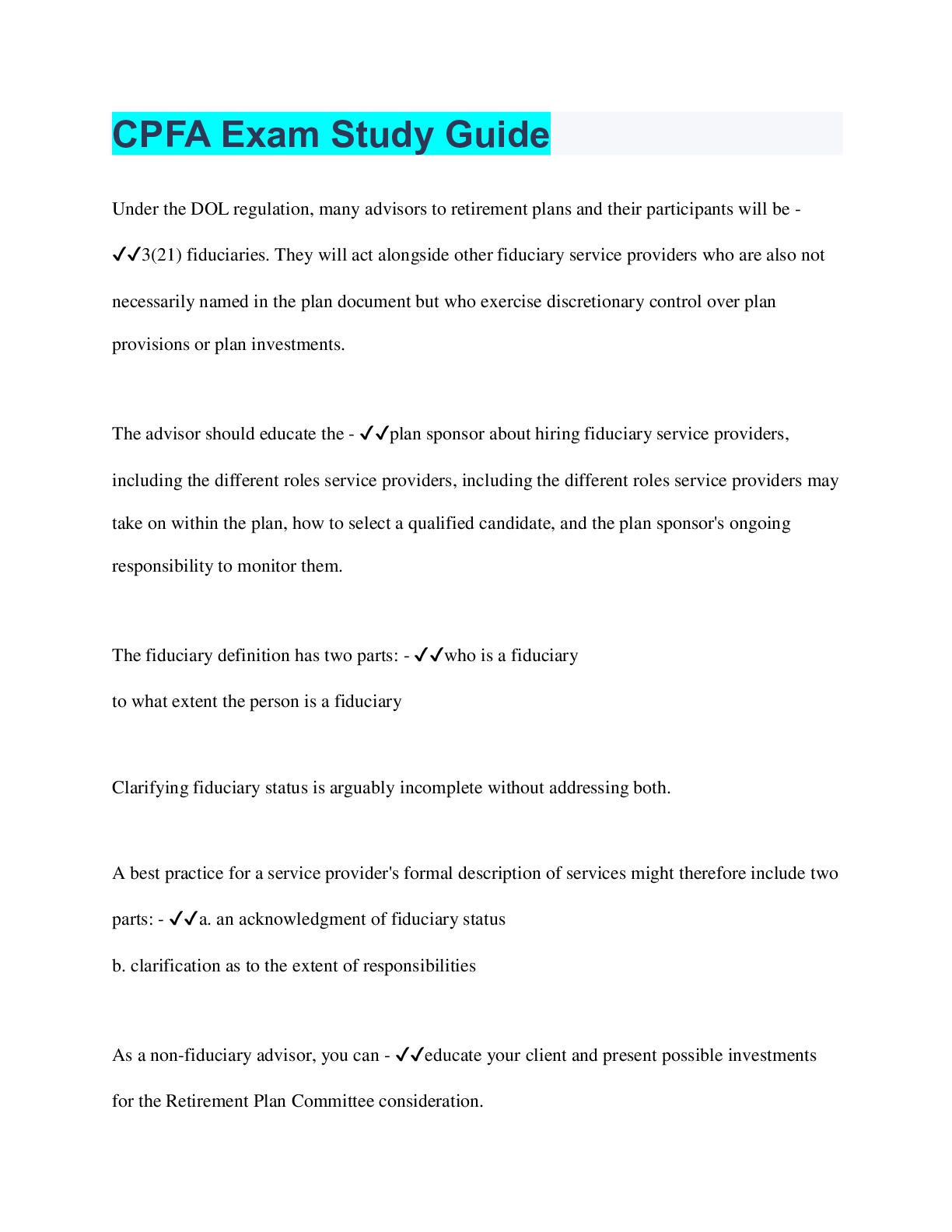
CPFA Exam Study Guide
Under the DOL regulation, many advisors to retirement plans and their participants will be -
✔✔3(21) fiduciaries. They will act alongside other fiduciary service providers who are also not
necessarily named in the plan document but who exercise discretionary control over plan
provisions or plan investments.
The advisor should educate the - ✔✔plan sponsor about hiring fiduciary service providers,
including the different roles service providers, including the different roles service providers may
take on within the plan, how to select a qualified candidate, and the plan sponsor's ongoing
responsibility to monitor them.
The fiduciary definition has two parts: - ✔✔who is a fiduciary
to what extent the person is a fiduciary
Clarifying fiduciary status is arguably incomplete without addressing both.
A best practice for a service provider's formal description of services might therefore include two
parts: - ✔✔a. an acknowledgment of fiduciary status
b. clarification as to the extent of responsibilities
As a non-fiduciary advisor, you can - ✔✔educate your client and present possible investments
for the Retirement Plan Committee consideration.
If you recommend a specific fund replacement to the plan sponsor or plan participants, you are
considered to be - ✔✔giving investment advice and are therefore a functional fiduciary to the
plan.
If fiduciaries of participants use your recommendations - as opposed to information - to make
investment decisions, this could be considered - ✔✔a fiduciary act
As a non-fiduciary advisor, you can meet with your client on a recurring basis (quarterly,
annually, etc) if providing - ✔✔general investment reports or discussing the appropriateness of
the investments to the plan without making specific investment suggestions.
Plan fiduciaries will almost always have to hire - ✔✔service providers for their plan under their
ERISA "duty to obtain expert assistance."
As a best practice, the advisor can help fiduciaries select: - ✔✔the service providers, which
usually includes a TPA and a record keeper.
In owner driven smaller plans, the advisor can assist the - ✔✔plan sponsor's HR staff - which is
likely to be one person in working with the various plan service providers.
In larger participant driven plans, the advisor can work with - ✔✔the HR director, CFO, and the
retirement plan committee to evaluate service providers.
A 3(21) fiduciary does not serve as a fiduciary investment manager, but instead usually as -
✔✔investment advice fiduciary
f your client wants an advisor to manager plan investments, or just the QDIA, they can hire a -
✔✔3(38) fiduciary advisor.
A 3(21) fiduciary advisors can recommend investments but the final decision on which
investments to choose is up to the - ✔✔plan fiduciaries.
A 3(16) plan administrator can take on administrative duties for the plan but does not act in -
✔✔an investment capacity.
A non-fiduciary advisors can provide - ✔✔education
The DOL is not required to be notified if - ✔✔the plan hires a 3(21) advisor.
The fiduciaries should do a review of the service provider qualifications in order to prove a -
✔✔prudent process was not followed when selecting the service provider. They should also
review the service agreement, document the decision process, and have a service agreement with
the 3(21) advisor.
A 3(21) advisor fiduciary is considered a - ✔✔fiduciary to the plan, but different than advisors
working as 3(38) fiduciaries, it is rarely named in the plan document.
The service agreement between the plan sponsor and the TPA is what determines if - ✔✔a TPA
will work as a 3(16) fiduciary Plan Administrator.
ERISA 3(16) fiduciaries serve as the - ✔✔"Plan Administrator" and are responsible for
administrative responsibilities in the plan. These include assuring the plan operation remains in
compliance with the plan document, providing administrative and compliance documents for the
fiduciary file and assuring that employee notices are drafted and distributed.
ERISA 3(21) and 3(38) fiduciaries serve as - ✔✔investment fiduciaries and their main duty
under ERISA is to provide investment advice.
3(38) fiduciaries may also serve as the - ✔✔named investment manager for the plan, and unlike
3(21) investment advice fiduciaries, will have discretionary control over plan investments.
Employee education through enrollment meetings is performed by - ✔✔retirement plan advisors,
including non-fiduciary, 3(21), and 3(38) fiduciary advisors. Assisting with fiduciary file
documentation is another function that all retirement plan advisors, both fiduciary and nonfiduciary are likely to perform.
As the advisor, you can assist the plan sponsor by - ✔✔by asking about documents he or she
may be missing from the fiduciary file.
For example:
Are there any plan amendments?
Does he or she have copies of the required participant notices (including participant fee
disclosure) and account statements?
Where are the 408(b)(2) fee disclosure notices?
Does he or she have evidence that looked at the fee disclosure to determine if plan fees are
reasonable?
You can also assist the plan sponsor in identifying the - ✔✔plan service providers who may have
copies of these documents, and assist him in setting up a fiduciary file.
You may also want to show the sponsor a - ✔✔sample DOL investigation letter, so he is aware
of what the DOL might ask in advance of an investigation. You can point out that unsigned
documents or amendments and/or missing and incomplete plan documentation may put him at
risk in an audit.
You should assure the that Plan Sponsor is aware of - ✔✔both your role as an investment
fiduciary regulations and what documentation she may need to review based on specific financial
institution requirements.
The advisor or the CPA is not responsible for - ✔✔the required plan amendments. The TPA or
ERISA counsel can prepare the required amendment.
The plan docs need to be amended when - ✔✔there is a law change that impacts the plan, or
when the fiduciaries are changing the plan provisions.
It is the fiduciaries' responsibility to - ✔✔distribute fee disclosures notices, the record keeper is
the one who prepares them.
The plan document, IPS, and SPD are only required to be updated if - ✔✔changes have been
made by the plan fiduciaries or law changes require a plan amendment and changes to the SPD.
Fiduciaries have personal liability for - ✔✔a "breach" of their duties.
It is important to remind the fiduciaries that an investment involving a party in interest is
prohibited even if - ✔✔it has been beneficial to the plan participants and beneficiaries. The
prohibited transaction still must be corrected.
Correcting prohibited transactions may or may not be done through - ✔✔the DOL Voluntary
Fiduciary Corrections Program (VFCP). Regardless, it is not the advisor's role to correct
prohibited transactions. Fiduciaries should consult an ERISA attorney to identified prohibited
transactions and assist in correcting the transactions. Transactions should be corrected as soon as
possible to avoid additional taxation.
Non-traditional plan investments can be associated with - ✔✔prohibited transactions
It is a best practice to recommend that an ERISA attorney review - ✔✔non-traditional plan
investments to identify potential prohibited transactions.
Spouses and lineal relatives of plan fiduciaries, such as children, are - ✔✔parties in interest
Service providers to the plan, such as CPAs doing audits, ERISA counsel, and plan advisors are
also - ✔✔parties in interest
Deferrals must be - ✔✔deposited as soon as possible after the payroll is run or it is a fiduciary
breach. Not only are late deferral deposits and investing with a party in interest prohibited
transactions, they may be fiduciary breaches as well. Fiduciaries are liable for these transactions
and should contact ERISA counsel on how to remedy them.
Improper valuation of privately held employer stock and purchasing a stock investment based on
a tip from a broker are errors that - ✔✔cannot be corrected using the DOL correction program.
It is the position of the DOL that plan fiduciaries need - ✔✔the information contained in the
408(b)(2) disclosures when selecting and monitoring services providers in order to satisfy their
fiduciary obligations under ERISA. As a result, there is a fiduciary duty for plan sponsors and/or
committees to utilize and demonstrate a prudent process to evaluate the services, fees, potential
conflicts of interest and fiduciary status of the service providers.
If the plan fiduciaries do not understand the information in the disclosures, they should - ✔✔get
help from someone who does.
Plan sponsors do not have access to - ✔✔benchmarking data in order to evaluate the fees of
service of providers. Advisors can offer these benchmarking services.
Advisors can not only help plan sponsors and committees navigate the fiduciary issues of
408(b)(2), but are themselves subject to: - ✔✔rules on reasonableness of compensation,
adequacy and appropriateness of services provided, and identifying and managing conflicts of
interest.
The plan sponsor, the plan administrator, and plan trustee will almost always be - ✔✔fiduciaries
to the plan.
Whenever someone is a fiduciary to the plan they are personally liable for - ✔✔any plan losses if
they breach their fiduciary responsibility, which goes beyond making contributions timely.
Fiduciary liability can never be - ✔✔totally delegated to service providers.
The interests of the plan sponsor should - ✔✔not be a factor when making plan decisions.
Fiduciaries must follow - ✔✔the plan's governing documents
If the plan fiduciary delegates fiduciary duties to other fiduciaries in accordance with the plan
document - such as delegating to an investment manager, allocation of duties to a discretionary
trustee or appointment of a TPA who serves as the named Plan Administrator: - ✔✔they are not
directly liable for the duties delegated, although they are still responsible for overseeing the
service providers for whom they delegated the duties.
The main responsibilities of the plan sponsor are - ✔✔prudently selecting and monitoring named
fiduciaries and maintaining plan records.
Safekeeping of plan assets is a responsibility of the - ✔✔plan trustee
Providing summary plan descriptions to participants is a responsibility of - ✔✔the plan
administrator
The trustee is responsible for - ✔✔safekeeping of plan assets, including pursuing monies owed
to the plan, overseeing investment managers and serving on an investment committee (typical of
a larger plan)
Plan administrators are responsible for - ✔✔operation of the plan, which includes filing required
forms and providing information to participants.
ERISA requires that fiduciaries manage the plan for the exclusive benefit of which of the
following parties? - ✔✔participants and their beneficiaries
June is a Plan Sponsor of a small plan and decided she'll be acting as the sole fiduciary of the
plan. All of the following are her responsibilities except? - ✔✔Give investment advice to
participants
Under ERISA, the Plan Admin has the following roles, except? - ✔✔Redesigning the plan's
employer matching contribution formula
Under ERISA, all of the following are Plan Trustee responsibilities, except? - ✔✔Oversee the
plan administrator
All of the following may be named fiduciaries in a plan document, except? - ✔✔Legal counsel
who prepares the plan document
Sue is a plan advisor for the ABC retirement plan. On the agenda for the upcoming ABC plan
Committee meeting is an action item to replace Len and nominate a new member to the
committee. Len has been asked to leave the committee due to his unsatisfactory attendance at
monthly meetings. All of the following are best practices regarding fiduciary changes, except? -
✔✔Per Len's request, the Committee minutes will exclude the reason Len was asked to leave the
committee.
Sharon is a 3(21) advisor. She is meeting with a potential client and is preparing for her meeting.
All of the following are services that Sharon may offer the prospect, except? - ✔✔Make
decisions to replace funds on the watch list pursuant to the investment policy statement, prior to
attending the investment committee meeting.
All of the following represent potential breaches of fiduciary responsibility by plan fiduciaries,
except? - ✔✔A plan trustee delegates some of his responsibilities to a discretionary trustee who
he continues to monitor.
All of the following statements represent the DOL's role in overseeing plans, except? - ✔✔A
DOL investigation letter will usually ask for no more than five items related to the plan's
operation.
Which statement regarding the IRS and the DOL corrections programs is true? - ✔✔The DOL
website includes an online calculator that calculates earnings earnings amounts to be paid to the
plan.
All of the following statements describe characteristics of ERISA fidelity bonds and fiduciary
insurance, except? - ✔✔An ERISA fidelity bond protects the employee from any error made
when submitting contributions to a service provider.
Larry is the owner of DEF company. Which of Larry's activities is considered a fiduciary
function? - ✔✔Hires the plans investment advisor.
All of the following documents should be maintained to show fiduciary best practices, except? -
✔✔Documentation of selection process for new payroll vendor.
All of the following documents are updated annually, except? - ✔✔Plan Document
All of the following are consequences of fiduciary breaches except? - ✔✔The corporate veil
protects fiduciaries from personal liability
All of the following are best practices for determining the reasonableness of plan fees, except? -
✔✔Owner driven plans are not required to determine the reasonableness of plan fee due to their
limited personnel and financial resources.
All of the following fees may be paid from the plan, except? - ✔✔Fee associated with union
negotiations regarding retirement plan benefits.
All of the following are parties-in-interest to the STU, inc. profit sharing plan, except? -
✔✔XYZ, inc. who is seeking to acquire STU, inc.
ERISA defines the following as plan fiduciaries, except? - ✔✔Plan accountant
All of the following describe non-fiduciary individuals performing ministerial functions, except?
- ✔✔A human resources director decides to fully vest a terminated employee because of his
excellent work history.
Plans and objectives: - ✔✔1. What are the primary concerns (tax benefits to the business and the
owners, attracting and retaining employee rank and file participant retirement outcome?)
2. Which group(s) of employees is the plan sponsor looking to benefit (rank and file employees,
mid-management, higher management, owners?)
3. Is there one or more groups of employees who may not need the plan or unlikely to participate
in the plan?
Business structure and type: - ✔✔1. What type of business entity is the plan sponsor?
2. What does the census data look like for the employer?
Related company ownership: - ✔✔1. Who are the owners of the business and what percent do
they own? (family members, what relationship?)
2. Do the owners of the current business or the current business own any other businesses?
3. Do the family members of the owners of the current business own any other businesses?
Business cash flow and budget: - ✔✔1. What is the contribution budget available?
2. Does the business have stable cash flow?
Advisors can add value by pointing out the advantages and disadvantages of different eligibility
requirements. Examples: - ✔✔1. Do your current plan eligibility provisions work well with your
plan goals?
2. Do you know why they were selected?
3. Can your HR staff and/or payroll system effectively handle employees who are immediately
eligible for the plan?
4. Would staff be able to process immediate entry into the plan along with automatic enrollment?
5. Are you comfortable making matching contributions every payroll period?
6. Do you have a lot of turnover?
7. Would a one-year wait help manage the impact of that turnover?
8. Would a requirement to work on the last day of the plan year help manage the cost of
turnover?
9. Are there employee groups that you would like to exclude from the plan if it is possible to do?
Contributions can have a major impact in - ✔✔supporting plan goals as well as plan costs.
Advisors should be familiar with different contribution provisions and consider the following
when designing contribution provisions: - ✔✔1. Is there a philosophy on making employer
contributions?
2. Is the objective to maximize contributions to the principal employees?
3. What is the objective and budget for non-principal employees?
4. Is there one or more group of employees who may not need the plan or who are unlikely to
participate in the plan?
5. How important is it that your employees be on track for an adequate retirement income?
6. What is the company's cash flow?
7. What is the approximate budget for plan contributions?
Vesting schedules add to a - ✔✔plan's administrative complexity for record keepers and TPAs,
and can add to the plan's cost. However, employers often consider forfeitures advantageous for
cost savings and therefore may prefer vesting schedules that do not vest participants 100%
immediately.
It is important to remind employers that not all their contributions are subject to - ✔✔vesting,
especially safe harbor contributions that are always 100% vested.
Advisors should discuss loan and hardship withdrawal provisions with - ✔✔plan sponsors and
plan fiduciaries.
Because these provisions are optional, plans whose goal is for participants to save for retirement
do not have to offer them. However, many participants will not defer if they believe they cannot
get their money out until they retire or leave the company.
Loans and hardships have a track record of - ✔✔encouraging participation
Loan provisions in particular can be - ✔✔tailored to a plan's employee demographics, offering
one loan at a time, requiring payroll deduction repayment and/or limiting loan amounts.
Although these options increase costs for administration, fees are charged to the participants
taking the loan or the hardship withdrawal, so they don't affect participants not taking loan or
hardships.
In owner-driven plans, advisors should caution owners and partners to - ✔✔to administer their
loan programs for themselves, just as they do for the other plan participants.
There are advantages to participants in allowing rollovers into the plan from another plan or
IRA: - ✔✔1. Participants can consolidate their retirement accounts.
2. Generally, investing in a 401k is more cost effective than investing in an IRA
3. Participants can take advantage of loans and hardship withdrawal provisions of the qualified
plan.
4. Participants have access to professionally managed 401k investments.
Large companies may want to consider a - ✔✔traditional 401k with auto enrollment and a
matching contribution. Because of their large size, they are less likely to consider a safe-harbor
design.
Pros of traditional 401k: - ✔✔1. Elective deferrals allow employees to save on a tax-preferred
basis for retirement
2. Employer matching contributions reward employee savings
3. Automatic enrollment designs create better participant outcomes
4. Roth 401(k) deferrals allow for tax-free savings
5. Catch up contributions allow additional savings for employees 50 and older
6. Safe harbor contributions can exempt a plan from nondiscrimination testing
7. Employees can select investments individualized to their needs
8. Designs can be flexible enough to allow for both principal and non-principal savings benefits
Cons of traditional 401k: - ✔✔1. Complex to administer and design; multiple contribution
sources make record-keeping complicated
2. Safe harbor contributions are fixed not flexible
3. Matching contributions can also be a fixed contribution commitment
4. Subject to ADP/ACP testing, unless the plan uses a safe harbor design
SEP or SIMPLE plans are attractive to start up firms because - ✔✔they are less expensive to
administer.
The other problem typically seen in SIMPLE IRAs is that - ✔✔employers do not realize the
plans have a required contribution component and often have not made those contributions to the
plan.
Although 401k plans are more complicated to administer, they allow - ✔✔more flexibility in
design for both owners and employees to save for retirement.
A partnership that has stable long-term cash flow and wants to speed up retirement contributions
for the partners, might want to consider a - ✔✔DB/cash balance or hybrid combination plan
design.
Both plan designs are based on employee demographics and both require a fixed annual
contribution. The DB/DC combination has little contribution flexibility. These types of plans are
also more complex and expensive to administer.
Plan features that often increase administration costs and HR staff time include - ✔✔eligibility,
vesting and compensation definitions
SIMPLE IRAs are designed for - ✔✔smaller employers, limited to 100 participants, and cannot
be offered in conjunction with another plan.
A SIMPLE IRA is - ✔✔less expensive than a 401k because it doesn't require a plan document or
testing and has also limited reporting and disclosure requirements. SIMPLE IRAs require either
an employer non-elective contribution or a match contribution.
401ks, on the other hand, have contributions limits that are - ✔✔two times greater that the
SIMPLE IRA. Although 401ks complex to administer, they can grow as the sponsor grows.
SIMPLE IRA plans usually do not have - ✔✔administrative fees that are billable to the
employer, but there is an employer contribution that the owner should be made aware of. There
are NO forfeitures in a SIMPLE IRA.
ERISA participant rights and IRS maximum dollar amount contribution limits are found in the
base plan document, not in the - ✔✔adoption agreement
Behavioral finance research shows that participants are better off with - ✔✔"opt out" features
rather than "opt-in" features. As a result, auto enrollment and re-enrollment in the plan's QDIA
can produce better participant outcomes that just participant education in a traditional 401k plan.
Although the DOL provides informal guidance, it does not provide - ✔✔regulations for the
service provider selection process. It is a best practice to use RFPs (Requests for Proposals) and
formal search processes for large plans and less formal solicitation of proposals and search
processes for small plans.
If the TPA and record keeper are separate, it is considered an - ✔✔unbundled arrangement
Which statement regarding service providers is TRUE? - ✔✔A TPA performs annual
compliance testing
All of the following are important factors when selecting a service provider, except? -
✔✔Willingness to provide revenue sharing to offset plan fees.
Which statement regarding bundled service arrangements is TRUE? - ✔✔Provides efficient
contribution and distribution processes.
Based on behavioral finance research, which of the following is a best practice for producing
successful participant outcomes? - ✔✔Combining auto-enrollment with targeted education
Company ABC and Company DEF are determined to be part of a related group of companies.
Which is not true? - ✔✔DEF has the right to "opt out" and be excluded from the related group.
Which of the following plan designs may result in better participant deferral behavior? -
✔✔Adding an employer matching contribution equal to 25% up to 12% of compensation
deferred.
An advisor is meeting with a Plan Sponsor to discuss contribution design in her plan. All of the
following questions will help with this conversation, except? - ✔✔Can participants convert their
existing contribution accounts to Roth accounts
All of the following describe the impact of a business' cash flow and budget when establishing a
plan, except? - ✔✔A plan advisor should inform the employer that required contributions will be
waived for any year that the company does not make a profit.
Which of the following reports can be used in measuring plan effectiveness and participant
outcomes? - ✔✔average deferral rate of participants in the plan
All of the following are benefits of participant retirement readiness, except? - ✔✔participants
receive a guarantee of lifetime income payments
All of the following are items to consider when developing a strategy to promote successful
participant outcomes, except? - ✔✔what is the average life expectancy for the participants
beneficiaries
All of the following statements describe the re-enrollment process of reinvesting participant
accounts in the plan's asset allocation funds, except? - ✔✔participant notices are not required
Which statement regarding IRA plans and 401k plans is true? - ✔✔participant loans are allowed
from a SIMPLE 401k plan but not a SIMPLE IRA
A traditional 401k plan may be an appropriate choice for all of the following employers, except:
- ✔✔an employer whose first priority is to maximize his or her retirement savings
An owner driven plan sponsor wants to retire in 5-10 years. His company has a stable cash flow
and ten employees. All of the following plan designs are compatible with the owner's goals,
except: - ✔✔a simple ira
A 401k plan has poor participation among the rank and file employees. As a plan advisor, all of
the following recommendations could boost plan participation except - ✔✔adding a profitsharing contribution based on years of service
An owner driven plan sponsor wants to know the advantages of a safe harbor 401k plan. Which
is a disadvantage? - ✔✔safe harbor contributions are discretionary
All of the following plan features are typically located in the plan's adoption agreement, except?
- ✔✔definition of ERISA fiduciary roles and responsibilities
All of the following are advantages of the request for proposal (RFP) process in a participant
driven plan, except: - ✔✔the RFP allows the fiduciaries to delegate the selection of finalists to
the plan advisor and the TPA
All of the following service providers may assist with plan document maintenance, except: -
✔✔plan auditor
A safe harbor 401k plan with a cross tested profit sharing contribution may be an appropriate
choice for all of the following employers, except: - ✔✔a 1500 employee manufacturing firm
All of the following describe the required participant disclosure process, except: - ✔✔the party
that distributes required notices to participants is considered a fiduciary.
Sponsors cannot devise and implement a comprehensive investment fiduciary process without -
✔✔the help of investment experts.
A balanced fund can be used as a - ✔✔QDIA
Documentation of investment education can be done in the - ✔✔retirement committee meeting
minutes and the IPS.
The duty of a fiduciary to obtain expert assistance is - ✔✔the key to the retirement plan advisor's
role in assisting fiduciaries.
An experienced advisor can help fiduciaries select and review the myriad of investment choices
available to plans, as well as to evaluate fees inherent in those investments, keeping in mind the
plan's goals and objectives and the rules of ERISA.
Although actively managed funds may have higher fees they are not designed to - ✔✔perform
better than passive funds that are tied to an index
the committee members have the responsibility to make the ultimate decision about -
✔✔whether or not to replace a fund
The IPS should be a guide for investment selection and review, and not contain details that make
it difficult for fiduciaries to use as a guide, including - ✔✔1. There is no required plan document
provision summary for an IPS
2. A list of active and passive funds could bring too much detail
3. A list of service providers is not necessary
The IPS is not - ✔✔an ERISA requirement.
The advisor can assist in the process, but the ERISA attorney and/or the retirement plan
committee should be responsible for - ✔✔revising and finalizing the plan's IPS.
The IPS should include broad fund and asset class definitions, and not contain fund names from
a specific provider.
The retirement plan committee and/or named fiduciaries are responsible for - ✔✔maintaining the
IPS.
If the plan has one, the fiduciary advisor will also typically maintain the IPS.
The IPS should include the - ✔✔methodology and process by which investments will be
selected, monitored, and replaced, if necessary.
The plan committee should finalize the - ✔✔IPS, and follow IPS guidelines in selecting and
reviewing plan investments.
Under ERISA, fiduciaries must follow - ✔✔an investment policy designed on behalf of plan
participants, even if they don't adopt a formal IPS.
A written IPS becomes a "document governing the plan" under ERISA, and should be written
and periodically updated so that fiduciaries can follow it.
The DOL interprets the "ERISA duty to follow an IPS" to mean - ✔✔that the plan investments
must be prudently monitored on an ongoing basis to ensure that they continue to be in the
interests of the plan participants and beneficiaries. And, like the original IPS and investment
selection, the prudent monitoring process should be documented.
Summary of the Investment oversight process: - ✔✔1. Use the IPS as a guiding document
2. Review investments to ensure participants have adequate choice
3. Review investments to ensure they meet plan and participant goals
4. Review and document fees for services provided, expenses and revenue sharing
5. Review compliance with 404(c), if applicable
6. Review employe stock allocation; document its suitability as an investment option
7. Document investment review and decision making processes
8. Document the history of investment selection and replacement
9. Comply with plan default investment rules in the IPS and review QDIA investments
10. Update the IPS if necessary
Which statement regarding "to" and "through" target date funds is TRUE? - ✔✔a key difference
between "to" and "through" target date funds are their gilded paths
All of the following describe qualified investment alternative (QDIA) rules, except? - ✔✔a plan
must use a QDIA as its default fund
All of the following are components of gap analysis, except? - ✔✔beneficiary's tax liability of
account balance after participant's death
All of the following are characteristics of target date funds, except? - ✔✔they require less
fiduciary oversight than other types of funds.
Which of the following parties typically maintains the investment policy statement? - ✔✔plan
advisor
The following statement regarding the timing of investment meetings is not true: - ✔✔A IPS
must specifically state how often the investments are reviewed.
Which statement describes a benefit of using target date funds as a qualified default investment
alternative? - ✔✔they offer a professionally managed investment
Which statement regarding investment options is true? - ✔✔asset allocation funds are designed
to be the sole investment holding for a participant
When it comes to plan errors, an advisor's role is not to correct them, but to - ✔✔help avoid
them
The form 5500, plan audit, and meeting minutes are not required to - ✔✔be sent to participants.
The plan administrator in the plan document has the responsibility for - ✔✔overseeing the
prudent process of adding or changing fiduciaries. It is also critical that the process for changing
fiduciaries be documented as part of plan best practices.
When a plan contemplates a change in service providers, the advisor can assist with - ✔✔the
prudent process, the fiduciaries must follow to select new service providers.
It is the advisor's responsibility to - ✔✔coordinate the timeline of conversion.
It is the recordkeeper/TPA's responsibility to - ✔✔provide the conversion timeline.
It is the recordkeeper/TPA's responsibility to - ✔✔provide disclosure notices.
It is the plan fiduciary's responsibility to - ✔✔distribute disclosure notices.
It is the responsibility of the record keeper to - ✔✔provide documentation of the conversion
process.
It is the plan fiduciary's responsibility to - ✔✔retain conversion due diligence documents.
[Show More]