CCHT exam Q's 148 Questions with Verified Answers
AAMI Chemical Analysis of water used for hemodialysis is tested:
annually
monthly
semi-annually
quarterly - CORRECT ANSWER annually
A 58-year old pati
...
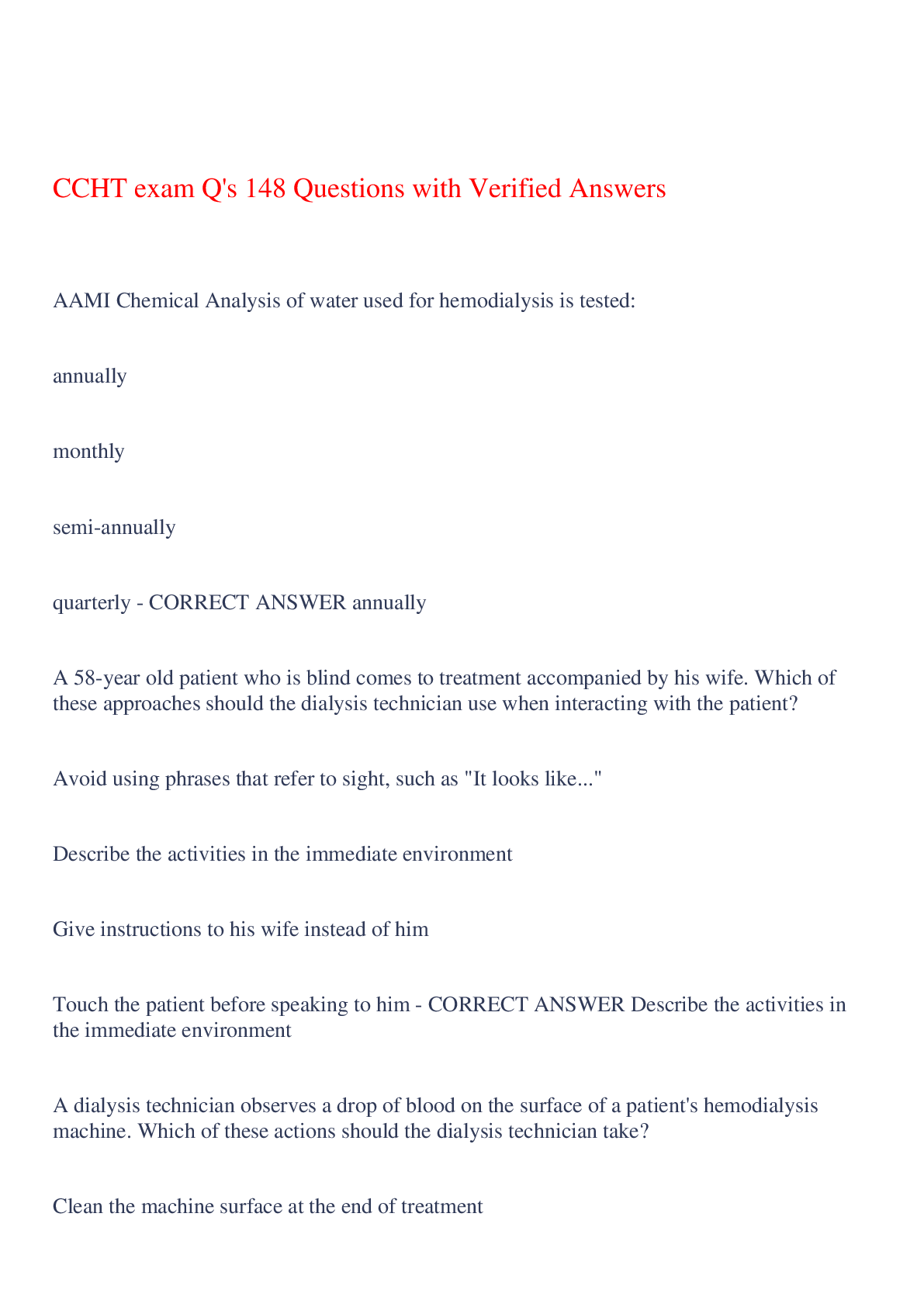
CCHT exam Q's 148 Questions with Verified Answers
AAMI Chemical Analysis of water used for hemodialysis is tested:
annually
monthly
semi-annually
quarterly - CORRECT ANSWER annually
A 58-year old patient who is blind comes to treatment accompanied by his wife. Which of these approaches should the dialysis technician use when interacting with the patient?
Avoid using phrases that refer to sight, such as "It looks like..."
Describe the activities in the immediate environment
Give instructions to his wife instead of him
Touch the patient before speaking to him - CORRECT ANSWER Describe the activities in the immediate environment
A dialysis technician observes a drop of blood on the surface of a patient's hemodialysis machine. Which of these actions should the dialysis technician take?
Clean the machine surface at the end of treatment
Clean the machine surface immediately
Notify the equipment technician
Notify the nurse - CORRECT ANSWER Clean the machine surface immediately
A dialysis technician observes all of the below on the treatment floor, which one poses an environmental risk?
About one ounce (30ml) fluid is on the floor
A patient's family member is present during initiation of treatment
Charts are lying on bedside tables
The wheels of the hemodialysis machine are locked - CORRECT ANSWER About one ounce (30ml) fluid is on the floor
A female dialysis technician has been caring for a male patient for several months. The patient tells the dialysis technician that he is lonely and depressed. He asks the dialysis technician to go out to dinner with him. In addition to politely declining the patient's invitation, which of these actions, if any, should the dialysis technician take?
No further action is needed
Recommend an over-the-counter mood stimulant, such as St. John's Wort
Refer the patient to the social worker
Share the patient's need for socialization with other patients - CORRECT ANSWER Refer the patient to the social worker
A marker used to determine the middle molecule clearance of a dialyzer is:
creatinine.
nitrogen.
urea.
vitamin B12. - CORRECT ANSWER vitamin B12.
A fistula connects:
a vein to a vein.
an artery and a vein to synthetic material.
an artery to an artery.
an artery to a vein. - CORRECT ANSWER an artery to a vein.
A nephron is made up of:
A glomerulus and a tubule system
The bladder and the ureters
The cortex and a capsule
The loop of Henle and the capillary ball - CORRECT ANSWER A glomerulus and a tubule system
A patient complains of pain at the venous needle site. The dialysis technician observes there is swelling distal to the venous needle site and that the venous pressure is rising. The dialysis technician should suspect:
a pseudoaneurysm.
an Infiltration.
recirculation.
stenosis. - CORRECT ANSWER an Infiltration.
A patient who is to receive their first dialysis treatment is prone to?
Crenation
Dialysis disequilibrium syndrome
First use syndrome
Steal syndrome - CORRECT ANSWER Dialysis disequilibrium syndrome
A patient tells the technician that the dietitian reviewed high-potassium foods with her. During the conversation she states she routinely eats the following foods. Which one is highest in potassium?
Bananas
Ice Cream
Pasta
Rice - CORRECT ANSWER Bananas
A slow pulse of 54 beats/minute would indicate the patient has:
A normal rate
An arrhythmia
Bradycardia
Tachycardia - CORRECT ANSWER Bradycardia
A teammate asks you to document the normal saline he just gave to Mr. Smith. You would:
ask what time he gave it and document it with his signature
ask what time he gave it and document it with his signature, as a late entry
ask what time he gave it and document that you gave it
never document something that someone else did - CORRECT ANSWER never document something that someone else did
A true aneurysm can be dangerous because it:
can result in hypertension.
may cause the patient to have pain in the fingers.
may cause the access to clot.
may rupture and cause the patient to bleed profusely. - CORRECT ANSWER may rupture and cause the patient to bleed profusely.
A patient's laboratory results indicate that the predialysis BUN level was lower than the post dialysis BUN level. When interpreting these findings the technician should seek the answer to which of these questions.
Was the machine in bypass during the post sampling?
Was the patient's heparin pump turned off when the post sample was drawn?
Was the post dialysis sample drawn correctly?
Was the port used for predialysis sampling cleaned with disinfectant? - CORRECT ANSWER Was the post dialysis sample drawn correctly?
A rapid pulse of 104 beats/minute would indicate that the patient has:
an arrhythmia
atrial flutter
bradycardia
tachycardia - CORRECT ANSWER tachycardia
A patient's target weight is 154.0 lb (70 kg) and the patient's pre treatment weight is 158.4 lb (72 kg). For a four-hour treatment, how many mL/hour must the patient lose to reach dry weight?
250
500
750
1000 - CORRECT ANSWER 500
AAMI standard for conventional dialysate requires the total microbial count be less than:
100 CFU/mL
200 CFU/mL
300 CFU/mL
400 CFU/mL - CORRECT ANSWER 100 CFU/mL
Abnormal levels of this electrolyte can cause cardiac arrhythmias and even death.
Potassium
Sodium
Bicarbonate
Chloride - CORRECT ANSWER Bicarbonate
Asepsis is defined as:
an access infection.
a bloodstream infection.
a reduction in the number of organisms.
the absence of disease producing organisms. - CORRECT ANSWER the absence of disease producing organisms.
During a hemodialysis treatment, a patient says to the technician, 'Three hours of time have passed according to the clock on the wall, but the machine shows that only 2.5 hours have passed. What could be the problem?' The technician should understand that the:
machine requires immediate service.
machine was in bypass for 30 minutes.
patient has reached their target weight.
patient's target weight has decreased. - CORRECT ANSWER machine was in bypass for 30 minutes.
During hemodialysis a patient goes into cardiac arrest. The first action for the dialysis technician is:
Apply a pericardial thump to the patient
Call for assistance
Return the patient's blood
Stop ultrafiltration - CORRECT ANSWER Call for assistance
During the hemodialysis treatment, a patient complains of feeling chilled. In addition to getting the patient a blanket, which of these actions should the technician take?
Decrease the blood flow rate
Increase the bicarbonate concentration in the dialysate
Put the patient in Trendelenburg
Take the patient's temperature - CORRECT ANSWER Take the patient's temperature
One disadvantage of a fistula is an increase in:
clotting.
biocompatibility.
infections.
time to mature. - CORRECT ANSWER time to mature.
Sam's TW is 70 kilograms (kg). He arrives for treatment today at a weight of 70 kg. He complains of shortness of breath and you notice his ankles are swollen. You notify the charge nurse. What do you think will be the plan for Sam's treatment today?
The nurse will ask you to give Sam fluid during treatment
The nurse will ask you to remove no fluid during treatment
The nurse will get an order to decrease the TW
The nurse will get an order to increase the TW - CORRECT ANSWER The nurse will get an order to decrease the TW
The normal range of resting respirations in an adult is:
12 - 20 breaths per minute
20 - 30 breaths per minute
30 - 40 breaths per minute
40 - 50 breaths per minute - CORRECT ANSWER 12 - 20 breaths per minute
The dextrose used in the Dialysate for peritoneal dialysis can cause:
hyperclacemia
hyperglycemia
hypocalcemia
hypoglycemia - CORRECT ANSWER hyperglycemia
The leading cause of chronic kidney disease for adults in the United States:
Diabetes
Glomerulonephritis
Hypertension
Urinary obstruction - CORRECT ANSWER Diabetes
The dialysis technician's role in patient education is to:
Assess patient's barriers to learning
Determine patient's level of readiness to learn
Educate patients on all aspects of their care
Reinforce educational information provided - CORRECT ANSWER Reinforce educational information provided
The most important intervention to prevent the spread of infection is:
Performing hand hygiene
Disinfecting surfaces
Immunizing patients and staff
Using personal protective equipment - CORRECT ANSWER Performing hand hygiene
The movement of fluid from the tissues toward a higher concentration of sodium in the blood is an example of:
Diffusion.
Filtration.
Osmosis.
Ultrafiltration. - CORRECT ANSWER Osmosis.
A decrease in transmembrane pressure in a high flux dialyzer during hemodialysis is indicative of:
Venous needle malposition
Excessive ultrafiltration
Clotting of the extracorporeal circuit
Nothing- this is normal for high flux - CORRECT ANSWER Clotting of the extracorporeal circuit
You have documented incorrectly on a patient's chart. How do you correct this?
circle it, initial, write correct information above entry
white out entry, write correct information, initial
draw line through wrong entry, write error, initial/date entry
circle wrong entry, writer error, initial/date entry - CORRECT ANSWER draw line through wrong entry, write error, initial/date entry
Which of these technician activities contributes to data collection used to measure quality outcomes?
Attending educational programs
Ensuring accurate documentation
Maintaining professional boundaries
Participating in staff meetings - CORRECT ANSWER Ensuring accurate documentation
Which of the following might indicate the need to increase heparin?
Clotting in the extracorporeal circuit
Prolonged bleeding post treatment
The patient is having surgery tomorrow
The patient is taking aspirin every day - CORRECT ANSWER Clotting in the extracorporeal circuit
Which of the following might indicate a need to decrease the heparin dose?
Clotting in the extracorporeal circuit
The patient has an access infection
The patient has a catheter with poor blood flow
The patient just had surgery yesterday - CORRECT ANSWER The patient just had surgery yesterday
Which of the following would cause a high venous pressure alarm?
Blood flow rate is decreased
Patient has pulled out the venous needle
Patient just received a 200 ml normal saline bolus
Venous needle is against the wall of the vessel - CORRECT ANSWER Venous needle is against the wall of the vessel
Which organization establishes the standards and recommendations for dialyzer reprocessing?
AAMI
CDC
CMS
FDA - CORRECT ANSWER AAMI
Which of the following is used to prevent air in the bloodlines?
Allow the normal saline bag to run dry
Maintain prescribed blood flow rates
Monitor patient's blood pressure
Tighten all connections - CORRECT ANSWER Tighten all connections
Which of these types of vascular accesses has the fewest complications?
A Scribner shunt
A synthetic graft
A subclavian catheter
An arteriovenous fistula - CORRECT ANSWER An arteriovenous fistula
Your patient is to receive 2000 units of heparin. The vial you are using is 1000u/ml heparin. How many mls will you draw up for this patient?
1.0
2.0
10
20 - CORRECT ANSWER 2.0
Which of the following symptoms would indicate a need to increase the target weight?
Edema and hypertension
Fever and chills
Hypotension and cramping
Shortness of breath and neck vein distension - CORRECT ANSWER Hypotension and cramping
When cannulating, the tips of the needles should be at least:
1.0 inches apart.
0.5 inches apart.
2.0 inches apart.
1.5 inches apart. - CORRECT ANSWER 1.5 inches apart.
Which learning domain is behavioral based?
Affective
Cognitive
Motor Skill
Psychomotor - CORRECT ANSWER Affective
What is the most important activity that the dialysis technician can perform to prevent the spread of infectious disease in the dialysis clinic?
Hand hygiene
Wearing a mask
Wearing gloves
Wearing protective equipment - CORRECT ANSWER Hand hygiene
Which of the following diffuses from the patient's blood during dialysis?
bacteria
fluid
protein
urea - CORRECT ANSWER urea
Which of the following actions would increase diffusion during dialysis?
decreasing the ultrafiltration rate
giving more saline with treatment
giving EPO to increase the hematocrit
using a bath that will provide a greater concentration gradient - CORRECT ANSWER using a bath that will provide a greater concentration gradient
Which of the following is the largest gauge?
18 gauge
20 gauge
25 gauge
27 gague - CORRECT ANSWER 18 gauge
Which of the following is considered to be safe water for dialysis?
city water
dialysis quality water
tap water
well water - CORRECT ANSWER dialysis quality water
Which of the following is NOT a possible cause of an increased temperature pre dialysis?
The patient has a cold
The patient has an access infection
The patient has fluid overload
The patient has the flu - CORRECT ANSWER The patient has fluid overload
Which of the following is a cause of hypotension during and after dialysis treatments?
Over the counter cold medicine
Patient forgetting to take their blood pressure pills
Removing too much fluid
Uremia - CORRECT ANSWER Removing too much fluid
Which of the following is NOT a symptom of uremia?
Elevated hematocrit
Decreased ability to concentrate
Itching
Lack of appetite - CORRECT ANSWER Elevated hematocrit
When fluid replacement is necessary during the hemodialysis treatment, which of the following solutions is used?
0.45% normal saline
0.9% normal saline
5% dextrose in normal saline
5% dextrose in water - CORRECT ANSWER 0.9% normal saline
Which food below is highest in phosphorus?
Bananas
Ice Cream
Pasta
Rice - CORRECT ANSWER Ice Cream
Which of the following is the classic sign of hemolysis?
Black blood in the arterial line
Black blood in the venous line
Clear looking blood in the arterial line
Cranberry juice colored blood in the venous line - CORRECT ANSWER Cranberry juice colored blood in the venous line
What is the desired outcome when the patient performs fistula exercises?
Aneurysm formation
Enlargement of the vein
Increased blood flow to the hand
Venous stenosis - CORRECT ANSWER Enlargement of the vein
Which learning domain is knowledge based?
Affective
Cognitive
Motor Skill
Psychomotor - CORRECT ANSWER Cognitive
What lab tests are used to monitor anemia in the ESKD patient?
Albumin/Potassium
BUN/KT/V
Calcium/ Phosphorus
Hemoglobin/Hematocrit - CORRECT ANSWER Hemoglobin/Hematocrit
Which of the following is most likely to cause a high venous pressure alarm?
Disconnection of the blood line
High water pressure
Kinking of the venous blood line
Low water pressure - CORRECT ANSWER Kinking of the venous blood line
Which component in dialysate is used to correct metabolic acidosis?
Bicarbonate
magnesium.
potassium.
sodium. - CORRECT ANSWER Bicarbonate
Which of the following is the most accurate measure of dialysis adequacy?
Creatinine Clearance
Creatinine Generation
Kt/V
URR - CORRECT ANSWER Kt/V
The substance that may be added to the municipal drinking water to make it clearer is:
Alum
Bleach
Potassium
Zinc - CORRECT ANSWER Alum
The total pressure that exists across the dialyzer membrane is called:
hydrostatic pressure.
oncotic pressure.
osmotic pressure.
transmembrane pressure. - CORRECT ANSWER transmembrane pressure.
The venous needle in an AV fistula
Should be placed retrograde
Should be placed in an aneurysm
Should be placed antegrade
Should be placed in anastomosis - CORRECT ANSWER Should be placed antegrade
he part of the cell wall of bacteria that, when released, can cause fever in hemodialysis patients is:
Endotoxin
Nucleus
Red blood cell
Transferrin - CORRECT ANSWER Endotoxin
The reprocessed dialyzer is carefully rinsed prior to patient use to remove:
bacteria
complement deposits
residual blood
residual germicide - CORRECT ANSWER residual germicide
The water softener removes
bicarbonate precipitate.
calcium and magnesium.
chlorine and chloramines.
iron and other heavy metals. - CORRECT ANSWER calcium and magnesium.
Waste products are removed during dialysis by which principle
Diffusion.
Filtration.
Osmosis.
Ultrafiltration. - CORRECT ANSWER Diffusion.
Ultrafiltration is influenced by:
concentration gradient
dialysate temperature.
transmembrane pressure.
solute drag. - CORRECT ANSWER transmembrane pressure.
To determine the patency of an arteriovenous vascular access, the dialysis technician should initially feel for the presence of:
a bruit.
a pulse.
a thrill.
edema. - CORRECT ANSWER a thrill.
The usual heparin sodium concentration for anticoagulation during hemodialysis is:
1,000u/ml
5,000u/ml
10,000u/ml
15,000u/ml - CORRECT ANSWER 1,000u/ml
What are the typical signs of fluid overload?
edema and shortness of breath
hypotension and cramping
nausea and vomiting
numbness and tingling - CORRECT ANSWER edema and shortness of breath
The water softener
is monitored at least once a week.
is monitored by checking the water pH.
operates on the principle of ion exchange.
removes bacteria. - CORRECT ANSWER operates on the principle of ion exchange.
Water moves across a membrane from an area of lower solute concentration to an area of higher solute concentration by which principle:
Diffusion.
Filtration.
Osmosis.
Ultrafiltration. - CORRECT ANSWER Osmosis.
The purpose of using counter-current flow is to:
decrease the amount of dialysate used.
decrease the surface area of the membrane.
increase the rate of fluid removal.
increase the rate of waste removal. - CORRECT ANSWER increase the rate of waste removal.
Total chlorine levels in the water are tested:
at the end of the day and as needed.
at the beginning and the end of the day.
before each patient shift and every four hours.
before first patient shift and as needed. - CORRECT ANSWER before each patient shift and every four hours.
Total cell volume (TCV) is an indirect measure of the:
Blood leak
Contamination of the dialyzer
Performance of the dialyzer
Residual chemicals - CORRECT ANSWER Performance of the dialyzer
The organization that sets the standards for dialysis water quality is called:
AAMI
JACHO
KDOQI
USRDS - CORRECT ANSWER AAMI
The scale says a patient weights 70 kg. This is the same as weighing how many pounds (lb)?
125
144
154
168 - CORRECT ANSWER 154
The usual fluid allowance for a person with kidney failure is:
1.0 to 1.5 liters per day.
2.0 to 2.5 liters per day
3.0 to 3.5 liters per day.
4.0 to 4.5 liters per day. - CORRECT ANSWER 1.0 to 1.5 liters per day.
Which statement is true about kidney transplantation?
There is a shortage of available kidney donors.
Transplantation is the best option for everyone.
Mortality rate is high for transplanted patients.
Transplantation is the only way to cure kidney failure. - CORRECT ANSWER There is a shortage of available kidney donors.
Name the two compartments of the dialyzer:
Conventional and high flux
Convection and adsorption
Blood and dialysate
Venous and arterial - CORRECT ANSWER Blood and dialysate
Dialysate conductivity measures:
The total electrical charge of a solution
The total level of alkalinity of a solution
The total level of acidity of a solution
The total percentage of solutes of a solution - CORRECT ANSWER The total electrical charge of a solution
Dwell time' in peritoneal dialysis is defined as:
The amount of time it takes to drain the peritoneal fluid
The amount of time it takes dialysis to occur
The amount of time the peritoneal fluid remains in the abdomen
The amount of time it takes to fill the peritoneal cavity with fluid - CORRECT ANSWER The amount of time the peritoneal fluid remains in the abdomen
How do you know if a patient can safely disconnect themselves in an emergency?
Ask the patient and he/she will tell you
Hand out a written quiz and see who passes
Let the patient show you after a treatment
Show the patient a video once a month - CORRECT ANSWER Let the patient show you after a treatment
The medication used to improve calcium absorption is:
Epogen
Heparin
Lidocaine
Zemplar - CORRECT ANSWER Zemplar
The most important member of the patient care team is the:
dietitian
nurse
patient
technician - CORRECT ANSWER patient
The National standard, based on the KDOQI (Kidney Disease Outcomes Quality Initiative) guidelines, for the Urea Reduction Rate (URR) is a ratio greater than:
45%
55%
65%
75% - CORRECT ANSWER 65%
The bruit in an AV fistula or graft is detected by:
feeling (palpating) the access.
listening with a stethoscope.
taking a blood pressure.
the dialysis machine pressure monitors. - CORRECT ANSWER listening with a stethoscope.
The functional unit of the kidney, or the structure in the kidney that does the work, is the:
Calyx
Cortex
Medulla
Nephron - CORRECT ANSWER Nephron
The organization that has as a goal to 'improve the care and outcomes of all individuals with kidney disease' is called:
AAMI
JACHO
KDOQI
USRDS - CORRECT ANSWER KDOQI
The extracorporeal circuit consists of the:
acid and the bicarbonate.
blood lines and the dialyzer.
machine and the water system.
patient's arteries and veins. - CORRECT ANSWER blood lines and the dialyzer.
The most important monitor in the dialysis setting is:
conductivity
pH
staff
venous alarm - CORRECT ANSWER staff
The medication used to treat anemia is:
Epogen
Heparin
Lidocaine
Zemplar - CORRECT ANSWER Epogen
Prior to cannulation a technician notices the skin over the patient's fistula is reddened and warm to touch. These symptoms are most likely due to:
a hematoma
an aneurysm
an infection
an infiltration - CORRECT ANSWER an infection
Short frequent hemodialysis treatments in patients with high BUN (blood urea nitrogen) are performed to prevent:
Cardiac arrhythmias
Dialysis disequilibrium syndrome
Excessive anticoagulation
Rapid decrease in hematocrit - CORRECT ANSWER Dialysis disequilibrium syndrome
The accuracy of lab results depends on adherence to proper lab draw technique. You must ensure that labs are drawn:
Anytime during the treatment, using any tube, and from the venous port
At the right time, right site, and right order
Before the start of the treatment only
Before treatment, after treatment, and after giving heparin - CORRECT ANSWER at the right time, right site, and right order
Symptoms of hyperkalemia may include:
hypertension.
hypotension.
numbness and tingling.
ringing in the ears. - CORRECT ANSWER numbness and tingling.
Solutions that have a higher osmolarity than body fluids are called?
hypertonic
hypotonic
hypo-osmole
isotonic - CORRECT ANSWER hypertonic
One sign and symptom of fluid overload is:
anemia.
hyperparathyroidism.
hypertension.
skin turgor. - CORRECT ANSWER hypertension.
Patient exposure to chloramines during the hemodialysis treatment may cause:
bleeding
hemolysis
hyponatremia
pyrogenic reaction - CORRECT ANSWER hemolysis
Pain at the venous needle site, along with respiratory difficulty and chest pain could be an indicator of:
Crenation
First use syndrome
Hyperkalemia
Sterilant infusion - CORRECT ANSWER Sterilant infusion
The air detector alarms during treatment. If the machine is working properly, the dialysis technician should expect which of these events to have occurred?
Blood flow rate has been increased
Blood pump has stopped
Dialysate temperature has increased
Dialyzer was bypassed - CORRECT ANSWER Blood pump has stopped
One cause of aneurysms and pseudoaneurysms is:
improper site preparation.
needle infiltrations.
poor rotation of sites.
using tourniquets. - CORRECT ANSWER poor rotation of sites.
Normal body pH is:
7.0 - 7.25.
7.25 - 7.35.
7.35 - 7.45.
7.45 - 7.55. - CORRECT ANSWER 7.35 - 7.45.
One reason that normal saline is used to prime and perform recirculation for the extracorporeal circuit prior to treatment is to remove:
Air
Bacteria
Carbon filings
Residual chlorine - CORRECT ANSWER Air
Ms. Foster complains of shortness of breath. While calling for the nurse the dialysis technician notices there is air in the extracorporeal circuit she/he should place Ms. Foster in:
a supine position with legs elevated
semi-fowlers position
trendelenburg position on left side
trendelenburg position on right side - CORRECT ANSWER trendelenburg position on left side
Mrs. Smith arrives for dialysis treatment complaining of shortness of breath. Her pre-dialysis weight is 4.7 kilograms above the last post-treatment weight. The dialysis technician reweighed and verified the weight. Which of the actions should the dialysis technician take next?
Advise patient to meet with the dietitian
Immediately initiate treatment
Instruct the patient to decrease fluid intake between treatments
Notify the nurse of the need for an assessment - CORRECT ANSWER Notify the nurse of the need for an assessment
Mrs. Pruitt's temperature is elevated post-hemodialysis treatment. Which of these actions should the dialysis technician take?
Administer Tylenol
Discharge the patient
No action is needed
Notify the nurse - CORRECT ANSWER Notify the nurse
Mr. Roberts verbalizes how to hand crank his blood pump in the event of an emergency. This is an example of which adult principle?
Affective
Cognitive
Motor Skill
Psychomotor - CORRECT ANSWER Cognitive
Mr. Jones suffers from constipation. He goes to the drug store to buy a laxative. Mr. Jones should avoid which medication?
Colase
Dulcolax
Metamucil
Milk of Magnesia - CORRECT ANSWER Milk of Magnesia
Mr. Jones demonstrates how to wash his access. This is an example of which adult learning principle?
Affection
Cognitive
Motor Skill
Psychomotor - CORRECT ANSWER Psychomotor
A medication that dialyzes off easily is:
Digoxin
Gentamycin
Tobramycin
Vitamin C - CORRECT ANSWER Digoxin
Low albumin levels in the dialysis patient have been linked with:
Decreased edema and infection rate
Higher hospitalization and death rates
Higher incidence of clotting in the vascular access
Lower cholesterol and less heart diseas - CORRECT ANSWER Higher hospitalization and death rates
Lidocaine is administered:
Intradermally
intrvenously
subcutaneous
transdermally - CORRECT ANSWER subcutaneous
Infection control protocols for hemodialysis equipment should include which of these actions by the caregiver?
Changing the machine between patients
Culturing the ports of the machine after each patient
Using gloves when touching the machine
Wiping the machine with a bleach solution after an alarm sounds - CORRECT ANSWER Using gloves when touching the machine
During dialyzer reprocessing, the blood compartment is tested to:
Check dialyzer for membrane leaks.
Check dialyzer for total cell volume
Check dialyzer for Ultrafiltration rate
Check dialyzer for presence of sterilant - CORRECT ANSWER Check dialyzer for total cell volume
If the extracorporeal circuit clots and it must be discarded, it would be most important to monitor the patient's serum level of:
Hemoglobin
Potassium
Sodium
Urea - CORRECT ANSWER Hemoglobin
If a patient develops an infection post transplant, the largest contributing factor would most likely be:
immunosuppressive medication
placement of the kidney close to the intestines
poor patient hygiene
surgical incisions - CORRECT ANSWER immunosuppressive medication
Hyperkalemia can lead to:
abdominal cramping.
cardiac arrest
constipation.
excessive thirst. - CORRECT ANSWER cardiac arrest
Hives, itching, tightness of the chest and respiratory distress may be signs and symptoms of:
A pyrogen reaction.
An air embolism.
Anaphylaxis (severe allergic reaction).
Dialysis disequilibrium syndrome. - CORRECT ANSWER Anaphylaxis (severe allergic reaction).
Based on Mrs. Smith's total amount of fluid to be removed, what is the ultrafiltration rate per hour (mL/hr) for her 4-hour treatment?
1,220 mL/hr
1,385 mL/hr
1,440 mL/hr
1,500 mL/hr - CORRECT ANSWER 1,385 mL/hr
Mrs. Smith's target weight is 62 kg. Her pretreatment weight when she came in for treatment on Monday was 67 kg. The priming saline amount is 240 mL, the rinseback amount is 200 mL, fluid from medications is 100 mL, and she is not allowed any fluids during treatment. What is the total amount of fluid weight to be removed during her treatment?
5,000 mL
5,230 mL
5,540 mL
5,820 mL - CORRECT ANSWER 5,540 mL
A semipermeable membrane is a porous barrier that:
Allows only certain sized particles to cross
Prevents fungal contamination
Can distinguish between particles
Is biocompatible and hypoallergenic - CORRECT ANSWER Allows only certain sized particles to cross
Germicide rebound occurs due to:
Germicide bound to the casing
Inadequate dialyzer priming
Leaching from the potting compound
Residual in the O ring - CORRECT ANSWER Inadequate dialyzer priming
luid to be removed divided by the treatment time tells us:
nothing.
the conductivity and pH.
the Kt/V and URR.
the ultrafiltration rate. - CORRECT ANSWER the ultrafiltration rate.
Fifteen minutes before the end of a hemodialysis treatment, a patient complains of dizziness and nausea. These symptoms are most likely due to:
Hyperphosphatemia
Hypertension
Hypophosphatemia
Hypotension - CORRECT ANSWER Hypotension
Feed conductivity minus product conductivity divided by feed conductivity X 100 is the formula for calculating:
percent rejection.
total dissolved solids.
percent resistivity.
total chlorine. - CORRECT ANSWER percent rejection.
Excess fluid is forced out of the blood and into the dialysate during dialysis by which principle?
Diffusion.
Filtration.
Osmosis.
Ultrafiltration. - CORRECT ANSWER Ultrafiltration.
ESRD specific tests such as BUN, Creatinine, and URR are:
good indicators for bone health.
helpful in identifying infections or inflammation.
indicators of adequate nutrition of the dialysis patient.
indicators of the adequacy of the renal replacement therapy. - CORRECT ANSWER indicators of the adequacy of the renal replacement therapy.
uring the set-up of a hemodialysis machine, the alarm test for conductivity fails. Which of these actions should the dialysis technician take?
Change the manufacturer's default settings
Clear the alarm and initiate treatment as prescribed
Notify the equipment technician
Re-bed the carbon tanks and postpone the treatment - CORRECT ANSWER Notify the equipment technician
During predialysis data collection, it would be best for the technician to ask the patient which of these questions?
Have you had any problems since your last dialysis treatment?
How have you been since your last dialysis treatment?
You haven't had any problems since your last treatment, have you? You've been feeling fine since your last treatment, haven't you? - CORRECT ANSWER How have you been since your last dialysis treatment?
During hemodialysis, the air detector on Ms. Foster's machine alarms and foam is visible in the venous drip chamber. The immediate action of the dialysis technician should be to:
Assess needle placement
Clamp the venous line
Mute the alarm
Return the blood - CORRECT ANSWER Clamp the venous line
Dialysate pH should be:
Between 5.0 and 5.4
Between 6.0 and 6.4
Between 6.9 and 7.6
Between 8.0 and 8.4 - CORRECT ANSWER Between 6.9 and 7.6
During a hemodialysis treatment, a patient's venous needle infiltrates. Which of these actions should the dialysis technician take first?
Apply ice to the area
Draw blood for a hematocrit
Insert another needle
Stop the blood pump - CORRECT ANSWER Stop the blood pump
Decreasing the patient's prescribed blood flow rate affects the rate of:
Diffusion
Filtation.
Osmosis.
Ultrafiltration. - CORRECT ANSWER Diffusion
Biohazardous waste includes any material exposed to:
bicarbonate
blood
heparin
saline - CORRECT ANSWER blood
During a hemodialysis treatment the technician responds to a low venous pressure alarm. The most likely cause for this alarm is:
Clot in the venous drip chamber
Disconnection of the blood line
Kinking of the blood line
Venous needle infiltration - CORRECT ANSWER Disconnection of the blood line
Target weight is defined as the:
difference between the last post weight and the pre weight for the present treatment.
weight at which the patient has no edema or fluid in the lungs and BP is normal.
weight the patient wants to be.
weight that the patient was at the end of their last dialysis treatment. - CORRECT ANSWER weight at which the patient has no edema or fluid in the lungs and BP is normal.
Dialysate that is too hot will cause:
air embolism.
hemolysis.
hypertension.
hypokalemia. - CORRECT ANSWER hemolysis.
Before a hemodialysis treatment, the technician removes the cap from the fistula needle and accidentally touches the chair with the tip of the needle. Which of these actions should the technician take first?
Continue to cannulate with the needle
Discard the needle
Place the needle in alcohol for five minutes
Put on new PPE - CORRECT ANSWER Discard the needle
All of the following may be signs and symptoms of an infected access EXCEPT :
fever and swelling of the access
numbness and tingling
redness and warmth
tenderness and drainage - CORRECT ANSWER numbness and tingling
All of the following are phosphate binders EXCEPT :
Renagel
Phos-Lo
Tums
Vitamin B12 - CORRECT ANSWER Vitamin B12
Albumin is an important test that tells about the patients' __________ status.
dequacy
anemia bone
health
nutritional - CORRECT ANSWER nutritional
The AAMI standard for endotoxin levels in conventional dialysate is:
less than one (1) EU/mL.
less than 0.50 EU/mL
less than two (2) EU/mL
less than 100 EU/mL. - CORRECT ANSWER less than 0.50 EU/mL
Acceptable interdialytic weight gains are:
3 - 5% of TW.
6 - 7% of TW.
8 - 9% of TW.
10 - 11% of TW. - CORRECT ANSWER 3 - 5% of TW.
A rise in transmembrane pressure in a low flux dialyzer during hemodialysis is indicative of:
Arterial needle malposition
Clotting of the extracorporeal circuit
Excessive ultrafiltration
Hypotension - CORRECT ANSWER Clotting of the extracorporeal circuit
A mixed-bed DI tank contains
Anions and sediment.
Activated charcoal and anions.
Cations and anions.
Cations and minerals. - CORRECT ANSWER Cations and anions.
[Show More]






.png)





.png)