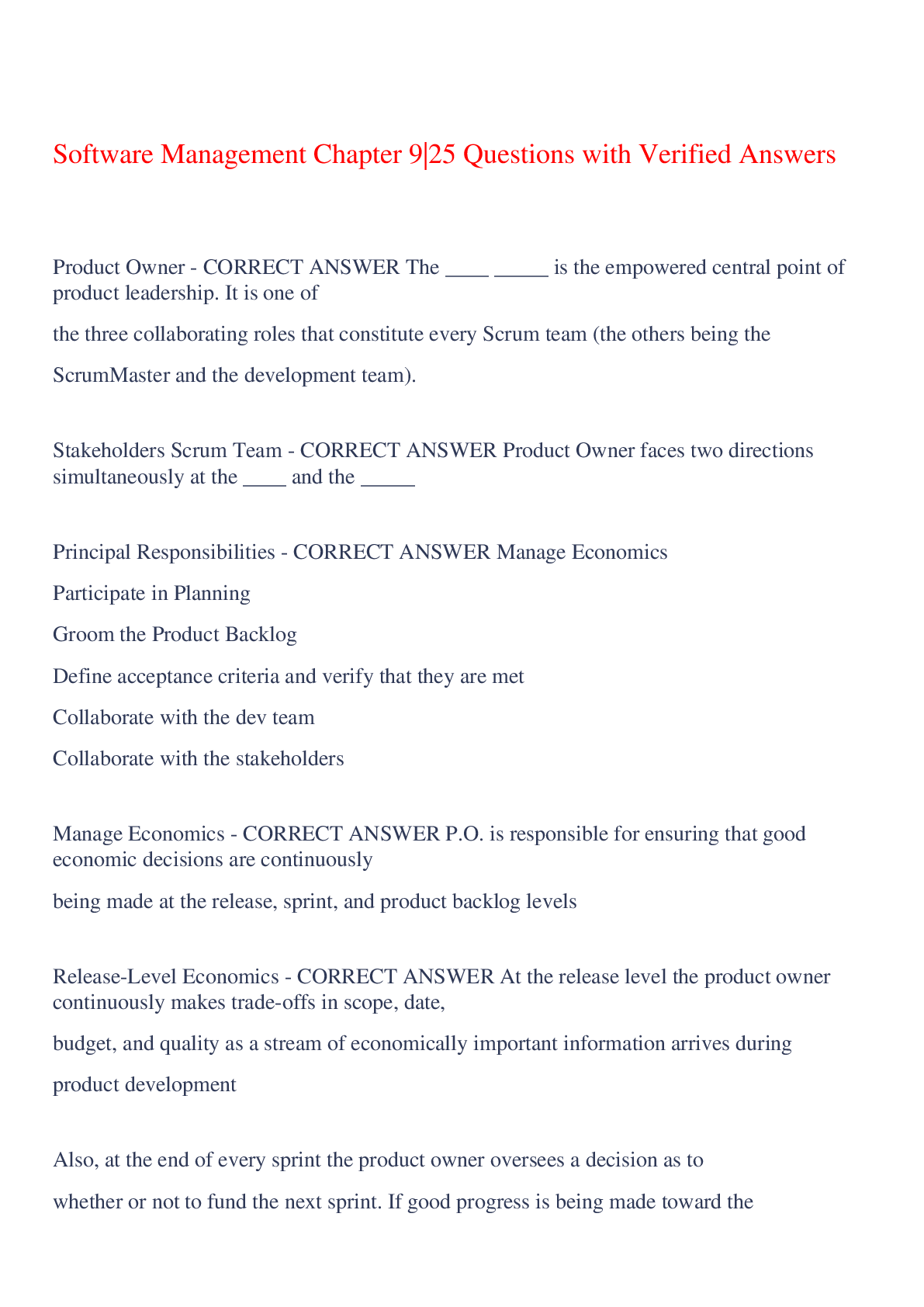
Software Management Chapter 9|25 Questions with Verified Answers
Product Owner - CORRECT ANSWER The ____ _____ is the empowered central point of product leadership. It is one of
the three collaborating roles that c
...
Software Management Chapter 9|25 Questions with Verified Answers
Product Owner - CORRECT ANSWER The ____ _____ is the empowered central point of product leadership. It is one of
the three collaborating roles that constitute every Scrum team (the others being the
ScrumMaster and the development team).
Stakeholders Scrum Team - CORRECT ANSWER Product Owner faces two directions simultaneously at the ____ and the _____
Principal Responsibilities - CORRECT ANSWER Manage Economics
Participate in Planning
Groom the Product Backlog
Define acceptance criteria and verify that they are met
Collaborate with the dev team
Collaborate with the stakeholders
Manage Economics - CORRECT ANSWER P.O. is responsible for ensuring that good economic decisions are continuously
being made at the release, sprint, and product backlog levels
Release-Level Economics - CORRECT ANSWER At the release level the product owner continuously makes trade-offs in scope, date,
budget, and quality as a stream of economically important information arrives during
product development
Also, at the end of every sprint the product owner oversees a decision as to
whether or not to fund the next sprint. If good progress is being made toward the
release goal or the next sprint is otherwise economically justified, the next sprint will
be funded. If poor progress is being made or the economics don't support additional
expenditures, the effort might be canceled.
Sprint-Level Economics - CORRECT ANSWER ensuring that a good return on investment (ROI) is delivered from each
sprint. Good product owners treat their organization's money as if it were their own
money. In most cases the product owner knows the cost of the next sprint (the duration and team composition of the sprint are known). With this knowledge the product
owner should ask himself at sprint planning, "Would I write a check out of my
own bank account equal to the cost of this sprint to get the features that we're planning
to build in this sprint?" If the answer is no, a good product owner wouldn't
spend the organization's money either.
Product Backlog Economics - CORRECT ANSWER responsible for prioritizing the
product backlog
Participate in Planning - CORRECT ANSWER The product owner is a key participant in the portfolio-, product-, release-, and
sprint-planning activities.
Groom the Product Backlog - CORRECT ANSWER The product owner oversees the grooming of the product backlog, which includes
creating and refining, estimating, and prioritizing product backlog items. The product owner doesn't personally perform all of the grooming work
The product owner also doesn't estimate the items
Define Acceptance Criteria and Verify That They Are Met - CORRECT ANSWER The product owner is responsible for defining the acceptance criteria for each product
backlog item. These are the conditions under which the product owner would
be satisfied that the functional and nonfunctional requirements have been met.
Collaborate with the Development Team - CORRECT ANSWER The product owner is an engaged, committed, everyday role. Many organizations
just starting to adopt Scrum fail to foster adequate product owner engagement
with the development team, delaying essential feedback and substantially reducing
the value of that feedback when it does occur.
Feature not Phase - CORRECT ANSWER Using Scrum, we build a feature at a time, not a phase at a time. This means that
we perform all activities to create a particular feature (design, code, integrate, test)
during one sprint.
Collaborate with the Stakeholders - CORRECT ANSWER The product owner is the single voice of the entire stakeholder community, internal
and external. Internal stakeholders can include business systems owners, executive
management, program management, marketing, and sales. External stakeholders
can include customers, users, partners, regulatory bodies, and others. The product
owner must work closely with the entire stakeholder community to gather input and
synthesize a coherent vision to guide product development.
Characteristics/Skills - CORRECT ANSWER Domain skills
People Skills
Decision Making
Accountability
Domain Skills - CORRECT ANSWER The product owner is a visionary who can synthesize a product vision and lead the
team to achieve that vision.
is a visionary
knows not everything can be anticipated
has business and domain expertise
People Skills - CORRECT ANSWER A product owner must also be the "voice of the customer," which requires a good
relationship with stakeholders. Because there are frequently multiple stakeholders
who could have conflicting needs, the product owner must also be a good negotiator and consensus builder.
Has a good relationship with stakeholders
Is a negotiator/consensus builder
Is a good communicator
Is a powerful motivator
Decision Making - CORRECT ANSWER The product owner must also be willing to make the hard decisions—usually by
trading off constraints like scope, date, and budget. These decisions must be made in
a timely manner and should not be reversed without good reason
IS empowered to make decisions
Is willing to make hard decisions
Is Decisive
Takes an economic view to balance business/technical issues
Accountability - CORRECT ANSWER The product owner is held accountable for delivering good business results
Accepts responsibility for the product
Is committed and available
Acts like a Scrum Team Member
Finally, the product owner is a member of the Scrum team and therefore realizes
that good economic results are impossible without the collaborative efforts of
the full Scrum team. So, the product owner treats the development team and Scrum-
Master with respect and trusts that they are partners in delivering the desired results.
A Day in the Life - CORRECT ANSWER Oversee Grooming -> product backlog
Participate in Sprint Planning
Answer Questions
Participate in Daily Scrum when possible
Review Features during sprint execution
Participate in Sprint Review and Retrospective
After these are completed, the sprint cycle repeats and the product owner participates in the next sprint-planning activity
product planning - CORRECT ANSWER where the product owner, working with appropriate stakeholders and others, will perform the envisioning of the new product.
At the completion of product planning, the proposed product will be submitted to portfolio planning, where it is subjected to the organization's economic filter
to determine if development will be funded and when work can begin.
In week 3 the product owner is engaged in initial release planning. This typically involves a PBI-writing (story-writing) workshop that includes internal stakeholders, the development team members,
and possibly external stakeholders to generate a high-level product backlog that can be used during release planning.
Next, the product owner facilitates an initial release-planning session (longer term planning).
Who Should Be a Product Owner? - CORRECT ANSWER Internal
development: Representative/customer from the business area
benefiting from the solution
Commercial
development: Internal proxy for the actual customers and users
(typically a product manager, product marketer, or
project manager)
Outsourced
development: Representative/customer from the company paying for
the solution and receiving the benefits
Component team
(architectural
development): Typically a technical person who can best prioritize the
backlog of technical items
Product Owner Combined with Other Roles - CORRECT ANSWER If capacity permits, the same person may act as the product owner for more than one
Scrum team.
Usually it is easier for this person to be the product owner of multiple teams on
the same development effort, because the work of these teams will most likely be
highly interrelated.
Although there are times when the same individual may be the product owner
and a member of the development team, it is considered a bad idea for the same person
to be both the product owner and the ScrumMaster on the same Scrum team.
These two roles counterbalance each other; having one person play both roles creates
a conflict of interest that we should try to avoid.
Same person as product owner of more than one Scrum team
Product Owner Team - CORRECT ANSWER Every Scrum team must have a single person who is identified as the product owner and is the only person empowered and accountable for fulfilling the product owner responsibilities for that Scrum team.
To properly apply Scrum, we need ONE individual to be the product owner, making decisions and acting as the single voice of the stakeholder communities to the
Scrum team.
Forming a product owner team in either of these circumstances is acceptable as long as there is one person on the team who is the ultimate decision maker and as long as having a product owner team does not degrade into design by committee, with every decision needing approval from eight other people.
Product Owner Proxy - CORRECT ANSWER is a person enlisted by the product owner to act on his
behalf in particular situations. Everyone on the Scrum team knows that the proxy is not the actual product owner, but everyone also knows that the product owner has empowered the proxy to make at least some tactical decisions on his behalf.
Chief Product Owner - CORRECT ANSWER is the product owner for the whole product. However, the chief product owner has a team of product owners to ensure that the product owner role is filled correctly at each lower level in the hierarchy. If you choose to use this approach, ensure that the individual team
product owners remain empowered to make the vast majority of the decisions at their levels, rather than having to pass such decisions up the hierarchy to be made at higher levels.
[Show More]



![Preview of eBook [PDF] Barash, Cullen, and Stoelting's Clinical Anesthesia 9th Edition By Bruce F. Cu](https://browseimages.nyc3.digitaloceanspaces.com/paper-images/2024/Aug/29/8DF2QRTq2024-08-29-10-3966d0259b7c4b5.png)
![Preview of eBook [PDF] Fundamentals of Nursing 3rd Edition By Joanne Tollefson, Sue C. DeLaune, Patri](https://browseimages.nyc3.digitaloceanspaces.com/paper-images/2024/Aug/26/U6SQ8mmq2024-08-26-01-4766cc5d40d7385.png)
![Preview of eBook [PDF] Burns' Pediatric Primary Care 7th Edition BY Dawn Lee Garzon Maaks,, Nancy Bar](https://browseimages.nyc3.digitaloceanspaces.com/paper-images/2024/Aug/26/WR2rowXX2024-08-26-02-0966cc625bea839.png)