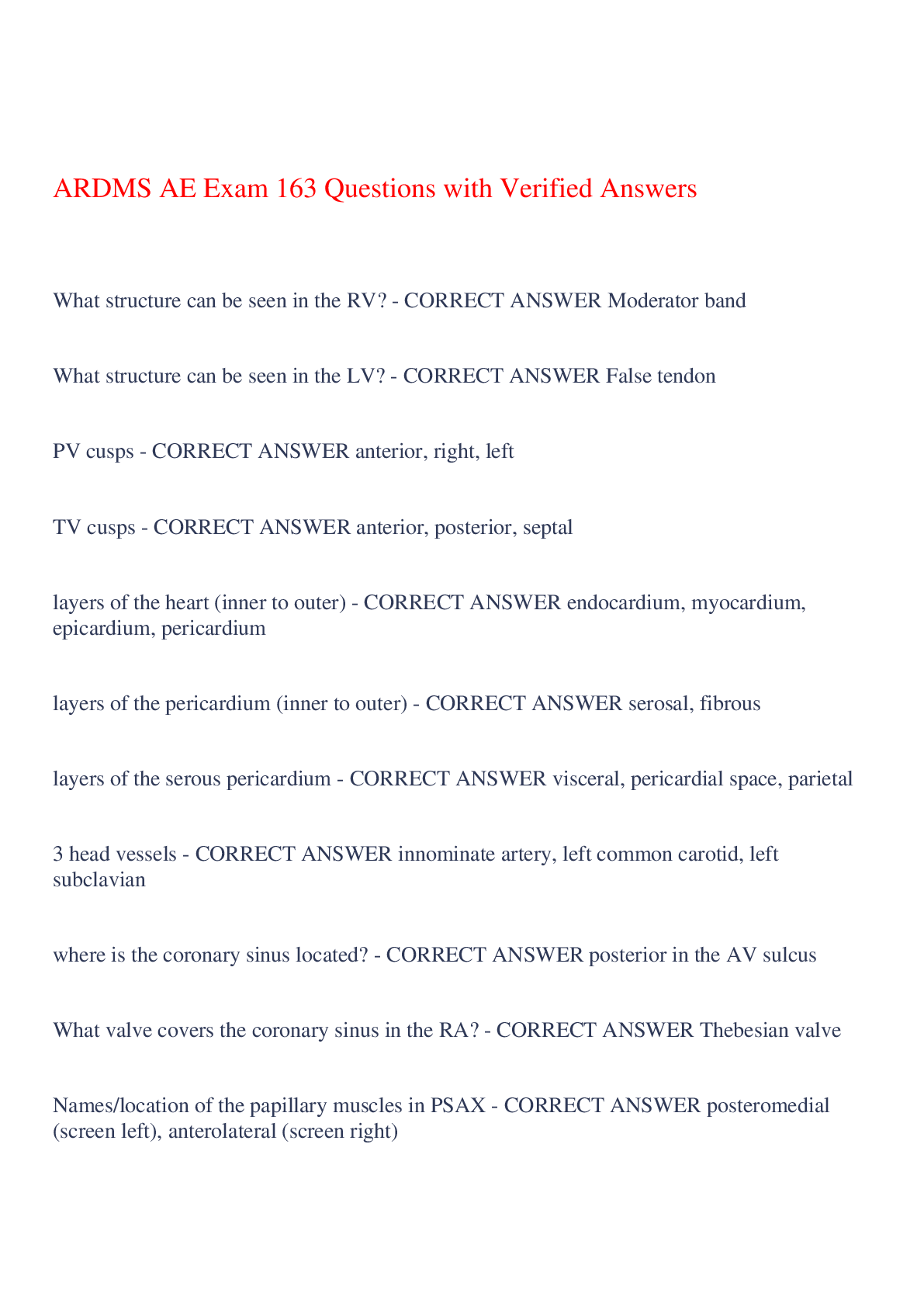
ARDMS AE Exam 163 Questions with Verified Answers
What structure can be seen in the RV? - CORRECT ANSWER Moderator band
What structure can be seen in the LV? - CORRECT ANSWER False tendon
PV cusps - CORRECT AN
...
ARDMS AE Exam 163 Questions with Verified Answers
What structure can be seen in the RV? - CORRECT ANSWER Moderator band
What structure can be seen in the LV? - CORRECT ANSWER False tendon
PV cusps - CORRECT ANSWER anterior, right, left
TV cusps - CORRECT ANSWER anterior, posterior, septal
layers of the heart (inner to outer) - CORRECT ANSWER endocardium, myocardium, epicardium, pericardium
layers of the pericardium (inner to outer) - CORRECT ANSWER serosal, fibrous
layers of the serous pericardium - CORRECT ANSWER visceral, pericardial space, parietal
3 head vessels - CORRECT ANSWER innominate artery, left common carotid, left subclavian
where is the coronary sinus located? - CORRECT ANSWER posterior in the AV sulcus
What valve covers the coronary sinus in the RA? - CORRECT ANSWER Thebesian valve
Names/location of the papillary muscles in PSAX - CORRECT ANSWER posteromedial (screen left), anterolateral (screen right)
which walls does the LAD supply? - CORRECT ANSWER Left and right anterior walls and superior septum
which walls does the left circumflex supply? - CORRECT ANSWER left lateral and inferior walls
which walls does the right posterior descending supply? - CORRECT ANSWER left and right posterior walls and inferior septum
which walls does the right marginal supply? - CORRECT ANSWER RV free wall
which walls does the right SVC branch supply? - CORRECT ANSWER posterior RA and SA node
what layer of the heart do the coronary arteries run through? - CORRECT ANSWER epicardium
4 chamber LV wall segments - CORRECT ANSWER basal inferoseptum, mid inferoseptum, apical septum, apex, apical lateral, mid anterolateral, basal anterolateral
2 chamber LV wall segments - CORRECT ANSWER basal inferior, mid inferior, apical inferior, apex, apical anterior, mid anterior, basal anterior
3 chamber LV wall segments - CORRECT ANSWER basal inferolateral, mid inferolateral, apicsl lateral, apex, apical anterior, mid anteroseptum, basal anteroseptum
PSAX mid/basal LV wall segments (12 o'clock clockwise) - CORRECT ANSWER anterior, anterolateral, inferolateral, inferior, inferoseptum, anteroseptum
PSAX apex LV wall segments (12 o'clock clockwise) - CORRECT ANSWER anterior, lateral, inferior, septal
3 factors of stroke volume - CORRECT ANSWER preload, contractility, afterload
preload - CORRECT ANSWER volume and pressure in LV at end diastole
afterload - CORRECT ANSWER resistance the ventricles encounters during systole (aortic pressure)
frank-starlings law - CORRECT ANSWER myocardial contractile force is proportional to myocardial fiber length
a pressure overload will lead to what? - CORRECT ANSWER hypertrophy
a volume overload will lead to what? - CORRECT ANSWER dilation
normal aortic root measurement - CORRECT ANSWER 2-4 cm
normal aortic cusp separation measurement - CORRECT ANSWER 1.5-2.6 cm
normal LA diameter measurement - CORRECT ANSWER <= 4 cm
normal LA volume measurement - CORRECT ANSWER <20 cm^2
normal LVIDd measurement - CORRECT ANSWER 3.7-5.7 cm
normal LVIDs measurement - CORRECT ANSWER 2.8-3.8 cm
normal IVS measurement - CORRECT ANSWER .6-1.1 cm
normal posterior LV wall measurement - CORRECT ANSWER .6-1.1 cm
phases of the cardiac cycle - CORRECT ANSWER passive filling (early diastole), atrial contraction (late diastole), isovolumetric contraction, ventricular systole, isovolumetric relaxation
when does S3 occur? - CORRECT ANSWER passive filling (early diastole)
when does S4 occur? - CORRECT ANSWER atrial contraction (late diastole)
when does S1 occur? - CORRECT ANSWER isovolumetric contraction
when does S2 occur? - CORRECT ANSWER isovolumetric relaxation
LV EF methods - CORRECT ANSWER Teicholtz, Area-length, modified Simpson's
Teicholtz - CORRECT ANSWER uses m-mode dimensions to calculate EF
area-length - CORRECT ANSWER uses LV diameter to calculate EF
modified Simpson's - CORRECT ANSWER uses planimetry for LV volumes to calculate EF
FS equation - CORRECT ANSWER (ED-ES)/ED x 100% (internal diameter)
normal FS% - CORRECT ANSWER >25%
EF equation - CORRECT ANSWER (ED-ES)/ED x 100% (volumes)
normal EF% - CORRECT ANSWER >55%
Mild AS (valve area, velocity, pressure) - CORRECT ANSWER 1.5-2 cm^2, 2.5-3 m/s, <25 mmHg
Mod AS (valve area, velocity, pressure) - CORRECT ANSWER 1.0-1.5 cm^2, 3-4 m/s, 25-40 mmHg
Severe AS (valve area, velocity, pressure) - CORRECT ANSWER .6-1 cm^2, >4 m/s, >40 mmHg
normal MV area - CORRECT ANSWER 4-6 cm^2
Mild MS (valve area, pressure, PA pressure) - CORRECT ANSWER >1.5 cm^2, <5 mmHg, < 30mmHg
Mod MS (valve area, pressure, PA pressure) - CORRECT ANSWER 1-1.5 cm^2, 5-10 mmHg, 30-50 mmHg
Severe MS (valve area, pressure, PA pressure) - CORRECT ANSWER <1.0 cm^2, >10 mmHg, >50 mmHg
clenching fist - CORRECT ANSWER acute increase BP, increase HR, increase CO; decrease AS, increase MR
amyl nitrate - CORRECT ANSWER decrease BP, increase HR, decrease venous return, increase CO, increase SV; decrease AI, decrease MR
valsalva - CORRECT ANSWER increase BP, decrease HR, decrease venous return, decrease CO, decrease SV; increase IHSS
exercise - CORRECT ANSWER increase BP, increase HR, increase CO
inspiration - CORRECT ANSWER increases venous return, decrease MV velocity
expiration - CORRECT ANSWER decreases venous return
standing - CORRECT ANSWER decreases venous return, decreases SV
which valve is least affected by rheumatic fever? - CORRECT ANSWER PV
which type of stenosis is most common? - CORRECT ANSWER AS
what is a typical sign of MS? - CORRECT ANSWER hockey stick sign
pressure half time - CORRECT ANSWER time it takes the peak gradient to become half
PHT equation using MV decel time - CORRECT ANSWER PHT = decel time x .29
pressure half time equation for finding MV area - CORRECT ANSWER MV area = 220/PHT
normal PHT - CORRECT ANSWER 30-90 msec
mild MS by PHT - CORRECT ANSWER 90-150 msec
mod MS by PHT - CORRECT ANSWER 150-219 msec
severe MS by PHT - CORRECT ANSWER >220 msec
mild MR by PISA - CORRECT ANSWER <= .1 ERO
mod MR by PISA - CORRECT ANSWER .2-.3 ERO
severe MR by PISA - CORRECT ANSWER >.4 ERO
mild MR by vena contracta - CORRECT ANSWER <3 mm
moderate MR by vena contracta - CORRECT ANSWER 4-6 mm
severe MR by vena contracta - CORRECT ANSWER >7 mm
what is an indicator of severe MR? - CORRECT ANSWER systolic flow reversal in the Pulm veins
what's MVP also known as? - CORRECT ANSWER Barlow's syndrome, systolic click syndrome
which leaflet is more commonly affected in MVP? - CORRECT ANSWER posterior
2 types of MVP - CORRECT ANSWER holo-systolic, mid-systolic
continuity equation - CORRECT ANSWER LVOT area/LVOT velocity = AV area/AS velocity
what is the continuity equation usually used to grade? - CORRECT ANSWER degree of AS
how do you find the LVOT area given the LVOT diameter? - CORRECT ANSWER LVOT area = pir^2 (r=d/2)
a steep slope signifies worse _____ - CORRECT ANSWER AI
a steep slope signifies better _____ - CORRECT ANSWER MS
mild AI by PHT - CORRECT ANSWER >500 msec
mod AI by PHT - CORRECT ANSWER 250-500 msec
severe AI by PHT - CORRECT ANSWER <250 msec
equation for RVSP? - CORRECT ANSWER 4 (TR) ^2 + RA pressure
mild PS (velocity, pressure) - CORRECT ANSWER <3 m/s, <36 mmHg
mod PS (velocity, pressure) - CORRECT ANSWER 3-4 m/s, 36-64 mmHg
severe PS (velocity, pressure) - CORRECT ANSWER >4 m/s, >64 mmHg
normal MV decel time - CORRECT ANSWER <220 msec
6 conditions to do a TEE - CORRECT ANSWER prosthetic valve, aortic dissection, endocarditis, embolism, suboptimal TTE, other
6 safety problems of TEE - CORRECT ANSWER pt discomfort, airway compromise, vagal response, electrical/temperature, esophageal/tracheal trauma, infection
at what temperature is it unsafe to use TEE - CORRECT ANSWER 40-45 degrees C
how does depolarization move through the heart layers? - CORRECT ANSWER endo-epi
how does coronary perfusion move through the heart layers? - CORRECT ANSWER epi-endo
what is a normal QRS duration? - CORRECT ANSWER .1 sec
what is a normal PR interval? - CORRECT ANSWER <.2 sec
what factors increase preload? - CORRECT ANSWER MR, TR, PI, AI, ASD, VSD, PDA, any volume overload
what factors increase afterload? - CORRECT ANSWER AS, PS, HTN
what is a normal SV? - CORRECT ANSWER 70-110 mL
SV equation using Doppler - CORRECT ANSWER VTI x CSA
when on ekg does isovolumetric contraction occur? - CORRECT ANSWER after R wave
when on ekg does isovolumetroc relaxation occur? - CORRECT ANSWER after T wave
how long do isovolumetric contraction and relaxation last? - CORRECT ANSWER 70 msec
how much less is right sided pressure than left? - CORRECT ANSWER 1/5
what will AS eventually lead to? - CORRECT ANSWER LVH and increased LA pressure
pulse pressure - CORRECT ANSWER difference between systolic and diastolic pressures
takayasu arteritis - CORRECT ANSWER aortic arch syndrome
equation for peak LVSP - CORRECT ANSWER 4 (AV) ^2 + systolic BP
when should you use VTI - CORRECT ANSWER decreased LV function, mod-severe AI
which are higher, echo or cath gradients? - CORRECT ANSWER echo
what murmur is heard with AI - CORRECT ANSWER diastolic blow murmur
what is a normal LV dp/dt? - CORRECT ANSWER >1200 msec
how big do vegetations need to be to be seen on echo? - CORRECT ANSWER => 3 mm
pannus - CORRECT ANSWER host-tissue over growth
2 types of valve replacements - CORRECT ANSWER mechanical valves, bioprosthetic valves
types of mechanical valves - CORRECT ANSWER ball and cage (starr-edwards), caged disc (beall-surgitool, kay-suzuki), tilting disc (bjork-shilley, lillehei-kaster), bileaflet tilting discs (st. jude)
types of bioprosthetic valves - CORRECT ANSWER heterograft (hancock, carpentier-edwards), homograft, autograft
characteristics of mechanical valves - CORRECT ANSWER require blood thinners, do not need to be replaced
characteristics of bioprosthetic valves - CORRECT ANSWER replaced every 10-15 years, always has 3 leaflets
type of valve repair - CORRECT ANSWER carpentier ring
venturi effect - CORRECT ANSWER modifiction of Bernoulli principle for HCM
LVOT obstruction causes what to happen to the AV? - CORRECT ANSWER premature closure
chagas' disease - CORRECT ANSWER posterior/apical thinning but normal septum
where is the oblique sinus of the pericardium located? - CORRECT ANSWER posterior to LA in PLAX
pulsus alternans - CORRECT ANSWER systolic dysfunction with LV dilated cardiomyopathy
beck's triad - CORRECT ANSWER increased venous pressure, decreased BP, increased HR
RA pressure, normal IVC w/ collapse - CORRECT ANSWER 10 mmHg
RA pressure, dilated IVC >2 cm w/ 50% collapse - CORRECT ANSWER 15 mmHg
RA pressure, dilated IVC >2cm w/o collapse - CORRECT ANSWER 20 mmHg
indications for stress echo - CORRECT ANSWER diagnosing CP, CAD, arrythmias
how many days for the heart to develop in embyology? - CORRECT ANSWER 43
when does the truncus divide in utero? - CORRECT ANSWER day 31
most common location for a pseudoaneurysm? - CORRECT ANSWER basal inferior
most common primary malignant cardiac tumor, most often seen in the RA - CORRECT ANSWER angiosarcoma
LA myxomas are usually attached to where? - CORRECT ANSWER IAS
the PV leaflet most commonly recorded by Mmode is? - CORRECT ANSWER left
during what phase will the IVS flatten with RV volume overload? - CORRECT ANSWER diastole
Mean velocity of circumferential fiber shortening (Vcfm) - CORRECT ANSWER determines the rate of change of left ventricular circumference in systole relative to its circumference at end-diastole
Normal Vcfm - CORRECT ANSWER 1.02 to 1.94 circumferences per second
The pressure obtained by a pulmonary artery wedge reflects the pressure in the: - CORRECT ANSWER left atrium
which maneuvers increase MVP? - CORRECT ANSWER any maneuver that decreases venous return
Which M mode finding is considered to be a specific indicator of a fenestrated AV - CORRECT ANSWER diastolic flutter of the aortic valve
The premature opening of the pulmonary valve may be seen in - CORRECT ANSWER Constrictive Pericarditis
A patient is sent to the echo lab with the diagnosis of constrictive pericarditis. You perform a contrast study to look for - CORRECT ANSWER presystolic appearance of contrast in the IVC
A pt is referred to the echo lab because of positional and respiratory variation in chest pain, Which of the disease are they likely to have - CORRECT ANSWER Pericarditis
A pt with has a higher BP in the right arm than the left may have - CORRECT ANSWER coarctation of the aorta
Type of murmur associated with AI - CORRECT ANSWER Austin Flint
Dressler's syndrome - CORRECT ANSWER A delayed form of pericarditis, occurs after 1-12 weeks after an MI
on M mode the aorta is measured at - CORRECT ANSWER end systole
diastasis - CORRECT ANSWER The slow filling phase of diastole
Symp of MVP - CORRECT ANSWER Palpitations, sharp pain unrelated to exercise. Fatigue, dyspnea. Dizzy spells. Can cause turbulent flow of blood in the aorta, increase in CO.
The DeBakey classification divides dissections into 3 types, as follows: - CORRECT ANSWER Type I involves the ascending aorta, aortic arch, and descending aorta.
Type II is confined to the ascending aorta.
Type III is confined to the descending aorta distal to the left subclavian artery.
grade 1 diastolic dysfunction - CORRECT ANSWER impaired relaxation, reduced E an increased A, increased decel time, normal pulm venous flow, reduced E'
grade 2 diastolic dysfunction - CORRECT ANSWER pseudonormal, normal E/A ratio, do valsalva to reverse E and A, elevated D wave in pulm vein, decreased E', E/E' >15
grade 3 diastolic dysfunction - CORRECT ANSWER restrictive filling, severely increased E wave, very short decel time, low A velocity, tall D wave and barely an S wave in pulm venous flow, E' velocity is low, E/E' >15
LA pressure using MV inflow and TDI - CORRECT ANSWER LA pressure = E/E' + 4 mmHg
[Show More]



![Preview of eBook [PDF] Barash, Cullen, and Stoelting's Clinical Anesthesia 9th Edition By Bruce F. Cu](https://browseimages.nyc3.digitaloceanspaces.com/paper-images/2024/Aug/29/8DF2QRTq2024-08-29-10-3966d0259b7c4b5.png)
![Preview of eBook [PDF] Burns' Pediatric Primary Care 7th Edition BY Dawn Lee Garzon Maaks,, Nancy Bar](https://browseimages.nyc3.digitaloceanspaces.com/paper-images/2024/Aug/26/WR2rowXX2024-08-26-02-0966cc625bea839.png)



![Preview of eBook [PDF] AACN Essentials of Progressive Care Nursing 5th Edition By Sarah A. Delgado](https://browseimages.nyc3.digitaloceanspaces.com/paper-images/2024/Aug/29/ipbdJSTN2024-08-29-11-1466d02df30fc96.png)


![Preview of [eTextbook] [PDF] Labor Economics 9th Edition By George Borjas](https://browseimages.nyc3.digitaloceanspaces.com/paper-images/2025/Jan/13/JcsHZtUb2025-01-13-07-42678542822cb77.png)