NURSING > EXAM > Clinical Annual Competency Exam - Fresenius (Complete Answered 2022/2023 guide) (All)
Clinical Annual Competency Exam - Fresenius (Complete Answered 2022/2023 guide)
Document Content and Description Below
Last updated: 3 years ago
Preview 1 out of 5 pages
Instant download

Buy this Document to get the Full Access Instantly
Provided by Students Who Aced it
We Verify Document Content to Gurantee Accuracy
Reviews( 0 )
Document information
Connected school, study & course
About the document
Uploaded On
Aug 30, 2023
Number of pages
5
Written in
All

Additional information
This document has been written for:
Uploaded
Aug 30, 2023
Downloads
0
Views
90
Topic Tags
Recommended For You
Get more on EXAM »
Introductory Clinical Pharmacology 11th Edition Ford Nursing T...

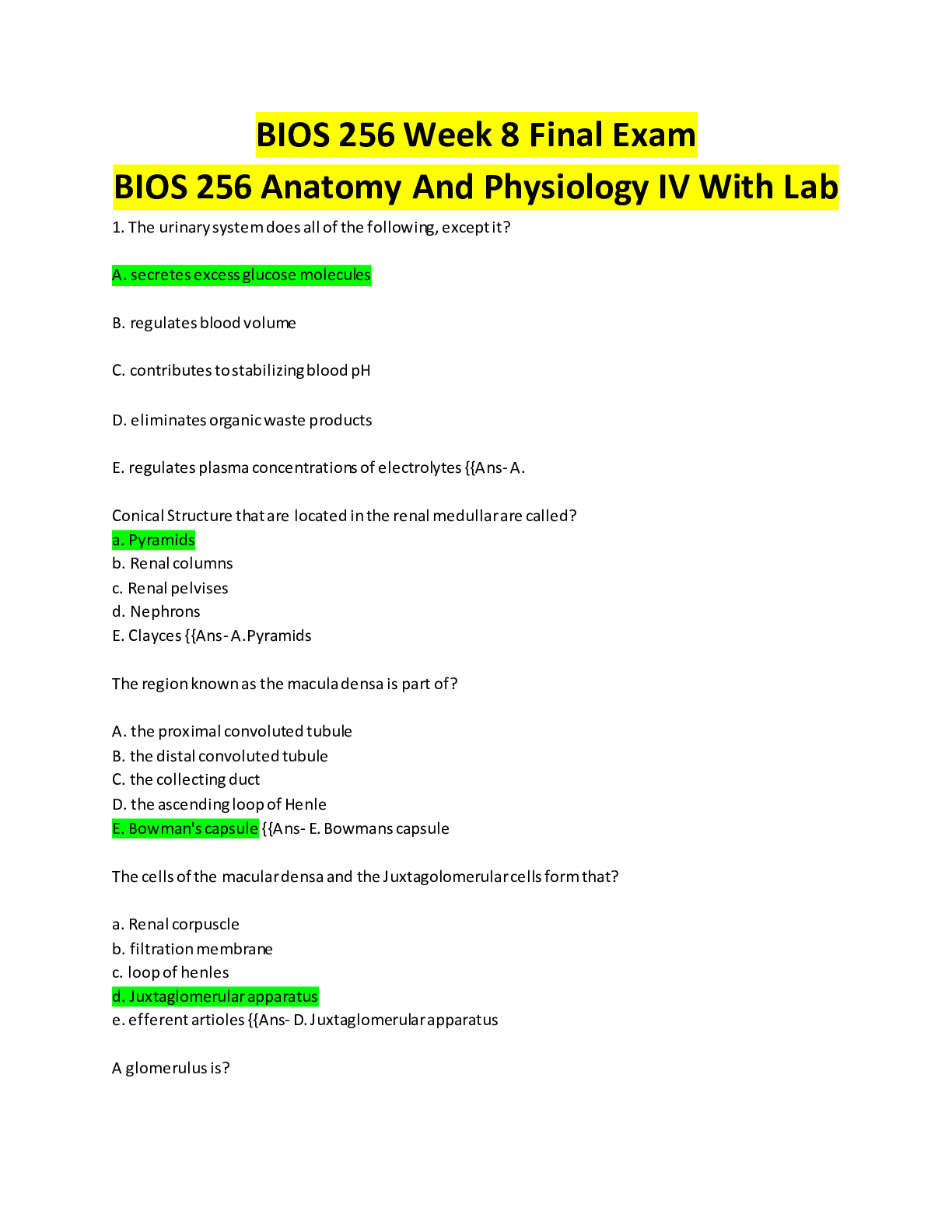
BIOS 256 Week 8 Final Exam BIOS 256 Anatomy And Physiology IV...

NREMT EMT Cognitive Final Exam Questions correctly Answered 20...


Prophecy Assessments - Core Mandatory Part I Answered 2022/202...

Prophecy Assessments - Core Mandatory Part I Answered 2022
.png)
Answered 2022 Prophecy RN Pharmacology A (2) with complete sol...

Medical-Surgical RN A Prophecy Relias Test, Answered 2022
Certified Postanesthesia Nurse CPAN Exams Answered 2022..pdf
Prophecy Assessments - Core Mandatory Part I Answered 2022


NUR 321 VCE #5 Fluid and Electrolyte Balance QUESTIONS AND ANS...
NUR 321 VCE # 1 Lesson 3- Critical Thinking in Nursing Practic...
.png)