FP&A Interview Questions
Walk me through the three financial statements. - ✔✔
- The balance sheet shows a company's assets, liabilities, and shareholders' equity, and is a
snapshot in time.
- income statement: outlin
...
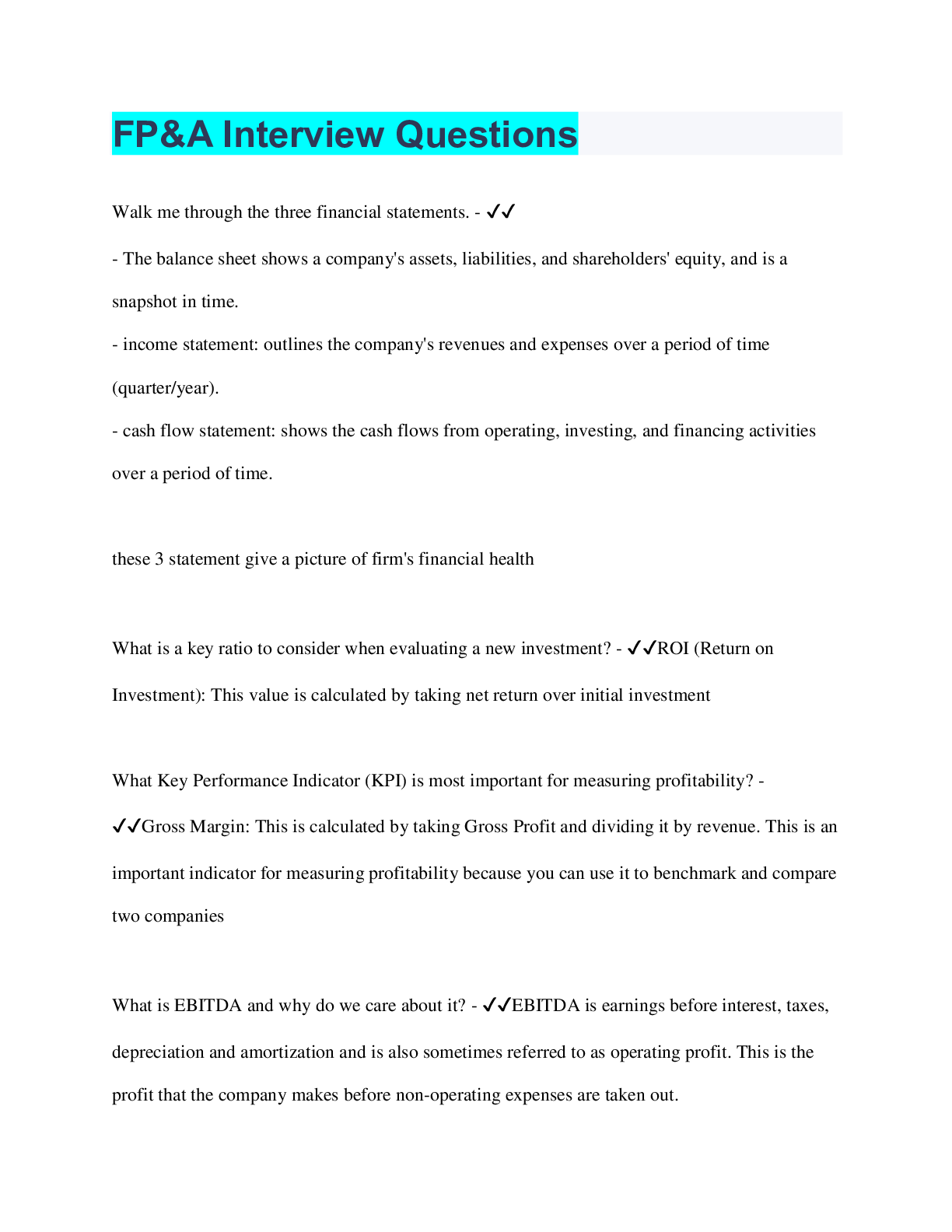
FP&A Interview Questions
Walk me through the three financial statements. - ✔✔
- The balance sheet shows a company's assets, liabilities, and shareholders' equity, and is a
snapshot in time.
- income statement: outlines the company's revenues and expenses over a period of time
(quarter/year).
- cash flow statement: shows the cash flows from operating, investing, and financing activities
over a period of time.
these 3 statement give a picture of firm's financial health
What is a key ratio to consider when evaluating a new investment? - ✔✔ROI (Return on
Investment): This value is calculated by taking net return over initial investment
What Key Performance Indicator (KPI) is most important for measuring profitability? -
✔✔Gross Margin: This is calculated by taking Gross Profit and dividing it by revenue. This is an
important indicator for measuring profitability because you can use it to benchmark and compare
two companies
What is EBITDA and why do we care about it? - ✔✔EBITDA is earnings before interest, taxes,
depreciation and amortization and is also sometimes referred to as operating profit. This is the
profit that the company makes before non-operating expenses are taken out.
Where do you see Dividends on the income statement? - ✔✔YOU DONT! You see this on the
shareholders equity statement. Dividends are not an expense, they are a distribution of previously
existing equity
If Accounts Receivable (AR) keeps going up, what could the driver be? - ✔✔Could be a
collection problem: if the company is not collecting its AR on time, then the AR will continue to
build up on the balance sheet. Another reason could be sales growth: if your company keeps
growing sales, the AR will also continue to rise
Why do you want to be a financial analyst? - ✔✔I love working with numbers to understand the
financial implications of a decision. Knowing the implications will help me guide business
managers toward educated and responsible business decisions.
What is the current ratio? - ✔✔current assets divided by current liabilities. Measures a
company's ability to fulfill short-term financial obligations
What is the quick ratio? - ✔✔(Current Assets - Inventory) / Current Liabilities. Measures a
companys ability to meet short term financial obligations without inventory
What line item appears on all three financial statements? - ✔✔Net Income or Depreciation
Expense
If you have only one financial statement to choose which one are you taking to understand the
most about the business? - ✔✔Statement of Cash Flows - If you look at the Income statement
alone, you won't be able to tell what the cash position/debt that the company carries. If you look
at the balance sheet alone, you can tell the cash position but you can't tell the actual health or
performance in terms of profitability. Statment of cash flows has everything you need: it begins
with Net Income and then goes on to detail cash from each of the activities
What is Working Capital and why is it negative sometimes? - ✔✔Working Capital is Current
Assets - Current Liabilities. Sometimes it goes negative because you could be collecting your
AR faster than you are paying you AP meaning that you are efficient in collecting your cash.
What is the impact on income if inventory goes up by $10? - ✔✔NOTHING! When you buy
inventory you are not impacting income you are simply debiting inventory and crediting cash
How does an inventory write-down affect the three statements? - ✔✔- on BS, asset account of
inventory is reduced by amount of write-down so is shareholder equity
- income statement affected: add expense under COGS or as separate line item, reduce net
income by amount of write-down
- on cash flow statement, write down is added back to cash from Op, as its a non-cash expense
but must not be double counted in ∆s in non-cash WC
How do you record PP&E and why is this important? - ✔✔Four areas when accounting for
PP&E
1. initial purchase
2. depreciation
3. capex
4. disposal
For many businesses, PP&E can be the main capital asset that generates revenue, profitability,
and cash flow
If you were CFO of our company, what would keep you up at night? - ✔✔
What does it take to be a great FP&A analyst? - ✔✔We believe there are three important
qualities: analytics, presentation, and soft skills
What are the hallmarks of a good FP&A financial model? - ✔✔- main objective of the FP&A
department: measure historical performance, evaluate future business needs, highlight issues and
strengths of business, communicate financial info to management, instill confidence in quality of
info presented
What's the difference between budgeting and forecasting? - ✔✔-budget: set a plan for future.
-> collaborative process, typically set once per year, and is static (unless it's a rolling budget).
- forecasting: creating an estimate of what will actually happen.
-> based on incoming data and sets the most probable expectation of what will transpire, and is
typically updated once a quarter.
How do you create a rolling budget or forecast model? - ✔✔-monthly rolling forecast: input the
historical data that comes in each month at the front of the model and extend a forecast out
beyond that.
-when you need to add a new month, it should be at the end of the model
- The model "rolls over" every month (or whatever time period is used) by extending the model
out one column.
How do you model revenues for a company? - ✔✔Approach that I have used:
- A year-over-year approach involves taking last year's revenue and increasing it or decreasing it
by a certain percentage.
Other approaches:
-A bottom-up approach: starting with individual products/services, estimating average prices/fees
per product or service and then growth rates.
-Top-down: starting with the overall market size, estimating a company's market share, and then
translating that into revenue.
How do you model operating expenses for a company? - ✔✔- typically op expense move in line
with revenues
- thus, models forecast op expense as % of revenues
- important to separate FC and VC and model appropriately
- FC should only ∆ in steps whereas VC is a function of revenue
How do you model working capital for a company? - ✔✔- WC- AR, inventory, and AP
- these items modeled to match what is happening with revenues and cost of sale by using
turns/days ratios
- e.g. we could look at historic r/s between Rev and AR by calculating receivable days
- next we'd forecast receivables days
What are the hallmarks of a good Excel model? - ✔✔- important to have strong fin modeling
fundamentals
- model assumptions (inputs) should be in one place and distinctly colored (bank models
typically use blue font for model inputs).
- Good Excel models also make it easy for users to understand how inputs are translated into
outputs.
- include error checks to ensure the model is working correctly
What makes a "good" budget? - ✔✔- one that has buy-in from all departments in the company (if
possible), is realistic, yet strives for achievement, has been risk-adjusted to allow for a margin of
error, and is tied into the company's overall strategic plan.
How would you become an excellent FPA analyst? - ✔✔1. analytics: have a good working
knowledge and application to master this skill
2. presentation: important to interpret data to key people of org
3. soft skill: ability to say things clearly and to have good interpersonal skills
What is your favor financial modeling methodology? - ✔✔
Example of assets for UL: - ✔✔Current assets
- cash & cash eq
- patient AR, net
- prepaid expenses
PPE
- leasehold
- furniture, fixture, eq
Goodwill
Intangible assets
Give examples of Current liabilities - ✔✔- current portion of long-term debt
- AP
- Accrued payroll and other
Example of operating expenses - ✔✔- Salaries and benefits
- Lab fees and dental supplies
- Office occupancy and facility changes
- D&A
- General and admin
- MN Care tax
Example of nonoperating activities - ✔✔- interest and other income
- interest expense
[Show More]