HSCO 506 Exam 1
• Question 1
5 out of 5 points
The lecture emphasized that different generations typically have different worldviews. If we are counseling someone just coming into adulthood in the 21st century,
...
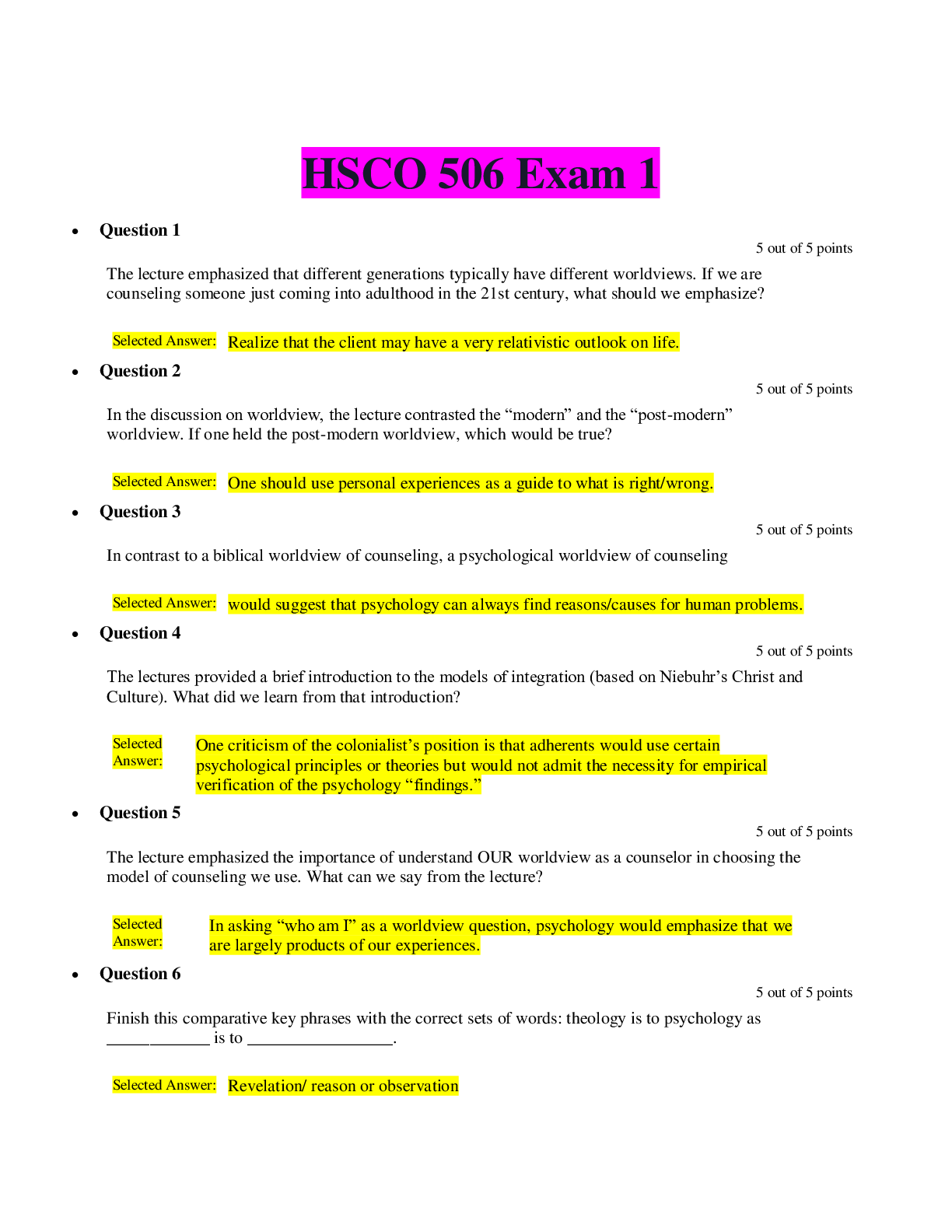
HSCO 506 Exam 1
• Question 1
5 out of 5 points
The lecture emphasized that different generations typically have different worldviews. If we are counseling someone just coming into adulthood in the 21st century, what should we emphasize?
• Question 2
5 out of 5 points
In the discussion on worldview, the lecture contrasted the “modern” and the “post-modern” worldview. If one held the post-modern worldview, which would be true?
• Question 3
5 out of 5 points
In contrast to a biblical worldview of counseling, a psychological worldview of counseling
• Question 4
5 out of 5 points
The lectures provided a brief introduction to the models of integration (based on Niebuhr’s Christ and Culture). What did we learn from that introduction?
• Question 5
5 out of 5 points
The lecture emphasized the importance of understand OUR worldview as a counselor in choosing the model of counseling we use. What can we say from the lecture?
• Question 6
5 out of 5 points
Finish this comparative key phrases with the correct sets of words: theology is to psychology as ____________ is to _________________.
• Question 7
5 out of 5 points
The lectures explain that ways of knowing (epistemologies) can be limited. What is a true statement based on that discussion?
• Question 8
5 out of 5 points
Christian counseling, based in theology, would identify sin as ultimately behind human problems. In contrast, psychology would emphasize
• Question 9
5 out of 5 points
The lectures talked about worldview. A worldview is
• Question 10
5 out of 5 points
If we are trying to distinguish what “Christian” counseling is (vs. secular counseling), which statement is true from the lecture?
• Question 11
5 out of 5 points
If I am following the “earmarks” of integration laid out in the lectures, which of the following would I demonstrate?
• Question 12
5 out of 5 points
In arguing for the value of integration, the lectures suggested the following:
• Question 13
5 out of 5 points
Why are self-awareness and humility so important in integrative counseling?
• Question 14
5 out of 5 points
The lecture emphasized that the way we interpret behavior has a lot to do with our worldview, and a lot to do with our expectations of our clients. What is true based on the lecture discussion?
• Question 15
5 out of 5 points
For the Christian counselor, epistemology, according to the lecture
• Question 16
5 out of 5 points
From the lecture discussion on ways of knowing truth, what can we say?
• Question 17
5 out of 5 points
“Imago Dei” is an important concept in the study of integration, and was mentioned in the lectures. This term refers to
• Question 18
5 out of 5 points
The lecture talked about levels of integration. What is an incorrect statement from that discussion?
• Question 19
0 out of 5 points
The lectures talked about the “two books” concept. What is a true statement from that lecture?
• Question 20
5 out of 5 points
The lectures in week one referred to Jay Adams (the founder of Nouthetic counseling) when discussing the biblical foundation/worldview of Christian counseling. What did the lecture emphasize in that discussion, based on Adam’s perspective?
[Show More]