PLSC 1 exam 2 (Sentementes spring)
A system of jurisprudence in which authoritative documents determine how the law is to be
interpreted is called - ✔✔civil law
Under this system, legal codes and statutes (and not jud
...
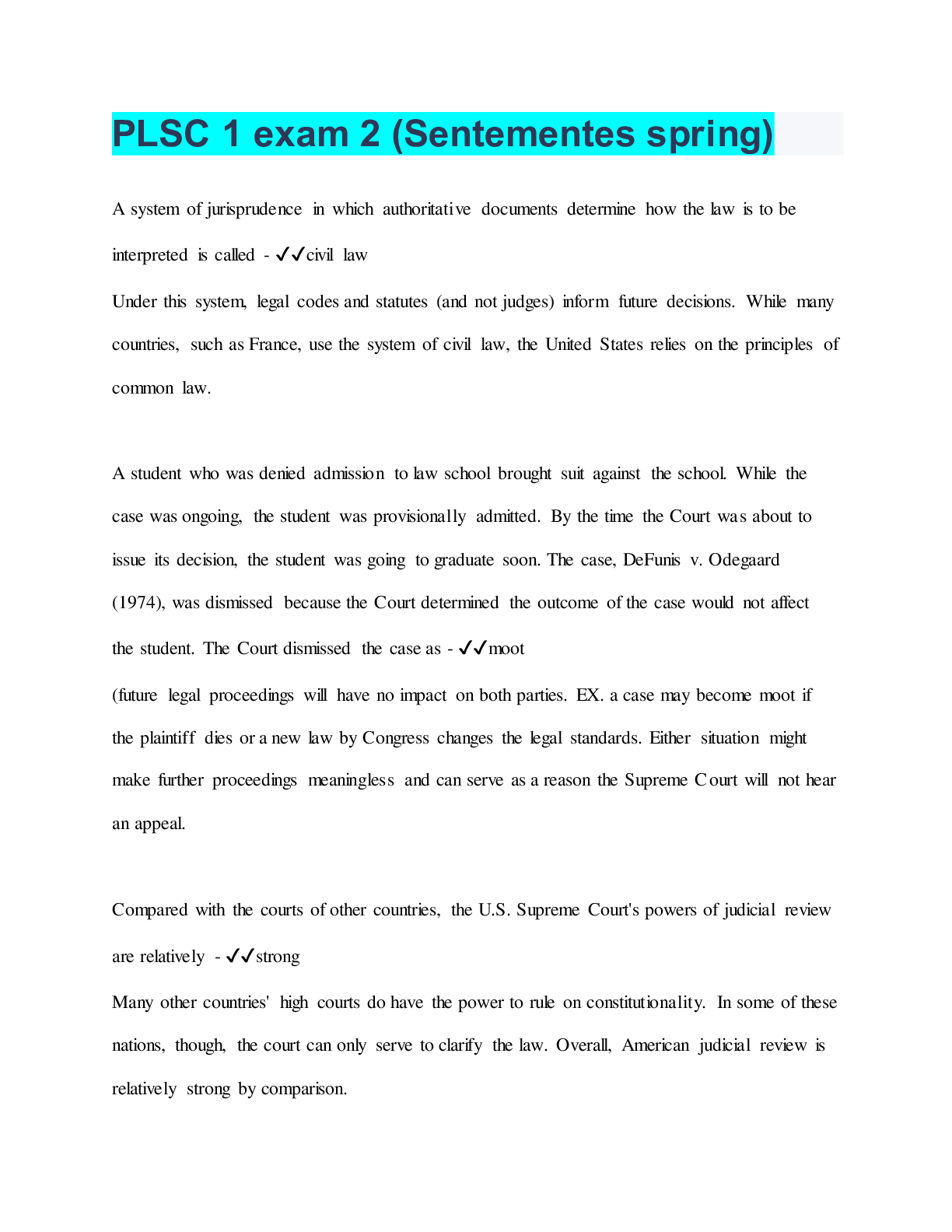
PLSC 1 exam 2 (Sentementes spring)
A system of jurisprudence in which authoritative documents determine how the law is to be
interpreted is called - ✔✔civil law
Under this system, legal codes and statutes (and not judges) inform future decisions. While many
countries, such as France, use the system of civil law, the United States relies on the principles of
common law.
A student who was denied admission to law school brought suit against the school. While the
case was ongoing, the student was provisionally admitted. By the time the Court was about to
issue its decision, the student was going to graduate soon. The case, DeFunis v. Odegaard
(1974), was dismissed because the Court determined the outcome of the case would not affect
the student. The Court dismissed the case as - ✔✔moot
(future legal proceedings will have no impact on both parties. EX. a case may become moot if
the plaintiff dies or a new law by Congress changes the legal standards. Either situation might
make further proceedings meaningless and can serve as a reason the Supreme Court will not hear
an appeal.
Compared with the courts of other countries, the U.S. Supreme Court's powers of judicial review
are relatively - ✔✔strong
Many other countries' high courts do have the power to rule on constitutionality. In some of these
nations, though, the court can only serve to clarify the law. Overall, American judicial review is
relatively strong by comparison.
How do federal and state judges obtain a seat on the bench? - ✔✔In a majority of states, state
judges are chosen by popular election. Federal judges are appointed by the president and
confirmed by the Senate.
Organization of the American Judiciary. In 37 of 50 states, at least some state judges are chosen
by popular election. This contrasts with the fed
[Show More]