Therapy Ed NPTE Practice Questions
Exam A
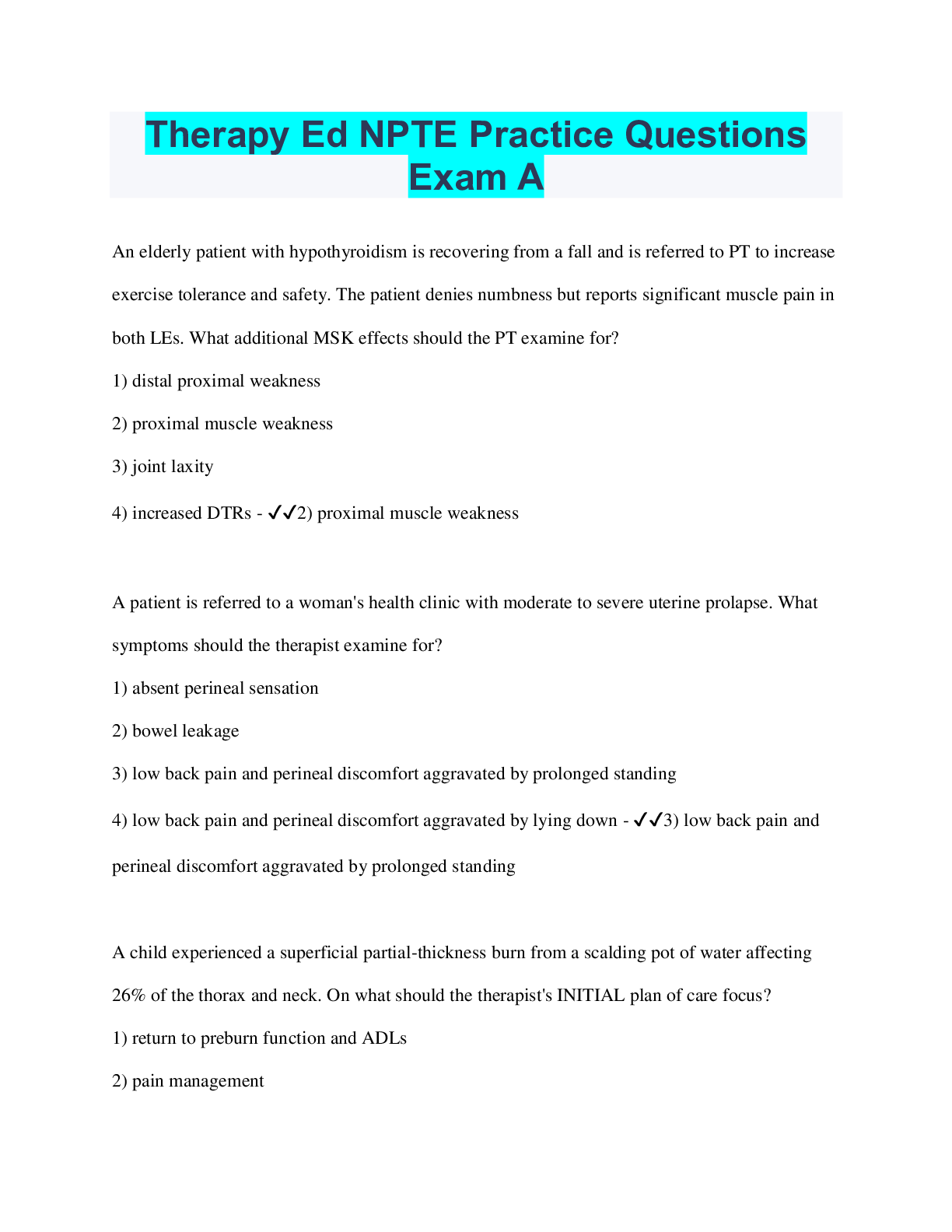
An elderly patient with hypothyroidism is recovering from a fall and is referred to PT to increase
exercise tolerance and safety. The patient denies numbness but reports signi
...
Therapy Ed NPTE Practice Questions
Exam A
An elderly patient with hypothyroidism is recovering from a fall and is referred to PT to increase
exercise tolerance and safety. The patient denies numbness but reports significant muscle pain in
both LEs. What additional MSK effects should the PT examine for?
1) distal proximal weakness
2) proximal muscle weakness
3) joint laxity
4) increased DTRs - ✔✔2) proximal muscle weakness
A patient is referred to a woman's health clinic with moderate to severe uterine prolapse. What
symptoms should the therapist examine for?
1) absent perineal sensation
2) bowel leakage
3) low back pain and perineal discomfort aggravated by prolonged standing
4) low back pain and perineal discomfort aggravated by lying down - ✔✔3) low back pain and
perineal discomfort aggravated by prolonged standing
A child experienced a superficial partial-thickness burn from a scalding pot of water affecting
26% of the thorax and neck. On what should the therapist's INITIAL plan of care focus?
1) return to preburn function and ADLs
2) pain management
3) infection management
4) chest wall mobility and prevention of scar contracture - ✔✔4) chest wall mobility and
prevention of scar contracture
A patient with coronary artery disease has been doing regular aerobic exercise on a treadmill. If
the patient fails to comply in taking prescribed beta-blocker medication and continues to
exercise, what potential rebound effects could result?
1) increase in BP, decrease in HR during exercise.
2) decrease in BP and HR during exercise
3) increase in BP and HR during exercise
4) decrease in BP and increase in HR during exercise - ✔✔3) increase in BP and HR during
exercise
A patient has persistent midfoot pain with weight bearing. The injury occurred during a soccer
match when an opposing player stepped on the patient's right foot when it was planted and
cutting to the left. Patient locates the pain where laces are tied. Upon examination there is
splaying of the 1st metatarsal and increased pain when passively stressing the foot with
plantarflexion and rotation. What injury should the therapist suspect the patient has sustained?
1) Lisfranc injury
2) turf toe
3) calcaneocuboid joint subluxation
4) hallux rigidus - ✔✔1) Lisfranc injury
A patient is referred to PT with a 10-year history of rheumatoid arthritis (RA). What are possible
extra-articular complications?
1) disc degeneration
2) psoriatic skin and nail changes
3) vasculitis
4) conjunctivitis and iritis - ✔✔3) vasculitis
A PT is instructing an elderly patient how to perform bed mobility following a THA. The
therapist should carefully consider the effects of aging that relate to skin. What is one such
effect?
1) increased perception of pain
2) impaired sensory integrity
3) increased skin elasticity
4) increased acute inflammatory response - ✔✔2) impaired sensory integrity
What would a therapist who is examining the breathing pattern of a patient with a complete
(ASIA A) C5 spinal cord injury expect to observe?
1) asymmetric lateral costal expansion due to ASIA A injury
2) an increased subcostal angle due to air trapping from muscle weakness
3) no diaphragmatic motion since the diaphragm is below the level of the lesion
4) rising of the abdomen due to no abdominal muscle tone on the abdominal viscera - ✔✔4)
rising of the abdomen due to no abdominal muscle tone on the abdominal viscera
Men are at risk for development of metabolic syndrome if they exhibit which of the following
symptoms?
1) HDL level lower than 45 mg/dL
2) waist size greater than 40 inches
3) triglyceride levels greater than 100 mg/dL
4) fasting blood glucose less than 100 mg/dL - ✔✔2) waist size greater than 40 inches
During an examination, the limitations of ultrasound imaging include which of the following?
1) inability to clearly see cartilage in infants
2) disruption of cardiac pacemakers
3) difficulty penetrating bone and therefore visualizing internal structure of bones
4) inability to give a clear picture of tendons and therefore diagnose tendon tears - ✔✔3)
difficulty penetrating bone and therefore visualizing internal structure of bones
A patient with a body mass index (BMI) of 37 is referred to physical therapy for exercise
conditioning. What are additional clinical manifestations associated with the BMI that this
particular patient might exhibit?
1) hyperpnea and hyperpituitarism
2) hypertension and hyperinsulinemia
3) hormone-related cancer
4) hypolipoproteinemia and hypotension - ✔✔2) hypertension and hyperinsulinemia
An 8-year-old boy is referred to physical therapy with chronic pain in the hip, thigh, and knee
without any precipitating trauma or other known cause. The symptoms initially began as
soreness and progressively worsened. The PT notes that the patient walks with exaggerated trunk
and pelvic movements, and there is significantly limited ROM with hip abduction and extension.
Examination of the knee region is normal. What is the MOST LIKELY diagnosis?
1) hip dysplasia
2) Legg-Calve-Perthes disease
3) growing pains
4) slipped capital femoral epiphysis - ✔✔2) Legg-Calve-Perthes disease
[Legg-Calve-Perthes: Idiopathic childhood hip disorder initiated by disruption of blood flow to
the femoral head, leading to avascular necrosis. Age of onset 2-13 years and is 4x more likely in
boys. Characteristic clinical presentation: gradual onset and limited ROM in abd/ext due to
collapse of subchondral bone at femoral neck/head. Gait deviation is called a psoatic limp d/t
weakness of psoas major muscle. Patient moves in hip ER, flexion, and adduction along with
exaggerated trunk & pelvic movements. Often misdiagnosed as growing pains in early stages.]
[Slipped capital femoral epiphysis: A common hip disorder observed in adolescents however age
of onset in males is usually 10-17 years. Patients demonstrate Trendelenburg gait and limited
ROM in abd/flex/IR.]
[Hip dysplasia: An abnormality in the size, shape, orientation, or organization of the femoral
head and/or acetabulum that can result in hip subluxation or dislocation. More common in
females.]
[Growing pains: can be differentiated by the fact that children experiencing growing pains
typically present with increased pain at night and do not commonly exhibit loss of ROM or a
dysfunctional gait pattern.]
To prepare a patient with cauda equina lesion for ambulation with crutches, what upper quarter
muscles would be the most important to strengthen?
1) upper trapezius, rhomboids, levator scapulae
2) deltoid, coracobrachialis, brachialis
3) middle trapezius, serratus anterior, triceps
4) lower trapezius, latissimus dorsi, pectoralis major - ✔✔4) lower trapezius, latissimus dorsi,
pectoralis major
[shoulder depressors and extensors plus elbow extensors are required for crutch use]
What will a patient with a signficant right thoracic structural scoliosis demonstrate on
examination?
1) decreased breath sounds on the right
2) decreased thoracic rib elevation on the right
3) increased lateral costal expansion on the right
4) shortened internal and external intercostals on the right - ✔✔3) increased lateral costal
expansion on the right
[The convexity is on the right allowing for increased aeration and mobility on that side. Ribs
would elevate normally or more on the right side. The left side would have shortened muscle
length and decreased aeration.]
A therapist has been treating a patient for several weeks for decreased shoulder elevation and a
loss of external rotation. Recovery has been good; however, the patient still complaints of being
unable to reach the upper shelves of kitchen cabinets and closets. To help the patient achieve this
goal, what should be the focus of manual therapy?
1) superior glide
2) inferior glide
3) anterior glide
4) grade II oscillations - ✔✔3) anterior glide
[To help external rotation, which is a component of full elevation. Anterior glide will help
increase external rotation and end range flexion which are required for overhead reaching.]
Which activity would help break up obligatory LE synergy patterns in a patient with hemiplegia?
1) high kneeling position, ball throwing
2) standing, alternating marching in place with hip and knee flexion and hip abduction
3) sitting, alternate toe tapping
4) sitting, foot slides under the seat - ✔✔1) high kneeling position, ball throwing (pg 624)
[Show More]