NUR3294 Summer 2019
Exam 1 Focused Review
• Characteristics of the Nursing Profession
• Respond to needs of patients
• Actively participate in policy
• Respond and adapt to challenges
• Make clinical judgments
...
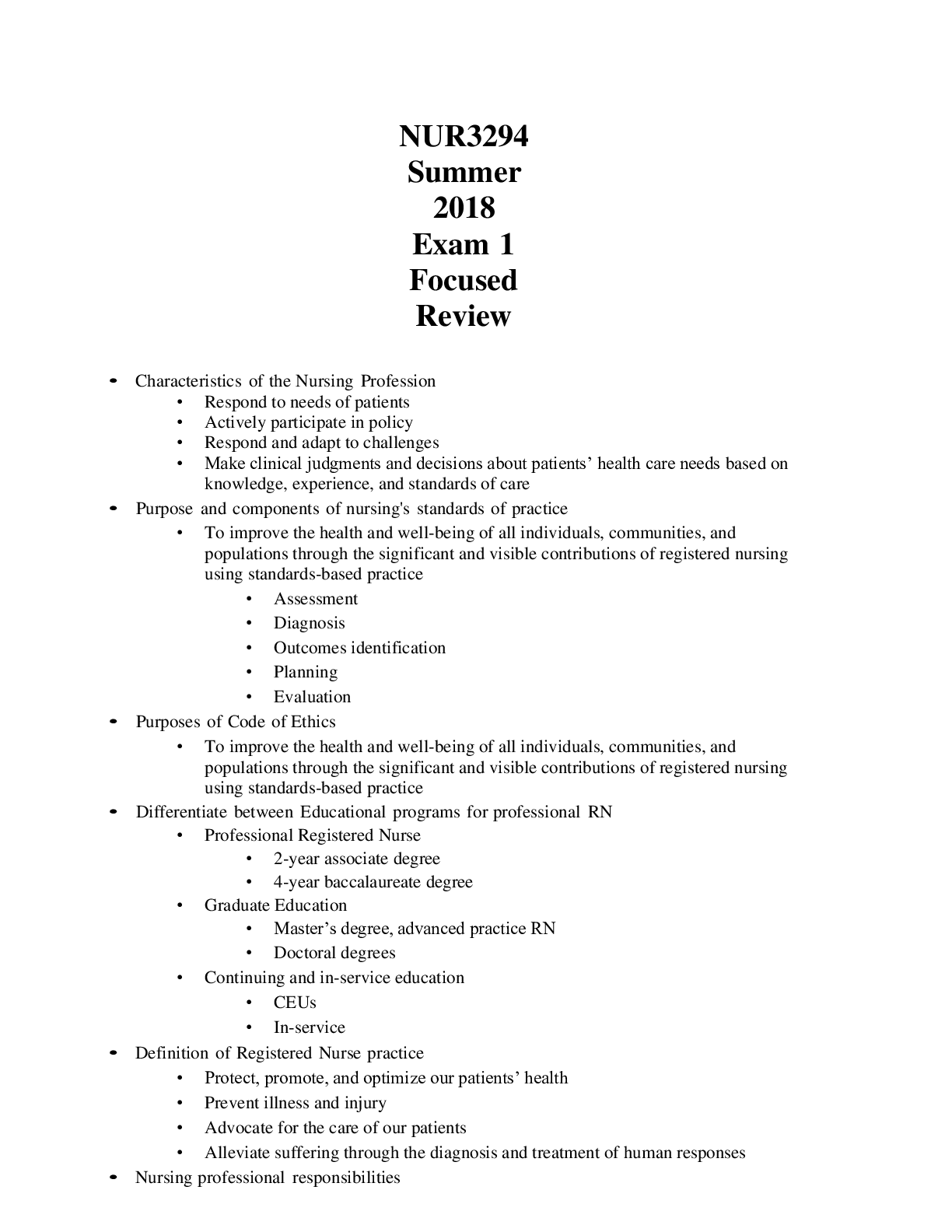
NUR3294 Summer 2019
Exam 1 Focused Review
• Characteristics of the Nursing Profession
• Respond to needs of patients
• Actively participate in policy
• Respond and adapt to challenges
• Make clinical judgments and decisions about patients’ health care needs based on knowledge, experience, and standards of care
• Purpose and components of nursing's standards of practice
• To improve the health and well-being of all individuals, communities, and populations through the significant and visible contributions of registered nursing using standards-based practice
• Assessment
• Diagnosis
• Outcomes identification
• Planning
• Evaluation
• Purposes of Code of Ethics
• To improve the health and well-being of all individuals, communities, and populations through the significant and visible contributions of registered nursing using standards-based practice
• Differentiate between Educational programs for professional RN
• Professional Registered Nurse
• 2-year associate degree
• 4-year baccalaureate degree
• Graduate Education
• Master’s degree, advanced practice RN
• Doctoral degrees
• Continuing and in-service education
• CEUs
• In-service
• Definition of Registered Nurse practice
• Protect, promote, and optimize our patients’ health
• Prevent illness and injury
• Advocate for the care of our patients
• Alleviate suffering through the diagnosis and treatment of human responses
• Nursing professional responsibilities
• For obtaining and maintaining specific knowledge and skills
• To provide care and comfort
• To emphasize health promotion and illness prevention
• Examples of nursing professional roles
• Caregiver
• Advocate
• Educator
• Communicator
• Manager
• What is the importance of Quality and Safety Education for Nurses (QSEN)?
• Patient-centered care
• Teamwork and collaboration
• Evidence-based practice
• Quality improvement
• Safety
• Informatics
• What are reason for studying theories and theorists?
• Gain understanding of what occurred in the past and events that have shaped what have gotten us to the point we are at today.
• Provide research to postulate fresh ideas to gain new insights and advance new technologies.
• What are examples of interdisciplinary theory used to guide nursing practice?
• Basic human needs
• Developmental
• Psychosocial
• Systems
• What are the relationships among nursing theory, the nursing process and patient needs?
• The nursing theory drives the process, which in turn directs the care taken to properly address the patient’s needs.
• Define theory based nursing practice?
• Generate nursing knowledge for use in practice
• Can direct how to use nursing process
• Are adaptable to different patients and all care settings
• The goal of nursing knowledge is to explain the practice of nursing as different and distinct from the practice of medicine, psychology, and other health care disciplines.
• Importance of theory based nursing practice important?
• Is a conceptualization of some aspect of nursing
• Describes, explains, predicts, and/or prescribes nursing care
• Know the differences between preventive care, primary care, secondary care, tertiary care, and restorative care (and different types of restorative care)
• Preventive care focuses on reducing and controlling risk factors for disease through activities such as occupational health programs.
• Primary health care focuses on improved health outcomes for an entire population. It includes primary care and health education, proper nutrition, maternal/child health care, family planning, immunizations, and control of diseases.
• Requires collaboration among health professionals, health care leaders, and community members.
• Health promotion programs lower the overall costs of health care by reducing the incidence of disease, minimizing complications, and reducing the need to use more expensive health care resources.
• Secondary and Tertiary Care
• Disease management is the most common and expensive service of a health care delivery system.
• Chronic illness causes disability, decreased quality of life, and increased health care costs.
• Hospitals
• Work redesign
• Discharge planning
• Intensive care
• Psychiatric facilities
• Rural hospitals
• Restorative Care
• Serves patients recovering from an acute or chronic illness/disability
• Helps individuals regain maximal function and enhance quality of life
• Restorative Care: Home Health Care
• Provision of medically related services and equipment to patients and families in their homes for health maintenance, education, illness prevention, diagnosis and treatment of disease, palliation, and rehabilitation.
• Involves coordination of services.
• Focuses on patient and family independence.
• Usually reimbursed by government (such as Medicare and Medicaid in the United States), private insurance, and private pay.
• Restorative Care: Rehabilitation
• Includes physical, occupational, and speech therapy, and social services
• Begins on admission
• Focuses on preventing complications
• Maximizes patient function and independence
• Restorative Care: Extended Care
• Extended care facility
• Provides intermediate medical, nursing, or custodial care for patients recovering from acute illness or disabilities
• Intermediate care/skilled nursing facility
• Provides care for patients until they can return to their community or residential care location
• Know the difference between hospice, respite care, assisted living, and skilled nursing
• Nursing centers or facilities
• Assisted living
• Long-term care setting
• Home environment
• Greater resident autonomy
• No fee caps
• Respite care
• Respite care provides short-term relief or “time off” for people providing home care to an individual who is ill, disabled, or frail.
• Settings include home, day care, or health care institution with overnight care.
• Trained volunteers enable family caregivers to leave the home for errands or social time.
• Adult day care centers
• Provide a variety of health and social services to specific patient populations who live alone or with family in the community
• May be associated with a hospital or nursing home or may operate independently
• Hospice
• Family centered care that allows patients to live with comfort, independence, and dignity while easing the pains of terminal illness.
• Focuses on palliative (not curative) care
• Many hospice programs provide respite care, which is important in maintaining the health of the primary caregiver and family.
• What is performance improvement?
• an organization analyzes and evaluates current performance and uses the results to develop focused improvement actions.
• What are some examples of quality improvement processes?
• Patient Self-Determination Act (PSDA)
• Six Sigma or Lean
• Rapid-cycle improvement or rapid-improvement event (RIE)
• How does technology affect nursing?
• Review Institute of medicine nurse competencies
• Provide Patient-Centered Care
• Recognize and respect differences in patients' values, preferences, and needs.
• Relieve pain and suffering.
• Coordinate continuous care.
• Effectively communicate with and educate patients.
• Share decision making and management.
• Advocate for disease prevention and health promotion.
• Work in Interdisciplinary Teams
• Cooperate, collaborate, and communicate.
• Integrate care to ensure that it is continuous and reliable.
• Use Evidence-Based Practice
• Integrate best research with clinical practice and patient values.
• Participate in research activities as possible.
• Apply Quality Improvement
• Identify errors and hazards in care.
• Practice using basic safety design principles.
• Measure quality in relation to structure, process, and outcomes.
• Design and test interventions to change processes.
• Use Informatics
• Use information technology to communicate, manage knowledge, reduce error, and support decision-making.
• Components of achieving magnet status
• Transformational leadership
• Structural empowerment
• Exemplary professional practice
• New knowledge, innovation, and improvements
• Empirical quality results
• What does public health nursing require the understanding of vs community health nursing?
• Needs of a population
• Factors that influence health promotion and health maintenance
• Trends and patterns influencing disease within populations
• Environmental factors contributing to health and illness
• Political processes used to affect public policy
• Community health nursing vs community-based nursing
• Community health nursing
• Nursing practice in the community
• Primary focus: health care of individuals, families, and groups within the community
• Goal: preserve, protect, promote, or maintain health
• Community-based nursing
• Health Promotion
• Disease Prevention
• Restorative Care
• Goals of Healthy People 2020
• Goals are to increase life expectancy and quality of life, and to eliminate health disparities through improved delivery of health care services
• Vulnerable populations
• Individuals living in poverty
• Older adults
• People who are homeless
• Immigrant populations
• Individuals in abusive relationships
• Substance abusers
• People with severe mental illnesses
• Skills and talents of nurses in community-based nursing
• Caregiver
• Case manager
• Change agent
• Collaborator
• Counselor
• Educator
• Epidemiologist
• Patient advocate
• Models of care delivery including case management, total patient care, primary nursing, and team nursing
• Traditional models
• Team nursing
• Primary nursing
• Today’s models
• Patient-centered care - mutual partnerships among the patient, family, and health care team are formed to plan, implement, and evaluate the nursing and health care delivered
• Respect and dignity
• Information sharing
• Participation
• Collaboration
• Total patient care
• Registered nurse works directly with patient, family, and health care team members.
• RN is responsible for patients during shift of care, although care can be delegated.
• Approach may not be cost-effective owing to high number of RNs needed.
• Patient satisfaction is high
• Case management - care management approach that coordinates and links health care services to patients and their families while streamlining costs and maintaining quality
• Collaborative process of assessing, planning, facilitating, and advocating for options and services to meet an individual’s health needs.
• Clinicians oversee the management of patients with specific, complex health problems and are usually held accountable for some standard of cost management and quality.
• Often the case manager is an advanced practice nurse (APN), who helps improve patient outcomes via specific interventions.
• Decentralized decision making
• Decentralized management means that decision making occurs at the level of the staff.
• Responsibility, autonomy, authority, and accountability- be able to recognize examples of each
• Responsibility: duties and activities an individual is employed to perform
• Autonomy: independent decisions about patient care
• Authority: legitimate power to give commands and make final decisions specific to a given position
• Accountability: answerable for the actions
• Clinical care coordination
• Clinical decision making
• Apply the nursing process
• Know your patient
• Use clinical decision making practices
• Accurate clinical decision-making keeps you focused on the proper course of action
• Priority setting
• Determine which patient’s needs should be addressed first:
• High priority: immediate threat to patient survival or safety
• Intermediate priority: nonemergent, non–life threatening
• Low priority: actual or potential problems may or may not be directly related to patient’s illness or disease
• Organizational skills
• Do the right things.
• Do things right.
• Inform and prepare patient.
• Clean and organize work area.
• Keep patient’s needs at the center of attention.
• Use of resources
• Appropriate use of resources is an important aspect of clinical care coordination.
• Administration of patient care occurs more smoothly when staff members work together.
• Time Management
• Remain goal oriented.
• Identify priorities.
• Establish personal goals.
• Evaluate
• The process
• Patient response
• Therapy efficacy
• Patient and expected outcomes
• Team communication
• Respect other’s ideas
• Share information
• Stay informed
• Strive to improve communication
• Share expectations of communications
• Use structured communication techniques
• Delegation
• Transfers responsibility while remaining accountable for outcomes
• Requires knowing which skills are transferable
• Results in improved quality, safe patient care, improved efficiency, increased productivity, an empowered staff, and skill development of others
• Assess the knowledge and skills of the delegatee.
• Match tasks to the delegatee’s skills.
• Communicate clearly:
• Task, outcome, time
• Listen attentively.
• Provide feedback.
• Knowledge building
• Remain competent.
• Pursue lifelong learning.
• Share the knowledge.
• To become a leader, actively pursue learning opportunities, both formal and informal, and learn to share knowledge with the professional colleagues you encounter.
• 5 rights of delegation
• Right Task
• Right Circumstance
• Right Person
• Right Direction
• Right Supervision
• What tasks can and cannot be delegated to unlicensed assistive personnel?
• Do not delegate the steps of the nursing process of assessment, diagnosis, planning, and evaluation because these steps require nursing judgment.
• Patient teaching is also the responsibility of an RN and should not be delegated.
• As an RN, you are always responsible for the assessment of a patient’s ongoing status; but if a patient is stable, you delegate vital sign monitoring to the NAP.
• Appropriate delegation begins with knowing which skills you are able to delegate. Know your state’s Nurse Practice Act.
• As a professional nurse you cannot simply assign the NAP tasks without considering the implications. Assess the patient and determine a plan of care before identifying which tasks someone else is able to perform.
• Globalization
• Evidence-based practice
• When does discharge planning start? At admission
• Differentiate between ethics and values
• Ethics - The study of conduct and character. It is concerned with determining what is good or valuable for individuals and society at large.
• Values - Personal beliefs about the worth of a given idea, attitude, custom, or object that set standards that influence behavior.
• What are examples of ethical principles?
• Define Risk Management
• A system of ensuring appropriate nursing care that attempts to identify potential hazards and eliminate them before harm occurs
• Liability and Nursing Students issues
• You are liable if your actions cause harm to patients, as is your instructor, hospital, and college/university.
• You are expected to perform as a professional when rendering care.
• Examples of negligent acts
• Failure to assess and/or monitor, including making a nursing diagnosis
• Failure to notify the health care provider of problems
• Failure to follow orders
• Failure to convey discharge instructions
• Failure to follow policies and procedures
• Failure to properly delegate and supervise
• Failure to ensure patient safety, especially for patients who have a history of falling, are heavily sedated, have disequilibrium problems, are frail, are mentally impaired, get up in the night, and are uncooperative
• Failure to monitor in timely fashion
• Failure to use proper equipment to monitor the patient
• Failure to document the monitoring
• What are examples of Federal statutory issues in nursing practice
• Americans with Disabilities Act
• Emergency Medical Treatment and Active Labor Act
• Mental Health Parity Act
• Uniform Anatomical Gift Act
• Living Wills, Durable Power of Attorney
• Health Insurance Portability and Accountability Act
• Advance Directives
• Restraints
• Differences and similarities in living will, advance directives, durable power of attorney
• What are issues related to Ethics of Care?
• Quality of life: central to discussions about end-of-life care, cancer therapy, physician-assisted suicide, and DNR
• Genetic screening: What are the risks and benefits to individuals and to society of learning about the presence of a disease that has not yet caused symptoms, or for which a cure is not yet available?
• Care at the end of life: interventions unlikely to produce benefit for the patient
• Access to care: As a nurse, you will certainly deal with ethical issues related to access to care.
• Examples. Definition, processing of ethical dilemmas
• Step 1: Ask if this is an ethical dilemma.
• Step 2: Gather all relevant information.
• Step 3: Clarify values.
• Step 4: Verbalize the problem.
• Step 5: Identify possible courses of action.
• Step 6: Negotiate a plan.
• Step 7: Evaluate the plan.
• Basic philosophies of health care ethics
• Deontology - Defines actions as right or wrong
• Utilitarianism - Proposes that the value of something is determined by its usefulness
• Feminist Ethics - Focuses on the inequality between people
• Ethics of Care - Emphasizes the importance of understanding relationships, especially as they are revealed in personal narratives
• Role of ethics in professional nursing
• The Code is written by nurses to express their understanding of their professional commitment to society. It describes the profession’s values, obligations, duties, and professional ideals.
• Legal obligations and role of nurse regarding federal laws
• Any competent individual 18 years of age or older for himself or herself
• Any parent for his or her unemancipated minor
• Any guardian for his or her ward
• Any adult for the treatment of his or her minor brother or sister (if an emergency, and parents are not present)
• Any grandparent for a minor grandchild (if an emergency, and parents are not present)
[Show More]