Question 1
Which societal changes have promoted the nurse’s return to school and further education? (Select all that apply.)
1. Patients have increasingly more complex and varied health needs.
2. Previously unknown di
...
Question 1
Which societal changes have promoted the nurse’s return to school and further education? (Select all that apply.)
1. Patients have increasingly more complex and varied health needs.
2. Previously unknown diseases are being identified.
3. New technologies are being developed that require continual knowledge updates.
4. Patients are staying longer in the hospital.
5. There is a relative increase in the number of children in the population.
Correct Answer: 1, 2, 3
Rationale: Changes in society have placed new demands on nurses. The population is aging and these older patients have more complex and varied health problems. New diseases related to social and environmental problems are being identified. Scientific discoveries and new technologies require the nurse to continually update his or her knowledge base in order to provide safe and competent care. Patients are going home from the hospital earlier (not staying longer), so much more care is being provided in community and outpatient settings. The population is aging so there is not a relative increase in the number of children in the population.
Question 2
Which statement regarding age trends of RNs is correct?
1. The average age of persons holding RN licensure has remained the same for the last 10 years.
2. The average age of male RN graduates is decreasing while the age for female RN graduates is increasing.
3. The average age of RN graduates has increased.
4. Overall, the average age of practicing RNs has decreased.
Correct Answer: 3
Rationale: The average age of RNs has increased. In 2000, the average age of RNs was 45.2 years; in 2013, the average age of RNs had increased to 50 years. There is no information in the text regarding age as it applies to gender.
Question 3
According to the 2013 National Workforce Survey, what is the highest level of educational preparation for the majority of RNs?
1. Diploma
2. Associate degree
3. Baccalaureate degree
4. Master’s degree
Correct Answer: 3
Rationale: According to The 2013 National Nursing Workforce Survey of Registered Nurses by the National Council of State Boards of Nursing and The Forum of State Nursing Workforce Centers, 8% of nurses hold a diploma, 29% of nurses hold an associate degree, 36% of nurses hold a baccalaureate degree, and 13.9% of nurses hold a master’s or doctoral degree as their highest level of educational preparation.
Question 4
How have the practice settings for nurses changed since 1980?
1. There has been little or no change in these settings.
2. The settings have shifted from the community to the hospital.
3. There has been a shift from the hospital to long-term care settings.
4. They have shifted from acute-care to community or primary care settings.
Correct Answer: 4
Rationale: The focus of professional nursing practice is shifting from acute hospital- based illness care to primary outpatient-based community care, emphasizing health promotion and illness/injury preventions. The percentage of RNs working in hospitals decreased from 66% in 1980 to 56.2% in 2004.
Question 5
What statement about specialty certification in nursing is true?
1. Specialty certification guarantees increase in salary for the nurse.
2. Healthcare agencies rarely recognize certifications by nursing specialty groups.
3. The nurse who works in hospital practice must hold at least one specialty certification.
4. The nurse must demonstrate extensive experience and continuing education in the specialty area.
Correct Answer: 4
Rationale: To be eligible to take the certification exam, the nurse must demonstrate extensive experience and continuing education in the specialty area. Although there is no guarantee that the nurse’s salary will be increased, healthcare agencies do recognize these certifications. There is no requirement that the nurse hold a specialty certification to work in a hospital; however, work in specialty areas, such as the emergency department, critical care areas, or surgery, may requirecertification.
Question 6
The nurse has been promoted from staff nurse to supervisor and is trying to make a transition to the new role. Which behavior reflects that the nurse is in the ending phase of Bridges’ model of transition?
1. The nurse is working to move forward in the job, avoiding the temptation of going back to familiar ways of thinking.
2. The nurse is beginning to accept the responsibilities of the new position.
3. The nurse has accepted that relationships with former peers on the unit will change.
4. The nurse questions the wisdom of accepting the new position.
Correct Answer: 4
Rationale: Bridges’ model of transition consists of three phases. The first phase, called the ending phase, consists of the individual “letting go” of the old situation. This phase consists of four components: disengagement, disidentification, disenchantment, and disorientation. The nurse who is questioning the wisdom of accepting the new position is in the letting go phase of disorientation. The second phase, neutral zone, is exemplified in this question by the nurse beginning to accept the responsibilities of the new position and accepting that relationships with former peers will change. As the nurse works to move forward in the job, resisting the temptation to go back to familiar ways of thinking and working, the nurse has moved into the final stage of transition, new beginnings.
Question 7
The nurse who has gone back to school to earn a master’s degree is eager to talk with peers who are also considering going back to school. Which stage of Spencer and Adams’ model of transition does this desire most closely exemplify?
1. Stage 2, minimizing the impact.
2. Stage 4, letting go of the past.
3. Stage 6, searching for meaning.
4. Stage 7, integration.
Correct Answer: 3
Rationale: Spencer and Adams describe a seven-stage model. The nurse’s actions most closely exemplify Stage 6, searching for meaning. In this stage, the individual desires to help others who are experiencing a similar situation. In Stage 2, minimizing the impact, the person feels a need to go back to what was normal or comfortable in order to avoid the full effect of the changes taking place. In Stage 4, letting go of the past, the individual begins to focus on the change’s benefits and to look forward to those benefits. Stage 7, integration, is the stage of completion. In this stage, the individual experiences satisfaction and self-confidence.
Question 8
The individual going through a transition may experience many feelings. Which feelings are common? (Select all that apply.)
1. Anger
2. Anxiety
3. Knowledge
4. Confusion
5. Grief
Correct Answer: 1, 2, 4, 5
Rationale: A variety of emotions and feelings are common when an individual is going through a transition. These feelings include anger, anxiety, confusion, and grief. Feeling knowledgeable will not occur until the individual has been functioning in the transitioned role for some time.
Question 9
The nurse has elected to return to school to pursue a baccalaureate degree. After the first week of classes, the nurse is overwhelmed. Which stage of Spencer and Adams’ model of transition is this nurse most likely experiencing?
1. Losing focus
2. Minimizing the impact
3. The pit
4. Letting go of the past
Correct Answer: 1
Rationale: Losing focus is Stage 1 of Spencer and Adams’ model of transition. In this stage, the individual has difficulty keeping things in perspective and may feel overwhelmed and panicked. Minimizing the impact is Stage 2, in which the individual may resist the change or ignore the need for change. The pit is Stage 3, and the individual may have feelings of depression, grief, anger, or powerlessness. Letting go of the past is Stage 4, in which there is a move toward optimism.
Question 10
The nurse who is returning to school to pursue a baccalaureate degree in nursing states, “I don’t know why I am putting myself through this. I have practiced just fine for 10 years as an associate degree nurse.” Which strategy, recommended by a friend, would be helpful in overcoming this feeling?
1. “Why don’t you take a one semester break from school?”
2. “Remember that a lot of people are depending on you.”
3. “Just think how much better a nurse you will be when you finish.”
4. “Think about all the extra money you will get when you graduate.”
Correct Answer: 3
Rationale: Reframing the nurse’s comment helps to focus on the positive. “Just think how much better a nurse you will be when you finish” helps the nurse remember the reason for seeking further education. If the nurse takes a break in this frame of mind, returning to school is unlikely. This nurse is already stressed, so focus on the dependence of others on him or her is unlikely to be very comforting. Although there may be some increase in salary associated with the BS degree, it is usually not substantial. Focus on a potential salary change that is not close in time will do little to assist the nurse in this period.
Question 11
The nurse who has decided to seek a master’s degree asks the hospital’s chief nurse for support. The chief nurse followed a career path from associate degree nurse, to baccalaureate nurse, to master’s prepared nurse, and eventually obtained a nursing doctorate. The chief nurse would be acting in which role for the new student?
1. Colleague
2. Friend
3. Faculty
4. Mentor
Correct Answer: 4
Rationale: While the nurses in the scenario may consider themselves friends and colleagues, the description of the role of the chief nurse most closely describes that of mentor. There is no indication that the chief nurse is fulfilling the role of faculty.
Question 12
The nurse has decided to go back to school. Which group is most likely to provide physical and financial support to this nurse?
1. Mentor
2. Family and friends
3. Career ladder organization
4. State nursing organization
Correct Answer: 2
Rationale: Although every person’s situation is different, family and friends are generally more likely to provide physical and financial support of some type. Mentors provide intellectual support along with information about the role transition. Career path organizations and state nursing organizations provide support related to career information and study skills, not specific physical and financial support.
Question 13
Which individual would most likely be the best choice as a mentor to an associate degree nurse who has enrolled in a baccalaureate nursing completion program?
1. A colleague at work who holds an associate degree.
2. A nurse who completed an ADN to RN program five years ago.
3. The minister of the nurse’s church.
4. The physician chief of staff at the hospital where the nurse works.
Correct Answer: 2
Rationale: The best choice for mentor is someone who has successfully achieved the transition the nurse is seeking; therefore, a nurse who completed an ADN to RN program would be the preferred mentor. Because the colleague at work has not completed the desired transition, that nurse would not understand the pressures of the program. Although the minister and the physician might offer support, they would not fulfill the mentor position as well as someone who has lived through the transition.
Question 14
The nursing student identifies a personal tendency toward procrastination. Which approach would be beneficial to this student?
1. Plan the majority of study in the two days prior to scheduled exams.
2. Plan recreational activities each week.
3. Limit reading to essential content.
4. Try to complete assigned papers in one setting.
Correct Answer: 2
Rationale: Good time management requires good physical health, which requires adequate sleep, good nutrition, and recreation. The student should develop a time plan that includes keeping up with assigned readings, ongoing study throughout the course (not just before exams), and preplanning for papers and projects. Although the reading load in nursing school is heavy, the student should read everything assigned. Ideally, papers should be written, put away, and then reviewed at a later time prior to submission.
Question 15
The nurse has received a financial aid package that has a “forgiveness” clause. What can the nurse expect as a result of this clause being part of this package?
1. If the student decides to change majors, the financial aid will be transferred to the new degree.
2. The student will not have to pay back some portion of the financial aid package if the student works in a specific location for a period of time after graduation.
3. Because the student is going to be a nurse, the amount of the financial aid package will be forgiven if the nurse continues to pursue advanced degrees in nursing.
4. The student won’t have to pay any money back unless the student’s grades fall below satisfactory.
Correct Answer: 2
Rationale: Although financial aid packages can be written in many ways, the most common meaning of “forgiveness” is that the recipient will not have to pay a portion (or sometimes all) of the money back if the recipient works in a specific location or specialty for a period of time after graduation. In most cases, financial aid packages change (and may be invalid or have to be repaid) when majors change or when grades are not satisfactory. In either case, the money owed is not forgiven. Although the student may continue to receive aid of some sort while seeking advanced degrees, there is a limit to federal aid that cannot be exceeded; and simply seeking advanced degrees does not mean that money owed does not have to be repaid.
Question 16
The nursing student would like to talk with a faculty advisor prior to registering for next semester’s classes. What is the best strategy for this student?
1. Catch the faculty member after a lecture and ask for a few minutes to talk.
2. Stop by the faculty member’s office to see whether the faculty member has time to talk.
3. Call the faculty member and request a time to meet for advisement.
4. Talk to the faculty member in the cafeteria at school.
Correct Answer: 3
Rationale: Faculty has multiple assignments and responsibilities. The best way to assure that the faculty member is prepared to help the student is for the student to call for an appointment. Although it might be more convenient for the student to catch the faculty member after a lecture or during lunch, the faculty member is likely not to be focused on the student’s needs at those times. Dropping by the faculty member’s office is the second best option, but the faculty member may be engaged with another student or another responsibility, so the best use of time is to call for an appointment.
Question 17
The nursing faculty has instructed students to use electronic literature databases to research for course papers. Which options should the nursing student use? (Select all that apply.)
1. Medline
2. Statistical Package for the Social Sciences (SPSS)
3. Turnitin.com
4. Cumulative Index to Nursing and Allied Health Literature (CINAHL)
5. American Psychological Association (APA)
Correct Answer: 1, 4
Question 18
The nursing student is concerned because a faculty member does not follow the outline of the textbook chapters during class. What is true about this situation?
1. Many faculty use textbook reading as background for more advanced discussion.
2. The student should bring this oversight to the faculty member’s attention.
3. The only way to correct this behavior is to report the faculty to the director of the nursing program.
4. The faculty member is probably not very comfortable with the material in the textbook. Correct Answer: 1
Rationale: Many nursing faculty use textbook reading to provide background information for more advanced discussion of the topic being covered. There is no indication that this faculty member is not comfortable with the textbook material. This educational strategy is valid and is not a reason for the student to report the faculty member or to enlighten the faculty member about what the student identifies as an oversight.
Question 19
The nursing student has identified a discrepancy between what is written in the textbook and what the nursing faculty member said during theory class. What should the student do?
1. Wait and see whether the material is covered on the next exam.
2. Ask a clinical staff nurse for clarification of the topic.
3. Request an appointment with the faculty member who taught the material.
4. Look the topic up on the Internet for clarification.
Correct Answer: 3
Rationale: In this case, the discrepancy is between what is written in the textbook and what the student has understood from theory class. The most logical approach is to request an appointment with the faculty member who taught the material so that questions about the topic can be discussed. Reputable Internet sites and clinical staff nurses are good resources for general topics, but this question is a particular discrepancy that should be clarified with the person who taught the material. Waiting to see whether the material is covered on the next exam is a passive action that will not help the student learn the correct concepts.
in nursing practice.
Question 20
The nursing student is planning to study all weekend for a final exam scheduled on Monday. Is this a good strategy for study?
1. Yes; this method will assure all material is fresh in the student’s mind.
2. No; the student should plan on an all-night study session on Sunday night only.
3. Yes, but the best strategy is to invite six or seven fellow students to join in the session
4. No; study should be incremental across the semester with a general review the day before the exam.
Correct Answer: 4
Rationale: The best strategy is to study often, covering small portions of content as they are presented in the theory classroom. Marathon study sessions such as the one described in this question do not allow for consideration and processing of the material. The presence of multiple people in the marathon study session is even less productive. These large sessions tend to become social events rather than study events. All-night study sessions make the student sleep deprived on the day of the examination.
Question 21
How much study should the student plan for each hour spent in class per week?
1. 30 minutes
2. 1 to 3 hours
3. 4 to 5 hours
4. 8 hours
Correct Answer: 2
Rationale: The minimum recommended time for study is one hour for each hour spent in class. Most experts recommend between one and 3 hours of study for each hour spent in class.
Question 22
Why is self-reflection important to the student?
1. It is the only way to discover whether the student is suitable for nursing.
2. Self-reflection is required by the state nursing practice acts of all states.
3. It helps the student understand self in relation to professional role.
4. Self-reflection is part of the code of ethics for nurses.
Correct Answer: 3
Rationale: Self-reflection is important in understanding self in relation to the professional role of a nurse. Although self-reflection is very important, it is neither a state nursing practice act requirement nor a part of the code of ethics for nurses. There are many ways to discover the student’s suitability for nursing.
lifelong, continuous learning of information technology skills.
Question 23
The nursing student is completing the Critical Thinking Exercises in the textbook. What is a strategy for getting the most benefit from these exercises?
1. Look for the single best answer to the questions asked.
2. Work independently to find answers.
3. Look for answers in an appendix in the back of the book.
4. Discuss the questions with classmates.
Correct Answer: 4
Rationale: Discussing the Critical Thinking Exercises in the book with classmates can enhance and expand the student’s understanding of text content. These exercises have multiple answer possibilities, and it is often best to work in groups on the answers. Simply looking up answers in the book is not a good way to learn.
Question 24
The nursing student attempting to validate an Internet source wonders whether the source’s author is credible in the field. How can this student make this determination? (Select all that apply.)
1. Review the author’s credentials.
2. Assume the author is credible because he or she is published on the Internet.
3. Conduct a literature search using the author’s name.
4. Look for links to information about the author.
5. Identify sites sponsored by the author individually as valid.
Correct Answer: 1, 3, 4
Rationale: In order to assess an author’s credibility, the student should review the author’s credentials, conduct a literature search using the author’s name, or look for links to information about the author. Just because an author is published on the Internet does not mean the author is credible. Authors that self-sponsor their Internet sites may not be credible.
Question 25
What is one indicator that an Internet site may not be accurate?
1. A long bibliography is provided for additional information.
2. There are spelling errors on the site.
3. An editor is listed on the site.
4. Background information is provided by link, not on site.
Correct Answer: 2
Rationale: To assess the accuracy of an Internet site, the reader should look for a bibliography or links to background information or bibliography. Spelling errors and grammatical errors may indicate that there is no editor for the site, suggesting that the material has not been reviewed for accuracy.
Question 26
The nursing instructor is preparing material to review the Bridges’ Model of Transition with beginning nursing students. In which order should the instructor introduce this material?
1. Neutral zone
2. Disorientation
3. Disengagement
4. New beginnings
5. Disenchantment
6. Disidentification
Correct Answer: 3, 6, 5, 2, 1, 4
Rationale: Within the ending phase, Bridges describes four components: disengagement, disidentification, disenchantment, and disorientation. Disengagement occurs when the person is separated from previous familiar settings or roles. Disidentification is the loss of self-definition. Disenchantment is the understanding that the individual’s world has changed. Disorientation is the sense of confusion that occurs with change, the period of emptiness as one moves from the previous or old phase to the new phase. The neutral zone is the second phase of transition. The neutral zone is, in itself, a transition between the ending phase and the phase of new beginnings. The final phase of Bridges’ model is called new beginnings. In this phase, there is an acceptance of new knowledge, values, attitudes, and behaviors associated with the role change.
models of transition to professional role change.
Question 27
The preceptor is reviewing material prior to discussing Spencer and Adams’s Models ofTransition with a group of new nursing students. In which order should the preceptor introduce this information?
1. The pit
2. Integration
3. Losing focus
4. Testing the limits
5. Letting go of the past
6. Minimizing the impact
7. Searching for meaning
Correct Answer: 3, 6, 1, 5, 4, 7. 2
Rationale: Spencer and Adams developed a model of transition that includes seven stages: 1. losing focus; 2. minimizing the impact; 3. the pit; 4. letting go of the past; 5. testing the limits; 6. searching for meaning; and 7. integration.
Question 28
The Vice President of Nursing is analyzing the number of nurses currently employed who have baccalaureate degrees. Of the current 750 nurses, 225 have this degree. To meet the average of 36% of nurses having this degree, how many additional nurses will need to earn this degree in nursing?
Correct Answer: 45
Rationale: The current number of nurses with a baccalaureate degree is 30% (750 × 30% = 225). To meet the average of 36%, a total of 270 nurses will need this degree. If 225 currently have this degree then 270 – 225 = 45 nurses will need to earn this degree.
Chapter 2: Socialization to Professional Nursing Roles
Question 1
Which organization published a 1965 position paper that identified associate degree nurses as “technical nurses”?
1. The American Medical Association
2. The American Nurses Association
3. The American Association of Colleges of Nursing
4. The National League for Nursing
Correct Answer: 2
Rationale: In 1965, the American Nurses Association published a position paper on education of nurses that differentiated nurses with baccalaureate degrees and nurses with associate degrees as professional and technical nurses. The other organizations listed did not publish such papers.
Question 2
The student nurse is using Pavalko’s work to support the argument that nursing is a profession. Which criteria should this student investigate as related to nursing? (Select all that apply.)
1. Relevance to social values
2. A code of ethics
3. Theory
4. Individual identity
5. Abstract knowledge
Correct Answer: 1, 2, 3, 5
Rationale: Pavalko listed eight categories as criteria to determine whether an occupation is a profession. Those eight categories are: 1. work is based on a systematic body of theory and abstract knowledge; 2. work has social value; 3. work is a service to the public; 4. education is required for specialization; 5. Autonomy; 6. commitment to the profession; 7. group identity and subculture; and 8. a code of ethics.
Question 3
Which option best describes discipline as it applies to nursing?
1. The discipline of nursing refers to autonomy of nursing practice.
2. The discipline of nursing is nursing’s distinct body of knowledge.
3. The discipline of nursing is nursing’s standards of practice.
4. The discipline of nursing refers to nursing’s code of ethics.
Correct Answer: 2
Rationale: A discipline is a branch of knowledge, and human knowledge is divided into disciplines. Therefore, the discipline of nursing refers to that body of knowledge distinct to nursing. Although nursing is often autonomous, is governed by standards of practice, and has a rigorous code of ethics, those concepts are not the discipline of nursing.
Question 4
What is the only major discipline that does not require its members to hold at least a baccalaureate degree in order to be licensed?
1. Nursing
2. Medicine
3. Physical therapy
4. Dentistry
Correct Answer: 1
Rationale: Nursing is the only major discipline listed in which a person can be licensed without a baccalaureate degree in the discipline. Most health-related disciplines require a degree advanced even beyond the baccalaureate level.
Question 5
What is the issue most central to the controversy over level of entry into professional nursing?
1. Professional title
2. Reimbursement for services
3. Definition of a profession
4. Cost of tuition
Correct Answer: 3
Rationale: The central issue involved in level of entry into professional nursing is the definition of a profession. Although nursing currently meets the criteria for a profession, some criteria are met at a minimal level. Many feel that a baccalaureate degree would prepare the nurse to better meet those criteria. Professional title and reimbursement for services are also issues associated with entry level, but they are not as central to the issue as is the definition of a profession. Tuition cost is an issue with all levels of entry into practice.
Question 6
The newly licensed nurse is modeling clinical actions and decisions after nurses who have worked on the unit for many years. In which activity is this nurse engaging?
1. Socialization
2. Ethics discrimination
3. Sanctioning
4. Norming
Correct Answer: 1
Rationale: Socialization is the process by which people learn social rules and become members of groups. It is accomplished by modeling self-behaviors after those occupying the role being assumed. Sanctions are actions used to enforce norms. Adopting the norms and ethics of a profession is a part of the socialization process.
Question 7
The newly licensed nurse committed a clinical error and was sanctioned by the unit manager. What is the purpose of a sanction?
1. Enforcement of norms
2. Documentation of wrongdoing
3. Development of leader-follower leveling
4. Externalization of ethics
Correct Answer: 1
Rationale: Sanctions can be internal or external, positive or negative, and are used to enforce norms. They are used to increase internalization of ethics. Although the sanction will often result in a “paper trail” or documentation of the nurse’s error and may serve to reinforce the leader’s position as supervisor over this nurse, this is not its central purpose.
Question 8
The newly licensed nurse finds many inconsistencies between what was taught in nursing school and what occurs in the practice setting. How is this situation likely to affect this nurse’s socialization into nursing practice?
1. It probably won’t have much effect.
2. It may hinder socialization.
3. It will make the new graduate a better nurse.
4. It will force the nurse to socialize more quickly.
Correct Answer: 2
Rationale: Generally, the more congruence there is between what was taught in nursing school and the way the new nurse is expected to practice, the more successful the socialization. Lack of congruence can impede socialization, not quicken it. It may also interfere with the quality of the nurse’s practice.
Question 9
How does a return to school for a baccalaureate degree affect socialization of practicing nurses?
1. It has little effect.
2. These nurses regress in socialization back to the pre-nursing levels.
3. These nurses experience resocialization in many ways.
4. Resocialization does not occur until the degree is completed.
Correct Answer: 3
Rationale: Returning to school triggers professional resocialization in registered nurses.
These nurses must reassume the student role, must reassess their personal practice, and must begin to identify with those who hold the degree the student seeks. There is no indication that the nurse regresses to pre-nursing levels, as experiences as a nurse have already resulted in initial socialization. Resocialization occurs throughout the education process.
Question 10
One model of professional socialization consists of three stages: Stage 1, proficiency in specific tasks; Stage 2, attachment to significant others in the work environment; and Stage 3, internalization of the values of the professional group and adoption of behaviors it prescribes. Who developed this model?
1. Simpson
2. Hinshaw
3. Davis
4. Benner
Correct Answer: 1
Rationale: This three-stage model was developed by Ida Harper Simpson. Hinshaw’s model is in three phases, but those phases are described differently. Davis’s model consists of six stages. Benner described stages of nursing expertise.
Question 11
The first-semester nursing student expresses concern that staff actions in the clinical setting do not reflect the same standards being taught in nursing classes. Which stage of Davis’s model does this represent?
1. Initial innocence
2. Labeled recognition of incongruity
3. Role simulation
4. Provisional internalization
Correct Answer: 2
Rationale: Students come into nursing with an idea of what they believe nursing to be. This describes Davis’s stage of initial innocence. When the student begins to see that nursing is different from the presupposed view and that practice does not always match theory, the student has moved into labeled recognition of incongruity. In role simulation, the student begins to “act the part” of the nurse, even though true assimilation of the values has not occurred. Provisional internalization occurs when the student begins to vacillate between commitment to his or her former image of nursing and performance of new behaviors attached to the professional image. The last stage is stable internalization, when the student’s behavior reflects the educationally and professionally approved model.
Question 12
The newly licensed nurse is experiencing reality shock related to first employment as a nurse. Which socialization model should this nurse investigate for information on coping with this issue?
1. Hinshaw
2. Davis
3. Kramer
4. Simpson
Correct Answer: 3
Rationale: Kramer’s model is related to reality shock and postgraduate resocialization. Hinshaw, Davis, and Simpson developed models that are linked to initial socialization of the nurse or nursing student into the role.
Question 13
What are Patricia Benner’s five levels of proficiency in nursing?
1. Student, graduate, clinical specialist, practitioner, clinician.
2. Pre-professional, technical, professional, advanced, expert.
3. Novice, advanced beginner, competent, proficient, expert.
4. Student, staff nurse, manager, supervisor, director.
Correct Answer: 3
Rationale: Benner describes five levels of proficiency in nursing that are based upon the Dreyfus model of skill acquisition derived from a study of chess players and airline pilots. The five stages are novice, advanced beginner, competent, proficient, and expert. The other options do not list these stages.
Question 14
Which element of a role is described as how the person assuming the role believes he or she should behave in the role?
1. Performed role
2. Ideal role
3. Perceived role
4. Provision role
Correct Answer: 3
Rationale: The perceived role refers to how the person who is assuming the role believes (or perceives) he or she should behave in the role. The ideal role refers to the socially prescribed or agreed-upon rights and responsibilities associated with the role. The performed role refers to what the person assuming the role actually does. Provision role is not one of the three elements of role described in the textbook.
Question 15
The newly licensed nurse has theoretical knowledge and technical skill abilities but has difficulty working within the constraints of the nursing unit. What issue associated with role development does this situation exemplify?
1. Sending
2. Role formation
3. Reality shock
4. Mastery
Correct Answer: 3
Rationale: Transition shock or reality shock may happen when the perceived role comes into conflict with the performed role. Role sending involves the members of the role set communicating role expectations. Role formation is affected by factors such as personality, attitudes, qualifications, educational preparation, and clarity of communication. Role mastery is when a person demonstrates behaviors that meet the societal or cultural expectations associated with the specific role.
Question 16
Which term is used to describe the process by which a person assumes or develops a new role?
1. Norm validation
2. Role transition
3. Cognitive dissonance
4. Role incumbent
Correct Answer: 2
Rationale: Role transition is a process by which a person assumes or develops a new role. Norms are the general expectations that support role behaviors, and validating these norms is essential to role development. Cognitive dissonance is a situation in which what a person knows intellectually does not match experience. The role incumbent is the person who is assuming a role.
Question 17
What determinants form the boundaries for nursing roles? (Select all that apply.)
1. Education and licensure
2. Nursing practice
3. Standards of nursing practice
4. Nurse practice acts
5. Codes of ethics
Correct Answer: 2, 3, 4, 5
Rationale: Determinants that form the boundaries for nursing roles include nursing practice, standards of practice, nurse practice acts, and codes of ethics. Education and licensure are not determinants that form the boundaries for nursing roles.
Question 18
What is true of standards of nursing practice?
1. They are written by the American Medical Association.
2. They outline the minimal care expected by patients.
3. They affect only the nurse-patient relationship.
4. They define the nurse’s professional legal obligations.
Correct Answer: 4
Rationale: Standards of nursing practice define the nurse’s ethical and legal obligations to clients and their support persons, to employers, and to society. The standards are established by the nursing profession. They outline nursing functions and the level of excellence required of the nurse.
Question 19
The nurse manager is concerned that the nursing staff is experiencing role stress related to higher acuity of clients. What is one way in which this manager could address this issue?
1. Encourage supportive relationships among the staff nurses.
2. Advocate for longer length of stay for these higher acuity clients.
3. Limit the number of high-acuity clients that can be admitted to the unit.
4. Create a structured management system with no room for individual variance.
Correct Answer: 1
Rationale: Factors found to be associated with role stress for nurses include having little control in the job, high demands or overload, and low supportive relationships. Encouraging the staff nurses to be supportive of one another may help to relieve some of the role stress. The nurse manager is not really in a position to determine acuity level of admitted clients or length of stay for those clients once admitted. A structured management system with little room for individual variance takes so much control of the job away from staff nurses, that it might actually increase role strain.
Question 20
A newly licensed nurse was previously employed as a unit secretary on the same unit where he now works as a staff nurse. This role transition is causing the nurse to experience stress. What information about role stress and transition would be most helpful for this nurse to consider?
1. Role stress is limited to newly licensed nurses and won’t continue after the first year of employment.
2. Taking on multiple roles on the unit will be helpful, as it will broaden the nurse’s understanding of other people’s jobs.
3. Nursing standards of care are different in the “real world” situation than they are in a theoretical situation explained in nursing school.
4. Role stress can be decreased by receiving clear and consistent information about expectations of the new role.
Correct Answer: 4
Rationale: Role stress is made worse by role ambiguity, role conflict, role incongruity, role overload or underload, and by role over- or underqualification. Having clear and consistent information about expectations of the new role is helpful and combats role ambiguity. Taking on multiple roles can result in role ambiguity and overload. Nursing standards of care are universal and are not different in the “real world,” even though the standards may not be upheld by overworked, overstressed nurses. Role stress is not limited to newly licensed nurses and can occur at any time during a nurse’s career.
Question 21
Which option best describes the major emphasis of the approach traditionally taken by physicians in their relationship with clients?
1. Caring
2. Communication
3. Clinical, biological
4. Behavioral science
Correct Answer: 3
Rationale: Physicians have traditionally taken a clinical, biological approach to their relationship with clients, with a strong emphasis on the curing aspects of care. Nurses use behavioral science and communication skills to develop their professional relationships with clients, with a strong emphasis on caring. This dichotomy can result in conflict between the physician role and the nursing role.
Question 22
Which option best defines professional self-concept?
1. Being the physician’s handmaiden.
2. Achievement of Benner’s levels of proficiency.
3. The set of beliefs held true as a result of professional socialization.
4. The belief in one’s own personal worth as a result of family culture.
Correct Answer: 3
Rationale: Strasen (1992) defines professional self-concept as the set of beliefs and images held to be true as a result of specific professional socialization. The other options reflect processes or outcomes that may be related to or the result of an individual nurse’s
Question 23
Which coping skill would be helpful as a strategy for stress reduction and time management?
1. Avoid being assigned to committees at work.
2. Delegate only when it is absolutely necessary.
3. Attend a support group to help give up the need for perfection.
4. Learn to use communication skills to win conflicts at work.
Correct Answer: 3
Rationale: There are multiple methods and coping skills to help reduce stress. Most reflect a positive, healthy life and work environment. The nurse should strive for excellence in practice, but should realize that perfection is not possible. The nurse should delegate when possible and appropriate and should give up trying to do it all. Participating in committees at work can lead to the feeling of shared governance and control, which decreases stress. Communication skills should be used to seek win-win resolutions to conflict, not to get the nurse’s way.
Question 24
The nursing instructor is analyzing the students in the clinical area to determine the level of doctrinal conversion process according to Davis. When analyzing these students in which order should the instructor make this analysis?
1. Stable internalization
2. Initial innocence work
3. Increasing role simulation
4. Provisional internalization
5. Psyching out and role simulation
6. Labeled recognition of incongruity
Correct Answer: 2, 6, 5, 3, 4, 1
Rationale: Fred Davis describes a six-stage doctrinal conversion process among nursing students: Stage 1, initial innocence; Stage 2, labeled recognition of incongruity; Stage 3, psyching out and role simulation; Stage 4, increasing role simulation; Stage 5, provisional internalization; and Stage 6, stable internalization.
Question 25
A new graduate is starting employment on a medical-surgical care area. If Kramer’s model is followed, in which order should this nurse resocialize to this new nursing role?
1. Moral outrage
2. Social integration
3. Conflict resolution
4. Skill and routine mastery
Correct Answer: 4, 2, 1, 3
Rationale: Kramer describes a four-stage postgraduate resocialization model for the transition of graduates from educational setting to work setting: Stage I, skill and routine mastery; Stage II, social integration; Stage III, moral outrage; and Stage IV, conflict resolution.
Question 26
The staff development instructor is preparing material for an in-service on role conflict in nurses. If the instructor provides the information according to consequences, in which order should this material be provided?
1. Role stress
2. Public image
3. Role discrepancy
4. Role value orientation
Correct Answer: 1, 4, 3, 2
Rationale: Role conflict occurs when competing demands are placed on the nurse who is trying to fulfill multiple roles. The primary consequence of role conflict is role stress. A second cause of role conflict is different views concerning what nursing is and should be. Role value orientations vary considerably among practitioners; some nurses have a more traditional view of the nurse’s role than new managers or new professionalsA third cause of conflict is a discrepancy between the nursing and medical views of what the nurse’s role should be. A fourth source of conflict is the public image of nursing. Personal expectations and self-image may conflict with perceived public expectations.
Chapter 3: Historical Foundations of Professional Nursing
Question 1
The nursing student developing a presentation on the early history of nursing is not able to find much information about this period. Why is the nurse unable to find any information?
1. There were not many nurses, so only the sickest people received nursing care.
2. Many of those providing care to the sick were slaves.
3. Only men provided health information and care.
4. Only the wealthiest of patients were provided nursing care.
Correct Answer: 2
Rationale: In early history, nursing care was often provided by female slaves. Mothers, daughters, and wives also provided care to family members during illness. This care was provided both in wealthy families and in poor families.
Question 2
What was the earliest documentation of law governing the practice of medicine?
1. The Code of Hammurabi
2. The writings of Hippocrates
3. The Ebers papyrus
4. The Mosaic Code
Correct Answer: 1
Rationale: The earliest documentation of law governing the practice of medicine is the Code of Hammurabi, attributed to the Babylonians and dating to 1900 BC. Hippocrates, who is considered the father of medicine, lived about 360 BC; the Ebers papyrus dates to approximately 1550 BC; the Mosaic Code is from the ancient Hebrew culture, probably around 1400 BC.
Question 3
Which statement describes the significance of the Mosaic Code in the history of health care?
1. The code outlined policy and procedure for early surgical interventions.
2. Early nurses ascribed to the code as a part of their registration process.
3. Public health was improved by this first sanitary legislation.
4. This code provided strict educational requirements for physicians.
Correct Answer: 3
Rationale: The Mosaic Code is considered the first sanitary legislation and contains the first record of requirements to improve public health. The code, which covered every aspect of individual, family, and community health, differentiated between clean and unclean. The code did not provide policy for surgical interventions or outline education requirements. Nurses were not “registered” at this time in history.
Question 4
Which option supports the way Hippocrates viewed disease?
1. A mystical connection between the body and the stars causes disease.
2. Diseases are the result of being a victim of black magic and spells.
3. Disease is caused by naturally occurring factors.
4. Evil thoughts and deeds cause disease.
Correct Answer: 3
Rationale: Hippocrates is considered to be the father of medicine. He believed that disease had a natural cause, in contrast to the magical and mystical causes that had been thought to cause disease by priests and witch doctors. He did not believe disease was caused by evil thoughts and deeds.
Question 5
What is the significance of Rufaidah in the development of nursing?
1. She is believed to have started the first nursing school in Islam.
2. She was a Knight Hospitaller of St. John.
3. She started the Parabolani Brotherhood.
4. After converting to Christianity, she started hospitals in Palestine.
Correct Answer: 1
Rationale: Rufaidah is identified as the first nurse in Islam and started the first nursing school in Islam. The need for women care providers in the Islamic world is dictated by the custom of purdah, which makes it difficult for women to receive care from men and for men to receive care from women other than their family members. The Knights Hospitallers of St. John was a male religious order during the Middle Ages and was not associated with Rufaidah. The Parabolani Brotherhood was a group of men that provided care to the sick and dying in Rome during the third century and were not associated with Rufaidah. The person who converted to Christianity and started hospitals in Palestine was Paula, not Rufaidah.
Question 6
How did the development of the Deaconess Institute at Kaiserwerth, Germany, change
nursing?
1. It supported prisoners and prostitutes who wished to provide nursing care.
2. It developed a training school for nurses that included hospital care of the sick and visiting nurse instruction.
3. Nurses graduating from Kaiserwerth were the first to be called “registered” nurses.
4. This institution provided university-based training for nurses.
Correct Answer: 2
Rationale: The development of the Deaconess Institute ignited recognition of the need for the services of women in the care of the sick, the poor, children, and female prisoners. The school was not university based, but did include care of the sick in hospitals, instruction in visiting nursing, instruction in religious doctrine and ethics, and pharmacy. This movement took nursing away from prisoners, prostitutes, and “uncommon” women and legitimized the role, but the graduates were not “registered” nurses.
Question 7
What was the first purely nursing religious order?
1. The Lazarus sisters
2. The Saad al-Aslamy sisters
3. The Augustinian sisters
4. The Fabiolan sisters
Correct Answer: 3
Rationale: The first purely nursing religious order was the Augustinian sisters. The other options are not religious orders.
Question 8
What was the impact on mortality as a result of the nursing care that Nightingale and her nurses provided to wounded soldiers in Crimea?
1. There was a slight increase in mortality.
2. Mortality increased dramatically.
3. There was no change.
4. There was a dramatic decrease in mortality.
Correct Answer: 4
Rationale: Before Nightingale went to Crimea, the death rate was estimated at 43%. In the course of six months of emphasis on environmental controls, the mortality rate dropped to 2%. This represents a dramatic decrease in mortality.
care can be improved through the active involvement of patients and families.
Question 9
During which war did Dorothea Dix serve as superintendent of the United States Army nurse corps?
1. Revolutionary War
2. Civil War
3. War of 1812
4. Spanish–American War
Correct Answer: 2
Rationale: Dorothea Dix was appointed superintendent of the first nurse corps of the United States Army during the Civil War.
Question 10
Which historical figures provided nursing services during the Civil War? (Select all that apply.)
1. Louisa May Alcott
2. Harriet Tubman
3. Sojourner Truth
4. Lillian Wald
5. Clara Barton
Correct Answer: 1, 2, 3, 5
Rationale: Louisa May Alcott, Harriet Tubman, Sojourner Truth, and Clara Barton are all historical figures associated with the Civil War. Lillian Wald is associated with World War I.
Question 11
A group of nursing students are creating a poster presentation on the history of mandatory licensure laws for nurses. Which state should these students have at the earliest end of their licensure timeline?
1. New Jersey
2. New York
3. California
4. Rhode Island
Correct Answer: 2
Rationale: New York passed the first mandatory licensure act in 1935, but the act did not go into effect until 1949.
Question 12
The American Red Cross is planning a celebration of its founding. Which nurse should be included as an important figure?
1. Clara Barton
2. Luther Christman
3. Lucy Osborne
4. Cecilia Makiwane
Correct Answer: 1
Rationale: Following the Civil War, Clara Barton traveled to Europe where she learned about the International Red Cross. After returning to the United States, she was instrumental in founding the American Red Cross in 1882. Luther Christman was the founder of the American Assembly for Men in Nursing and the National Student Nurses’ Association. Lucy Osborne is credited with founding the Sydney training school, which was the first training school for nurses in Australia that followed the Nightingale model. Cecilia Makiwane became South Africa’s first Black African professional nurse.
Question 13
What is the significance of Linda Richards to nursing and society?
1. She was America’s first African American professional nurse.
2. She is considered the first trained nurse in the United States.
3. She cared for sick and wounded officers in Crimea.
4. She was the first nurse to go on to become a physician.
Correct Answer: 2
Rationale: Linda Richards received her nursing certificate October 1, 1873, and became the first trained nurse in the United States. She did not go on to become a physician. Mary Mahoney was America’s first African American professional nurse. Florence Nightingale cared for sick and wounded officers in Crimea.
Question 14
Which nurse founded the National Association of Colored Graduate Nurses in 1908?
1. Mary Seacole
2. Cecilia Makiwane
3. Mary Mahoney
4. Loretta Ford
Correct Answer: 3
Rationale: Mary Mahoney is considered America’s first African American professional nurse and founded the National Association of Colored Graduate Nurses in 1908. Mary Seacole opened a lodging house in the Crimea for the care of wounded and sick officers. Cecilia Makiwane was a pioneer for nurses in Africa. Loretta Ford is credited with founding the first nurse practitioner program in 1965.
Question 15
Lillian Wald is known for which contribution to nursing?
1. Established the Frontier Nursing Service
2. Founded the Nursing Order of Ministers of the Sick
3. Wrote the collections of poems called Drumtops
4. Developed the Henry Street Settlement
Correct Answer: 4
Rationale: Lillian Wald was a cofounder of the Henry Street Settlement. The Frontier Nursing Service was established by Mary Breckinridge. Walt Whitman wrote the collection of poems called Drumtops. The Nursing Order of Ministers of the Sick was founded by St. Camillus de Lellis.
Question 16
Which African American woman was noted for her roles as both a nurse and an abolitionist during the Civil War of the United States?
1. Louisa May Alcott
2. Harriet Tubman
3. Jeanne Mance
4. Mary Seacole
Correct Answer: 2
Rationale: Harriet Tubman was an abolitionist who became active with the Underground Railroad during the American Civil War. She also provided nursing care to the sick and suffering slaves and former slaves. Mary Seacole used her own money to travel to the Crimea where she set up a lodging house for the care of wounded and sick officers. Louisa May Alcott provided nursing service during the Civil War and went on to become an important literary figure. Jeanne Mance was the founder of the Hotel Dieu hospital in Montreal, Canada, and is credited with being the first lay nurse in North America.
Question 17
Which nurse died as a result of experiments on yellow fever?
1. Clara Maass
2. Jeanne Mance
3. Mary Mahoney
4. Edith Cavell
Correct Answer: 1
Rationale: Clara Maass allowed herself to be bitten by a mosquito to prove the theory that mosquitoes carried yellow fever. She developed a mild case of the disease, allowed herself to be bitten a second time, developed a more severe case, and died. Jeanne Mance was the founder of the Hotel Dieu hospital in Montreal, Canada, and is credited with being the first lay nurse in North America. Mary Mahoney is considered to be America’s first African American professional nurse. Edith Cavell was a nurse during World War I and was executed after being charged by the Germans with harboring British and French soldiers and aiding them in escape.
Question 18
Who was the first health care provider to acquire AIDS?
1. Linda Richards
2. Clara Maass
3. Barbara Fassbinder
4. Sharon Lane
Correct Answer: 3
Rationale: Barbara Fassbinder was infected with HIV while caring for a patient with AIDS. She is recognized as the first health care provided to acquire AIDS on the job and died as a result of her infection in 1994. Linda Richards is considered the first trained nurse in the United States. Clara Maass was a nurse who allowed herself to be bitten by a mosquito to prove a theory that yellow fever was transmitted by mosquitoes. She subsequently died of the disease. Sharon Lane was the only nurse to die as a result of enemy fire during the Vietnam War.
Question 19
What was Sojourner Truth’s contribution to society?
1. She helped identify the similarity between the problems of African Americans and women.
2. She was a crusader for the mentally ill.
3. She was known as the “Moses of her people.”
4. Her work resulted in the passage of the Nineteenth Amendment to the U.S. Constitution, granting women the right to vote.
Correct Answer: 1
Rationale: Sojourner Truth was an early feminist and abolitionist who identified the similarity between the problems of African Americans and women. Dorothea Dix was a crusader for the mentally ill. Harriet Tubman was known as the “Moses of her people.” Lavinia Dock’s work helped to pass the Nineteenth Amendment.
Question 20
The history of nursing is most strongly associated with which other factor?
1. The history of women
2. The development of medical technology
3. The growth of religion across the frontier
4. The decline of the family unit
Correct Answer: 1
Rationale: There is a strong symbiosis among the history of nursing, the history of caring, and the history of women. Although there may be some link to development of medical technology, there is not a relationship to the growth of religion across the frontier or to the decline of the family unit.
Question 21
The nursing faculty asks the nursing student: “What is the proposed reason that Nightingale chose to become a nurse?” Which response, made by the student, reflects the best understanding of Nightingale?
1. “She was from a poor family and needed to find a way to make a living.”
2. “She wanted to diminish the suffering of the helpless.”
3. “She wanted to provide care to the sick in hospitals.”
4. “She wanted to go to the Crimea to nurse wounded soldiers.”
Correct Answer: 2
Rationale: While Nightingale did provide care to the sick in hospitals and did go to Crimea to nurse wounded soldiers, her reason for choosing to become a nurse was to diminish the suffering of the helpless. The sick in hospitals and wounded soldiers fall into that category. She was from a wealthy family and could have spent her life in luxury and ease.
Question 22
What is the common denominator for nursing leaders across history?
1. They desired to obtain power in their job positions.
2. They were all women of wealth and influence.
3. They cared deeply about the society in which they lived.
4. They were focused on caring for people in hospitals.
Correct Answer: 3
Rationale: Across history, nursing leaders have cared deeply about the society in which they lived. Many of these leaders did not have an official “job position” and power was focused on caring, not on influence over others. Whereas some nurse leaders were wealthy (Nightingale), others were from poor surroundings (Truth). Nursing leaders have focused on care in hospitals, homes, communities, and across the nation and world.
Question 23
A nurse would like to join a nursing organization and wants to be certain that it represents all nurses in the United States. Which organization should this nurse investigate?
1. The American Nurses Association (ANA)
2. The American Association of Colleges of Nursing (AACN)
3. The National League for Nursing (NLN)
4. The International Council of Nurses (ICN)
Correct Answer: 1
Rationale: The national professional organization representing all registered nurses in the United States is the American Nurses Association. AACN is the national voice for baccalaureate and higher degree nursing education programs in the United States. The NLN is an organization whose mission is to promote “excellence in nursing education to build a strong and diverse nursing workforce.” The ICN is the world’s first and widest international organization for health professionals.
Question 24
The prospective nursing student has investigated an associate degree nursing program and finds that it is nationally accredited. Which organization most likely has accredited this school?
1. National League for Nursing Accrediting Commission (NLNAC)
2. American Association of Colleges of Nursing Accrediting Branch (AACN) 3. National Student Nurses’ Association (NSNA)
4. American Nurses Association (ANA)
Correct Answer: 1
Rationale: The NLNAC is an accrediting commission that serves nursing programs at the vocational, associate degree, baccalaureate, and graduate levels. The AACN serves baccalaureate and higher degree programs and does not accredit at the associate degree level. NSNA and ANA are not accrediting bodies for schools of nursing.
Question 25
A nursing student has achieved academic excellence and has been invited to join nursing’s honor society. Which organization has this student been invited to join?
1. National League for Nursing
2. American Nurses Association
3. Sigma Theta Tau International
4. American Association of Colleges of Nursing
Correct Answer: 3
Rationale: Sigma Theta Tau is the international honor society for nursing. The American Nurses Association is the national professional organization representing all registered nurses in the United States. The National League for Nursing promotes excellence in nursing education, but is not an honor society. The American Association of Colleges of Nursing is the national voice for baccalaureate and higher degree nursing education programs in the United States.
Question 26
The nurse is reviewing nursing in ancient civilizations. Which order did the following occur?
1. Kosher slaughter of animals
2. Practice of mummification begins
3. Quarantine used to control disease
4. Roman female created a monastery for the ill
5. Causes of disease were superstition and magic
Correct Answer: 5, 2, 1, 3, 4
Rationale: In early times beliefs about the cause of disease were imbedded in superstition and magic, so treatment often required magical cures. Important historical findings related to the Egyptian culture included the practice of mummification. Dietary laws were a significant part of the Mosaic Code and provided for the kosher slaughter of animals, as well as the preparation and preservation of animal and plant foods. The use of quarantine as a method to prevent the transmission of communicable diseases, such as leprosy and diphtheria, is recorded in the Bible. Marcella converted her palace into a monastery and encouraged other Roman matrons to join her in caring for the sick poor.
Question 27
The nurse is preparing a presentation on notable nursing figures. In which order, chronologically, should the nurse present this information?
1. Loretta Ford
2. Mary Seacole
3. Lucy Osborne
4. Faye G. Abdellah
5. Cecilia Makiwane
Correct Answer: 2, 3, 5, 1, 4
Rationale: Mary Seacole (1805–1881) learned about nursing from her mother in Jamaica, British West Indies. When she learned about the war in the Crimea, she offered to go to the Crimea to tend the soldiers. Lucy Osborne (1835–1891) was a Nightingale- trained nurse who arrived in Australia in 1868 as superintendent of nurses, along with five head nurses, to provide nursing care to patients at the Sydney Hospital. Cecilia Makiwane (1880–1919) became South Africa’s first Black African professional nurse in 1908. Loretta C. Ford (1920– ) is credited with founding the first nurse practitioner program in 1965, in collaboration with Dr. Henry K. Silver, a pediatrician. Together, they developed the Public Health Nurse Pediatric Nurse Practitioner program to educate nurses in advanced nursing practice to provide care for children in rural Colorado. Faye G. Abdellah (1919– ), the first nurse and woman to serve as the Deputy Surgeon General of the United States, is credited with developing the first nurse scientist program.
Question 28
The nursing instructor is preparing material for students about the development of nursing organizations. In which chronological order should the instructor present this material?
1. ICN
2. STT
3. CNATN
4. NLN
5. ANA
6. NSNA
Correct Answer: 4, 5, 1, 3, 2, 6
Rationale: The NLN began in 1893 as part of the American Society of Superintendents of Training Schools for Nurses. The ANA was founded in 1896. The International Council of Nurses (ICN) was formed in 1899. The Canadian National Association of Trained Nurses (CNATN) was formed in 1908. Sigma Theta Tau International was founded in 1922. The National Student Nurses’ Association (NSNA) was established in 1952.
Chapter 4: Ethical Foundations of Professional Nursing
Question 1
What are the processes for acquiring values?
1. Prescribed by the dominant religion.
2. Formal education and study.
3. Discussions with clergy.
4. Choosing, prizing, and acting.
Correct Answer: 4
Rationale: The valuing process includes cognitive, affective, and behavioral components, referred to as choosing, prizing, and acting. While people may be exposed to a value system through religion, by formal education and study, and through discussions with clergy, these avenues only introduce a value. The person must then choose to adopt the value as his or her own.
Question 2
Which statement about values is correct?
1. Most everyone adopts the same values.
2. Once adopted, values are not changed.
3. Values clarification is associated with personal growth.
4. People must have values identified for them.
Correct Answer: 3
Rationale: Values clarification promotes personal growth by fostering awareness, empathy, and insight. A principle of values clarification is that no one set of values is right for everyone. When people are able to identify their values, they can retain or change them based on freely chosen values.
Question 3
The nurse has a strong personal value system and is concerned that these values may conflict with the values of a newly assigned nursing unit. What should the nurse do? (Select all that apply.)
1. Identify personal values.
2. Be watchful for situations in which there may be a values conflict.
3. Hold personal values in check if it is still possible to provide effective care.
4. Refuse to be transferred to this unit.
5. Discuss the situation with the nursing supervisor.
Correct Answer: 1, 2, 3, 5
Rationale: In order to identify potential values conflicts, the nurse must first be aware of his or her personal value system. The nurse should be watchful for situations in which a values conflict may occur so that unrecognized conflict will not interfere with care. If possible, the nurse should hold personal values in check as long as effectiveness and quality of care are not compromised. If a values conflict occurs, the nurse should discuss the situation with the nursing supervisor. If this nurse has already accepted this assignment, refusal to provide care may constitute abandonment, which is not ethical and could result in action against the nurse’s license to practice.
Question 4
The client has made a difficult decision to refuse treatment for a potentially curable malignancy. The nurse asks the client, “How are you going to tell your spouse about this decision?” What is the nurse attempting to assess?
1. Whether the client has considered all of the treatment options available.
2. Whether the client was able to choose freely among treatment options.
3. Whether the client is prepared to act on the decision.
4. Whether the client feels good about the decision made.
Correct Answer: 3
Rationale: This question helps to determine whether the client is prepared to act on the decision made. A question to assess whether the client has considered all of the treatment options available would be something like, “What are the benefits and risks of your decision?” A question to assess whether the client was able to choose freely among treatment options would be something like, “Did you have any say or choice in this decision?” A question to assess whether the client feels good about the decision made would be something like, “How do you feel about your decision?”
Question 5
The nurse educator asks the nursing student about the difference in standards between codes of ethics and legal standards. Which response by the student indicates the greatest level of understanding?
1. “Standards in codes of ethics and legal standards are generally the same.”
2. “Codes of ethics are much higher standards than legal standards.”
3. “Legal standards are much higher than codes of ethics standards.”
4. “Codes of ethics are usually higher, and can be no lower, than legal standards.”
Correct Answer: 4
Rationale: Codes of ethics have standards that are generally higher than those of legal standards, and they can never be less that the legal standards of the profession. The standards are not the same, but are generally similar, so it is neither correct to state that codes of ethics are much higher than legal standards nor the reverse.
Question 6
How is the Code of Ethics for Nurses with Interpretative Statements most useful for nurses?
1. It gives direction for actions as related to specific cases of ethical dilemma.
2. It gives suggestions for use in cases of general-duty ethical dilemma.
3. It is best used to make suggestions to solve problems in critical situations.
4. It offers general guidelines for the ethical delivery of nursing care.
Correct Answer: 4
Rationale: Codes of ethics give general guidelines for how the profession believes ethical care should be delivered. There are no specific guidelines for cases in general duty or in critical situations and no guidelines for specific cases.
Question 7
What is the framework for nurses to use for decision making in an ethical dilemma?
1. The ANA social policy statement
2. The Bible
3. The ANA Code of Ethics for Nurses
4. The nurse practice act
Correct Answer: 3
Rationale: The ANA Code of Ethics for Nurses provides the framework for nurses to use for decision making in an ethical dilemma. The other options may provide some help in making decisions, but the Code is the standard for ethical issues.
Question 8
Which scenario represents a nurse working at Kohlberg’s preconventional stage of moral development?
1. The nurse agrees to work overtime today if he or she can have a weekend shift off.
2. The nurse agrees to work overtime today to gain the approval of the new nursing supervisor.
3. The nurse agrees to work overtime today because the hospital administration has released a rule stating that each nurse must work one overtime shift per month.
4. The nurse agrees to work overtime today because the other nurse who was asked to work the overtime shift needs to attend his or her child’s school play.
Correct Answer: 1
Rationale: At the preconventional level, the person takes action to satisfy personal needs. At the conventional level, the person takes action to please another and to gain approval as in the option regarding the new nursing supervisor. When the nurse takes an action to follow a rule as in the option regarding the rule stating that each nurse must work one overtime shift per month, he or she is also working at the conventional level. The postconventional level is represented by the remaining option in which the nurse respects the other nurse’s need and acts to protect the interests of another.
Question 9
According to Gilligan, which statement is true?
1. Men usually follow the moral development path of nonviolence.
2. Women usually follow the moral development path of equality.
3. Men usually follow the moral development path of fairness.
4. Women usually follow the moral development path of justice.
Correct Answer: 3
Rationale: According to Gilligan, for women moral maturity is less a matter of abstract, impersonal justice or equality and more an ethic of caring relationships. Men generally
follow the path of justice or fairness, based upon the idea that everyone should receive the same treatment. Women typically follow the path of caring, which is based upon the premise of nonviolence: that no one should be harmed or abandoned.
Question 10
What knowledge or skill must the nurse possess to make the best use of the teleologic theory of ethics in decision-making?
1. Ability to predict the outcome of decisions.
2. What the rules are concerning the decision to be made.
3. Ability to see how good character traits impact the decision.
4. What the central caring goal of the decision is.
Correct Answer: 1
Rationale: In teleology, the ends justify the means, and applying this requires that the person be able to predict the outcomes of actions when making decisions. Concern for rules reflects the deontologic focus. Good character traits are associated with virtue ethics. Caring is a separate basis of nursing ethics.
Question 11
The nurse who is faced with an ethical dilemma refers to the Code of Ethics for Nurses with Interpretative Statements for guidance. What help can the nurse expect from this document?
1. Specific guidelines for common ethical issues.
2. Some ideas of the ethics of nursing that are negotiable depending upon circumstance.
3. The basis for ethical analyzing and decision making for nurses practicing in the United States.
4. A lengthy description of the need for ethical behavior and decision making in nursing
Correct Answer: 3
Rationale: The Code of Ethics for Nurses with Interpretative Statements is a statement of the ethical obligations and duties of every individual who enters the nursing profession in the United States. It is succinct, not lengthy, and is nonnegotiable. There are no specific guidelines for individual cases; instead it is an expression of nursing’s own understanding of ethics and its commitment to society.
Question 12
The nurse has a strong personal belief that life begins at conception. Can this nurse legally refuse to assist with an abortion?
1. Yes, but only if there is no health danger to the mother if the abortion is not performed.
2. Yes; most states have conscience clauses or provisions to protect the nurse in this situation.
3. No; if the nurse has willingly taken a job where assisting with an abortion is a possibility, he or she cannot refuse to assist.
4. No; because abortions are considered medical procedures, the nurse is ethically required to assist.
Correct Answer: 2
Rationale: Assisting with an abortion is an ethical decision that each nurse must make. Most states have provisions known as conscience clauses that permit individual physicians and nurses, as well as institutions, to refuse to assist with an abortion if doing so violates their religious or moral principles. Nurses are not required to violate their religious or moral principles and may choose to leave a position in a facility that provides abortions. The health danger to the mother is not a factor in the nurse’s decision.
Question 13
The nurse has been caring for a ventilator-dependent patient for several days. The family has made the decision to withdraw ventilatory support. How should the nurse interpret this decision?
1. As active euthanasia
2. As illegal euthanasia
3. As passive euthanasia
4. As alleviation euthanasia
Correct Answer: 3
Rationale: There are two types of euthanasia discussed in the textbook: active and passive. Withdrawal of life-sustaining technology is considered passive euthanasia. Active euthanasia is purposefully doing something that will result in the client’s death, such as knowingly and purposefully administering a medication overdose. Alleviation and illegal are not forms of euthanasia discussed in the textbook.
Question 14
What ethical issues arise from organ donation and transplantation? (Select all that apply.)
1. Allocation of organs.
2. Selling of organs.
3. Advanced consent for donation.
4. Involvement of children as donors.
5. Cloning for the manufacture of organs.
Correct Answer: 1, 2, 4, 5
Rationale: The ethical issues that arise from organ donation and transplantation include allocation of organs, selling of organs, involvement of children as donors, and cloning for the manufacture of organs. Advanced consent for donation is a way to assure that the wishes of the donor are followed, which helps to avoid an ethical situation.
Question 15
What is the major ethical argument related to allocation of health resources?
1. The question of whether health care is a right or a privilege.
2. How to provide low-cost prescription medication to low-income persons.
3. Whether physician or nurse practitioners provide the most cost-effective care.
4. Whether medication therapy is superior to diet therapy in the control of chronic illness.
Correct Answer: 1
Rationale: All of these options are ethical dilemmas faced by healthcare providers, but the major argument is whether health care is a right or a privilege. The other options reflect this basic argument.
Question 16
What is the major benefit of ethics education courses that include both nursing students and medical students?
1. The nursing students learn how difficult medical school is.
2. The medical students learn how difficult nursing school is.
3. It helps bring about better team communication in practice.
4. Both groups learn that medicine is a business, not just a service.
Correct Answer: 3
Rationale: Interdisciplinary education courses including both nursing students and medical students would have all of these options as benefits. The major benefit is that they bring about better team communication in practice.
Question 17
Why are nurses valuable members of ethics committees?
1. They have more time to work on committees than many healthcare providers.
2. Their wages are lower than many disciplines so it is more cost effective.
3. They are direct and to the point and make decisions quickly.
4. They frequently have more contact with clients and families than other disciplines.
Correct Answer: 4
Rationale: Nurses are valuable because they have more direct contact with clients and families than any other discipline. They do not have any more time than others to work on committees. Nursing salaries are higher than many disciplines. Although nurses can make quick decisions, this is not a quality that is beneficial in an ethics committee. -
Question 18
The nurse wishes to participate in educational ethics rounds at the hospital. What is essential in these rounds?
1. The client must give consent.
2. The group must be interdisciplinary.
3. These rounds must be conducted privately.
4. The cases must be hypothetical.
Correct Answer: 1
Rationale: Ethics rounds use hypothetical or real cases and incorporate the traditional rounding approach to education whereby discussions may be held at the client’s bedside. The client must give consent. These ethics rounds may or may not be interdisciplinary.
Question 19
To what does the moral principle of nonmaleficence refer?
1. Truth telling
2. Duty to do no harm
3. Faithfulness
4. Doing good
Correct Answer: 2
Rationale: Nonmaleficence is duty to do no harm. Veracity is truth telling. Fidelity is faithfulness. Beneficence is doing good.
Question 20
To what does the moral principle of beneficence refer?
1. Truth telling
2. Duty to do no harm
3. Faithfulness
4. Doing good
Correct Answer: 4
Rationale: Beneficence is doing good. Veracity is truth telling. Nonmaleficence is duty to do no harm. Fidelity is faithfulness.
Question 21
To what does the moral principle of fidelity refer?
1. Truth telling
2. Duty to do no harm
3. Faithfulness
4. Doing good
Correct Answer: 3
Rationale: Fidelity is faithfulness. Veracity is truth telling. Nonmaleficence is duty to do no harm. Beneficence is doing good.
ethical, and legal conduct.
Question 22
To what does the moral principle of veracity refer?
1. Truth telling
2. Duty to do no harm
3. Faithfulness
4. Doing good
Correct Answer: 1
Rationale: Veracity is truth telling. Nonmaleficence is duty to do no harm. Fidelity is faithfulness. Beneficence is doing good.
Question 23
What is the focus of client advocacy?
1. The nurse is responsible for the client’s health.
2. The nurse should influence the client to make the right decision.
3. The focus is respect for the client’s decisions and enhancement of autonomy.
4. Emphasis is on correcting the client’s reported weaknesses.
Correct Answer: 3
Rationale: Client advocacy is focused on respect of the client’s decision-making and enhancement of the client’s autonomy. The nurse should assist the client with decision- making, but not influence the decision. The nurse is not responsible for the client’s health; that is the client’s responsibility. The nurse is not responsible for correcting the client’s weaknesses.
Question 24
The nurse working at the bedside traditionally participates in which advocacy role?
(Select all that apply.)
1. Legal
2. Self
3. Collective
4. Class
5. Citizen
Correct Answer: 2, 5
Rationale: The bedside nurse is most likely to participate in self-advocacy and citizen advocacy roles. Self-advocacy refers to supporting the nurse’s needs at work and the client and family needs in health care. Citizen advocacy is concerned primarily with empowering people through an individual relationship, so bedside nurses also work in this role. Legal advocacy is more limited to attorneys or other court-appointed agents. Collective or class advocacy refers to relatively large organizations that pursue the interests of a category of people.
ethical, and legal conduct.
Question 25
Which attribute is necessary for the nurse who wishes to be a client advocate?
1. Restricting work to those areas in which the nurse has expertise and experience.
2. Referring any political action needs to a political action committee.
3. Avoiding conflicts with physicians and healthcare agency administrators.
4. Being assertive in representing the needs of the client and family.
Correct Answer: 4
Rationale: The client advocate nurse must be assertive in representing the needs of the client and family. The nurse must be willing to become politically active and to work in areas and with agencies that are unfamiliar. The nurse must also be aware that conflicts with physicians, agency administrators, and others in health care may arise in the advocacy role and must accept this conflict rather than trying to avoid it.
Cognitive Level: Applying
Client Need: Safe and Effective Care Environment
Question 26
The nurse is assisting a client with values clarification. In which order should the nurse suggest that the client complete the steps in this process?
1. Choose freely
2. List alternatives
3. Act on the choice
4. Affirm the choice
5. Act with a pattern
6. Feed good about the choice
7. Examine consequences of choices
Correct Answer: 2, 7, 1, 6, 4, 3, 5
Rationale: The following steps may help clients clarify their values: 1. list alternatives; 2. examine possible consequences of choices; 3. choose freely; 4. feel good about the choice; 5. affirm the choice; 6. act on the choice; and 7. act with a pattern.
Question 27
The nurse is preparing an education seminar that focuses on moral development. In which order should the nurse explain Kohlberg’s stages?
1. Instrumentalism/self-interest
2. Good boy/good girl
3. Obedience and punishment
4. Social contract
5. Law and order
6. Universal moral principle
Correct Answer: 3, 1, 2, 5, 4, 6
Rationale: Kohlberg’s stages of moral development are: 1. obedience and punishment; 2. instrumentalism/self-interest; 3. good boy/good girl; 4. law and order; 5. social contract; and 6. universal moral principle.
Question 28
The nurse is participating on a committee to address an ethical dilemma. The bioethical decision-making process will be used. In which order should the steps of this process be implemented?
1. Implement the action.
2. Evaluate the action taken.
3. Identify ethical theories and principles.
4. Gather relevant facts related to the issue.
5. Develop alternative actions and project outcomes.
Correct Answer: 4, 3, 5, 1, 2
Rationale: The steps in the bioethical decision-making process are as follows: 1. gather relevant facts related to the issue; 2. identify ethical theories and principles; 3. develop alternative actions and project outcomes; 4. implement the action; and 5. evaluate the action taken.
Chapter 5: Legal Foundations of Professional Nursing
Question 1
What are the primary sources of law? (Select all that apply.)
1. Statutes
2. Contract
3. Constitutions
4. Decisions of court
5. Federal
Correct Answer: 1, 3, 4
Rationale: The three primary sources of law are statutes, constitutions, and decisions of court or common law. Contract and federal are types of law, but are not sources of law. Administrative laws are the fourth primary source of law.
What happens when a federal law and a state law conflict?
1. Federal law supersedes state law.
2. State law supersedes federal law.
3. Both federal and state laws are superseded by local law.
4. The two types of law carry equal weight.
Correct Answer: 1
Rationale: Laws enacted by any legislative body are called statutes or statutory laws. When federal and state laws conflict, federal law supersedes. Likewise, state laws supersede local laws.
Question 3
Which act requires that a copy of the client’s advance health care directive be included in the client’s medical record?
1. Good Samaritan Act
2. Americans with Disabilities Act
3. Patient Self-Determination Act
4. Nurse practice Act
Correct Answer: 3
Rationale: The Patient Self-Determination Act enables clients to participate in decisions about their care, and requires that a copy of the client’s advance health care directive be included on the client’s chart. The Americans with Disabilities act supports equal access for those with disabilities. Good Samaritan laws protect healthcare professionals who volunteer services in an emergency situation. Nurse practice acts govern the practice of nursing on a state-by-state basis.
Question 4
A nurse has been sued for malpractice after a client received a wrong medication and required two additional days in the hospital. What type of legal action is most likely in this case?
1. Contract
2. Public
3. Criminal
4. Civil
Correct Answer: 4
Rationale: There are two kinds of legal actions: civil (private) actions and criminal actions. Civil actions deal with conflicts between individuals, whereas criminal actions deal with disputes between an individual and the society as a whole. Most nursing
Question 5
When was the first nurse practice act implemented in the United States?
1. 1900
2. 1935
3. 1949
4. 1960
Correct Answer: 3
Rationale: In 1938, New York State passed the first nurse practice act, which was implemented in 1949. By 1952, all states had nurse practice acts.
Question 6
Which option(s) are generally included in nurse practice acts? (Select all that apply.)
1. A definition of the authority of the board of nursing.
2. Specific guidelines for policy and procedures for nurses.
3. A definition of nursing.
4. The requirements for licensure.
5. Statements outlining clinical responsibilities of nurses.
Correct Answer: 1, 3, 4
Rationale: The nurse practice act usually defines the authority of the board of nursing, its composition, and its powers; defines nursing and the boundaries of the scope of nursing practice; identifies types of licenses and titles; states the requirements for licensure; protects titles; and identifies grounds for disciplinary action. Nurse practice acts do not generally offer specific guidelines for policies and procedures or statements of clinical responsibilities.
Question 7
The advanced practice nurse is thinking of moving to another state. What information about regulation of advanced nursing practice is important for this nurse to consider?
1. Regulations are specified by each state.
2. This is a national regulation.
3. It is the same as the regulation of basic nursing practice within each state.
4. Specific, separate regulation for advanced practice is not necessary except for nurse anesthetists.
Correct Answer: 1
Rationale: The ANA’s position is that it is the function of the professional association, not the law, to establish the scope of practice for advanced nursing practice and that state boards of nursing regulate advanced nursing practice within each state. All levels of advanced practice nursing are subject to specific and separate regulations that are different from those that apply to basic level nurses.
Question 8
What is true about certification in nursing?
1. It is the same as registration.
2. It is the same as credentialing.
3. It is voluntary.
4. It can be obtained only in maternal-child health.
Correct Answer: 3
Rationale: Certification is the voluntary practice of validating that an individual nurse has met minimum standards of nursing competence in specialty or advanced practice areas. Registration is the listing of an individual’s name and other information on the official roster of a governmental or nongovernmental agency. Credentialing is the process of determining and maintaining competence in nursing practice. Certification can be obtained in many areas and is not limited to maternal-child health.
Question 9
The nurse has been charged with malpractice. Which option reflects an element that must be present for this charge to be substantiated?
1. The nurse had no way of predicting that injury would result from the error.
2. The client had a duty to report what he or she was experiencing.
3. The nurse was providing care consistent with a national standard.
4. There was a causal relationship between the error and client injury.
Correct Answer: 4
Rationale: The elements of proof for nursing malpractice are: 1. a duty of the nurse to the client to provide care and follow an acceptable standard; 2. a breach of the duty on the part of the nurse; 3. foreseeability or the remembering that if the nurse fails in the duty an injury may occur; 4. an injury to the client; and 5. a causal relationship between the breach of the duty and the client’s subsequent injury.
Question 10
The nurse works in a small hospital that uses narrative documentation rather than computer documentation. The nurse makes a practice of documenting care only at the end of the shift, just before giving shift report. Which aspect of documentation credibility does this most clearly violate?
1. It is contemporaneous.
2. It is accurate.
3. It is truthful.
4. It is appropriate.
Correct Answer: 1
Rationale: Documentation should be contemporaneous (documented at the time it is provided), accurate, truthful, and appropriate. In this case, the most clearly violated aspect is that of being contemporaneous. Although documenting late may impact the accuracy and truthfulness of the notes, the nurse may be very accurate and very truthful, but just late in documenting. The documentation may be appropriate for the care provided even though it is late.
Question 11
A client was admitted to the medical unit after emergency treatment of hypertensive crisis. To which staff member should the charge nurse delegate or assign measurement of this client’s vital signs?
1. A patient care technician
2. A nursing assistant
3. An LPN
4. An RN
Correct Answer: 4
Rationale: Because this client is under treatment likely to be changed based upon vital signs and blood pressure, the best person to measure and monitor vital signs is the RN. The unpredictability of the outcome of the medication and treatments being given requires the advanced nursing remembering of the RN.
Question 12
Which option is a major element of informed consent?
1. The physician, the nurse, and the client must agree on the treatment or procedure.
2. The consent must be given by family members as well as the client.
3. The client only needs to know the purpose of the treatment or procedure.
4. The consent must be given voluntarily.
Correct Answer: 4
Rationale: There are three major elements of informed consent: 1. the consent must be given voluntarily; 2. the consent must be given by an individual with the capacity and competence to understand; and 3. the client must be given enough information to be the ultimate decision maker. There is no requirement that the physician, nurse, and client agree on treatment, just that the client consents to the treatment. The consent can be given by the client alone, and family does not need to be consulted or to give consent. The client must know the purpose of the treatment or procedure, its potential benefits, its potential risks, and any alternative treatments that exist.
accordance with legal and regulatory requirements, including HIPAA, for faculty, students, patients, and families.
Question 13
In which case can the physician and nurse initiate care without consent?
1. A 15-year-old female who requests treatment for acne.
2. An 80-year-old client presenting with the flu who seems to be confused.
3. A 35-year-old male who is unconscious and in shock following an auto accident.
4. A 6-year-old child with a possible broken arm brought to the emergency room by a teacher.
Correct Answer: 3
Rationale: If a person is unconscious or injured in such a way that he or she is unable to give consent, physicians and nurses can provide care. Minors cannot be treated without parental consent unless the situation is life-threatening. The 80-year-old must give consent for treatment unless confusion is so profound as to make the person’s decision- making capacity suspect.
Question 14
For which nurse would the concern about chemical abuse be most appropriate?
1. A nurse who avoids colleagues and friends and has frequent mood swings.
2. A nurse who requests night shifts because of increasing financial responsibilities.
3. A nurse who always comes to work 15 minutes early by bus.
4. A nurse who arrives late for work with the excuse of a flat tire.
Correct Answer: 1
Rationale: Increasing isolation from colleagues, friends and family, mood swings, irritability, and depression are behavioral indicators of chemical abuse. The request for night shifts may also be a behavioral indicator, but in this case there is an apparent reason for the request. Arriving early or staying late for no reason may be a behavioral indicator, but this nurse is likely early because of the bus schedule. Arriving late with an excuse of a flat tire may be a behavioral indicator if lateness is chronic and excuses become redundant. In this question, the most suspicious behavior is that of isolation and mood swings.
Question 15
When an impaired nurse provides care, the primary concern should be for which victim?
1. The client
2. The nurse’s colleagues
3. The impaired nurse
4. The healthcare facility where the nurse works
Correct Answer: 1
Rationale: All of the options reflect groups that are in danger or are harmed when the nurse is impaired. The primary concern is for the client, as the client is the most vulnerable of the groups listed.
Question 16
The nurse suspects that a coworker is impaired at work. What is this nurse’s priority
action?
1. Closely observe the coworker to gain evidence of impairment.
2. Plan to work with the person as a team to provide care.
3. Report the suspicion to the appropriate supervisor.
4. Confront the coworker with the suspicion.
Correct Answer: 3
Rationale: In this case, the priority is to report the suspicion to the supervisor so that appropriate action can be taken. Confronting the coworker is the responsibility of the supervisor, not the nurse. Just observing the coworker or planning to provide care as a team may allow injury to a client or involve the nurse in unsafe actions.
Question 17
A nurse who has been taking antihistamines for a head cold says these medications always make her “sleepy.” Is this nurse impaired?
1. No; impairment means under the influence of alcohol.
2. Yes; any situation that clouds the nurse’s professional vigilance can be thought of as impairment.
3. No; impairment from drug ingestion occurs only if the drugs are illegal.
4. The nurse is impaired only if he or she has taken more medication than is recommended by the medication literature.
Correct Answer: 2
Rationale: Impairment is anything that clouds the nurse’s professional vigilance. This impairment can come from legal drugs at recommended dosages, as well as from illegal drugs, alcohol, depression, sleeplessness, and other situations that change vigilance.
Question 18
The nurse educator is developing materials to educate hospital employees about sexual harassment. Which information should be included in these materials?
1. Victims of sexual harassment are always female.
2. Any sexual conduct, even if it is desired by both parties, is considered sexual harassment.
3. It includes unwanted verbal or physical conduct of a sexual nature.
4. Sexual harassment occurs only in the workplace.
Correct Answer: 3
Rationale: Sexual harassment includes unwanted verbal or physical conduct of a sexual nature. It can occur at the workplace or outside the workplace and occurs to both genders. If both parties desire the sexual conduct, it is not considered sexual harassment. Cognitive Level: Applying
Question 19
The nurse has made a claim of sexual harassment against a coworker. What evidence must this nurse present?
1. The sexual advances occurred over a period of at least 6 weeks.
2. The conduct was explicit and was a condition of employment.
3. There was psychological damage from the conduct.
4. The actions created a hostile or abusive environment.
Correct Answer: 4
Rationale: The nurse must prove that the actions created a hostile or abusive environment. There is no need for the advances to occur over a specific period of time. If the conduct is explicit and was a condition of employment, it is sexual harassment; but the conduct does not have to meet those requirements to be considered sexual harassment. There does not have to be psychological damage to be sexual harassment.
Question 20
A staff nurse continually tells sexually explicit jokes during shift report and frequently focuses those jokes on a newly hired nursing assistant. Who can make the charge of sexual harassment against this staff nurse?
1. Only the nursing assistant.
2. Only the staff nurse’s supervisor.
3. Anyone affected by the offensive material.
4. Any person who hears the jokes.
Correct Answer: 3
Rationale: The victim of sexual harassment does not have to be the person who is being harassed. Anyone who is affected by the offensive conduct may make the charge of sexual harassment.
Question 21
What is the first action the victim of sexual harassment should take?
1. Ignore the behavior, hoping it will decrease.
2. Confront the harasser and ask that the behavior stop.
3. Report the sexual harassment to the appropriate supervisor.
4. Report the sexual harassment to the Equal Employment Opportunity Commission.
Correct Answer: 2
Rationale: When sexual harassment begins, the victim should confront the harasser, name the behavior as sexual harassment, and ask that the behavior stop. In some cases, the harasser may not be aware that behaviors are inappropriate and are offensive. Ignoring the behavior will not make it stop. Naming the behavior to the harasser may be sufficient to increase understanding and the behavior may stop. Reporting should follow chain of command if the behavior does not stop after the initial request.
Question 22
Which organization was established by the American Nurses Association as the first labor union for registered nurses in the United States?
1. United American Nurses
2. National Labor for Nurses
3. United States Nurses United
4. American Federal Union of Nurses
Correct Answer: 1
Rationale: In 1999 the ANA established the United American Nurses as the labor union for registered nurses in the United States. The remaining options are not recognized labor unions.
Question 23
The nurse educator asks the student whether the American Nurses Association supports striking as a strategy when collective bargaining breaks down. Which response, made by the student, reflects the best understanding of the ANA’s position?
1. “No, the organization holds that striking is not professional.”
2. “Only when no direct client care is delivered in the area affected by work stoppage.”
3. “Only when the daily operation of the healthcare facility is not compromised.”
4. “Yes, as a means of achieving economic and general welfare.”
Correct Answer: 4
Rationale: The ANA supports striking as a means of achieving economic and general welfare. Striking is used when collective bargaining breaks down, and is not effective unless the daily operations of the facility are compromised. There is nothing in the ANA support that indicates it is limited to non-client care areas.
Question 24
Are nurses who work as team leaders, overseeing the nursing care provided by other nurses, considered supervisors by the National Labor Relations Act?
1. Yes; these nurses are supervising others.
2. They are considered supervisors only if they supervise more than three other nurses.
3. There is still debate over this issue.
4. No; there is too much variation in a team leader’s day-to-day responsibilities.
Correct Answer: 3
Rationale: Nurses who are supervisors are not covered by the National Labor Relations Act. There is still debate regarding whether all nurses who oversee the nursing care provided by other nurses, such as team leaders, are supervisors as defined by the NLRA. Some of the questions are related to the numbers of persons supervised and the level of supervision provided.
Question 25
The nursing instructor is preparing material for an introduction to nursing class. In which order should the instructor present events that affected nursing practice?
1. Nurse registration laws present in all states.
2. ANA published the Nursing Practice Act.
3. ANA published the Nursing Disciplinary Diversion Act.
4. Nursing licensure module legislation developed.
5. Model Nursing Practice Act revised for background checks.
6. Uniform licensure requirements published.
Correct Answer: 3, 1, 5, 4, 6, 2
Rationale: By 1923, all states had nurse registration laws. In 1981, the American Nurses Association (ANA) published a document titled The Nursing Practice Act: Suggested State Legislation, to serve as a guide for states in developing their nurse practice acts. In 1990, the ANA published Suggested State Legislation: Nursing Practice Act, Nursing Disciplinary Diversion Act, and Prescriptive Authority Act, to help state nurses’ associations revise their nurse practice acts to incorporate issues related to impaired nurses and advanced nursing practice. In 1998 the NCSBN developed Nurse Licensure Compact Model Legislation. In 2006, the National Council of State Boards of Nursing revised the Model Nursing Practice Act to include new sections that require criminal background checks on all applicants for licensure and current licensees as determined by the state board. The 2011 Uniform Licensure Requirements published by the NCSBN, an applicant for initial licensure must graduate or be eligible to graduate from an approved RN prelicensure program; successfully complete the NCLEX-RN; self-disclose all misdemeanors, felonies, and plea agreements up to the time of application; submit to state and federal fingerprint checks; and self-disclose any substance use disorder in the previous 5 years.
Question 26
The nurse manager is concerned that a staff nurse will be sued for malpractice. In which order should the manager analyze information to make this determination?
1. The client was injured.
2. The nurse did not follow standards of care.
3. Nurse had a duty to follow standards of care.
4. The client’s injury was caused by not following standards of care.
5. The nurse was aware that an injury could occur if standards not followed.
Correct Answer: 3, 2, 5, 1, 4
Rationale: The elements of proof for nursing malpractice are: 1. a duty of the nurse to the client to provide care and follow an acceptable standard; 2. a breach, or failure of the nurse to perform the duty; 3. foreseeability, or the knowledge that if the nurse fails in the duty an injury may occur; 4. an injury to the client; and 5. a causal relationship between the breach of the duty and the client’s subsequent injury.
Question 27
A new graduate is planning to delegate aspects of client care to unlicensed assistive personnel (UAP). Before completing this delegation, in which order should the graduate review the rights of delegation?
1. Task
2. Person
3. Circumstance
4. Supervision and evaluation
5. Direction and communication
Correct Answer: 1, 3, 2, 5, 4
Rationale: To delegate tasks safely, nurses must delegate appropriately and supervise adequately. The five rights of delegation include the right task being performed, in the
patient outcomes when delegating to and supervising other members of the health care team.
Chapter 6: Remembering Development in Nursing
Question 1
The nurse’s research is directed toward testing a specific hypothesis deduced from a theory. Which research approach does this work represent?
1. Dynamicism
2. Positivist
3. Constructivist
4. Naturalistic
Correct Answer: 2
Rationale: The positivist approach deals with natural law and assumes that there is a body of facts and principles to be discovered and understood that is independent of the context. In this approach, hypotheses are deduced from the theory to be tested in research. The dynamic approach is also referred to as constructivist. In this approach theories are inductively constructed and give insights into social contexts and personal meanings. This approach uses naturalistic settings and observational methods.
Question 2
The nurse strongly believes that truth is based in experiences. Which research approach is this nurse most likely to favor?
1. Hard science model
2. Positivist
3. Cause and effect
4. Constructivist
Correct Answer: 4
Rationale: In the constructivist approach, truth is found in one’s experiences, and research uses naturalistic settings and observational methods to describe phenomena. The positivist approach represents what many people regard as hard science and attempts to look at cause and effect.
Question 3
Which option is the most general in the scope of nursing theories and looks at the nature of things?
1. Grand theory
2. Middle-range theory
3. A concept
4. Philosophy
Correct Answer: 4
Rationale: A philosophy looks at the nature of things and aims to provide the meaning of nursing phenomena. It is the most general in the scope of nursing theories. A grand theory is broad and complex and tends to be very general. Middle-range theory has a narrower scope and is derived from earlier works, such as philosophies and grand theories. A concept is the abstract idea or mental image of a phenomenon.
Question 4
Which strategy would be most useful in integrating nursing theory and nursing practice?
1. Link nursing theories to medical theories.
2. Present theories in a compelling, practice-focused manner.
3. Define theories in terms of advanced nursing education.
4. Require each nurse to identify a personal nursing theorist.
Correct Answer: 2
Rationale: There is a gap between nursing theory and practice. This gap must be bridged to achieve theory-based practice. Nursing theories must be seen as supporting and guiding practice, and must be communicated in ways that are compelling to nurses who must apply them in a clinical setting. Nursing theories do not have to be linked to medical
theories and doing so may decrease their usefulness in nursing. A part of the gap between theory and practice is based upon the disconnect between academia and practice, so it would not be helpful to define theories in terms of advanced nursing education. Requiring each nurse to identify a personal nursing theorist is not a practical solution.
Question 5
Why has nursing theory not been formally integrated into everyday nursing practice?
(Select all that apply.)
1. Historically, nursing education was accomplished following an apprenticeship model.
2. Nursing theories were developed by nurses in graduate school at a time when advanced education in nursing was uncommon.
3. The theoretical basis of nursing was developed centuries ago and does not apply to current nursing practice.
4. There is little evidence that nursing theories are applicable in today’s nursing practice.
5. Insufficient numbers of nursing theories exist to guide nursing practice.
Correct Answer: 1, 2
Rationale: The gap between nurse theorists and practicing nurses can be attributed in part to the development of nursing theories in the 1960s by nurses who were pursuing graduate degrees in nursing and related fields. Few other nurses knew or cared about such matters. Until the 1950s nursing practice was based on principles and traditions passed on through an apprenticeship form of education. Nursing theories are current and do apply to today’s nursing practice. Although there is room for the development of new nursing theories, sufficient numbers exist to guide practice.
Question 6
What are the four concepts that have historically been identified as the focus of nursing theory?
1. Assessment, goals, interventions, and evaluation.
2. Pain, anxiety, stress, and fatigue.
3. Disease, death, care, and cure.
4. Person, environment, health, and nursing.
Correct Answer: 4
Rationale: The four concepts that are the focus of nursing theory are person, environment, health, and nursing. Assessment, goals, interventions, and evaluation are steps of the nursing process. Pain, anxiety, stress, fatigue, disease, death, care, and cure are all aspects of the care that nurses provide.
Question 7
The nursing faculty is revising their program’s curriculum and is developing a conceptual framework. What will this faculty develop?
1. A document that relates concepts by defining their significance to one another.
2. An overall view or orientation to focus thoughts.
3. A system of ideas proposed to explain a given phenomenon.
4. A specific outline of the curriculum’s topics and contents.
Correct Answer: 2
Rationale: A conceptual framework is a group of related concepts that provides an overall view or orientation to focus thoughts. A theory is a system of ideas proposed to explain a given phenomenon. Theories also relate concepts by using definitions that state the concepts’ significant relationships. A specific outline of curriculum topics and contents is a topic outline.
Question 8
The nursing faculty is revising their program’s curriculum and plan to use a specific theory as a basis of their work. What is a theory?
1. A document that relates concepts by defining their significance to one another.
2. An overall view or orientation to focus thoughts.
3. A graphic illustration of a conceptual framework.
4. A specific outline of the curriculum’s topics and contents.
Correct Answer: 1
Rationale: Theories relate concepts by using definitions that state significant relationships between concepts. A conceptual framework is a group of related concepts that provides an overall view or orientation to focus thoughts. A graphic illustration of a conceptual framework is a conceptual model. A specific outline of curriculum topics and contents is a topic outline.
Question 9
The nursing faculty is revising their program’s curriculum and is developing a conceptual model. What will this faculty develop?
1. A graphic illustration of a conceptual framework.
2. An overall view or orientation to focus thoughts.
3. A system of ideas proposed to explain a given phenomenon.
4. A specific outline of the curriculum’s topics and contents.
Correct Answer: 1
Rationale: A conceptual model is a graphic illustration of the program’s conceptual framework. A conceptual framework is a group of related concepts that provides an
overall view or orientation to focus thoughts. A theory is a system of ideas proposed to explain a given phenomenon. Theories also relate concepts by using definitions that state the concepts’ significant relationships. A specific outline of curriculum topics and contents is a topic outline.
Question 10
Which option is an example of an inferential concept?
1. Rash
2. Equilibrium
3. Pain
4. Powerlessness
Correct Answer: 3
Rationale: Inferential concepts are indirectly observable and include such ideas as pain and temperature. Rash is a concrete or readily observable concept. Equilibrium and powerlessness are nonobservable or abstract concepts.
Question 11
The nurse is planning a research study to test a theory. Which approach is generally best for this endeavor?
1. Deductive using quantitative research methods.
2. Inductive using quantitative research methods.
3. Deductive using qualitative research methods.
4. Inductive using qualitative research methods.
Correct Answer: 1
Rationale: Generally speaking, theory testing uses a deductive approach and applies quantitative research methods. Theory generation uses an inductive approach and is the result of qualitative research. Inductive approach using quantitative research methods and deductive approach using qualitative research methods are not as commonly used in theory testing.
Question 12
The nurse’s research is designed to generate a new theory. What research approach has this nurse most likely chosen?
1. Deductive using quantitative research methods.
2. Inductive using quantitative research methods.
3. Deductive using qualitative research methods.
4. Inductive using qualitative research methods.
Correct Answer: 4
Rationale: Generally speaking, theory testing uses a deductive approach and applies quantitative research methods. Theory generation uses an inductive approach and is the result of qualitative research. Inductive approach using quantitative research methods and deductive approach using qualitative research methods are not as commonly used in theory generation.
Question 13
According to Carper, which way of knowing reflects the science of nursing?
1. Empirical knowing
2. Personal knowing
3. Esthetic knowing
4. Ethical knowing
Correct Answer: 1
Rationale: In Carper’s framework, empirical knowing represents the science of nursing that emphasizes generation of theory that is systematic and controlled by factual evidence. Esthetic knowing represents the art of nursing. Personal knowing focuses on interpersonal processes and the therapeutic use of self. Ethical knowing represents a pattern of knowing related to what ought to be done and focuses on matters of obligation.
Question 14
The nurse says she knows a particular fact is true because “God says it is true.” Which of Kneller’s types of knowing is this nurse describing?
1. Rational
2. Empirical
3. Intuitive
4. Revealed
Correct Answer: 4
Rationale: Kneller’s framework describes five kinds of knowledge: (1) revealed knowledge that is disclosed by God; (2) intuitive knowledge that comes from a process of discovery nurtured by experience; (3) rational knowledge that uses principles of formal logic; (4) empirical knowledge that is tested by observation or experiment; and (5) authoritative knowledge that is vouched for by authorities in the field.
theory,
Question 15
Why do most nursing theories reflect such strong influence from other disciplines such as sociology?
1. Those disciplines are more professional than nursing.
2. The theorists who developed nursing theories were often doing graduate work in those disciplines, not nursing.
3. Nursing theories were developed by non-nurses.
4. Nursing is not an independent entity, but a spin-off from other disciplines such as sociology and psychology.
Correct Answer: 2
Rationale: At the time that many nursing theories were developed, advanced education in nursing did not exist, so nurses were doing graduate work in related fields such as sociology and psychology. It does not mean that those disciplines are more professional than nursing or that nursing is not an independent entity. These theories were developed by nurses.
Question 16
The psychiatric nurse’s practice is based on Peplau’s Interpersonal Relations Model. The nurse has developed a relationship with a client in which the client has assumed the power. How would Peplau identify this phase of the relationship?
1. Orientation
2. Identification
3. Exploitation
4. Resolution
Correct Answer: 3
Rationale: Peplau’s model identifies the four phases listed as options. Exploitation occurs when the client derives full value from what the nurse offers and the power in the relationship shifts from the nurse to the client. In orientation the client seeks help, and the nurse assists the client in understanding the problem and the extent of the need for help. During the identification phase, the client assumes a posture of dependence, interdependence, or independence in relation to the nurse. The nurse’s focus is to assure the person that the nurse understands the interpersonal meaning of the client’s situation. Resolution is the final phase in which old needs and goals are put aside and new ones adopted.
Question 17
What is the underlying theme of Virginia Henderson’s work?
1. Nurses move in stages from novice to expert in the field.
2. Nursing is best provided when culture is considered.
3. Control of the environment of healing is the most important aspect of nursing.
4. Nursing is independent from and interdependent with other health care disciplines.
Correct Answer: 4
Rationale: Virginia Henderson formulated a definition of the unique function of nursing that defined nursing as unique and separate from medicine. Novice to expert is the theme of Benner’s work. Leininger’s work is based upon cultural competence. Controlling the environment of healing is central to the work of Nightingale.
Question 18
The nursing school’s curriculum is based on Orem’s self-care deficit theory of nursing.
How would this curriculum describe nursing interventions designed for individuals who are unable to perform some (but not all) self-care activities?
1. Wholly compensatory
2. Partly compensatory
3. Supportive
4. Educative
Correct Answer: 2
Rationale: Orem postulates that nursing systems form when nurses prescribe design, and provide nursing that regulates the individual’s self-care capabilities and meets therapeutic self-care requirements. She identifies three types of nursing systems: (1) wholly compensatory in which the client is unable to control and monitor their environment and process information; (2) partly compensatory designed for individuals who are unable to perform some (but not all) self-care activities; and (3) supportive-educative designed for persons who need to learn to perform self-care measures and need assistance to do so.
Question 19
Which statement best reflects the essence of Madeleine Leininger’s work?
1. Caring and curing cannot exist independently of each other.
2. Persons of all cultures tend to expect similar interventions from nursing care providers.
3. Both differences and commonalities exist in the ways cultures practice caring.
4. Western cultures practice caring at a superior level to that practiced in non-Western cultures.
Correct Answer: 3
Rationale: Central to Leininger’s work is the belief that cultures have differences in their ways of perceiving, knowing, and practicing care, but that there are also commonalities about care among cultures. She says there can be no cure without caring, but that there may be caring without curing. She emphasizes that human caring, although a universal phenomenon, varies among cultures in its expressions, processes, and patterns; it is largely culturally derived. She does not believe one culture is superior to any other.
Question 20
The nurse who bases practice on the theory of unitary human beings will focus on which set of concepts?
1. Caring factors, transpersonal caring relationships, and caring moments/situations.
2. Regulator, cognator, stimuli, and adaptation.
3. Energy fields, universe of open systems, pattern, and pandimensionality.
4. Self-care deficit, self-care agency, and therapeutic self-care demand.
Correct Answer: 3
Rationale: The major components of Martha Rogers’ theory of unitary human beings are energy fields, openness, pattern, and pandimensionality. Caring factors, transpersonal caring relationships, and caring moments/situations are a part of Jean Watson’s Human Caring Theory. Regulator, cognator, stimuli, and adaptation are portions of Callista Roy’s Adaptation Model. Self-care deficit, self-care agency, and therapeutic self-care demand are parts of Dorothea Orem’s general theory of nursing.
Question 21
A hospital’s nursing assessment form reflects first-level and second-level assessment. From this information, the nurse seeking employment at this facility determines that nursing service follows which theorist?
1. Orem
2. Roy
3. Benner
4. Leininger
Correct Answer: 2
Rationale: Roy’s Adaptation Model states that assessment involves two levels. First- level assessment includes collecting data about output behaviors related to the four adaptive modes. Second-level assessment includes collecting data about internal and external stimuli that are influencing the identified behaviors. The other theories and models listed do not direct that assessment involves two levels.
Question 22
The nurse reviewing medical records finds that nurses working in a particular hospital state nursing diagnosis in terms of the client’s limitations to maintaining self-care. The record reviewer determines that this nursing service follows which theorist?
1. Orem
2. Roy
3. Benner
4. Leininger
Correct Answer: 1
Rationale: Orem’s work is the self-care deficit theory of nursing. Roy’s work is the Adaptation Model. Benner’s work focuses on the development of a nurse from novice to expert. Leininger’s work focuses on cultural aspects of care.
Question 23
While planning care, the nurse works with the client and chooses a wholly compensatory nursing system to help the client achieve an optimal level of self-care. What is true about
this situation?
1. Most nursing theorists support a different form of planning.
2. Nursing theories do not lend themselves to the action of planning nursing care.
3. Orem’s general theory of nursing involves this type of planning.
4. This type of planning is only supported by the caring theorists.
Correct Answer: 3
Rationale: The wholly compensatory nursing system is a part of Orem’s general theory of nursing. Planning is used by many different theorists and many use the same general planning principles. It is not true that planning is only supported by the caring theorists.
Question 24
How is nursing research related to nursing conceptual models?
1. There is little relationship; researchers choose subjects based on need or interest.
2. These models drive nursing research and provide a way to organize findings.
3. Nursing research has proved that most conceptual models are false.
4. Nursing research can be undertaken only if it is tied to a conceptual model.
Correct Answer: 2
Rationale: Conceptual models can drive nursing research, and nursing research can help to develop and prove new theories. Nursing research can be undertaken without a current model in hopes of generating new theories and models. There is no evidence that nursing research has proven that most conceptual models are false.
Question 25
The nurse’s practice is based upon the theory of Jean Watson. What is the primary theme of this theory?
1. Caring
2. Cultural care
3. Goal attainment
4. Environment
Correct Answer: 1
Rationale: Jean Watson’s theory is the theory of human caring. Leininger’s theory concerns transcultural nursing. King’s theory is the goal-attainment theory. Nightingale’s theory concerns the environment.
Question 26
The nursing instructor is preparing information to present to students on the development of nursing knowledge. In which order should the instructor review this information?
1. Theory
2. Concept
3. Paradigm
4. Conceptual model
5. Conceptual framework
Correct Answer: 2, 5, 4, 1, 3
Rationale: Concepts, the building blocks of theory, are abstract ideas or mental images of phenomena. Concepts are words that bring forth mental pictures of the properties and meanings of objects, events, or things. A conceptual framework is a group of related concepts. It provides an overall view or orientation to focus thoughts. A conceptual model, a term often used interchangeably with conceptual framework, is a graphic illustration or diagram of a conceptual framework. A theory is a supposition or system of ideas that is proposed to explain a given phenomenon. A theory goes one step beyond a conceptual framework; a theory relates concepts by using definitions that state significant relationships between concepts. Theories are not discovered; individuals who think and see the world in different ways create them. These worldviews provide contrasting
Question 27
The student nurses are preparing a poster to explain the evolution of nursing theories. In which chronological order should the students display information about these theorists?
1. Roy
2. King
3. Peplau
4. Rogers
5. Watson
6. Leininger
Correct Answer: 3, 4, 2, 1, 5, 6
Rationale: Hildegard Peplau, a psychiatric nurse, introduced her interpersonal concepts in 1952. Martha Rogers first presented her theory of unitary human beings in 1970. Imogene King first published Toward a Theory of Nursing: General Concepts of Human Behavior in 1971. Roy’s adaptation model published in book form in 1976. Jean Watson’s theory of the science of caring was first published in 1979. Madeleine Leininger first published her cultural care diversity and universality theory in 1985.
Question 28
A clinical instructor is assisting a student understand the nurse-client relationship. In
which order should the instructor introduce the phases of this process?
1. Old needs and goals are put aside and new ones are adopted.
2. The client uses the available services on the basis of self-interest and needs.
3. The nurse assists the client to understand the problem and the extent of the need for help.
4. The nurse’s focus is to assure the person that the nurse understands the interpersonal meaning of the client’s situation.
Correct Answer: 3, 4, 2, 1
Rationale: This nurse-client relationship evolves in four phases: 1. Orientation. During this phase, the client seeks help, and the nurse assists the client to understand the problem and the extent of the need for help. 2. Identification. During this phase, the client assumes a posture of dependence, interdependence, or independence in relation to the nurse (relatedness). The nurse’s focus is to assure the person that the nurse understands the interpersonal meaning of the client’s situation. 3. Exploitation. In this phase, the client derives full value from what the nurse offers through the relationship. The client uses the available services on the basis of self-interest and needs. Power shifts from the nurse to the client. 4. Resolution. In this final phase, old needs and goals are put aside and new ones are adopted. Once older needs are resolved, newer and more mature ones emerge.
Chapter 18: Providing Care in Home and Community
Question 1
Which are considered factors that have contributed to the growth of home health? (Select all that apply.)
1. The ability of home care agencies to provide high-technology services in the home
2. The preference of third-party payers
3. Government mandates for home care rather than hospitalization
4. The increase in the population of older adults
5. Lack of consumer interest in home care
Correct Answer: 1, 2, 4
Rationale: In the 1980s and 1990s it was found that multiple factors increased the use of home health care: an increase in the older population, consumers and agencies that preferred health care at home versus hospitalization, and the ability of the industry to deliver high-technology care in the home environment. Medicare and Medicaid encouraged clients to assume more responsibility for their own care in a timelier manner, which led to a decrease in length of treatment, but these initiatives were not mandated. There has been an increase in the need for home care due to the increase in consumers who prefer to receive care in the home rather than an institution.
Question 2
A community health nurse collected data for several months on the birth weights of newborns of mothers who drank alcohol during their pregnancy. Which role did this nurse perform?
1. Teacher
2. Care provider
3. Collaborator
4. Researcher
Correct Answer: 4
Rationale: Collecting data on specific groups and monitoring patient outcomes in relationship to that data is research. The other options are roles of the community health nurse but are not in effect in this example.
Question 3
When a home health nurse consults the patient’s physician and pharmacy about a patient’s medications, which role is being demonstrated?
1. Teacher
2. Researcher
3. Collaborator
4. Care provider
Correct Answer: 3
Rationale: Collaboration is two or more persons working together to achieve a goal. The other options are roles of the home health nurse, but are not in effect in this example.
Question 4
On what do community health nurses focus?
1. Ability to pay for care
2. Diagnoses
3. Client aggregates
4. The total person
Correct Answer: 3
Rationale: Community health nursing focuses on health initiatives at the local community level. This may include at-risk aggregates in the community (e.g., people with AIDS, homeless, victims of violence), or people with similar problems within the community. Ability to pay for care is not a focus of the community health nurse. Community health nurses focus on persons with similar problems and needs within the community, not on specific diagnoses. The community health nurse focuses on health promotion and disease/injury prevention for families, groups, and populations; their goal is community based and does not encompass the care of the total person.
Cognitive Level: Understanding
Question 5
What are advantages of home health care? (Select all that apply.)
1. Accessibility
2. Preference
3. Convenience
4. Cost
5. Relationship
Correct Answer: 1, 3, 4, 5
Rationale: Advantages of home health care include convenience, access, information, relationship, cost, and outcome. Preference is not identified as an advantage of home health care.
Question 6
Which is the largest source of reimbursement for home health services?
1. Self-pay
2. Private insurance
3. Medicaid
4. Worker's compensation
Correct Answer: 3
Rationale: Medicare and Medicaid are the primary funders of home health care. Next is private insurance. Worker’s compensation and self-pay are not identified as sources of reimbursement for home health services.
Question 7
When formulating a nursing diagnosis for a client, what must the home health nurse consider?
1. The needs of the client, needs of the client’s family, and the characteristics of the home.
2. The needs of the client and the caregivers of the client.
3. The current needs of the client and any potential “at risk” needs.
4. The community the client lives in and any potential risks for the client.
Correct Answer: 1
Rationale: In forming nursing diagnoses related to clients in their places of residence, the nurse must consider the needs of the client, the needs of the client’s family members or caregivers, and also the characteristics of the home environment (steps in the home, poor lighting, homes without heat can all lead to potential health problems for the client). Current “at risk” needs of the client may be addressed but the priority concern are the current needs. The community risks are not covered in the home health nurse’s plan of care.
Question 8
What constitutes a healthy community?
1. Uses natural resources wisely
2. Encourages maximum governmental control over decision making
3. Being a problem-solving community with open communication among its members
4. Defers community crises to the federal government
5. Strives to provide for all members
Correct Answer: 1, 3, 5
Rationale: Characteristics of a healthy community include using natural resources wisely, encouraging open communication among its members, and striving to provide for all members. Maximum government control and deferring community crises to the federal government are not characteristics of a healthy community.
Question 9
What would be included in the assessment of the economic subsystem of a community? (Select all that apply.)
1. Industries in the community
2. Places where people shop
3. The number of bike trails
4. The number of parks
5. The unemployment rate
Correct Answer: 1, 2, 5
Rationale: The subsystem identified as economics addresses employment and economics of the community. Bike trails would address transportation, and parks would address safety and recreation.
Question 10
What would be included in the assessment of the physical environment subsystem of a community?
(Select all that apply.)
1. The appearance of the environment
2. The number of schools
3. The size of the community in square miles
4. The number of homeless shelters
5. A map of the area
Correct Answer: 1, 3, 5
Rationale: The subsystem identified as physical environment would include the appearance of the environment and the size of the community in square miles. How the community looks overall, and the ability to find or develop a map of the area would be included in the physical environment assessment. The number of schools would address the education subsystem, and the number of homeless shelters would be included in the health and social services subsystem.
Question 11
What would be included in the assessment of the recreation subsystem of a community? (Select all that apply.)
1. The air and water quality
2. Where children play
3. The number of libraries
4. Who participates in sports programs
5.Gyms and pools
Correct Answer: 2, 4, 5
Rationale: The subsystem identified as recreation would address the topics of where children play who participates in sports programs. What facilities for recreation are seen would also be part of the assessment of the recreation subsystem. Air and water quality would be addressed in the subsystem of physical environment, and the number of libraries would be addressed in the subsystem education.
Question 12
What would be included in the assessment of the health and social services subsystem of a community? (Select all that apply.)
1. Availability of emergency centers
2. The size of the community
3. Evidence of traditional healers
4. Presence of mental health facilities
5. Where families and children play
Correct Answer: 1, 3, 4
Rationale: The subsystem identified as health and social services would address the topics of evidence of traditional healers and the presence of mental health facilities. When assessing the health and social services subsystem, one should also assess the availability of clinics, hospitals, emergency centers, nursing homes and other social service facilities. The topic of where families and children play is addressed in the recreation subsystem, and the topic of the size of the community is addressed in the physical environment subsystem.
Question 13
What would be included in the assessment of the safety and transportation subsystem of a community? (Select all that apply.)
1. The types of public transportation
2. The number of local published newspapers
3. Modes of transportation
4. Air and water quality monitoring
5. Number of schools in the area
Correct Answer: 1, 3, 4
Rationale: The subsystem identified as safety and transportation would address types of public transportation, modes of transportation, and air and water quality monitoring. The number of local published newspapers would be included in the subsystem assessment for communication. The number of schools in the area would be included in the educational assessment for the community.
Question 14
What would be included in the assessment of the education subsystem of a community? (Select all that apply.)
1. Graduation and dropout rates
2. Libraries in the community
3. Number of public bus routes
4. Bookstores in the community
5. Educational issues
Correct Answer: 1, 2, 5
Rationale: The subsystem of education would address graduation rates, dropout rates, other educational issues, and the number of libraries available in the community. Public bus routes would be addressed when assessing the transportation and safety subsystem. The subsystem of education does not address the number of bookstores in the community, which might be included in the economics subsystem under “where do people shop.”
Question 15
What would be included in the assessment of the politics and government subsystem of a community? (Select all that apply.)
1. The predominant political party affiliation
2. The number of crimes committed
3. The unemployment rate
4. Participation of residents in decision making
5. Election of a local board of education
Correct Answer: 1, 4
Rationale: The subsystem of politics and government would address the predominant political party affiliation of the community and the participation of residents in decision making. The number of crimes committed in a community would be addressed under the subsystem safety and transportation, and the unemployment rate would be addressed under the subsystem of economics. The board of education would be assessed under the education subsystem.
Question 16
The high school nurse reviewed past records of female students in the school to determine the rate of teenage pregnancy. What is this an example of?
1. A retrospective study
2. A controlled study
3. A prospective study
4. An experimental study
Correct Answer: 1
Rationale: A retrospective study starts with an event and then reviews past records to determine the possible causes or past rates of occurrence. A controlled study is not covered in the text. A prospective study starts with an event and then moves forward in time to look at outcomes such as follow-up studies. An experimental study is often conducted to determine the effectiveness of a particular therapeutic modality.
Question 17
The nurse implemented an immunization program for influenza for members of a parish. Following the implementation of the program, the nurse gathered data on the incidence of flu. What is this an example of?
1. A retrospective study
2. A controlled study
3. A prospective study
4. An experimental study
Correct Answer: 3
Rationale: A prospective study starts with an event and then monitors the outcomes. A retrospective study starts with an event and then looks at past records to determine the possible causes or past rates of occurrence. A controlled study is not covered in the text. An experimental study is often conducted to determine the effectiveness of a particular therapeutic modality.
Question 18
Data indicate that there were 14 deaths in the year 2003 related to suicide in a specific community. What would this be termed?
1. Prospective rate
2. Prevalence rate
3. Incidence rate
4. Epidemiologic rate Correct Answer: 3
Rationale: The incidence rate reflects the number of people with a particular health problem or characteristic over a given unit of time, such as a year. The prevalence rate describes a situation at a given point in time. Prospective and epidemiology refer to types of studies and not statistical rates. Cognitive Level: Remembering
Question 19
Data indicate that of 100 residents in a nursing home, there are 25 older adults with influenza at this time, or 25%. What would this be termed?
1. Prospective rate
2. Prevalence rate
3. Incidence rate
4. Epidemiologic rate
Correct Answer: 2
Rationale: The prevalence rate describes a situation at a given point in time. The incidence rate reflects the number of people with a particular health problem or characteristic over a given unit of time, such as a year. Prospective and epidemiology refer to types of studies and not statistical rates.
Question 20
What would be the greatest difference in care delivery when comparing the hospital-based nurse to the community and public health nurse?
1. The hospital-based nurse does not have to follow as many policies as the community and public health nurses.
2. The community and public health nurses have a higher degree of autonomy and independence than the hospital-based nurse.
3. All three groups of nurses perform their jobs identically.
4. The community and public health nurses do not have to document care as much as the hospital- based nurse.
Correct Answer: 2
Rationale: In home, community, and public health nursing, the nurse has a higher degree of autonomy and independence than in hospital-based nursing, as nurses work with patients/clients and groups who have greater control of their own healthcare decision making. The community, public health, and hospital-based nurses each have to document care and follow policies; all three groups of nurses do not perform their jobs identically.
Question 21
On what do home health services focus?
1. Intravenous therapy
2. Individualized, episodic care with curative, short-term outcomes
3. Prevention of disease processes
4. Reimbursement issues first
Correct Answer: 2
Rationale: Many home health nurses are generalists in nursing and can perform many types of nursing interventions in the home environment. Home health services focus specifically on individualized, episodic care with curative, short-term outcomes. Intravenous therapy may be included in home health services but is not an inclusive description of home health services. Prevention of disease process is a goal of community health nurses. Home health nurses document care provided to aid in reimbursement, but do not place this as their priority focus when providing patient care.
Question 22
The community health nurse usually works in which area?
1. Providing care to a client who is recovering from an illness
2. Providing care for individuals in their homes
3. Health promotion and illness prevention
4. Planning care related to Medicare reimbursement
Correct Answer: 3
Rationale: The community health nurse is focused on the health needs of the community as a whole; health promotion and illness prevention for the community is their primary focus. Providing care to a patient who is recovering from an illness may be the priority of concern for the hospital based nurse or the home health nurse. Providing care for individuals in their homes is the priority of focus of the home health nurse. Case managers focus on planning care related to Medicare reimbursement to ensure that the patient receives high quality cost efficient care.
Question 23
The administrator of a healthcare-related business published the following position description online:
Wanted: Are you a registered nurse with maternal–child, pediatric, or adult medical–surgical experience? If so, consider a position with ABC Agency. We have several positions available to provide care to patients in their homes and to provide care in neighborhood clinics. Call XXX- XXX-XXXX for more information.
Which type of nursing practice is being advertised?
1. Public health
2. Population health
3. Community-based
4. Community-oriented
Correct Answer: 3
Rationale: Community-based nursing practice is defined as “setting specific practice in which care is provided for ‘sick’ individuals and families where they live, work, and attend school.” The emphasis is on managing acute and chronic conditions through the provision of comprehensive, coordinated, and continuous care. Nurses working in community-based settings may be generalists or specialists in maternal–infant, pediatric, adult, gerontological, or psychiatric–mental health care. Community-based nursing settings include home health settings, hospitals, clinics, and other acute care settings located within communities. Community-oriented nursing encompasses care provided through a multitude of agencies that are designed to enhance the health of an entire community or population. Community-oriented care settings include public health agencies at all geopolitical levels. Nurses in public health practice intervene at the community and population levels, by using political processes to affect public policy change to achieve health for all members of the community or population, especially vulnerable subpopulations. Population health is an approach to providing care and not a specific type of nursing practice.
Question 24
The administrator of an organization is preparing a posting for an online employment web site and includes the following sentence: “Nurses in this role have the main objective of primary prevention with the goal of achieving health equity.” For which type of organization is the administrator seeking a registered nurse to hire?
1. Parish
2. School
3. Home health
4. Public health
Correct Answer: 4
Rationale: Public health nurses address population health priorities through identification, implementation, and evaluation of universal and targeted evidence-based programs and services. Primary prevention with the goal of achieving health equity is the main objective of public health nurses. Parish nursing is the specialized practice of professional nursing that focuses on the intentional care of the spirit as part of the process of promoting holistic health and preventing or minimizing illness in a faith community. School nurses facilitate positive student responses to normal development; promote health and safety, including a healthy environment; intervene with actual and potential health problems; provide case management services; and actively collaborate with others to build student and family capacity for adaptation, self-management, self-advocacy, and learning. Home care encompasses a wide range of health services delivered at home and throughout the community to recovering, disabled, or chronically or terminally ill persons in need of medical, nursing, social, or therapeutic treatment and/or assistance with the essentials of
Question 25
The nurse includes the following information as part of daily documentation:
The air quality at Elizabeth, PA has reached the unhealthful range with >100 microns/unit of particulate matter. The ozone level is elevated and individuals with respiratory illnesses should stay indoors during the afternoon hours.
In which type of role is this nurse practicing?
1. Public health
2. Occupational health
3. Environmental health
4. Patient-centered medical home
Correct Answer: 3
Rationale: Environmental health encompasses the physical, chemical, and biological factors external to a person, and includes all behaviors that result from the person interacting with environmental factors. Environmental health is concerned with the assessment and control of environmental factors that influence health and contributes to the development of strategies to prevent disease/injury and create health-supportive environments. Public health nurses address population health priorities through identification, implementation, and evaluation of universal and targeted evidence-based programs and services. The primary functions of the occupational health nurse are to provide emergency treatment and promote worker health and safety. The aims of the patient-centered medical home are to engage patients and their providers in a collaborative partnership with the patient and his or her healthcare needs and outcomes as the focal point.
Chapter 7: The Nurse as Health Promoter and Care Provider
Question 1
The nurse is involved in an organization whose goal is to help children make the decision not use tobacco. Which type of health organization does this represent?
1. Health protection
2. Health restoration
3. Preventive health services
4. Health promotion
Correct Answer: 4
Rationale: Health promotion includes individual and community activities to promote a healthful lifestyle. Examples of these health-promotion activities include improving nutrition, preventing alcohol and drug misuse, restricting smoking, maintaining fitness, and exercising. Health protection includes actions by government and industry to minimize environmental health threats. Preventative health services include actions that healthcare providers take to prevent health problems. Health restoration is restoring clients to optimal health once disease has occurred.
Question 2
The government has authorized a series of influenza immunization clinics that will be provided free of cost to citizens. Which type of health organization does this represent?
1. Health protection
2. Health restoration
3. Preventive health services
4. Health promotion
Correct Answer: 1
Rationale: Health protection includes actions by government and industry to minimize environmental health threats. Examples of these health protection activities include maintaining occupational safety, controlling radiation and toxic agents, and preventing infectious diseases and accidents. Health restoration is restoring clients to optimal health once disease has occurred. Preventative health services include actions that healthcare
providers take to prevent health problems. Health promotion includes individual and community activities to promote a healthful lifestyle.
Question 3
A nurse has accepted a job position in a clinic whose focus is on health care during pregnancy and infancy. Which type of health organization does this represent?
1. Health protection
2. Health restoration
3. Preventive health services
4. Health promotion
Correct Answer: 3
Rationale: Preventive health services include actions that healthcare providers take to prevent health problems. Examples of these health preventive services include control of high blood pressure, control of sexually transmitted diseases, immunization, family planning, and health care during pregnancy and infancy. Health protection includes actions by government and industry to minimize environmental health threats. Health restoration is restoring clients to optimal health once disease has occurred. Health promotion includes individual and community activities to promote a healthful lifestyle.
Question 4
Which level of prevention as defined by Leavell and Clark most closely reflects health promotion?
1. Primary
2. Secondary
3. Tertiary
4. None of the levels is related to health promotion
Correct Answer: 1
Rationale: In the model used by Leavell and Clark, primary prevention precedes any disease symptoms and encourages optimal health and increases the person’s resistance to illness. Secondary prevention presumes the presence of a disease or illness. Tertiary prevention relates to situations in which a disability is already present.
Question 5
According to Pender, Murdaugh, and Parsons, what is the definition of health promotion?
1. Behavior designed to avoid illness.
2. Behavior to increase early detection.
3. Behavior to help maintain function within constraints of illness.
4. Behavior motivated by a desire to increase well-being.
Correct Answer: 4
Rationale: Health promotion is considered to be an approach that is motivated by a desire to increase well-being and is not disease oriented. Illness avoidance, early detection of illness, and behavior motivated by a desire to increase well-being are all components of health protection.
Question 6
What is a mission of Healthy People 2020?
1. Encourage all people to change behavior.
2. Identify nationwide health improvement priorities.
3. Increase the number of health-related research studies.
4. Increase the number of healthcare professionals.
Correct Answer: 2
Rationale: The mission of Healthy People 2020 is to identify nationwide health improvement priorities. Healthy People 2020 does not have as a mission to encourage all people to change behavior, increase the number of health-related research studies, or to increase the number of healthcare professionals.
Question 7
What is a goal of Healthy People 2020?
1. Elimination of health disparities.
2. Improvement of personal sense of well-being.
3. Identifying differences between health promotion and health protection.
4. Increasing people’s involvement in health-promotion activities.
Correct Answer: 1
Rationale: A goal of Healthy People 2020 is to achieve health equity, eliminate disparities, and improve the health of all groups. The other options are not Healthy People 2020 goals.
Question 8
What do the leading health indicators developed as a part of Healthy People 2020 have in common?
1. They are all focused on young people.
2. They all can be measured by objective data.
3. They are passive and do not require client motivation.
4. They eliminate health disparities.
Correct Answer: 2
Rationale: These indicators have the ability to motivate action, can be measured by objective data, and are relevant to broad public health issues. They consider all age groups. They will not eliminate health disparities, but may serve to narrow this problem.
Question 9
What is the purpose of a risk appraisal program?
1. To inform the public about the risks of particular lifestyle choices.
2. To improve the quality of risky environmental situations.
3. To enhance the quality of life and extend the life span.
4. To apprise individuals of the risk factors that are inherent in their lives.
Correct Answer: 4
Rationale: Health risk appraisal/wellness assessment programs are used to apprise individuals of the risk factors that are inherent in their lives in order to motivate them to
reduce specific risks and develop positive health habits. Environmental control programs have been developed in response to environmental hazards. Information dissemination makes use of a variety of media to offer information to the public about the risk of particular lifestyle choices. Lifestyle- and behavior-change programs require the participation of the individual and are geared toward enhancing the quality of life and extending the life span.
Question 10
A small school district cannot afford to employ registered nurses at each of its individual school campuses. Can this school offer health-promotion activities?
1. No; there must be a healthcare professional present for these activities.
2. It can only do so if the district employs a nurse consultant to plan the curriculum.
3. It can only do so if the district has access to preprinted curriculum approved by the state.
4. Yes; many professionals such as teachers can teach health-related topics.
Correct Answer: 4
Rationale: Classroom teachers may include health-related topics in their lesson plans, for example, the way the normal heart functions or the need for clean air and water in the environment. Although a full-time health professional would be optimal for this district, others can also teach some content. Health based curriculums are available commercially, so there is no requirement that the school district employ a nurse consultant to write the curriculum. The school district can choose curriculum; it does not have to be approved by the state.
Question 11
What is the outcome of a work-site health-promotion program for the company offering these classes to employees?
1. There is no benefit documented.
2. Employees report feeling coerced to attend.
3. Morale among employees often increases.
4. Absenteeism increases during classes.
Correct Answer: 3
Rationale: Companies that offer these programs report benefits such as an increase in employee motivation and productivity, an increase in employee morale, a decrease in absenteeism, and a lower rate of employee turnover. There is no information in the text that supports that employees feel coerced to attend these sessions.
Question 12
A client asks the nurse about a new treatment for Alzheimer disease that the client found during a search of the Internet. The treatment is based upon alternative medicine strategies. How should the nurse respond to questions about this treatment?
1. Since the treatment was discovered on the Internet, it is probably not valid.
2. Because the treatment is based upon alternative medicine strategies, it is probably not valid.
3. The treatment must be researched and found to be valid before it can be added to the Internet.
4. The treatment may be valid, but further investigation should be done before it is trusted.
Correct Answer: 4
Rationale: Just because the treatment was found on the Internet and/or it is based upon alternative medicine strategies, it is not necessarily invalid. The treatment may be based in science, but further investigation should be done into its validity before trusting the treatment modality. There is no requirement that information has to be researched or
Question 13
The nurse working to promote a client’s health identifies that the client did not finish high school. Using Pender’s Health-Promotion Model, the nurse classifies this information as which personal factor?
1. Biologic
2. Psychologic
3. Sociocultural
4. Affect
Correct Answer: 3
Rationale: Personal factors in Pender’s model include biologic, psychologic, sociocultural, cognitions, affect, and health behaviors. Education level is described as sociocultural. Biologic factors include such factors as age, gender, and familial disease risk. Psychologic factors include such characteristics as self-esteem, self-motivation, and perceptions of health status. Affect is also a psychologic factor.
Question 14
The client has a strong belief that he can successfully change his eating and exercise pattern in order to lose weight. Using Pender’s Health-Promotion Model, how would the nurse document this belief?
1. As a positive activity-related affect.
2. As a perceived barrier to action.
3. As positive self-efficacy.
4. As good interpersonal influence.
Correct Answer: 3
Rationale: When a client has a strong belief that he or she can successfully carry out the behavior necessary to achieve a desired outcome, it is termed positive self-efficacy. Positive activity-related affect occurs when the person has had a previous positive experience with a health-promoting behavior. Perceived barriers to action are negative in that they give a reason why the health-promoting behavior will not succeed. Good interpersonal influences have to do with the perceptions of others.
Question 15
A client tells the nurse that a group of friends have all decided to stop smoking. The group has planned a party at which they will each smoke their last cigarette. According to Pender’s model, how does the nurse interpret this information?
1. This group’s plan sounds too frivolous to be successful.
2. Group actions generally are not as successful as individual efforts.
3. This party demonstrates a plan of action and is positive.
4. There is no connection between successful outcomes and planning.
Correct Answer: 3
Rationale: Commitment to a plan of action is essential to success in behavioral change. This group has a plan that will elicit a commitment from each group member. Group actions are often more successful since there is support among the group members. This plan is not frivolous if it elicits commitment from the group. Attendance at this party and participation in the ritual of a last cigarette may serve to bond the group so that they can support each other through smoking cessation.
Question 16
After being provided with smoking cessation information the client responds, “I’m not interested. I enjoy smoking and don’t want to quit.” According to Prochaska and DiClemente, in which stage of change is this client?
1. Preparation
2. Precontemplation
3. Action
4. Contemplation
Correct Answer: 2
Rationale: This response reflects precontemplation, in which the patient neither thinks about changing behavior nor is interested in information about the behavior. In contemplation, the patient seriously considers changing a specific behavior, actively gathers information, and verbalizes plans to make the change in the near future. The preparation stage occurs when the person undertakes cognitive and behavioral activities that prepare the person for change. The action stage occurs when the person actively implements behavioral and cognitive strategies to interrupt previous behavior patterns and adopt new ones.
Question 17
After receiving information about smoking cessation the client responds, “OK. I’ve been
thinking about quitting.” According to Prochaska and DiClemente, in which stage of change is this client?
1. Preparation
2. Precontemplation
3. Action
4. Contemplation
Correct Answer: 4
Rationale: This response reflects contemplation, when the patient seriously considers changing a specific behavior, actively gathers information, and verbalizes plans to make the change in the near future. In precontemplation the patient neither thinks about changing behavior nor is interested in information about the behavior. The preparation stage occurs when the person undertakes cognitive and behavioral activities that prepare the person for change. The action stage occurs when the person actively implements behavioral and cognitive strategies to interrupt previous behavior patterns and adopt new ones.
Question 18
During a health visit a client who has been reviewing smoking cessation material states “I’ve already cut back from a pack a day to half a pack.” According to Prochaska and DiClemente, in which stage of change is this client?
1. Preparation
2. Precontemplation
3. Action
4. Contemplation
Correct Answer: 1
Rationale: This response reflects the preparation stage when the person undertakes cognitive and behavioral activities that prepare the person for change and may have already changed some small aspect of the behavior. Contemplation is when the patient seriously considers changing a specific behavior, actively gathers information, and verbalizes plans to make the change in the near future. In precontemplation the patient neither thinks about changing behavior nor is interested in information about the behavior. The action stage occurs when the person actively implements behavioral and cognitive strategies to interrupt previous behavior patterns and adopt new ones.
Question 19
A client who has been considering smoking cessation says “I’ve already quit. I haven’t had a cigarette for 6 weeks.” According to Prochaska and DiClemente, in which stage of change is this client?
1. Preparation
2. Precontemplation
3. Action
4. Contemplation
Correct Answer: 3
Rationale: This response reflects the action stage when the person actively implements behavioral and cognitive strategies to interrupt previous behavior patterns and adopt new ones. This stage may need to continue for several weeks or months. The preparation stage occurs when the person undertakes cognitive and behavioral activities that prepare the person for change and may have already changed some small aspect of the behavior. Contemplation is when the patient seriously considers changing a specific behavior, actively gathers information, and verbalizes plans to make the change in the near future. In precontemplation the patient neither thinks about changing behavior nor is interested in information about the behavior.
Question 20
What is the primary role in which the nurse works when leading a health-promotion group?
1. Provider of care
2. Manager of care
3. Facilitator of the process
4. Member of the discipline of nursing
Correct Answer: 3
Rationale: Whereas all of these roles are inherent in health-promotion work, the nurse’s primary role is as facilitator of the process. The nurse works with the client, not for the client, and not as director of the client’s health.
Question 21
Which model does the nurse employ while working in the role of health promoter?
1. Nursing process
2. Medical model
3. Scientific method
4. Problem-solving model
Correct Answer: 1
Rationale: The nurse’s practice is always based upon nursing process. Although some aspects of the other options may be considered in care planning, the model for nursing care is nursing process.
Question 22
The nurse has been asked to provide a health-promotion session for a group of preschool children. Can the nurse work in this capacity?
1. No; health-promotion activities are limited to individual sessions.
2. The nurse may do so only if there is a medical order for the session.
3. No; health promotion is effective only with adult clients.
4. Yes; the nurse can work with groups or individuals of all ages.
Correct Answer: 4
Rationale: In the health-promotion role, the nurse may work with individuals of all age groups and with individuals or with groups. There is no need for a medical order for these sessions; however, there may be need for parental permission, depending upon the content of the session. The activities may be limited to one session or may continue through several days or weeks.
Cognitive Level: Applying
Question 23
The nurse is reviewing data within a client’s medical record:
Current Problem: Right hip pain
Explaining Factors: “It started when I rode the stationary bike at home. It’s that bike’s fault I have pain now and I’m not going to do any exercise anymore.”
Efforts take to relieve pain: “I take over-the-counter pills, but I figure if I’m supposed to get over this I will. Something will come up that will help with the pain.”
Based upon this information, which health belief model should the nurse identify that the client follows?
1. Internal locus of control
2. External local of control
3. Rosenstock’s health belief model
4. Pender’s health promotion model
Correct Answer: 2
Rationale: People who believe their health is largely controlled by outside forces and is beyond their control have an external locus of control and may need assistance to become more internally controlled if behavior changes are to be successful. People who believe that they have a major influence on their own health status are internally controlled; that is, they have an internal locus of control. The health belief model (HBM), developed by Rosenstock provides a framework for understanding why people do not adopt disease prevention strategies or participate in screening tests for the early detection of disease. Pender’s health promotion model focuses on health-promoting behaviors rather than health-protecting or preventive behaviors.
Question 24
A client comes into the community clinic for a wellness check-up. During the interview the nurse collects the following information:
Reason for visit: “Just wanted to get a quick check-up. I know I’m not sick and will not get anything serious. And even if I do, what can be done? You people will tell me to take some pills, change my diet, get more exercise ... the list goes on and on and why? If I’m meant to live long I will and if I’m meant to die early, then I will do that too.” Which health belief model should the nurse consider as the guiding principle for this client?
1. Internal locus of control
2. Neuman systems model
3. Rosenstock’s health belief model
4. Pender’s health promotion model
Correct Answer: 3
Rationale: The health belief model (HBM), developed by Rosenstock provides a framework for understanding why people do not adopt disease prevention strategies or participate in screening tests for the early detection of disease. As the model evolved, individual responses to symptoms and compliance with medical treatments were examined. Initially the model was used to explain why people do not take action to prevent disease/injury. While mostly associated with disease/injury prevention, the model may also be used to explain why people do or do not participate in health promotion
behaviors. People who believe that they have a major influence on their own health status are internally controlled; that is, they have an internal locus of control. The Neuman Systems Model is wellness oriented and views health promotion as an intervention component of primary prevention. Pender’s health promotion model focuses on health- promoting behaviors rather than health-protecting or preventive behaviors.
Question 25
The nurse is creating a weight-reduction teaching plan for a client who has a BMI of 42 and type 2 diabetes mellitus. In which order should the nurse implement the contents of this plan?
1. Set realistic goals.
2. Raise awareness of healthy behaviors.
3. Explain relapse as an opportunity to try again.
4. Identify strategies that support healthy behavior.
5. Further clarify values in relation to the health behavior.
6. Identify unhealthy behavior triggers and ways to reduce them.
Correct Answer: 2, 5, 6, 1, 4, 3
Rationale: In the first stage of precontemplation (1) the nurse raises the client’s awareness of healthy behaviors. In the contemplation stage (2) the nurse helps the client further clarify his or her values in relation to the health behavior. In the preparation stage (3) the nurse helps the client identify stimuli that trigger unhealthy behavior and consider ways to remove or minimize those stimuli. In the action stage (4) the nurse helps the client set realistic goals. In the maintenance stage (5) the nurse identifies and encourages strategies that support healthy behavior. In the termination stage (6) the nurse should review the role of relapse as an opportunity to try again.
[Show More]


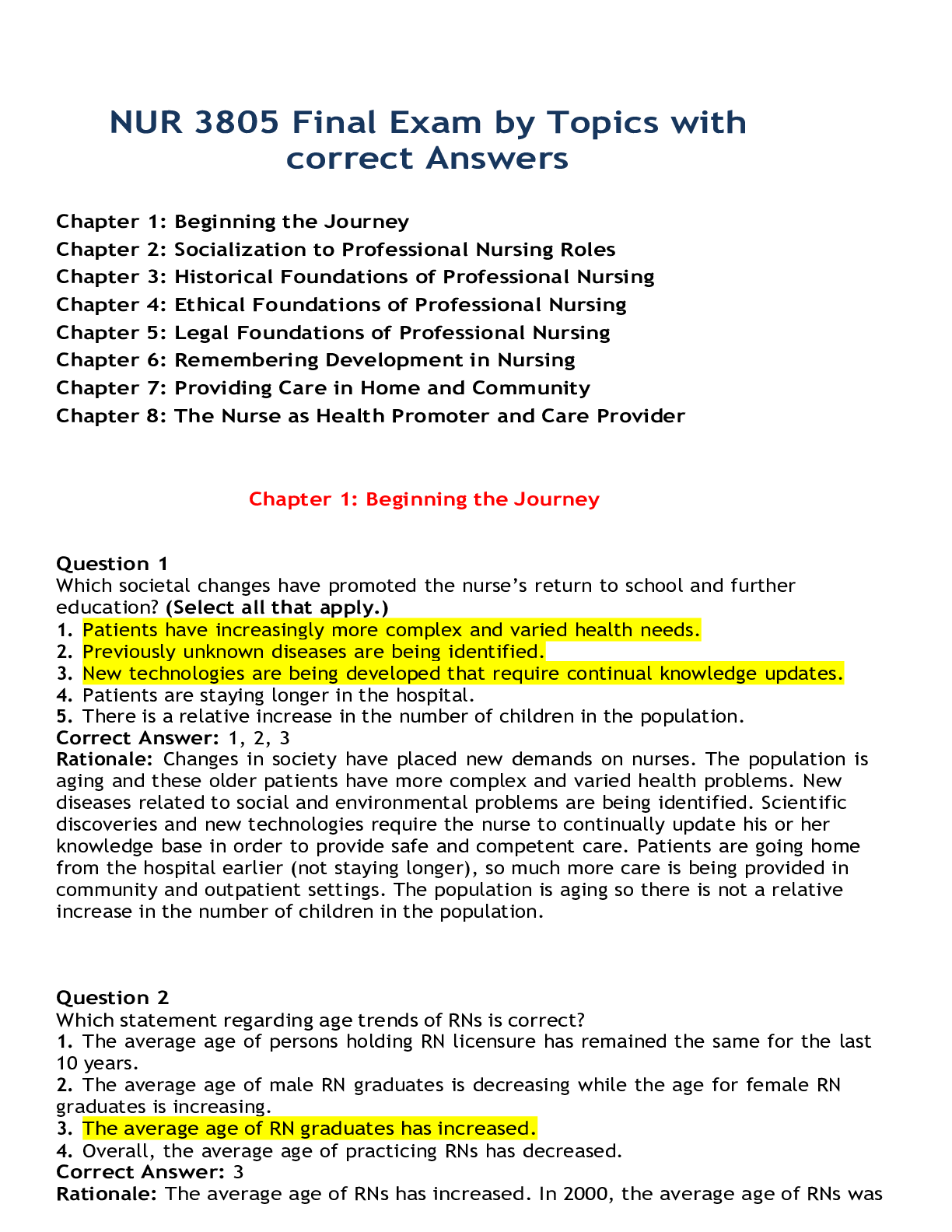



 Head To Toe Assessment Guide.png)