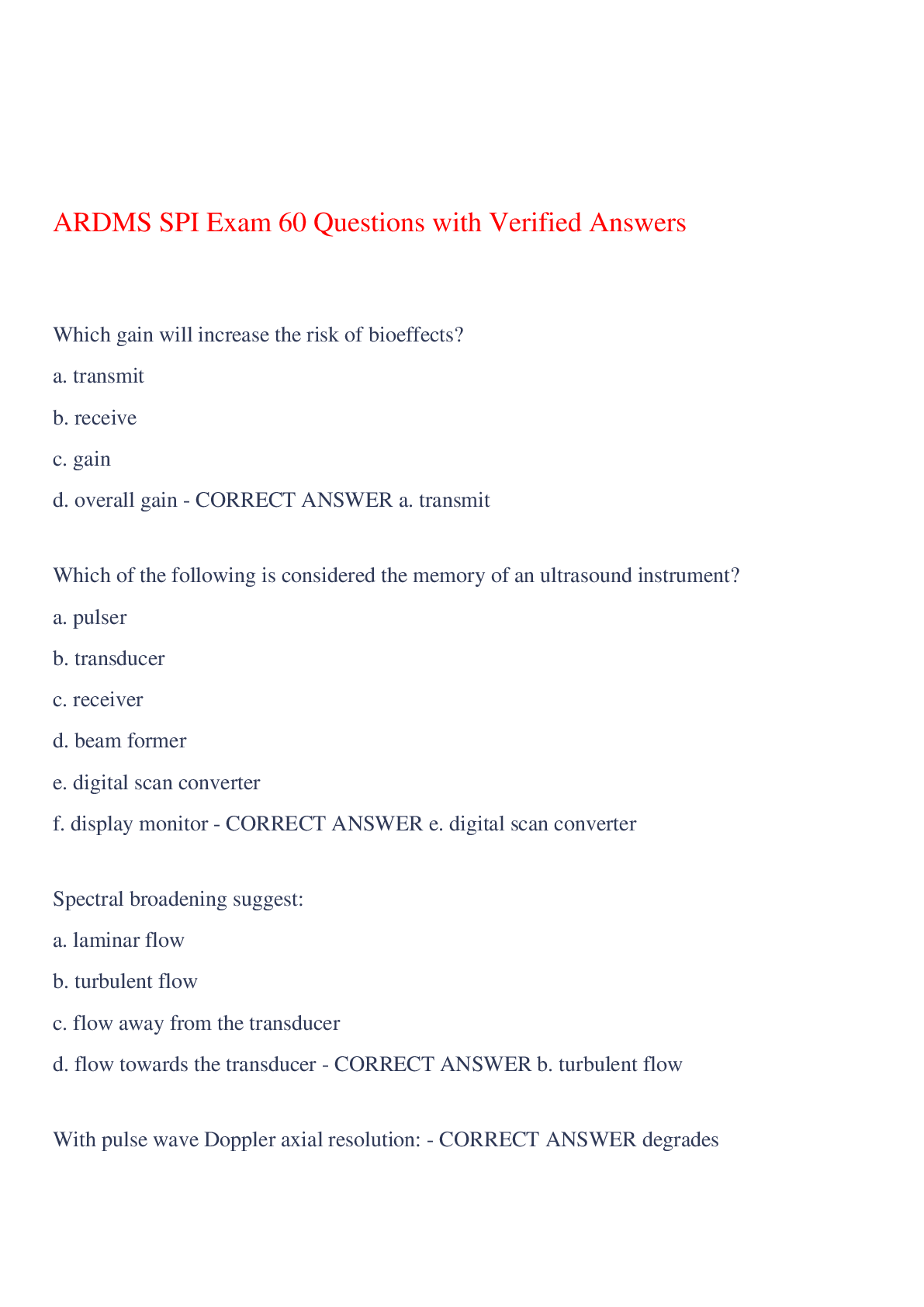
ARDMS SPI Exam 60 Questions with Verified Answers
Which gain will increase the risk of bioeffects?
a. transmit
b. receive
c. gain
d. overall gain - CORRECT ANSWER a. transmit
Which of the following is conside
...
ARDMS SPI Exam 60 Questions with Verified Answers
Which gain will increase the risk of bioeffects?
a. transmit
b. receive
c. gain
d. overall gain - CORRECT ANSWER a. transmit
Which of the following is considered the memory of an ultrasound instrument?
a. pulser
b. transducer
c. receiver
d. beam former
e. digital scan converter
f. display monitor - CORRECT ANSWER e. digital scan converter
Spectral broadening suggest:
a. laminar flow
b. turbulent flow
c. flow away from the transducer
d. flow towards the transducer - CORRECT ANSWER b. turbulent flow
With pulse wave Doppler axial resolution: - CORRECT ANSWER degrades
What color is usually use in color flow Doppler variance map to indicate turbulent flow? - CORRECT ANSWER green
Doppler high pass filter eliminates: - CORRECT ANSWER high amplitude signals; low velocity flow
The Doppler wall filter is considered a: - CORRECT ANSWER high pass filter
The Nyquist Limit is equal to:
a. propagation speed x frequency
b. propagation speed/ wavelength
c. PRF/2
d. 4xV^2 - CORRECT ANSWER c. PRF/2
Multiple echoes, equally spaced originating from a gas bubble is called:
a. comet tail
b. ring down
c. slice thickness artifact
d. multipath - CORRECT ANSWER b. ring down
An increase in red blood cell velocity will_____ the Doppler Shift:
a. increase
b. decrease
c. not change
d. cannot be predicted - CORRECT ANSWER a. increase
The primary advantage of CW Doppler is:
a. range resolution
b. range discrimination
c. range ambiguity
d. range gating
e. absence of sampling rate - CORRECT ANSWER e. absence of sampling rate
The range for ultrasound begins:
a. 20 Hz
b. 20,000 Hz
c. 2 MHz
d. 15 MHz - CORRECT ANSWER b. 20,000 Hz (useful frequency range for clinical imaging is 2MHz-10MHz)
Which instrument control affects the amplitude (dB) of the outgoing signal:
a. gain
b. receiver gain
c. TGC
d. transmit gain
e. overall gain - CORRECT ANSWER d. transmit gain; amplitude can be affected by the sonographer
Which of the following is used to convert Doppler shift information into color:
a. high PRF
b. fast Fourier transform
c. autocorrelation
d. time interval histogram - CORRECT ANSWER c. autocorrelation
b is incorrect because fast Fourier transform is the method used to process conventional Doppler shift information but is too slow a method for color Doppler
Pulse repetition frequency - CORRECT ANSWER Number of pulses that an ultrasound system transmits into the body each second. Hz. Typically 4-15 KHz. PRF and depth of a view are inversely related: When system is imaging deeper, the pulse repetition frequency is lower.
Also the number of pulses created each second
The best way to increase the near field length of an ultrasound beam is to: - CORRECT ANSWER increase transducer diameter
The range of frequencies produced by a damped PZT element is called:
a. fundamental frequencies
b. Q Factor
c. near field
d. bandwith - CORRECT ANSWER d. bandwidth
The percentage of time that the ultrasound instrument is emitting ultrasound is called:
a. PRF
b. pulse duration
c. pulse repetition period
d. duty factor - CORRECT ANSWER d. duty factor; the maximum value is 1, the minimum is 0
The unit of duty factor is:
a. Hz
b. mm
c. ms
d. unitless - CORRECT ANSWER d. unitless
Quality Factor= Fundamental frequency/ bandwidth - CORRECT ANSWER This allows doses of different types of radiation to be compared for their biological effects.
Clinical imaging transducers are: - CORRECT ANSWER wide bandwidth; low q factor
Power/area= - CORRECT ANSWER Intensity
Increasing wavelength will ___________ frequency.
a. increase
b. decrease
c. not change
d. cannot be predicted. - CORRECT ANSWER b. decrease
All of the following directly affect frame rate except:
a. depth of penetration
b. field of view
c. number of focuses
d. line density
e. beam width - CORRECT ANSWER e. beam width
A reflection will occur at the boundary of two media if the acoustic impedences of the two media are:
a. equal
b. different
c. unchanged
d. cannot be predicted - CORRECT ANSWER b. different
A mechanical transducer utilizes:
a. transmit focus
b. receive focus
c. fixed focus
d. dynamic aperture focusing - CORRECT ANSWER c. fixed focus; sonographer cannot determine the location of # of foci. mechanical transducer uses cross sectional imaging, rotating wheel, wobbler, oscillating mirror
The transducer frequency is primarily determined by the transducer element:
a. diameter
b. thickness
c. propagation speed
d. type - CORRECT ANSWER b. thickness
A strongly focused transducer implies a:
a. short focal length; decreased beam divergence
b. medium focal length; increased beam divergence
c. long focal length; no beam divergenc
d. short focal length; increased beam divergence - CORRECT ANSWER d. short focal length; increased beam divergence
B-mode displays reflector:
a. amplitude and distance
b. amplitude and velocity
c. power and direction
d. depth and speed - CORRECT ANSWER a. amplitude and distance
An increase in the number of pixels on the display will improve: - CORRECT ANSWER detail resolution
Propagation speed is determined by:
a. frequency
b. harmonics
c. bandwidth
d. bulk modulus - CORRECT ANSWER d. bulk modulus
Increasing transmit gain increases everything except: - CORRECT ANSWER frequency
The correct depth placement of reflectors depends primarily upon:
a. frequency
b. period
c. power
d. propagation speed - CORRECT ANSWER d. propagation speed
Which of the following will increase the color flow jet area displayed?
a. increase color gain
b. increase velocity scale
c. increase frequency - CORRECT ANSWER a. increase color gain
Increasing propagation speed: - CORRECT ANSWER air, soft tissue, bone
The most common type of transducer used in echo is: - CORRECT ANSWER sector phased array
Decibels are the units for all of the following except:
a. amplitude
b. transmit gain
c. gain
d. attenuation
e. TGC
f. dynamic range
e. intensity - CORRECT ANSWER e. intensity= mW/cm2
What are the four acoustic variables: - CORRECT ANSWER 1. temperature, density, particle motion, pressure
Frequency is - CORRECT ANSWER Cycles per second (Hz)
not affected by sonographer
increase frequency; decrease depth
Pulse duration - CORRECT ANSWER period (ms) x # of cycles in a pulse
Wavelength - CORRECT ANSWER the length of one cycle
wavelength= propagation speed/ frequency
1.54/3MHz= .5mm
An increase in packet size will _______ the frame rate - CORRECT ANSWER Decrease
The range for audible sound is: - CORRECT ANSWER 20 Hz- 20kHz
The wavelength of a 1MHz transducer is: - CORRECT ANSWER 1.54/1= 1.54mm
The average speed of sound in soft tissue is: - CORRECT ANSWER 1540m/s; 1.54km/s; 1.54mm/us
An increase in overall gain will result in all of the following except:
a. increase in image brightness
b. increase in output power
c. increase in amplification of the returning signal
d. decrease risk in bioeffects - CORRECT ANSWER b. increase in power
Reject eliminates: - CORRECT ANSWER low amplitude signals
There have been no proven biological effects for unfocused transducers for intensities below: - CORRECT ANSWER 100mW/cm2 SPTA
The primary cause of attenuation of ultrasound in soft tissue is caused by: - CORRECT ANSWER absorption
Resolution artifact - CORRECT ANSWER When two structures parallel to the ultrasound beam are displayed as one reflector.
Damping does not decrease: - CORRECT ANSWER bandwidth
Spectral Broadening - CORRECT ANSWER The widening of the doppler shift spectrum. Meaning the increase of the range of doppler shift frequencies present, owing to a broader range of flow speeds encountered by the sound beam.
Refraction - CORRECT ANSWER Change in direction of a wave when it changs speed as in travels from one material to another. The change in the direction of sound as it crosses a boundary.
autocorrelation - CORRECT ANSWER used to convert Doppler shift information into color.
PRF - CORRECT ANSWER Pulse Repetition Frequency. The rate at which pulses are transmitted, given in hertz or pulses per second; reciprocal of pulse-repetition time.
Period - CORRECT ANSWER the time per cycle
1-10usec
Period Calculation - CORRECT ANSWER 1/frequency
1/5MHz= .2
How do you decrease period? - CORRECT ANSWER Increase frequency
Impedance - CORRECT ANSWER the opposition of sound propagation
The unit for impedance? - CORRECT ANSWER Rayls
[Show More]