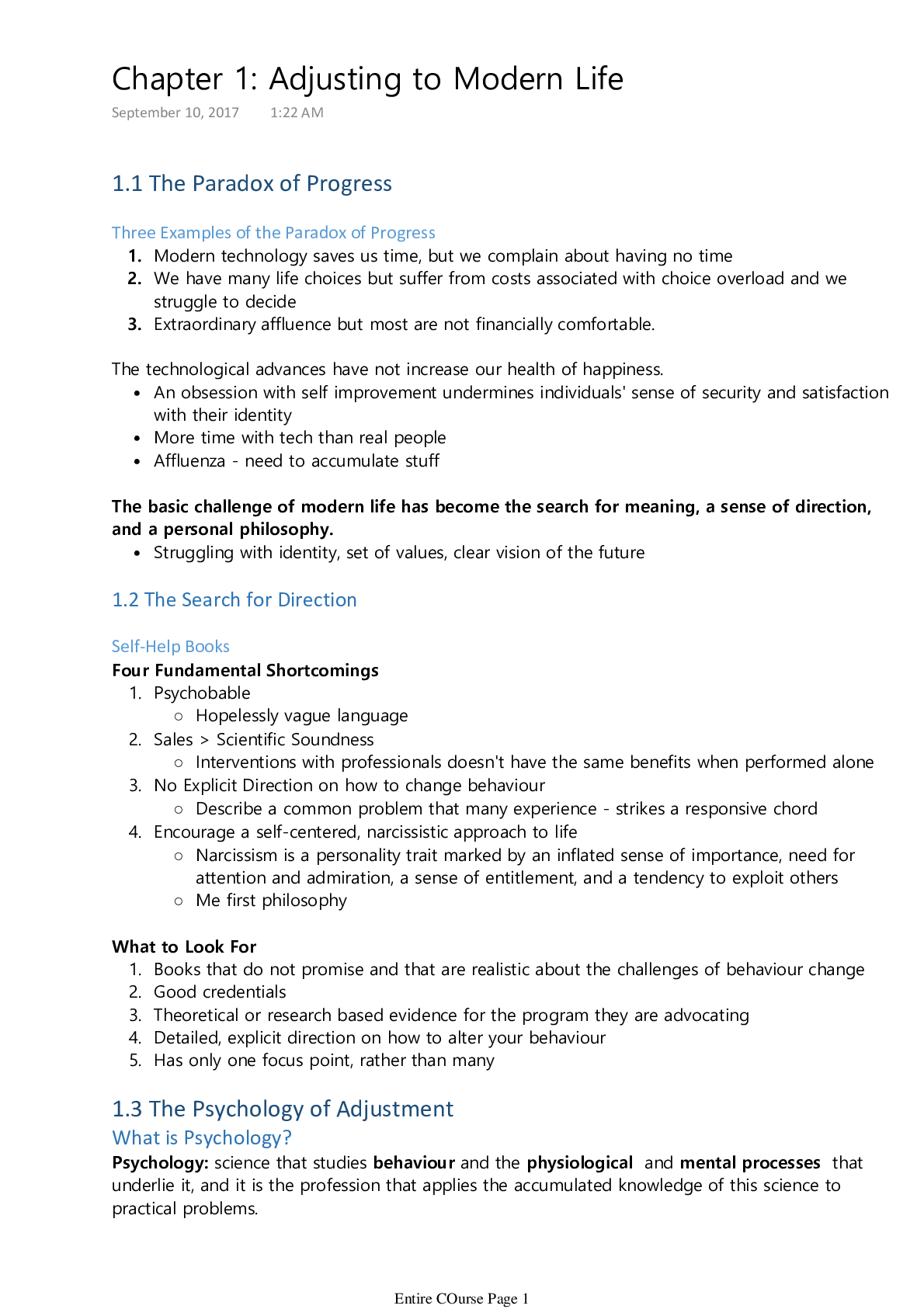
1.1 The Paradox of Progress
1. Modern technology saves us time, but we complain about having no time
We have many life choices but suffer from costs associated with choice overload and we
struggle to decide
2.
3. Ex
...
1.1 The Paradox of Progress
1. Modern technology saves us time, but we complain about having no time
We have many life choices but suffer from costs associated with choice overload and we
struggle to decide
2.
3. Extraordinary affluence but most are not financially comfortable.
Three Examples of the Paradox of Progress
An obsession with self improvement undermines individuals' sense of security and satisfaction
with their identity
•
• More time with tech than real people
• Affluenza - need to accumulate stuff
The technological advances have not increase our health of happiness.
• Struggling with identity, set of values, clear vision of the future1.2 The Search for Direction
Self-Help Books
○ Hopelessly vague language
1. Psychobable
○ Interventions with professionals doesn't have the same benefits when performed alone
2. Sales > Scientific Soundness
○ Describe a common problem that many experience - strikes a responsive chord
3. No Explicit Direction on how to change behaviour
Narcissism is a personality trait marked by an inflated sense of importance, need for
attention and admiration, a sense of entitlement, and a tendency to exploit others
○
○ Me first philosophy
4. Encourage a self-centered, narcissistic approach to life
Four Fundamental Shortcomings
1. Books that do not promise and that are realistic about the challenges of behaviour change
2. Good credentials
3. Theoretical or research based evidence for the program they are advocating
4. Detailed, explicit direction on how to alter your behaviour
5. Has only one focus point, rather than many
What to Look For
1.3 The Psychology of Adjustment
What is Psychology?
Psychology: science that studies behaviour and the physiological and mental processes that
underlie it, and it is the profession that applies the accumulated knowledge of this science to
practical problems.
Behaviour: is an overt/observable response or activity of the organism.
Chapter 1: Adjusting to Modern Life
September 10, 2017 1:22 AM
Entire COurse Page 1• Is not confined to human study, prefer animals for more control
Behaviour: is an overt/observable response or activity of the organism.
• Represented through psych services available to the public
I.e Clinical Psychology - concerned with the diagnosis and treatment of psychological
problems and disorders
•
Applied side
What is Adjustment?
• Coined from adaptation - efforts to change to the changing environment
Adjustment is the psychological processes through which people manage or cope with the
demands and challenges of everyday life.
1.4 The Scientific Approach to Behaviour
Conclusions are based on systemic observation rather than reasoning, speculation, traditional
beliefs and common sense
•
• Two main types: experimental and correlation
Empiricism is the premise that knowledge should be acquired through observation
Hindsight Bias: tendency to exaggerate one's ability to have foreseen how something turned out
Experimental Research
If the experimental and control groups alike in every way except for the treatment from the
independent variable
•
• If a difference is the dependent variable is found
• The difference in their response must be due to the IV
Experimental Research: method where one variable is manipulated (independent) in a controlled
condition to observe changes in the second variable (dependent)
Entire COurse Page 2Independent and Dependent Variables
Independent Variable: condition or event that an experimenter varies in order to see its impact on
another
Dependent Variable: the variable that is thought to be affected by the manipulation of the
independent variable.
Groups
Experimental Group: subjects who receive the special treatment in regards to the independent
variable
Control Group: do not receive the special treatment given to the experimental group.
If the two groups are alike in everything except the treatment, than the treatment is responsible for
the variation.
Advantages and Disadvantages
• Cause and effect between variables conclusion
• Precise control allows isolation of the relationship between variables
Advantage:
• Some variables cannot be manipulated because of ethical concerns
• May not be generalizable
Disadvantage:
Correlational Research: Looking for Links
• Cannot control the variables in the study
Correlation exists when two variables are related to each other
Measuring Correlation
○ Close the correlation coefficient is to |1.00|
1. How strongly related two variables are
○ Positive = same direction
○ Negative=opposite direction
2. Direction of the relationship
[Show More]







.png)
-Hesi-Anatomy-and-physiology-(Complete-Answers).png)