BIS 245 Week 8 Final
Grading Summary
Grade Details - All Questions
Page: 1 2 3
Question 1. Question : (TCO 1) Databases create business value by:
Student Answer:
Facilitating transaction processing
Providing data
...
BIS 245 Week 8 Final
Grading Summary
Grade Details - All Questions
Page: 1 2 3
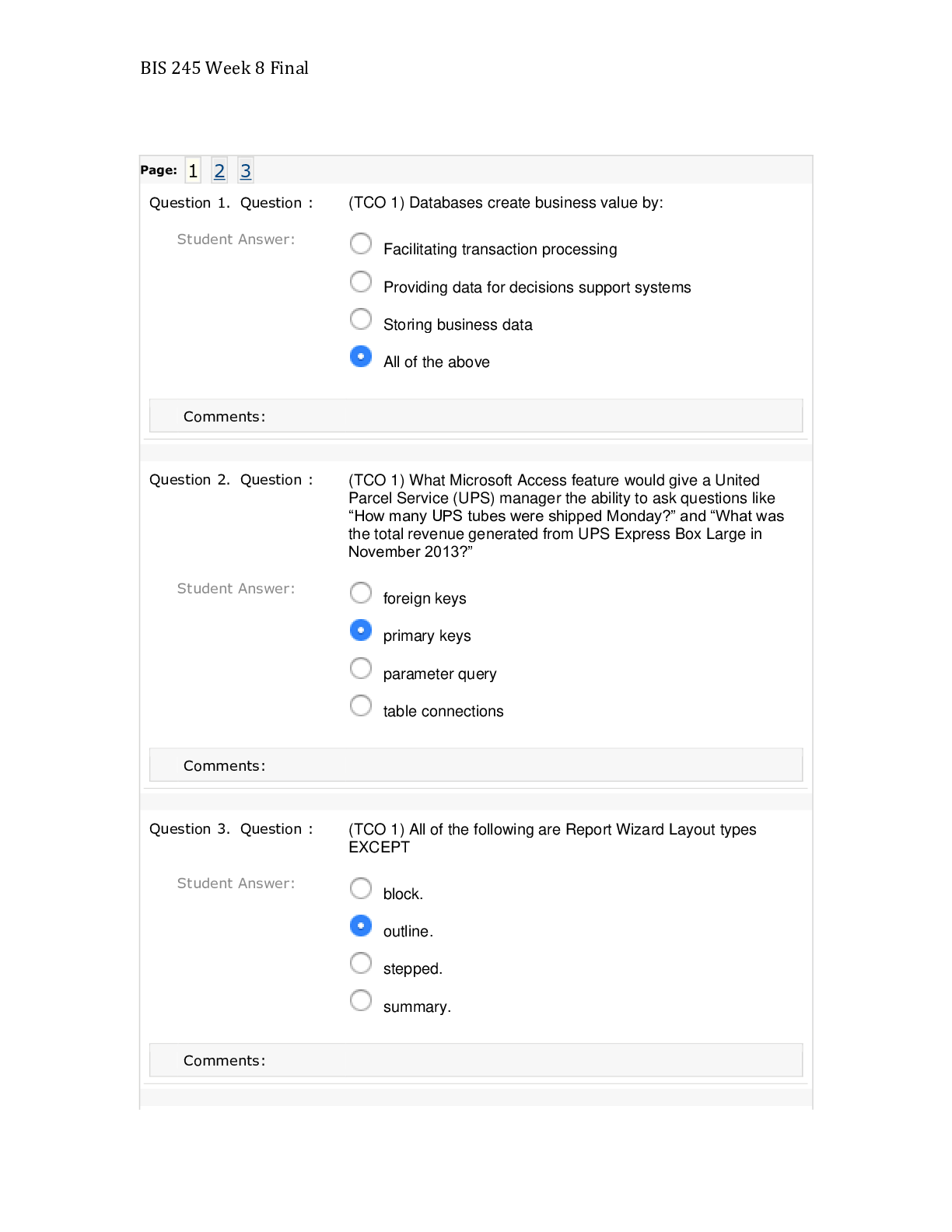
Question 1. Question : (TCO 1) Databases create business value by:
Student Answer:
Facilitating transaction processing
Providing data for decisions support systems
Storing business data
All of the above
Comments:
Question 2. Question : (TCO 1) What Microsoft Access feature would give a United
Parcel Service (UPS) manager the ability to ask questions like
“How many UPS tubes were shipped Monday?” and “What was
the total revenue generated from UPS Express Box Large in
November 2013?”
Student Answer:
foreign keys
primary keys
parameter query
table connections
Comments:
Question 3. Question : (TCO 1) All of the following are Report Wizard Layout types
EXCEPT
Student Answer:
block.
outline.
stepped.
summary.
Comments:BIS 245 Week 8 Final
Question 4. Question : (TCO 1) Which of the following is a/are question(s) that you
should ask before you create an Access report?
Student Answer:
What is the purpose of the report?
Who will use the report?
How will the report be distributed?
All the above questions should be asked.
Comments:
Question 5. Question : (TCO 1) A Detail line is used to
Student Answer:
print more detailed information on one record only.
provide additional field information on a record.
repeat data for each record in the record source.
All of the above
Comments:
Question 6. Question : (TCO 2) A field that uniquely identifies each record in a table is a
Student Answer:
link.
relationship.
primary key.
foreign key.
Comments:
Question 7. Question : (TCO 2) SQL is a fourth-generation language that is
Student Answer:
flat-file oriented and nonprocedural.
oriented toward static data.BIS 245 Week 8 Final
procedural and record oriented.
table oriented and nonprocedural.
Comments:
Question 8. Question : (TCO 3) Which of the following should be considered when
designing a database?
Student Answer:
How calculated fields are used
Store data in its smallest parts
The relationship between attribute keys
The relationships between records
Comments:
Question 9. Question : (TCO 3) Summarized data in an easy-to-read view is known as a
Student Answer:
design.
PivotTable.
report.
table.
Comments:
Question 10. Question : (TCO 3) Which of the following does NOT describe a caption
property?
Student Answer:
A label can substitute for a field name in Datasheet View.
The caption appears in Datasheet View, Form, and Report.
The label allows spaces between words.
The label can be used in place of a field name in an
expression.BIS 245 Week 8 Final
Comments:
Question 11. Question : (TCO 4) Which function is used to isolate a specific portion of a
date such as year, month, or day in a date field?
Student Answer:
Date
DateDiff
DateParse
DatePart
Comments:
1. Question : (TCO 5) To edit a form, use
Student Answer:
datasheet view.
design view.
layout view.
layout view or design view.
Comments:
Question 2. Question : (TCO 5) Clicking on the form tool will open a(n)
Student Answer:
existing form.
new form in design view.
new form in layout view.
wizard to design a form.
Comments:
Question 3. Question : (TCO 6) Which of the following describes a poor design
consideration for a form?BIS 245 Week 8 Final
Student Answer:
Arrange controls closely together or in a sequence that is
easy to read by the user.
Each form should have a different theme.
Make labels descriptive and clear.
Right-align labels followed by a colon and left-align bound
controls.
Comments:
Question 4. Question : (TCO 6) After running a query, which view will be shown?
Student Answer:
Datasheet
Design
Query
Result
Comments:
Question 5. Question : (TCO 7) When making vertical data comparisons, you should use
the following chart.
Student Answer:
Bar
Column
Pie
Scatter Plot
Comments:
Question 6. Question : (TCO 7) Which of the following statements best describes data
mining?
Student Answer:
It is the determining of future volume of sales.
It is the predicting of future customer buying behavior.BIS 245 Week 8 Final
It is identifying patterns or relationships through a process of
analyzing large quantities of data.
It is tracking customer purchasing behavior.
Comments:
Question 7. Question : (TCO 8) A switchboard is a
Student Answer:
form that looks like a menu or a series of menus that ties objects in
a database.
design tool to analyze and optimize a database.
report that looks like a menu or a series of menus that
ties objects in a database.
screen that is used to hide objects from users.
Comments:
Question 8. Question : (TCO 9) Open Exclusive means that
Student Answer:
a password is required to open the Access database.
only one person has access to the Access database at any
time.
only selected persons can have access to the Access
database.
two or more people cannot open the same Access database
at the same time.
Comments:
Question 9. Question : (TCO 9) All of the following are true when a user creates their own
self-signed digital signature EXCEPTBIS 245 Week 8 Final
Student Answer:
a time stamp is not required to go through a commercial
service or local server for processing.
a time stamp will prove when the file was last used.
it is created through another software application.
it will prove that the creator owns the database.
Comments:
Question 10. Question : (TCO 10) ACCDE files
Student Answer:
deny users permission to create and change forms and
reports within a database.
deny users permission to create forms and reports but will
allow them to modify forms and reports.
give users permission to create and change forms and
reports within a database.
give users permission to fully access a database.
Comments:
Question 11. Question : (TCO 4) The term "cascading" refers to
Student Answer:
data changes travel from one table to another.
data is put in sequential order.
queries can retrieve data at a faster rate.
records are arranged in order.
Comments:
1. Question : (TCO 1) Designing a database often involves obtaining different
perspectives from various sources to gather information. Discuss
the importance of end user interviews in the data requirements
gathering process.
Student Answer: Data modeling helps to understand the informationBIS 245 Week 8 Final
requirements. Data modeling differs according to the type of the
business, because the business processes or each sector is
different, and it needs to be identified in the modeling stage.
Initial step is the analyzing the situation, gather data. Data
modeling process starts with requirement gatherings. When
developing the proper data model it is important to
communicate with the stakeholders about the requirements.
Data modeling is the act of exploring data oriented structures.
This can be used for variety of purposes. One of the important
functions of data modeling is that, it helps to understand the
information requirements. Especially this makes both developers
and end users lives easier. As mentioned above, data modeling
helps the end users to define their requirements, and the
developers are able to develop a system to meet those specified
requirements.
Comments:
Question 2. Question : (TCO 2) Explain the purpose of a conceptual database model and
describe the most common method of creating one.
Student Answer: A conceptual data model is a summary-level data model that is
most often used on strategic data projects. It typically describes
an entire enterprise. Due to its highly abstract nature, it may be
referred to as a conceptual model. Enterprise-wide coverage of
the business concepts. Think Customer, Product, Store,
Location, Asset. Designed and developed primarily for a business
audience Contains around 20-50 entities (or concepts) with no
or extremely limited number of attributes described. Sometimes
architects try to limit it to printing on one page. Contains
relationships between entities, but may or may not included to
the database. Designed and developed to be independent of
DBMS, data storage locations or technologies. In fact, it would
address digital and non-digital concepts. This means it would
model paper records and artifacts as well as database artifacts.
Comments:
Question 3. Question : (TCO 4) Explain the terms entity and attribute. Describe an
example of an entity and then list two attributes. Using your
examples, explain the data types that would be used to capture the
attributes.
Student Answer: In clinical data, the entity is typically a clinical event, as
described above. In more general-purpose settings, the entity is
a foreign key into an "objects" table that records common
information about every "object" (thing) in the database at the
minimum, a preferred name and brief description, as well as the
category/class of entity to which it belongs. Every record
(object) in this table is assigned a machine-generated object ID.
The "objects table" is now standard in most large bioinformaticsBIS 245 Week 8 Final
databases. The use of an objects table does not mandate the
concurrent use of an EAV design: conventional tables can be
used to store the category-specific details of each object. In the
EAV table itself, this is just an attribute ID, a foreign key into an
Attribute Definitions table, as stated above. However, there are
usually multiple metadata tables that contain attribute-related
information, and these are discussed shortly.
Comments:
Question 4. Question : (TCO 4) Explain 1NF, 2NF, and 3NF as related to database
design.
Student Answer: The database utilized for the design for data entry. This makes it
possible that all information is all input into individual table of
categories. This makes it impossible for information to not be
duplicated and do not repeat themselves. 1NF :As per 1NF, no
two rows of data must contain repeating group of information. In
all, each table must be organized into rows, and each row should
have a primary key that distinguishes it as unique. 2NF: As per
2NF, There must not be any partial dependency of any column
on primary key. 3NF: As per 3NF,every non-prime attribute of
table must be dependent on primary key. It removes the
transitive dependency . Therefore, by noting all of the
information if the 1NF, 2NF and 3NF make it possible to fulfill all
of the information needed to complete the database. This is a
very important contribution to make a report and get a clear
table all of data.
[Show More]