POLI 330N Week 8 Final Exam 3
with Answers
Question 12 Pointss
(TCO 1) Which best explains the differences between historians and political scientists?
Historians look for generalizations, and political scientists ar
...
POLI 330N Week 8 Final Exam 3
with Answers
Question 12 Pointss
(TCO 1) Which best explains the differences between historians and political scientists?
Historians look for generalizations, and political scientists are reluctant to generalize.
Historians are reluctant to generalize, and political scientists look for generalizations.
Historians are more likely to look for comparisons than political scientists.
Historians tend to focus on nature-based explanations, and political scientists focus on nurture-based
explanations.
Question 22 Pointss
(TCO 1) Which are both true for most political scientists?
They think practically and seek accuracy
They seek popularity and are skeptical of power
They offer single causes and think abstractly
They are skeptical of power and offer long-term consequences
Question 32 Pointss
(TCO 1) Voting for someone who is charismatic but whose policies might not benefit you would be
considered _____ behavior.
irrational
rational
legitimate
selfish
Question 42 Pointss
(TCO 1) Which of the following best exemplifies sovereignty?
The United States negotiating a trade agreement with Canada
The people of France acknowledging the authority of their president
Israel asserting jurisdiction over the Gaza Strip
President Obama having the support of the people who elected him
Question 52 Pointss
(TCO 1) The notion that you respect the U.S. Congress, even though it is controlled by a party with which
you do not agree, pertains to _____.
sovereignty
authority
legitimacy
monarchy
Question 62 Pointss
(TCO 1) Descriptions of political phenomena often lack _____.
rationality
reasoning
theory
balance
Question 72 Pointss
(TCO 1) The term for measuring with numbers is _____.
quantifying
hypothesis
qualifying
empirical
Question 82 Pointss
(TCO 4) The English common law stressed the rights of free and equal men and was developed on the
basis of precedent set by earlier judges, known today as _____.
judge-made law
judicial precedent
example by trial
court generated
Question 92 Pointss
(TCO 4) Under which of the following circumstances might a case be pursued as both a criminal and a
civil case?
A state accuses banks of mortgage fraud, sold to investors elsewhere in the nation.
Drug traffickers violate property and federal law by moving drugs across state borders.
Burglars violate federal property and the state sues them for damages.
The federal government accuses a food manufacture of unsafe food practices and consumers injured by
their product sue them.
Question 102 Pointss
(TCO 4) The concept of judicial review falls under which article of the U.S. Constitution?
Article I: The Legislative Branch
Article III: The Judicial Branch
Article VI: Debts, Supremacy, Oaths
Judicial review is not mentioned in the U.S. Constitution.
Question 112 Pointss
(TCO 4) Who nominates and approves federal judges in the U.S. court system?
The president and the Senate
The Senate and the House
The president and Speaker of the House
The Senate and the Secretary of State
Question 122 Pointss
(TCO 4) When was judicial review granted to the Supreme Court within the United States?
It was granted during the Constitution Convention of 1787.
It was granted in the Bill of Rights.
It was the result of the Marbury v. Madison decision of 1803.
It was never officially adopted but is an unofficial practice.
Question 132 Pointss
(TCO 4) Examine the ideal role of American judges.
Judges should intervene frequently, interpreting the law according to their expertise and ensuring a fair trial.
Judges should act as umpires, passively watching the legal drama and ruling only on disputed points of
procedure.
Judges should not intervene unless attorneys object, at which point they may either overrule or sustain the
objection.
Judges should take an active role, questioning witnesses, eliciting evidence, and commenting on procedure.
Question 142 Pointss
(TCO 4) In Lombard v. Louisiana (1963), the Warren Court supported _____, ruling that blacks who had
refused to leave a segregated lunch counter could not be prosecuted.
boycotts
sit-ins
picket lines
protests
Question 152 Pointss
(TCO 5) Countries with limits on government have usually had feudal pasts, which suggests what about
the dispersion of power?
Equal distribution of power is the only effective political structure.
Power must be distributed by the working class.
Power should be concentrated among the lower classes.
Dispersion of power is good and concentration of power is bad.
Question 162 Pointss
(TCO 5) How often does the cabinet change in a parliamentary system?
Every 4 years
Every 6 years
Every 8 years
When the cabinet is voted out or resigns
Question 172 Pointss
(TCO 5) Because of the separation of powers inherent in a presidential system, some scholars think that
executive-legislative _____ is common in systems like that used in the United States.
cooperation
stagnation
deadlock
insolvency
Question 182 Pointss
(TCO 5) Each division of government in a parliamentary system is headed by a _____.
secretary
president
prime minister
minister
Question 192 Pointss
(TCO 5) Distinguish the process that a parliamentary system uses to oust a chief executive from the one
available in the U.S. presidential system.
Parliamentary systems rely on impeachment, and presidential ones rely on constructive no confidence.
Parliamentary systems use constructive no confidence, and presidential systems have the option of
impeachment.
The prime minister can dissolve parliament, and the president can resign from office.
Parliamentary systems can hold a vote of no confidence and presidential ones have the option of
impeachment.
Question 202 Pointss
(TCO 5) Describe how the election process in a parliamentary system slightly resembles presidential
elections in the United States.
Party chiefs run as candidates for prime minister.
Citizens vote directly for the each new prime minister.
Citizens vote for a party member with the knowledge that the next prime minister will be the head of the
largest party.
The prime minister is appointed for a 4-year term and can be reappointed one time.
Question 212 Pointss
(TCO 5) Explain which type of candidate parliamentary systems seek out to become ministers.
Those who have experience winning elections and serving on a parliamentary committee
Newcomers who can bring in a fresh perspective to the ministry
Individuals who possess a great knowledge of the specific ministry’s area
Those who have political experience regardless of whether or not they have been elected in the past
Question 222 Pointss
(TCO 7) Radicals use the term political economy instead of _____ to describe their critique of capitalism
and the inequitable distribution of wealth among nations.
Marxism
laissez-faire
public choice
Keynesian
Question 232 Pointss
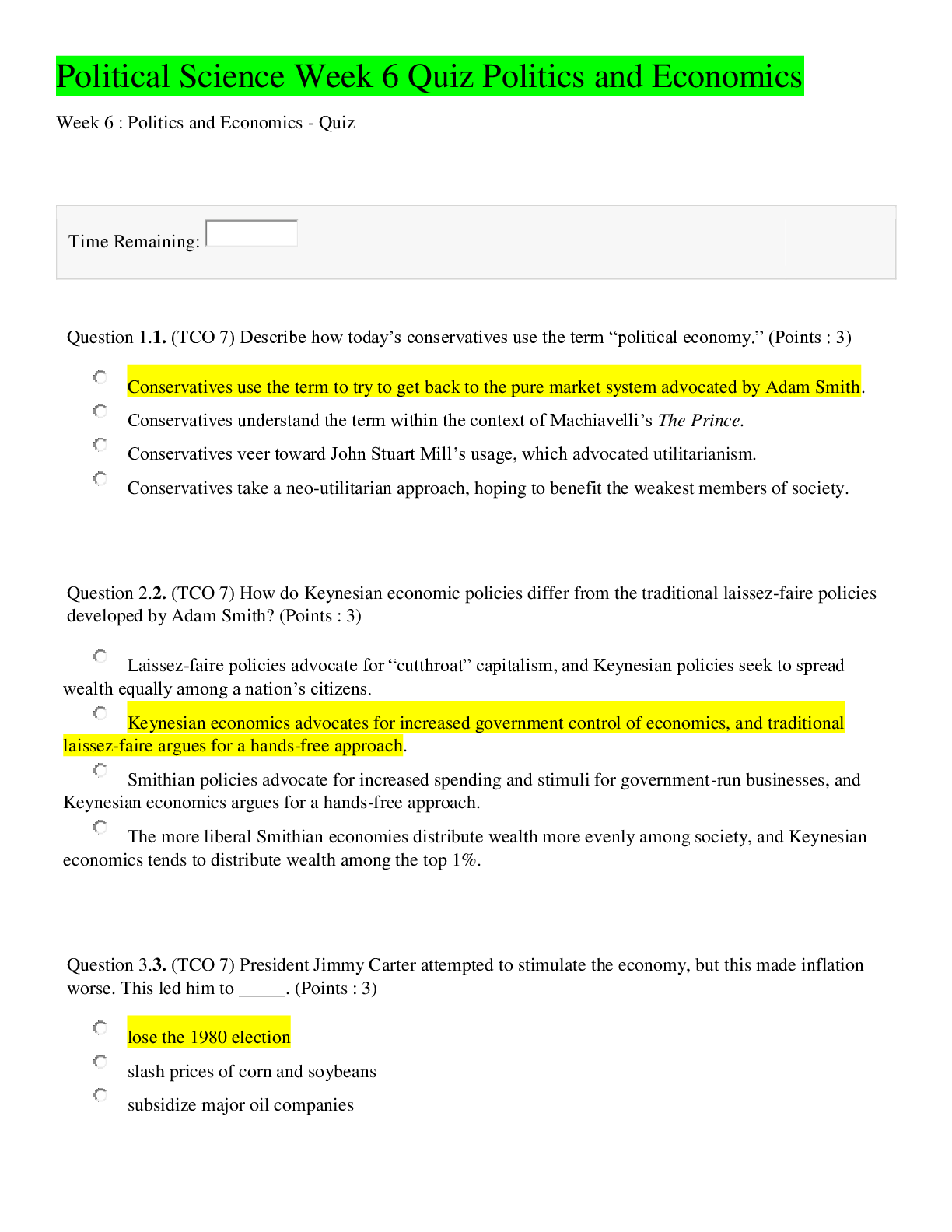
(TCO 7) How do Keynesian economic policies differ from the traditional laissez-faire policies developed
by Adam Smith?
Laissez-faire advocates for “cutthroat” capitalism, and Keynesian policies seek to spread wealth equally
among a nation’s citizens.
Keynesian economics advocate for increased government control of economics, and traditional laissez-faire
argues for a hands-free approach.
Smithian policies advocate for increased spending and stimuli for government-run businesses, and
Keynesian economics argues for a hands-free approach.
The more liberal Smithian economies distribute wealth more evenly among society, and Keynesian
economics tends to distribute wealth among the top 1%.
Question 242 Pointss
(TCO 7) What event is largely considered responsible for deterring Johnson’s War on Poverty?
Great Society
Vietnam War
Middle-class entitlements
Tax expenditures
Question 252 Pointss
(TCO 7) Differentiate between the rising costs of Medicare and Medicaid.
Medicare anticipates rising costs due to changing proportions of people over 65.
Medicaid expects rising costs due to looming financial busts.
Medicare plans to keep spending down by raising the eligibility age to 69.
Medicaid hopes to beat rising costs by adjusting the poverty level.
Question 262 Pointss
(TCO 7) According to political scientist Ira Sharkansky, “All modern states are welfare states, and all
welfare states are _____.”
democratic
compassionate
bureaucratic
incoherent
Question 272 Pointss
(TCO 7) How does the American welfare state compare to those of other industrialized nations?
Much less is allocated to welfare in the United States.
Other nations allocate less to welfare than the United States.
The United States allocates about the same to welfare.
Few nations besides the United States maintain funds for welfare.
Question 282 Pointss
(TCO 7) Many conservative economists argue that some banks are _____, because they would topple
the rest of the economy with them.
inherently successful
too big to fail
destined for profit
practically invincible
Question 292 Pointss
(TCO 9) _____ is a small or moderate change that essentially leaves the system intact.
Mass discontent
Reform
Dramatic system change
A coup d’etat
Question 302 Pointss
(TCO 9) What is the relationship between a high sense of government legitimacy among the people and
police officers when legitimacy is high?
Spending on policing is low.
There are fewer police interfering in civilian life.
Fewer police are needed.
The police must use a particularly heavy hand.
Question 312 Pointss
(TCO 9) What is likely to happen if the people are unhappy and there is no organization to focus their
discontent?
They will almost surely turn to violence.
Not much will happen.
The people will organize themselves, regardless.
They will eventually find other means of achieving contentedness.
Question 322 Pointss
(TCO 9) What are the aims of terrorists via their calculated acts of terrorism?
To panic their enemies, to gain publicity and recruits, and to get the foe to overreact and drive more people
to side with the terrorists
To destroy as much of the economic strength of a nation as possible
To kill national leaders
To kill their enemies, to gain recruits, and to get the UN to overreact and cause more people to side with the
terrorists
Question 332 Pointss
(TCO 9) According to Hannah Arendt, the American struggle was indeed a revolution, perhaps history’s
only complete revolution, _____.
because it alone ended with democratic institutions.
because it became an example for other nations.
because it managed to route what was then the great world power.
because it alone ended with a new foundation of liberty instead of the tyranny that came after other
revolutions.
Question 342 Pointss
(TCO 9) Why is the Middle East currently the breeding ground for considerable terrorist activity?
High birth rates produce many unemployed youth who are attracted to the simplistic lessons of Islamism,
which has made the United States an object of hate.
Low birth rates produce too few citizens to keep the economy growing, and poverty breeds unrest.
High birth rates produce many unemployed youth who are attracted to the complex lessons of Islamism,
which has made other Middle Eastern nations an object of hate.
Low birth rates produce too few citizens to keep the economy growing, and the poor are attracted to the
simplistic lessons of Islamism, which has made the United States an object of hate.
Question 352 Pointss
(TCO 9) Hannah Arendt pointed out that rage is the fuel of revolution, but what is now the greatest cause
of rage?
The low level of education in developing nations
The enormous economic mismanagement in industrialized nations
The extreme violence utilized by industrialized nations against developing nations
The massive corruption now found in developing lands
[Show More]





-Graded 100%.png)






 5e William Bianco David Canon.png)