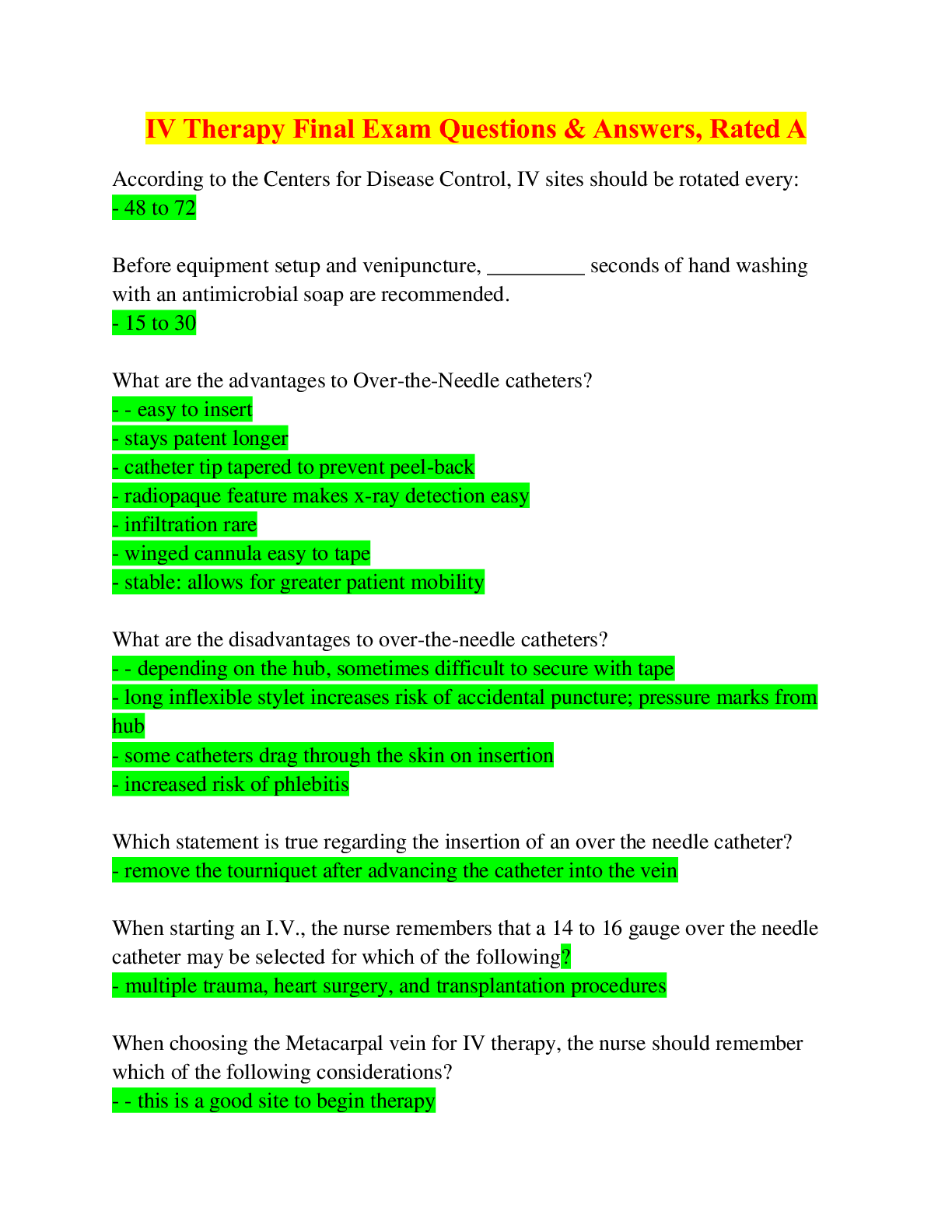
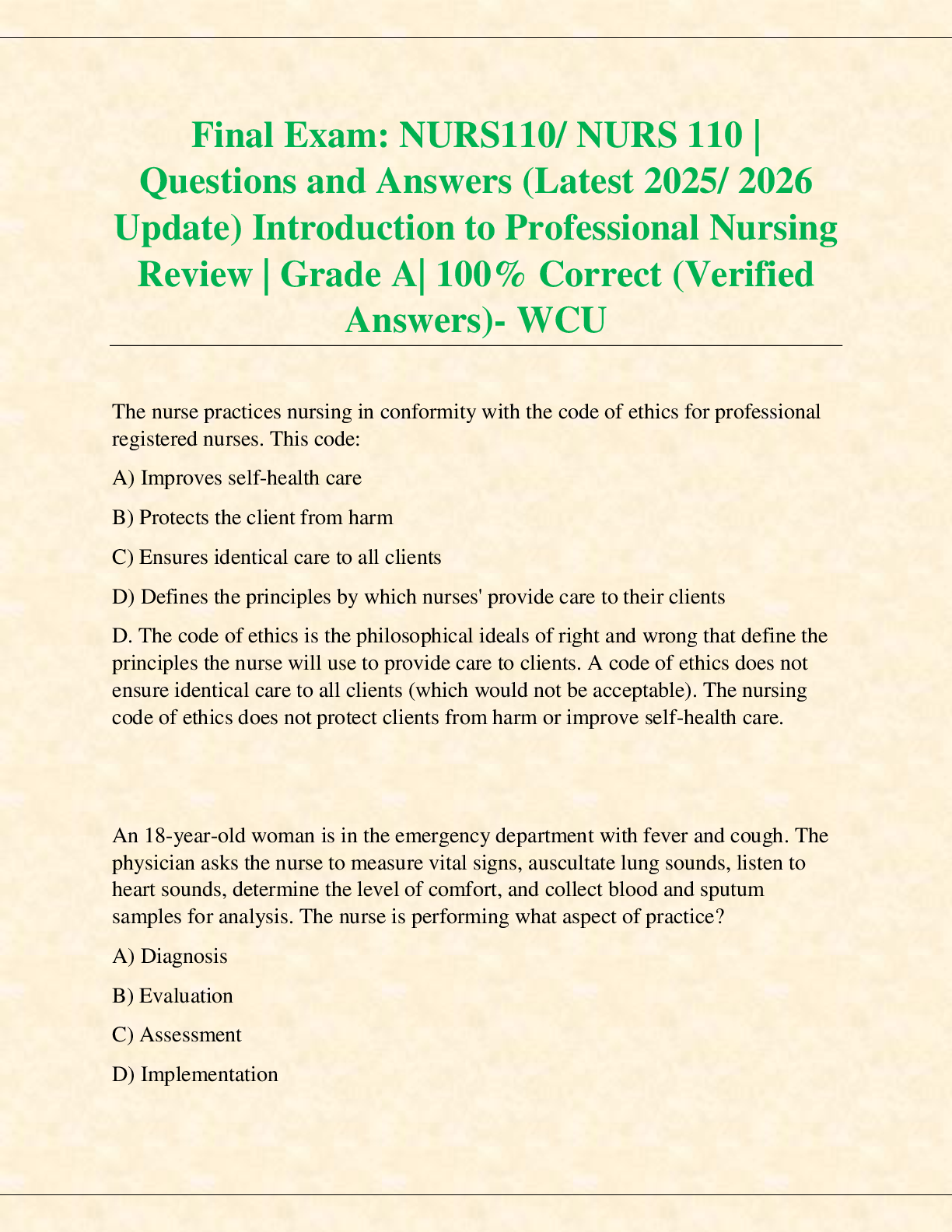
IV Therapy Final Exam Questions & Answers, Rated A-According to the Centers for Disease Control, IV sites should be rotated every:
- 48 to 72
Before equipment setup and venipuncture, _________ seconds of hand washin
...
IV Therapy Final Exam Questions & Answers, Rated A-According to the Centers for Disease Control, IV sites should be rotated every:
- 48 to 72
Before equipment setup and venipuncture, _________ seconds of hand washing with an antimicrobial soap are recommended.
- 15 to 30
What are the advantages to Over-the-Needle catheters?
- - easy to insert
- stays patent longer
- catheter tip tapered to prevent peel-back
- radiopaque feature makes x-ray detection easy
- infiltration rare
- winged cannula easy to tape
- stable: allows for greater patient mobility
What are the disadvantages to over-the-needle catheters?
- - depending on the hub, sometimes difficult to secure with tape
- long inflexible stylet increases risk of accidental puncture; pressure marks from hub
- some catheters drag through the skin on insertion
- increased risk of phlebitis
Which statement is true regarding the insertion of an over the needle catheter?
- remove the tourniquet after advancing the catheter into the vein
When starting an I.V., the nurse remembers that a 14 to 16 gauge over the needle catheter may be selected for which of the following?
- multiple trauma, heart surgery, and transplantation procedures
When choosing the Metacarpal vein for IV therapy, the nurse should remember which of the following considerations?
- - this is a good site to begin therapy
- this site is usually easily visualized
- this site should be avoided if infusing antibiotics, potassium chloride, or chemotherapeutic agents
When choosing an IV therapy site always try to:
- select a vein that's straight and will not be disturbed when the patient moves
The nurse should monitor the client receiving infusion therapy at least every:
- 2 hours for adults and one hour for children
IV therapy labels should be on which areas?
- catheter site, tubing, and solution container
Which IV fluid type pulls fluid into the veins from the more dilute area in cells and interstitial space?
- hypertonic
A client is scheduled a test that requires an NPO status and has been ordered 5% Dextrose in water (D5W). The nurse understands which of the following to be the best rational for this action:
- isotonic solutions maintain body fluid balance
A patient is prescribed an IV fluid to replace electrolytes and expand plasma volume. Which type of fluid will the nurse provide to the patient?
- hypertonic solution
Is an isotonic solution good to use?
- yes, because they maintain fluid balance
A patient is prescribed an IV infusion of a hypertonic solution. Which fluid shift should the nurse expect to occur with this type of infusion?
- Fluid moves from the interstitial space into the venous circulation
What are the examples of an Isotonic solution?
- - 0.9% NaCl
- 5% D and 0.2% NaCl
- Lactated Ringer's (multiple electrolyte solution)
- Ringer's injection (MES)
- Normosol-R (MES)
- Plasmalyte-A (MES)
- Isolyte E (MES)
- 10% Dextran and 0.9% NaCl (Specialty solution)
What are some examples of a Hypertonic solution?
- - 10% D/W
[Show More]