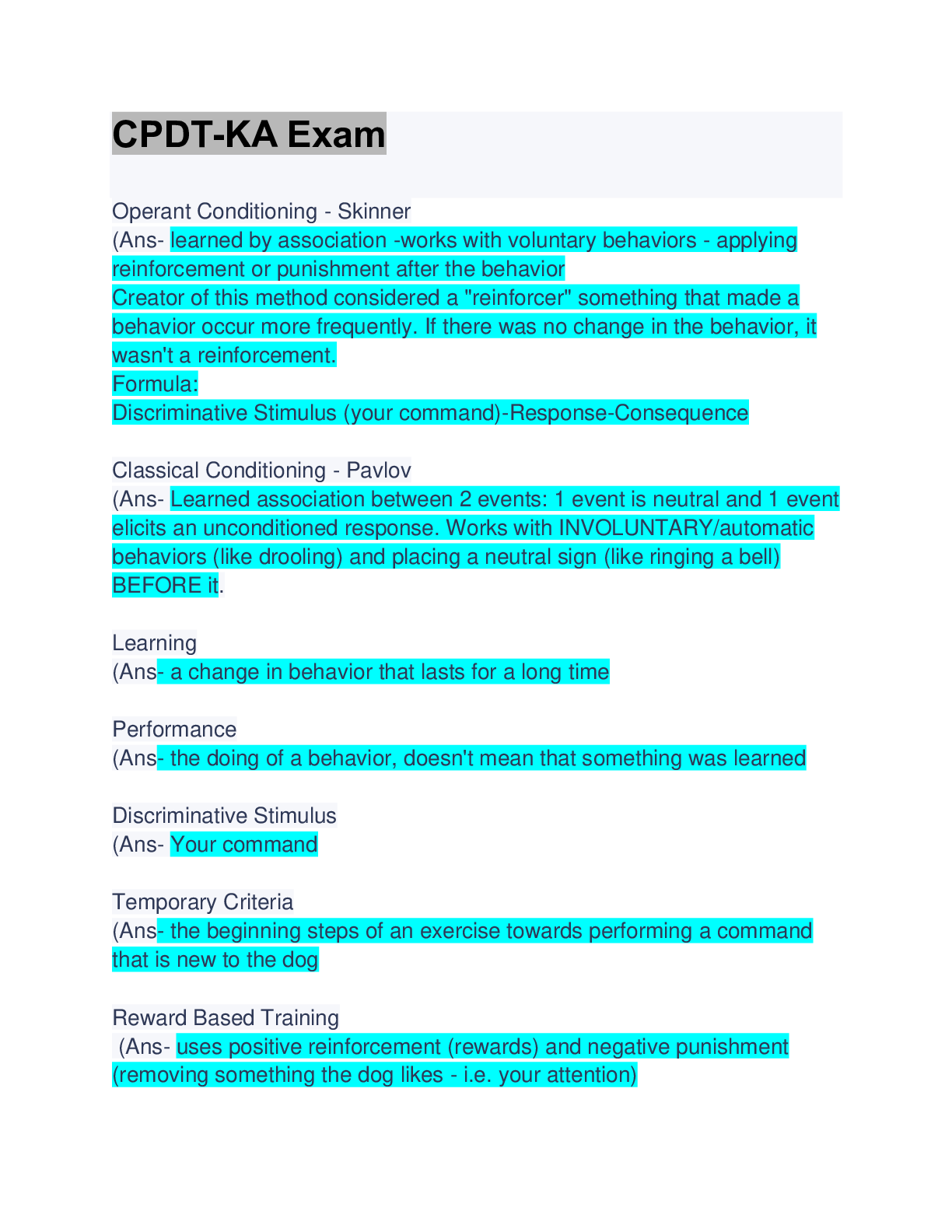
Operant Conditioning - Skinner
(Ans- learned by association -works with voluntary behaviors - applying reinforcement or punishment after the behavior
Creator of this method considered a "reinforcer" something that mad
...
Operant Conditioning - Skinner
(Ans- learned by association -works with voluntary behaviors - applying reinforcement or punishment after the behavior
Creator of this method considered a "reinforcer" something that made a behavior occur more frequently. If there was no change in the behavior, it wasn't a reinforcement.
Formula:
Discriminative Stimulus (your command)-Response-Consequence
Classical Conditioning - Pavlov
(Ans- Learned association between 2 events: 1 event is neutral and 1 event elicits an unconditioned response. Works with INVOLUNTARY/automatic behaviors (like drooling) and placing a neutral sign (like ringing a bell) BEFORE it.
Learning
(Ans- a change in behavior that lasts for a long time
Performance
(Ans- the doing of a behavior, doesn't mean that something was learned
Discriminative Stimulus
(Ans- Your command
Temporary Criteria
(Ans- the beginning steps of an exercise towards performing a command that is new to the dog
Reward Based Training
(Ans- uses positive reinforcement (rewards) and negative punishment (removing something the dog likes - i.e. your attention)
Primary Reinforcer
(Ans- food, water, anything dog needs for survival. Food activates parasympathetic nervous system, can calm dog, make him less fearful, & result in training process being enjoyable
Secondary Reinforcer aka Conditioned Reinforcer
(Ans- Clicker, saying "yes", . . . marks a behavior as rewardable and promises reward in near future. Rewards such as tennis balls, petting, clapping, tug- dog is conditioned to like them. all of these are learned through classical conditioning.
Tertiary Reinforcer
(Ans- cues the dog knows and enjoys doing. the doing is the reinforcer
[Show More]