https://www.coursehero.com/file/18474389/MIS589-Week-3-Quiz-3-prep/
MIS 589 Week 3 Quiz with
Answers
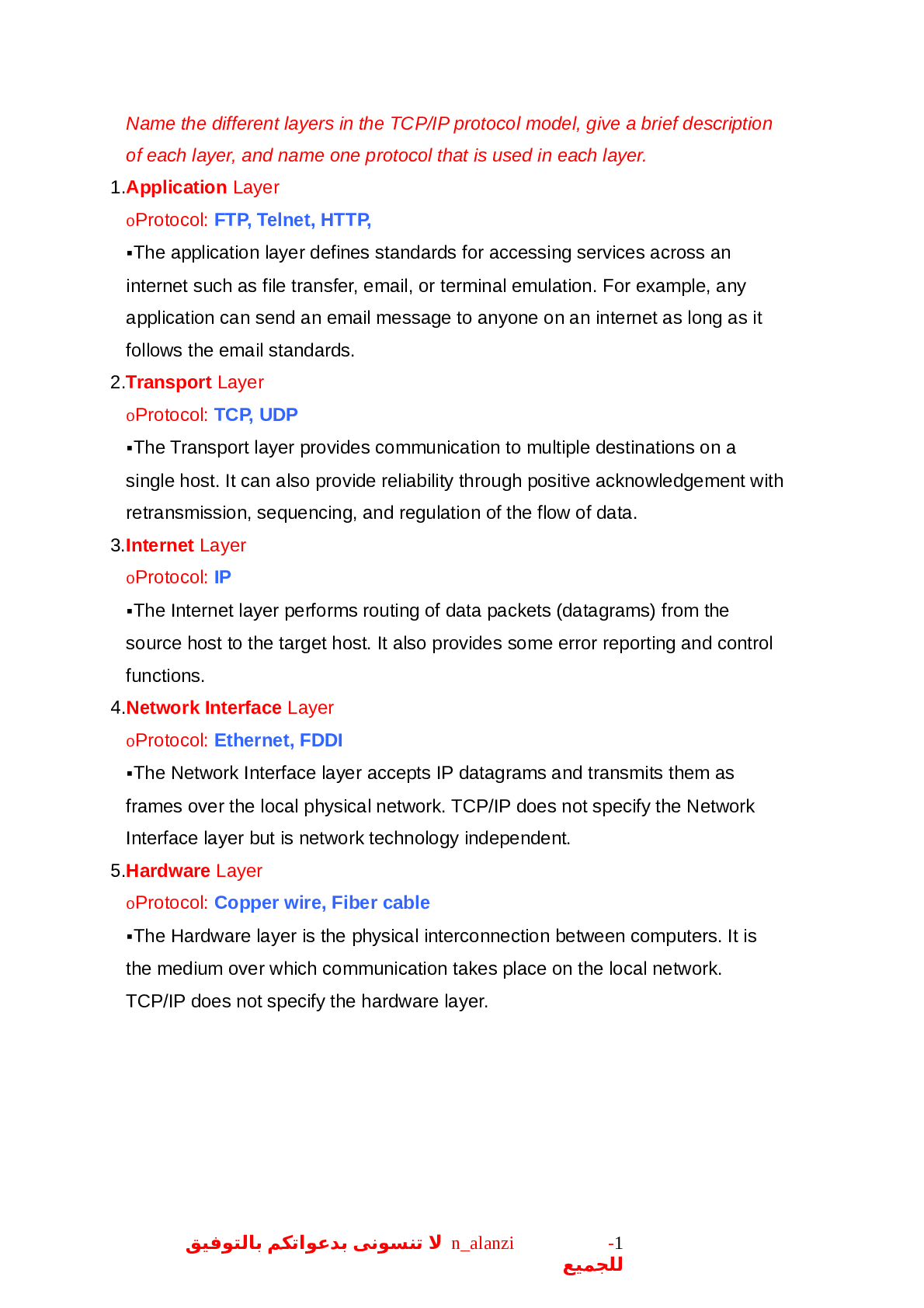
Question 1. 1. (TCO B) The layer links the application layer with the network layer and is
responsible for end-to-e
...
https://www.coursehero.com/file/18474389/MIS589-Week-3-Quiz-3-prep/
MIS 589 Week 3 Quiz with
Answers
Question 1. 1. (TCO B) The layer links the application layer with the network layer and is
responsible for end-to-end delivery of messages. (Points : 1)
physical
transport
session
presentation
data link
Question 2. 2. (TCO B) Transmission control protocol and Internet protocol was developed for in
1974. (Points : 1)
ARPANET
IBM
Hewlett-Packard
University of Minnesota
Xerox
Question 3. 3. (TCO B) The source destination port identifier tells the destination station (Points : 1)
which computer sent the TCP packet.
which application layer program that the packet should be sent.
which application layer process the packet is from.
the IP address of the source computer.
the IP address of the destination computer.
Question 4. 4. (TCO B) The newer form of IP, version 6 (Ipv6) (Points : 1)
is running out of address space to support the growth of the Internet.
has a 20 byte header.
has an increased address size from 32 bits to 128 bits.
does not include version number in its header.
does not include hop limit in its header.
Question 5. 5. (TCO B) A(n) refers to a group of computers that are logically grouped together by
IP number. (Points : 1)
IPv6 group
TCP group
https://www.coursehero.com/file/18474389/MIS589-Week-3-Quiz-3-prep/
data link group
https://www.coursehero.com/file/18474389/MIS589-Week-3-Quiz-3-prep/
subnet
application net
Question 6. 6. (TCO B) Server name resolution is done using the (Points : 1)
address resolution protocol.
border gateway protocol.
Internet control message protocol.
routing information protocol.
domain name service.
Question 7. 7. (TCO B) is the process of determining the path that a message will travel from
sending computer to receiving computer. (Points : 1)
Routing
Addressing
Interfacing
Broadcasting
Packetizing
Question 8. 8. (TCO B) A special type of message that is used when sending the same message to all
computers on a specific LAN or subnet is called a (Points : 1)
unicast message.
multicast message.
broadcast message.
guided message.
radiated message.
Question 9. 9. (TCO B) A special type of message that is used when sending the same message to a
specific group of computers is called a (Points : 1)
unicast message.
multicast message.
broadcast message.
guided message.
radiated message.
Question 10. 10. (TCO B) A majority of routers use the following operating system. (Points : 1)
Windows 95
Red Hat Linux
https://www.coursehero.com/file/18474389/MIS589-Week-3-Quiz-3-prep/
When a variety of devices are used in a network, it takes less time to perform network
Windows Server 2008
Cisco Internetwork Operating System
Linksys OSI System
Question 11. 11. (TCO D) Which of the following is not a step under the traditional network design
approach? (Points : 1)
An analyst develops cost estimates of the circuits needed to support the network.
come up with the estimate of the total traffic for the new network.
An analyst meets with users to identify user needs.
An analyst develops a precise estimate of the amount of data that users will send and receive to
estimate the total amount of traffic on each part of the network.
An analyst designs the circuits to support the estimated traffic, allowing for modest growth.
Question 12. 12. (TCO F) Which of the following is not contributing to the dramatic increase in network
traffic today? (Points : 1)
Video applications on networks are becoming common.
Electronic mail is now used by most people who work in organizations.
Web searches are now commonly performed by network users.
Client computers today can have 8 GB of RAM, a 1 TB hard drive, and 2 Ghz processors.
Multimedia applications on networks are becoming common.
Question 13. 13. (TCO F) Which of the following is false about staff costs for a network? (Points : 1)
The most expensive part of the network today is the staff who design, operate, and maintain it.
The emphasis is on network designs that reduce staff time needed to operate them.
Network staff are often required to learn how to operate a variety of devices.
Network staff are often required to maintain a variety of devices.
management activities.
Question 14. 14. (TCO F) In , the network designer attempts to understand the fundamental
current and future network needs of the various users, departments, and applications. (Points : 1)
technology design
needs analysis
narrow and deep analysis
cost assessment
distribution layering
An analyst takes the traffic on the current network and then multiplies that by a factor of 3.65 to
https://www.coursehero.com/file/18474389/MIS589-Week-3-Quiz-3-prep/
Question 15. 15. (TCO D) The network architecture component that contains the organization’s servers
is called the (Points : 1)
LAN.
building backbone.
data center.
enterprise edge.
WAN.
Question 16. 16. (TCO D) The network architecture component that is a special LAN with a group of
servers that enables electronic data exchange between the organization and the external entities it does
business with is called the (Points : 1)
LAN.
building backbone.
data center.
enterprise edge.
e-commerce edge.
Question 17. 17. (TCO F) Which of the following is a way to sell the network proposal to management?
(Points : 1)
Talk about upgrades from 10Mbps to 100Mbps.
Give many details about using routers versus gateways for a particular connection.
Concentrate on a discussion about token ring versus Ethernet protocol.
Focus on the growth in network use.
Discuss SNA architecture.
Question 18. 18. (TCO D) To estimate costs for large network purchases, organizations often (Points :
1)
purchase all network purchases off the shelf.
obtain book value information for the existing network from the accounting department.
ask other users what they paid for their network bought in the past.
multiply old network costs by a factor of three.
issue an RFP to vendors.
Question 19. 19. (TCO D) The goal of the needs analysis step is to produce a , or a statement of
the network elements necessary to meet the needs of the organization. (Points : 1)
building block
access layer
core layer
cost assessment
Question 20. 20. (TCO D) Which of the following is not true about network design? (Points : 1)
In designing LAN networks, network designers tend to err on the side of building too big a
[Show More]





.png)





.png)