Chem 103 Module 6 Complete Questions and Answers
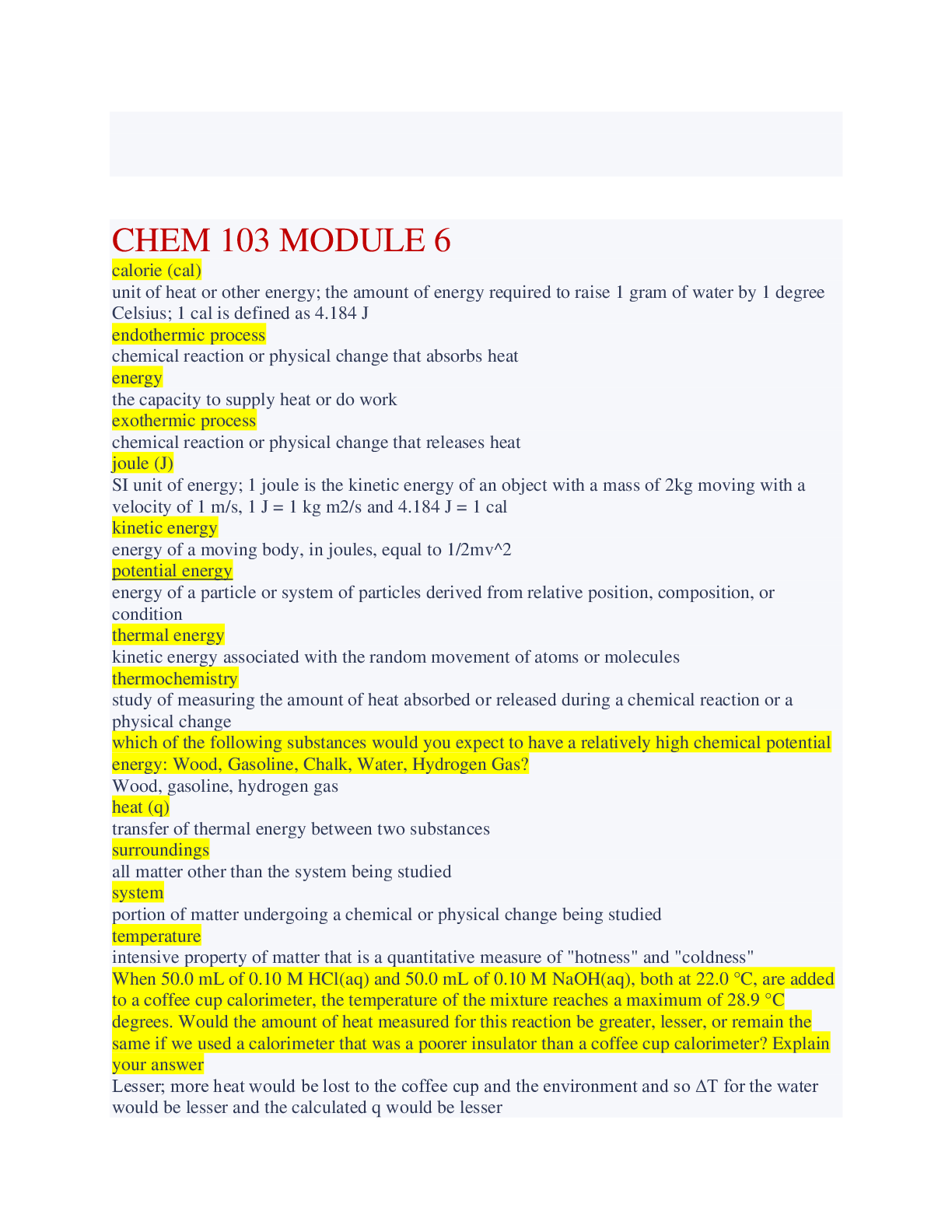
CHEM 103 MODULE 6
calorie (cal)
unit of heat or other energy; the amount of energy required to raise 1 gram of water by 1 degree Celsius; 1 cal is defined as 4.1
...
Chem 103 Module 6 Complete Questions and Answers
CHEM 103 MODULE 6
calorie (cal)
unit of heat or other energy; the amount of energy required to raise 1 gram of water by 1 degree Celsius; 1 cal is defined as 4.184 J
endothermic process
chemical reaction or physical change that absorbs heat
energy
the capacity to supply heat or do work
exothermic process
chemical reaction or physical change that releases heat
joule (J)
SI unit of energy; 1 joule is the kinetic energy of an object with a mass of 2kg moving with a velocity of 1 m/s, 1 J = 1 kg m2/s and 4.184 J = 1 cal
kinetic energy
energy of a moving body, in joules, equal to 1/2mv^2
potential energy
energy of a particle or system of particles derived from relative position, composition, or condition
thermal energy
kinetic energy associated with the random movement of atoms or molecules
thermochemistry
study of measuring the amount of heat absorbed or released during a chemical reaction or a physical change
which of the following substances would you expect to have a relatively high chemical potential energy: Wood, Gasoline, Chalk, Water, Hydrogen Gas?
Wood, gasoline, hydrogen gas
heat (q)
transfer of thermal energy between two substances
surroundings
all matter other than the system being studied
system
portion of matter undergoing a chemical or physical change being studied
temperature
intensive property of matter that is a quantitative measure of "hotness" and "coldness"
When 50.0 mL of 0.10 M HCl(aq) and 50.0 mL of 0.10 M NaOH(aq), both at 22.0 °C, are added to a coffee cup calorimeter, the temperature of the mixture reaches a maximum of 28.9 °C degrees. Would the amount of heat measured for this reaction be greater, lesser, or remain the same if we used a calorimeter that was a poorer insulator than a coffee cup calorimeter? Explain your answer
Lesser; more heat would be lost to the coffee cup and the environment and so ΔT for the water would be lesser and the calculated q would be lesser
When solid ammonium nitrate dissolves in water, the solution becomes cold. This is the basis for an "instant ice pack". When 3.21 g of solid NH4NO3 dissolves in 50.0 g of water at 24.9 °C in a calorimeter, the temperature decreases to 20.3 °C. Would the amount of heat absorbed by the dissolution appear greater, lesser, or remain the same if the experimenter used a calorimeter that was a poorer insulator than a coffee cup calorimeter? Explain your answer.
Lesser; heat from the environment would make ΔT smaller since the heat can affect the temperature of the reaction system, and the calculated q would be lesser
chemical thermodynamics
area of science that deals with the relationships between heat, work, and all forms of energy associated with chemical and physical processes
enthalpy (H)
is an energy like internal energy (E). The most important attribute of H is ΔH = Qp, the heat transferred at constant pressure
expansion work (pressure-volume work)
work done as a system expands or contracts against external pressure
first law of thermodynamics
internal energy of a system changes due to heat flow in or out of the system or work done on or by the system
internal energy (E)
sum of all kinetic and potential energies of the molecules in the system. It is the change in E that is useful to understand, and it is expressed through the first law of thermodynamics, ΔE = q + w.
heat capacity (C)
extensive property of a body of matter that represents the quantity of heat required to increase its temperature by 1 degree Celsius (or 1 kelvin)
specific heat capacity (c)
intensive property of a substance that represents the quantity of heat required to raise the temperature of 1 gram of the substance by 1 degree Celsius (or 1 kelvin)
bomb calorimeter
device designed to measure the energy change for processes occurring under conditions of constant volume; commonly used for reactions involving solid and gaseous reactants or products
calorimeter
a device used to measure the amount of heat absorbed or released during chemical or physical processes
calorimetry
process of measuring the amount of heat involved in a chemical or physical process
[Show More]