Chem 103 Exam 3 Questions and Answers Graded A CHEM 103 EXAM 3
absorption
atoms gain energy and become excited
emission
excess energy of excited atoms can be released
electromagnetic radiation
oscillating electri
...
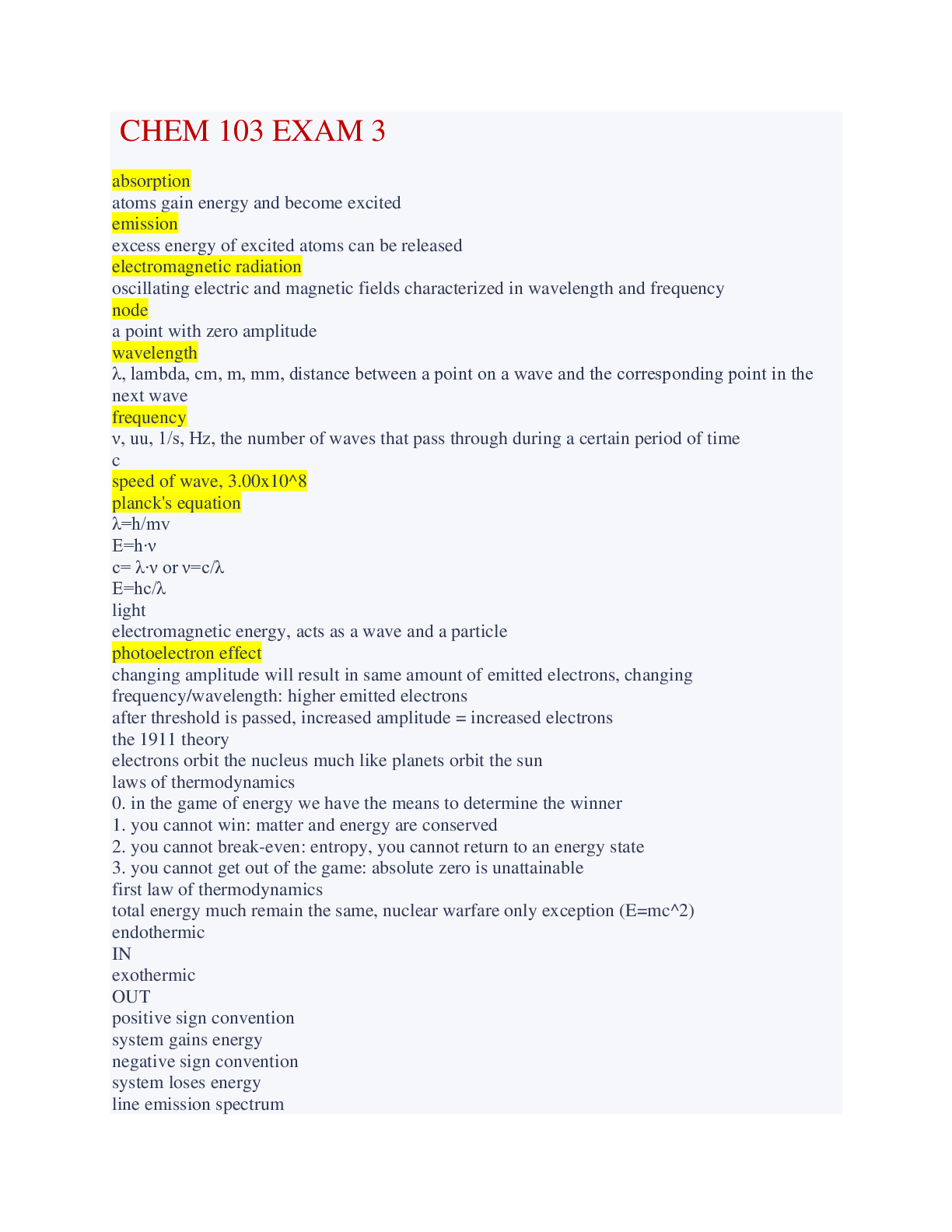
Chem 103 Exam 3 Questions and Answers Graded A CHEM 103 EXAM 3
absorption
atoms gain energy and become excited
emission
excess energy of excited atoms can be released
electromagnetic radiation
oscillating electric and magnetic fields characterized in wavelength and frequency
node
a point with zero amplitude
wavelength
λ, lambda, cm, m, mm, distance between a point on a wave and the corresponding point in the next wave
frequency
ν, uu, 1/s, Hz, the number of waves that pass through during a certain period of time
c
speed of wave, 3.00x10^8
planck's equation
λ=h/mv
E=h∙ν
c= λ∙ν or ν=c/λ
E=hc/λ
light
electromagnetic energy, acts as a wave and a particle
photoelectron effect
changing amplitude will result in same amount of emitted electrons, changing frequency/wavelength: higher emitted electrons
after threshold is passed, increased amplitude = increased electrons
the 1911 theory
electrons orbit the nucleus much like planets orbit the sun
laws of thermodynamics
0. in the game of energy we have the means to determine the winner
1. you cannot win: matter and energy are conserved
2. you cannot break-even: entropy, you cannot return to an energy state
3. you cannot get out of the game: absolute zero is unattainable
first law of thermodynamics
total energy much remain the same, nuclear warfare only exception (E=mc^2)
endothermic
IN
exothermic
OUT
positive sign convention
system gains energy
negative sign convention
system loses energy
line emission spectrum
passing a beam of light from excited neon or hydrogen atoms through a prism and observing a select array of colors
balmer equation
used to calculate wavelength in visible light spectrum |1/λ|=R(1/2^2 -1/n^2) when n>2
rydberg constant (R)
1.0974x10^7 m^-1
ground state
lowest possible energy level of an electron for a specific type of atom
principal quantum number (n)
unitless integer in the equation to find En
total energy of electron in the nth level = E_n = -Rhc/n^(2)
planck's constant (h)
6.626x10^-34 Jsec
excited state
an atom with higher energies (n >1)
ionized state
electron gains so much energy that n = infinity, no longer feels attraction
lyman series
a series of emission lines having energies in the ultraviolet region arises from electrons moving from states with n > 1 to the n = 1 state.
balmer series
arises from electrons moving from states with n>2 to the transitions from higher levels to the n = 3, 4, 5
shell
n, defined as 1 to infinity, describes the size of an orbital
subshell
l, defined as 0,1,2,3...n-1, different orbital shapes
l = 0
s (1 orbital)
l = 1
p (3 orbitals)
l = 2
d (5 orbitals)
l = 3
f (7 orbitals)
orbital
m_l, magnetic quantum number, +-1,2,3...+-l, three possible orbitals (x,y,z) for p orbitals
spin
m_s, spin quantum number, two possible values +1/2, -1/2, same sign = magnetic
pauli exclusion principle
every orbital has a unique set of quantum numbers
aufbau principle
electron orbitals fill with electrons from low energy to high energy
s orbitals
spherical, one circular node at start
p orbitals
dumbbells, xyz, plainer node, plains are the (x,y,z) values opposite to the name of orbital
d orbitals
two dumbbells, axis are running between the probability clouds
Z*
effect of nuclear charge, shielding, net charge experienced by an electron, competing Z and S
isoelectric
having the same electron configuration
hund's rule
electrons will spread out whenever possible
core electrons
electrons inside the valence electrons [core e-]
valence electrons
outside, determines radioactivity
atomic size
total number of electrons
Z
nuclear charge
S
shielding term, determined by core electrons
ionization energy (IE)
the specific energy required to remove a single electron to an atom, endothermic, production of cations
electron affinity (EA)
the process of making ions, production of anions
breaking the octet rule
electron deficient atoms
too many shared electrons
n > 3, has a d orbital
formal charges
calculated for each individual atom in the molecule (# ve-/atom) - (2e/pair, 1e/bond)
d and f block begins
3d, 4f
resonance structures
different possible ways of satisfying the octet rule, calls for not a sound structure, some bonds are above single but below double
electron deficient molecules
BH3 having 6ve-, H-B-H2
[Show More]