Test Bank
Pharmacology A Patient-Centered Nursing Process Approach, 11th Edition by Linda E. McCuistion Chapter 1-58
Table of Contents
Chapter 01: The Nursing Process
...
Test Bank
Pharmacology A Patient-Centered Nursing Process Approach, 11th Edition by Linda E. McCuistion Chapter 1-58
Table of Contents
Chapter 01: The Nursing Process and Patient-Centered Care 3
Chapter 02: Drug Development and Ethical Considerations 9
Chapter 03: Pharmacokinetics and Pharmacodynamics 17
Chapter 04: Pharmacogenetics 30
Chapter 05: Complementary and Alternative Therapies 33
Chapter 06: Pediatric Considerations 38
Chapter 07: Geriatric Considerations 45
Chapter 08: Drugs in Substance Use Disorder 50
Chapter 09: Safety and Quality 56
Chapter 10: Drug Administration 62
Chapter 11: Drug Calculations 67
MSC: NCLEX: Physiological Integrity: Pharmacological and Parenteral Therapies 71
Chapter 12: Fluid Volume and Electrolytes 71
Chapter 13: Vitamin and Mineral Replacement 80
Chapter 14: Nutritional Support 87
Chapter 15: Adrenergic Agonists and Antagonists 94
Chapter 16: Cholinergic Agonists and Antagonists 100
Chapter 17: Stimulants 106
Chapter 18: Depressants 110
Chapter 19: Antiseizure Drugs 117
Chapter 20: Drugs for Parkinsonism and Alzheimer Disease 123
Chapter 21: Drugs for Neuromuscular Disorders and Muscle Spasms 130
Chapter 22: Antipsychotics and Anxiolytics 135
Chapter 23: Antidepressants and Mood Stabilizers 142
Chapter 24: Antiinflammatories 149
Chapter 25: Analgesics 156
Chapter 26: Penicillins, Other Beta-Lactams, and Cephalosporins 162
Chapter 27: Macrolides, Oxazolidinones, Lincosamides, Glycopeptides, Ketolides, and Lipopeptides 167
Chapter 28: Tetracyclines, Glycylcyclines, Aminoglycosides, and Fluoroquinolones 171
Chapter 29: Sulfonamides and Nitroimidazoles Antibiotics 175
Chapter 30: Antituberculars, Antifungals, and Antivirals 179
Chapter 31: Antimalarials, Anthelmintics, and Peptides 187
Chapter 32: HIV- and AIDS-Related Drugs 191
Chapter 33: Transplant Drugs 195
Chapter 34: Vaccines 197
Chapter 35: Anticancer Drugs 201
Chapter 36: Targeted Therapies to Treat Cancer 206
Chapter 37: Biologic Response Modifiers 211
Chapter 38: Upper Respiratory Disorders 216
Chapter 39: Lower Respiratory Disorders 222
Chapter 40: Cardiac Glycosides, Antianginals, and Antidysrhythmics 230
Chapter 41: Diuretics 240
Chapter 42: Antihypertensives 246
Chapter 43: Anticoagulants, Antiplatelets, and Thrombolytics 255
Chapter 44: Antihyperlipidemics and Drugs to Improve Peripheral Blood Flow McCuistion: Pharmacology: A Patient-Centered Nursing Process Approach, 11th Edition 265
Chapter 45: Gastrointestinal Tract Disorders 272
Chapter 46: Antiulcer Drugs 281
Chapter 47: Eye and Ear Disorders 289
Chapter 48: Dermatologic Disorders 294
Chapter 49: Pituitary, Thyroid, Parathyroid, and Adrenal Disorders 301
Chapter 50: Antidiabetics 311
Chapter 51: Urinary Disorders 320
Chapter 52: Pregnancy and Preterm Labor 327
Chapter 53: Labor, Delivery, and Postpartum 336
Chapter 54: Neonatal and Newborn 343
Chapter 56: Men’s Health and Reproductive Disorders 355
Chapter 57: Sexually Transmitted Infections 361
Chapter 58: Adult and Pediatric Emergency Drugs 365
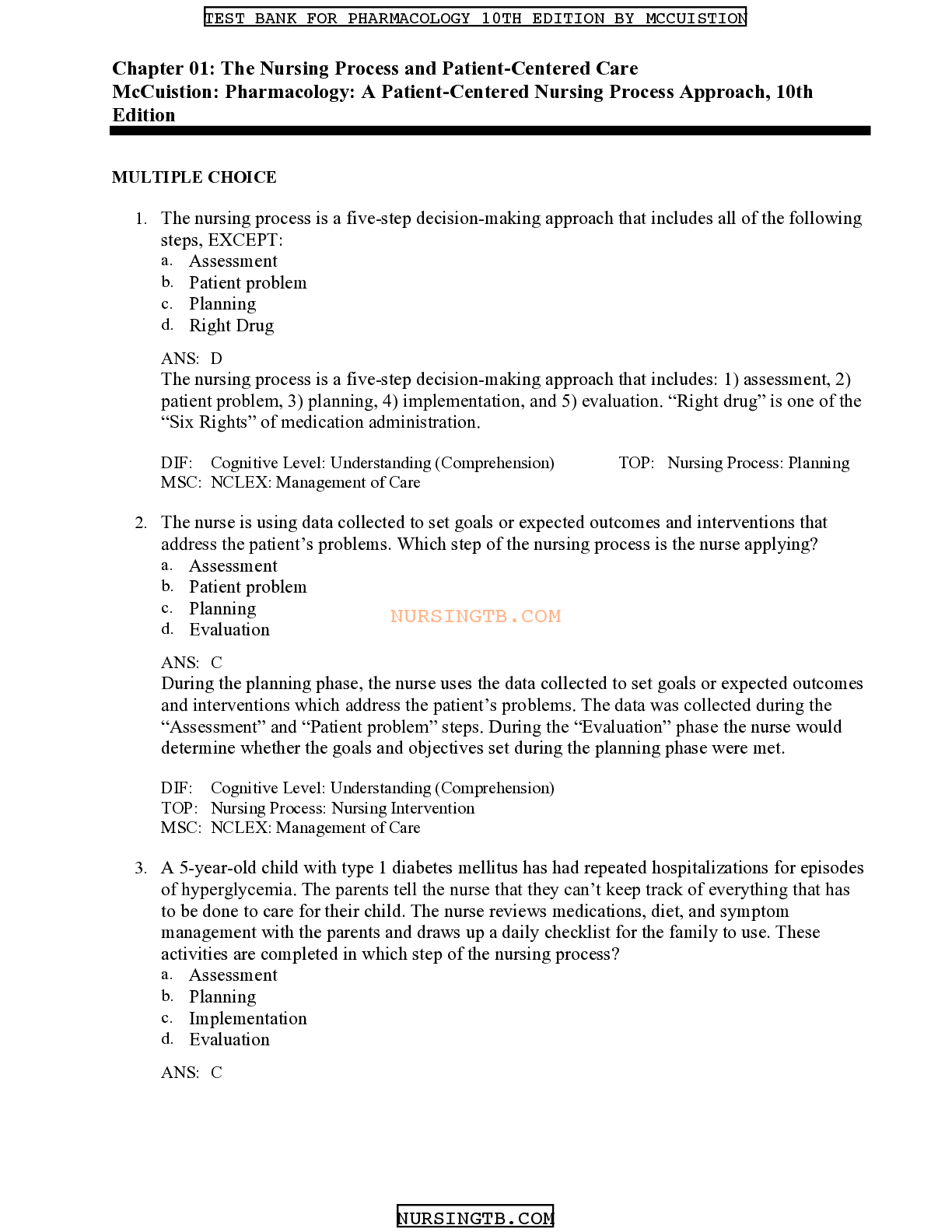
Chapter 01: The Nursing Process and Patient-Centered Care
McCuistion: Pharmacology: A Patient-Centered Nursing Process Approach, 11th Edition
MULTIPLE CHOICE
1. All of the following would be considered subjective data, EXCEPT:
a. Patient-reported health history
b. Patient-reported signs and symptoms of their illness
c. Financial barriers reported by the patient’s caregiver
d. Vital signs obtained from the medical record
ANS: D
Subjective data is based on what patients or family members communicate to the nurse. Patient- reported health history, signs and symptoms, and caregiver reported financial barriers would be considered subjective data. Vital signs obtained from the medical record would be considered objective data.
DIF: Cognitive Level: Understanding (Comprehension) TOP: Nursing Process: Planning MSC: NCLEX: Management of Client Care
2. The nurse is using data collected to define a set of interventions to achieve the most desirable outcomes. Which of the following steps is the nurse applying?
a. Recognizing cues (assessment)
b. Analyze cues & prioritize hypothesis (analysis)
c. Generate solutions (planning)
d. Take action (nursing interventions)
ANS: C
When generating solutions (planning), the nurse identifies expected outcomes and uses the patient’s problem(s) to define a set of interventions to achieve the most desirable outcomes. Recognizing cues (assessment) involves the gathering of cues (information) from the patient about their health and lifestyle practices, which are important facts that aid the nurse in making clinical care decisions. Prioritizing hypothesis is used to organize and rank the patient problem(s) identified. Finally, taking action involves implementation of nursing interventions to accomplish the expected outcomes.
DIF: Cognitive Level: Understanding (Comprehension) TOP: Nursing Process: Nursing Intervention
MSC: NCLEX: Management of Client Care
3. A 5-year-old child with type 1 diabetes mellitus has had repeated hospitalizations for episodes of hyperglycemia. The parents tell the nurse that they can’t keep track of everything that has to be done to care for their child. The nurse reviews medications, diet, and symptom management with the parents and draws up a daily checklist for the family to use. These activities are completed in which step of the nursing process?
a. Recognizing cues (assessment)
b. Analyze cues & prioritize hypoth
[Show More]