1
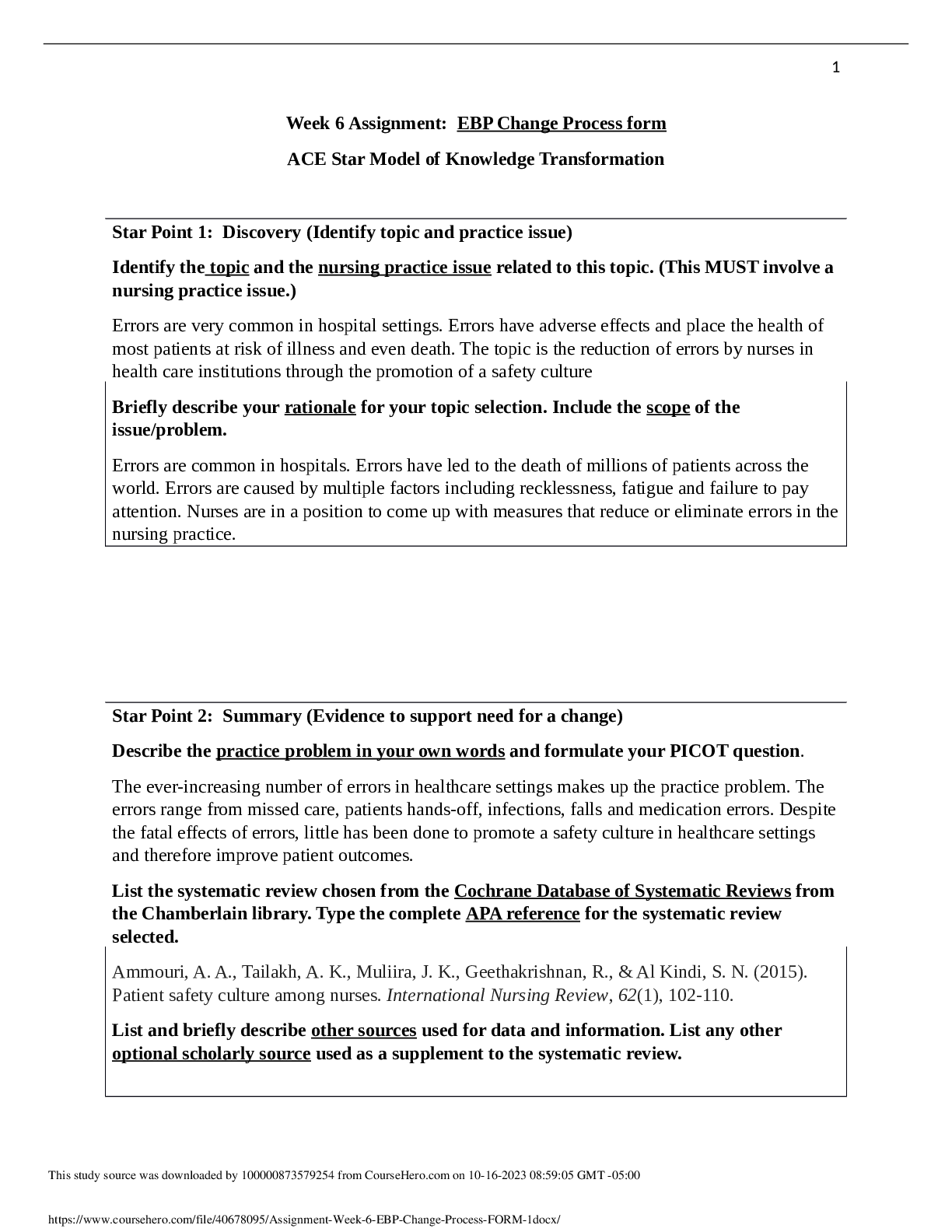
Week 6 Assignment: EBP Change Process form
ACE Star Model of Knowledge Transformation
Star Point 1: Discovery (Identify topic and practice issue)
Identify the topic and the nursing practice issue related to this to
...
1
Week 6 Assignment: EBP Change Process form
ACE Star Model of Knowledge Transformation
Star Point 1: Discovery (Identify topic and practice issue)
Identify the topic and the nursing practice issue related to this topic. (This MUST involve a
nursing practice issue.)
Errors are very common in hospital settings. Errors have adverse effects and place the health of
most patients at risk of illness and even death. The topic is the reduction of errors by nurses in
health care institutions through the promotion of a safety culture
Briefly describe your rationale for your topic selection. Include the scope of the
issue/problem.
Errors are common in hospitals. Errors have led to the death of millions of patients across the
world. Errors are caused by multiple factors including recklessness, fatigue and failure to pay
attention. Nurses are in a position to come up with measures that reduce or eliminate errors in the
nursing practice.
Star Point 2: Summary (Evidence to support need for a change)
Describe the practice problem in your own words and formulate your PICOT question.
The ever-increasing number of errors in healthcare settings makes up the practice problem. The
errors range from missed care, patients hands-off, infections, falls and medication errors. Despite
the fatal effects of errors, little has been done to promote a safety culture in healthcare settings
and therefore improve patient outcomes.
List the systematic review chosen from the Cochrane Database of Systematic Reviews from
the Chamberlain library. Type the complete APA reference for the systematic review
selected.
Ammouri, A. A., Tailakh, A. K., Muliira, J. K., Geethakrishnan, R., & Al Kindi, S. N. (2015).
Patient safety culture among nurses. International Nursing Review, 62(1), 102-110.
List and briefly describe other sources used for data and information. List any other
optional scholarly source used as a supplement to the systematic review.
This study source was downloaded by 100000873579254 from CourseHero.com on 10-10-2023 03:03:15 GMT -05:00
https://www.coursehero.com/file/40678095/Assignment-Week-6-EBP-Change-Process-FORM-1docx/
2
1. Flynn, F., Evanish, J. Q., Fernald, J. M., Hutchinson, D. E., & Lefaiver, C. (2016).
Progressive care nurses improving patient safety by limiting interruptions during
medication administration. Critical care nurse, 36(4), 19-35.
2. Cloete, L. (2015). Reducing medication errors in nursing practice. Cancer Nursing
Practice, 14(1).
3. Bush, P. A., Hueckel, R. M., Robinson, D., Seelinger, T. A., & Molloy, M. A. (2015).
Cultivating a culture of medication safety in prelicensure nursing students. Nurse
educator, 40(4), 169-173.
Briefly summarize the main findings (in your own words) from the systematic review and
the strength of the evidence.
Patient safety is one of most critical factors in the promotion of quality healthcare. It is one of the
factors constantly monitored by most health organizations across the world. Nurses are critical in
the promotion of safety culture due to the nature of their roles and their hand-on handling of
patients. Some of the outlined patient safety predictors include communication about errors,
constant feedback, hospital management support, management expectations and teamwork in
solving possible errors.
Outline one or two evidence-based solutions you will consider for the trial project.
Hospital management needs to develop systems and practices that enhance patient safety culture.
They should also aim at developing leadership capacity to allow constant communication,
progressive organizational learning, and teamwork and blame free environment.
Star Point 3: Translation (Action Plan)
Identify care standards, practice guidelines, or protocols that may be in place to support
your intervention planning (These may come from your organization or from the other
sources listed in your Summary section in Star Point 2).
The presence of a comprehensive learner-centered and engaging training and supervision
modules that increase skills, attitude and knowledge as well as create awareness to nurses on the
various ways to avoid errors promote patient safety
List your stakeholders (by title and not names; include yourself) and describe their roles
and responsibilities in the change process (no more than 5).
1) Nurse
This study source was downloaded by 100000873579254 from CourseHero.com on 10-10-2023 03:03:15 GMT -05:00
https://www.coursehero.com/file/40678095/Assignment-Week-6-EBP-Change-Process-FORM-1docx/
3
Nurses have a hand-on contact with patients. Their role is to implement the developed strategies
to limit the number of errors.
2) Management
The management is involved the development of strategies and policies that promote safety
culture in the healthcare setting. They also provide training to staff as well as supervise them to
ensure that the developed strategies are implemented to the latter.
3) Patients
Patients should provide maximum cooperation to the nurses and be keen to point out any errors
that the nurses may miss out
What specifically is the nursing role in the change process?
Nurses should report any errors or near misses to the relevant authorities to enable them analyze
the situation and come up with measures to avoid possible reoccurrences in the future. They
should also report any unsafe material in their line of work such as faulty equipment through
shared governance. They should ensure that they perform activity checklists in every instance to
ensure that nothing is missed.
List your stakeholders by position titles (charge nurse, pharmacist, etc.).-Why are the
members chosen (stakeholders) important to your project?
Nurse leaders - 5
Nurse leaders are responsible for the supervision of nurses as well as advocacy on changes to be
implemented.
Pharmacists – 3
Pharmacists are critical in the promotion of safety culture since prescription errors are very
common in medical care facilities.
What type of cost analysis will be needed prior to a trial? Who needs to be involved with
this?
The main form of cost is in the training of the involved parties. The trial period involves the
training of eight nurses and pharmacists. The awareness campaign that entails printing and
distribution of notices and flashcards, checklists and the development of training videos makes
up most of the cost.
Star Point 4: Implementation
This study source was downloaded by 100000873579254 from CourseHero.com on 10-10-2023 03:03:15 GMT -05:00
https://www.coursehero.com/file/40678095/Assignment-Week-6-EBP-Change-Process-FORM-1docx/
4
Describe the process for gaining permission to plan and begin a trial. Is there a specific
group, committee, or nurse leaders involved?
The nurse leaders to the hospital management seek permission officially. The nurse leaders sends
and letter to the management clearly detailing the problem, its implications and the need to
implement the relevant intervention measures. The intervention measures are also listed as well
as the benefits expected from the process.
Describe the plan for educating the staff about the change process trial and how they will
be impacted or asked to participate.
Change can be ineffective due to lack of proper communication. The parties involved need to be
trained on the need to make changes and improve patient safety through the reduction of errors.
The training process should be convincing enough to make sure that the stakeholders involved
clearly understand the need for change and therefore adopt the change process.
Outline the implementation timeline for the change process (start time/end time, what steps
are to occur along the timeline).
01.02.2018 to 14.02.2018 Training of staff on the need to change
15.02.2018- 28.02.2018 Preparation of advertisement materials
01.03.2018- 30.03.2018 Creation of awareness on the strategies and
policies to reduce errors and promote patient
safety
01.04.2018- 31.04.2018 Assessment of trained concepts and skills
List the measurable outcomes based on the PICOT. How will these be measured?
-P- Number of Medication Errors
-I- Promotion of patient safety
C- Application of checklists during intervention
O- Mortality rate
This study source was downloaded by 100000873579254 from CourseHero.com on 10-10-2023 03:03:15 GMT -05:00
https://www.coursehero.com/file/40678095/Assignment-Week-6-EBP-Change-Process-FORM-1docx/
5
T – 6 months
What forms, if any, might be used for recording purposes during the pilot change process.
Describe.
Data on the type and nature of errors is recorded against individual nurses
What resources are available to staff (include yourself) during the change pilot?
-Checklists
-Posters
Flashcards
Will there be meetings of certain stakeholders throughout the trial? If so, who and when
will they meet?
The involved stakeholders will meet every week to assess the success of the intervention and
make changes where necessary.
Star Point 5: Evaluation
How will you report the outcomes of the trial?
The outcomes will be reported using frequency tables to identify the difference before and after
the intervention.
What would be the next steps for the use of the change process information?
The information will provide a blueprint on whether the applied changes have reduced the
number of medication errors in the facility. The information will also provide insight into
possible ways to improve the situation even further.
This study source was downloaded by 100000873579254 from CourseHero.com on 10-10-2023 03:03:15 GMT -05:00
https://www.coursehero.com/file/40678095/Assignment-Week-6-EBP-Change-Process-FORM-1docx/
6
This study source was downloaded by 100000873579254 from CourseHero.com on 10-10-2023 03:03:15 GMT -05:00
https://www.coursehero.com/file/40678095/Assignment-Week-6-EBP-Change-Process-FORM-1docx/
Powered by TCPDF (www.tcpdf.org)
[Show More]