What are the 3 primary physiological changes of aging?
(Ans-
1. Reduced physiological reserve of most body systems, esp. cardiac, resp, renal.
2. Reduced homeostatic mechanisms that fail to adjust regulatory syste
...
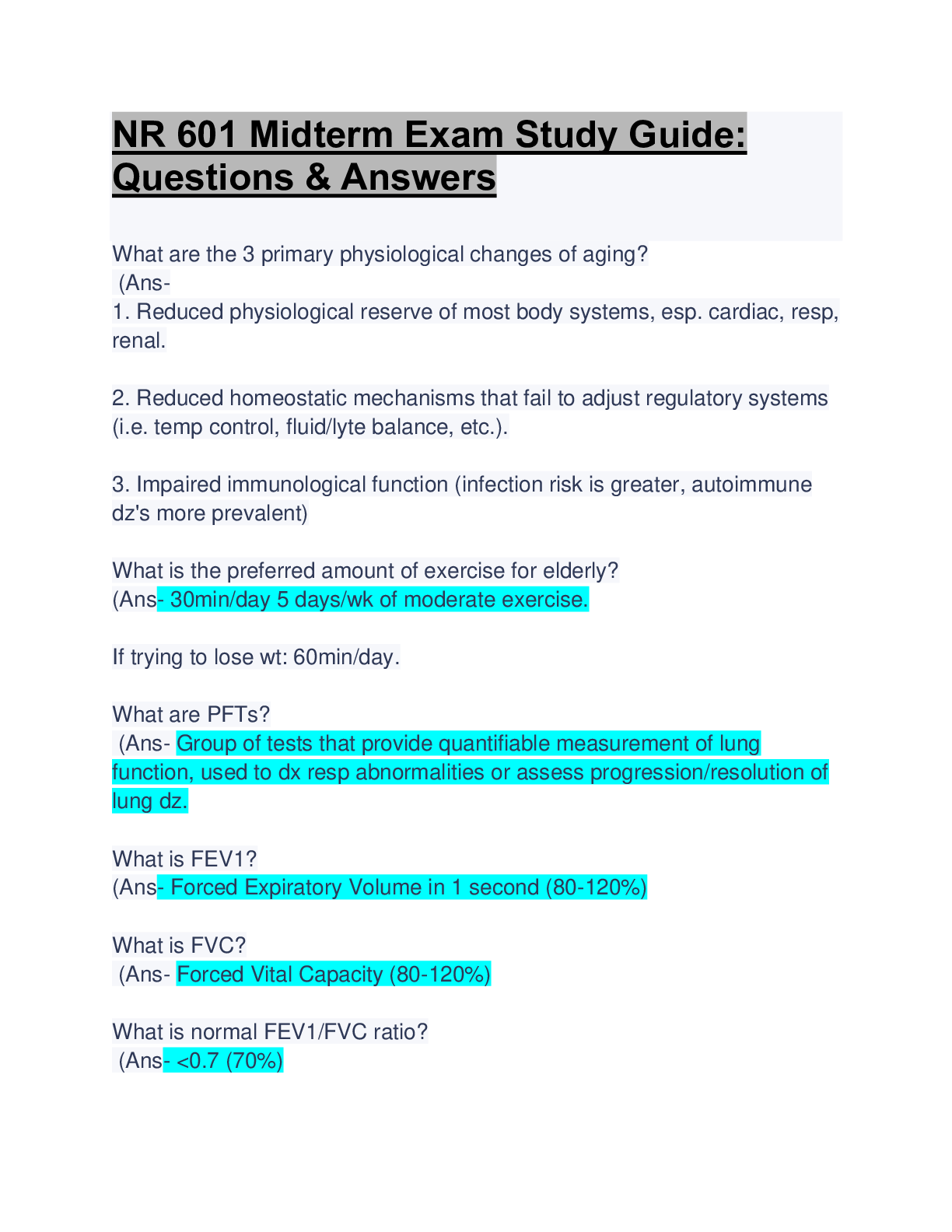
What are the 3 primary physiological changes of aging?
(Ans-
1. Reduced physiological reserve of most body systems, esp. cardiac, resp, renal.
2. Reduced homeostatic mechanisms that fail to adjust regulatory systems (i.e. temp control, fluid/lyte balance, etc.).
3. Impaired immunological function (infection risk is greater, autoimmune dz's more prevalent)
What is the preferred amount of exercise for elderly?
(Ans- 30min/day 5 days/wk of moderate exercise.
If trying to lose wt: 60min/day.
What are PFTs?
(Ans- Group of tests that provide quantifiable measurement of lung function, used to dx resp abnormalities or assess progression/resolution of lung dz.
What is FEV1?
(Ans- Forced Expiratory Volume in 1 second (80-120%)
What is FVC?
(Ans- Forced Vital Capacity (80-120%)
What is normal FEV1/FVC ratio?
(Ans- <0.7 (70%)
What is GOLD 1 criteria?
(Ans- Mild
FEV1 >/= 80% predicted
What is GOLD 2 criteria?
(Ans- Moderate
FEV1 50-79% predicted
What is GOLD 3 criteria?
(Ans- Severe
FEV1 30-49% predicted
What is GOLD 4 criteria?
(Ans- Very severe
FEV1 <30% predicted
What are the signal symptoms of COPD?
(Ans-
Dyspnea
Chronic cough w/sputum
Decreased activity tolerance
Wheezing
What are characteristics of COPD?
(Ans- Common, preventable, treatable.
Characterized by persistent airflow limitation.
Usually progressive, associated with enhanced chronic inflammatory response in airways and lungs to noxious particles/gases
Airway fibrosis, luminal plugs, airway inflammation, increased airway resistance, small airway dz.
Decreased elastic recoil of alveoli.
What are risk factors for COPD?
(Ans- Smoking (increasing w/number of pack years)
Second hand smoke
Environmental pollution (endotoxins, coal dust, mineral dust)
What is seen on phys exam in COPD?
(Ans- May be normal in early states
As severity progresses: lung hyperinflation, decreased breath sounds, wheezes at bases, distant heart tones (b/c of hyperinflation, so S1/S2 sounds off in distance), accessory muscle use, pursed lip breathing, increased expiratory phase, neck vein distention.
How is COPD diagnosed?
(Ans- Spirometry is gold standard (pre and post bronchodilator).
Irreversible airflow limitation is hallmark.
How is COPD treated?
(Ans- Bronchodilators: beta agonists (long/short), anticholinergics (long/short), or combo.
What is the MOA of beta agonists?
(Ans- Stimulates beta-2-adrenergic receptors, increasing cyclic AMP, resulting in relaxing airways.
What is the MOA of anticholinergics?
(Ans- Block the effect of acetylcholine on muscarinic type 3 receptors, resulting in bronchodilation.
Why are long-acting beta agonists prescribed for COPD?
(Ans- They are for moderate airflow limitation.
They relieve symptoms, increase exercise tolerance, reduce number of exacerbations, improve QOL.
What are some non pulmonary diagnoses that result in COPD-type symptoms?
(Ans- CHF
Hyperventilation syndrome
Panic attacks
Vocal cord dysfunction
Obstructive sleep apnea
Aspergillosis
Chronic fatigue syndrome
What are signal symptoms of asthma?
(Ans-
Wheezing
Shortness of breath
Cough (esp at night)
Chest tightness
What is chronic bronchitis?
(Ans- Daily chronic cough w/increased sputum for at least 3 consecutive months in at least 2 consecutive years.
Usually worse on wakening.
May or may not be associated with COPD.
What is emphysema?
(Ans- Characterized by obstruction to airflow caused by abnormal airspace enlargement distal to terminal bronchioles.
Chronic inflammation/remodeling, trapping air, hindering effective O2/CO2 exchange (all due to inflammatory mediators infiltrating airways).
What are signal symptoms of ischemic heart dz?
(Ans- Chest pain
Chest tightness
[Show More]


 GRADE A SOLUTION.png)