CHEM 120 Final Exam Review
1. Know what is the atomic number, atomic mass, protons, neutrons and electrons
Atomic number – is the number of protons in the nucleus of an atom of any element
Atomic mass – is express
...
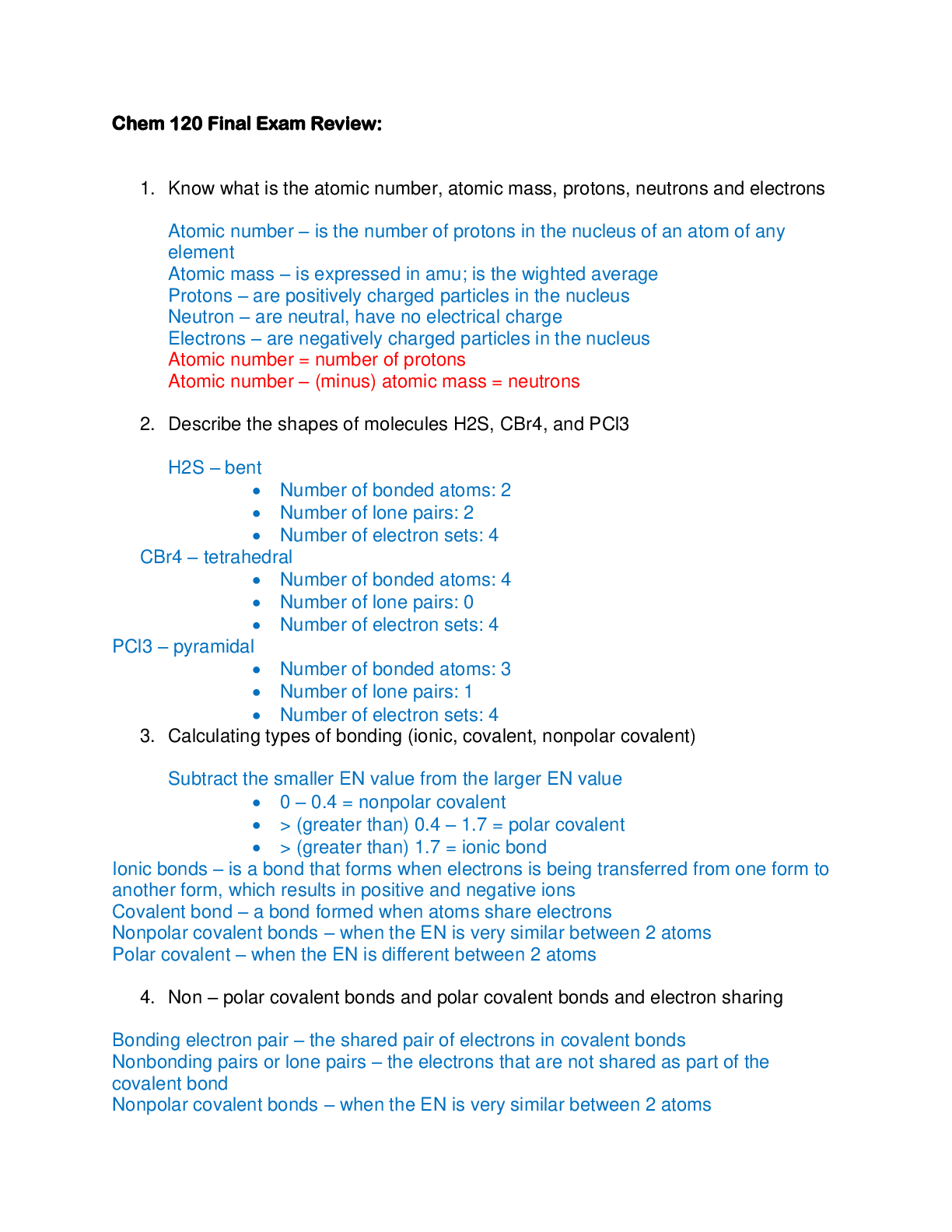
CHEM 120 Final Exam Review
1. Know what is the atomic number, atomic mass, protons, neutrons and electrons
Atomic number – is the number of protons in the nucleus of an atom of any element
Atomic mass – is expressed in amu; is the wighted average
Protons – are positively charged particles in the nucleus
Neutron – are neutral, have no electrical charge
Electrons – are negatively charged particles in the nucleus
Atomic number = number of protons
Atomic number – (minus) atomic mass = neutrons
2. Describe the shapes of molecules H2S, CBr4, and PCl3
H2S – bent
• Number of bonded atoms: 2
• Number of lone pairs: 2
• Number of electron sets: 4
CBr4 – tetrahedral
• Number of bonded atoms: 4
• Number of lone pairs: 0
• Number of electron sets: 4
PCl3 – pyramidal
• Number of bonded atoms: 3
• Number of lone pairs: 1
• Number of electron sets: 4
3. Calculating types of bonding (ionic, covalent, nonpolar covalent)
Subtract the smaller EN value from the larger EN value
• 0 – 0.4 = nonpolar covalent
• > (greater than) 0.4 – 1.7 = polar covalent
• > (greater than) 1.7 = ionic bond
Ionic bonds – is a bond that forms when electrons is being transferred from one form to another form, which results in positive and negative ions
Covalent bond – a bond formed when atoms share electrons
Nonpolar covalent bonds – when the EN is very similar between 2 atoms
Polar covalent – when the EN is different between 2 atoms
4. Non – polar covalent bonds and polar covalent bonds and electron sharing
Bonding electron pair – the shared pair of electrons in covalent bonds
Nonbonding pairs or lone pairs – the electrons that are not shared as part of the covalent bond
Nonpolar covalent bonds – when the EN is very similar between 2 atoms
Polar covalent – when the EN is different between 2 atoms
5. Know the structure and makeup of DNA and RNA, know what DNA replication, transcription and translation are and ribosomes role in protein synthesis.
Deoxyribonucleic acid (DNA) – provides a mechanism for heredity and serves as the blueprint for all the proteins of an organism
• The DNA helix is held together by hydrogen bonds between the nucleotides
• Adenine (A) binds with Thymine (T) in DNA
• Guanine (G) binds with Cytosine (C) in DNA and RNA
• DNA complimentary base pairs: A – T; C – G
• DNA is made up of genes that code for specific proteins
Ribonucleic acid (RNA) – carries information needed to the protein synthesis
• Adenine (A) binds with Uracil (U) in RNA
• Guanine (G) binds with Cytosine (C) in DNA and RNA
• RNA complimentary base pairs: A – U; C – G
DNA and RNA are polymers of repeating units of nucleotides
DNA Replication – is copying or duplication of DNA molecules
Transcription – the transfer of the DNA gene information to RNA which is transported out of the nucleus
• A segment of DNA called the template strand transfers its information to a special RNA molecule called messenger RNA
• The base sequence of DNA specifies the base sequence of mRNA
• In eukaryotes the mRNA is transported out of the nucleus to the ribosome
Translation – the translation of the mRNA sequence into a specific protein
• Decoding of the mRNA results in protein synthesis which occurs in the ribosome in the cytoplasm of the cell
6. Know what a protein is, its makeup and what is primary, tertiary (globular), and quaternary structure. Also the types of bonds that holds the structure together.
Proteins – serve as the structural materials and enzymes of animals
• Muscle tissue, skin and hair are mostly proteins
• Silk, wool, nails, claws, feathers, horns, and hooves are proteins
• Proteins are polymers with the monomer units are about 20 different amino acids
• The amino acids differ in their side chains
The structure of proteins have four organizational levels:
Primary Structure – is simply the order of its amino acids; held together by the chain of amino acids
Secondary structure – polypeptide chains can fold into regular structures within the protein chain such as alpha chains and beta sheets; held together by alpha helix or alpha chain which can be many
.........continued.......
[Show More]