CNL Exam Questions 1-50 with Verified Answers
*A new graduate nurse approaches you and states she needs help removing a PICC. Which of the following is the best response when acting as a horizontal leader?*
a. re
...
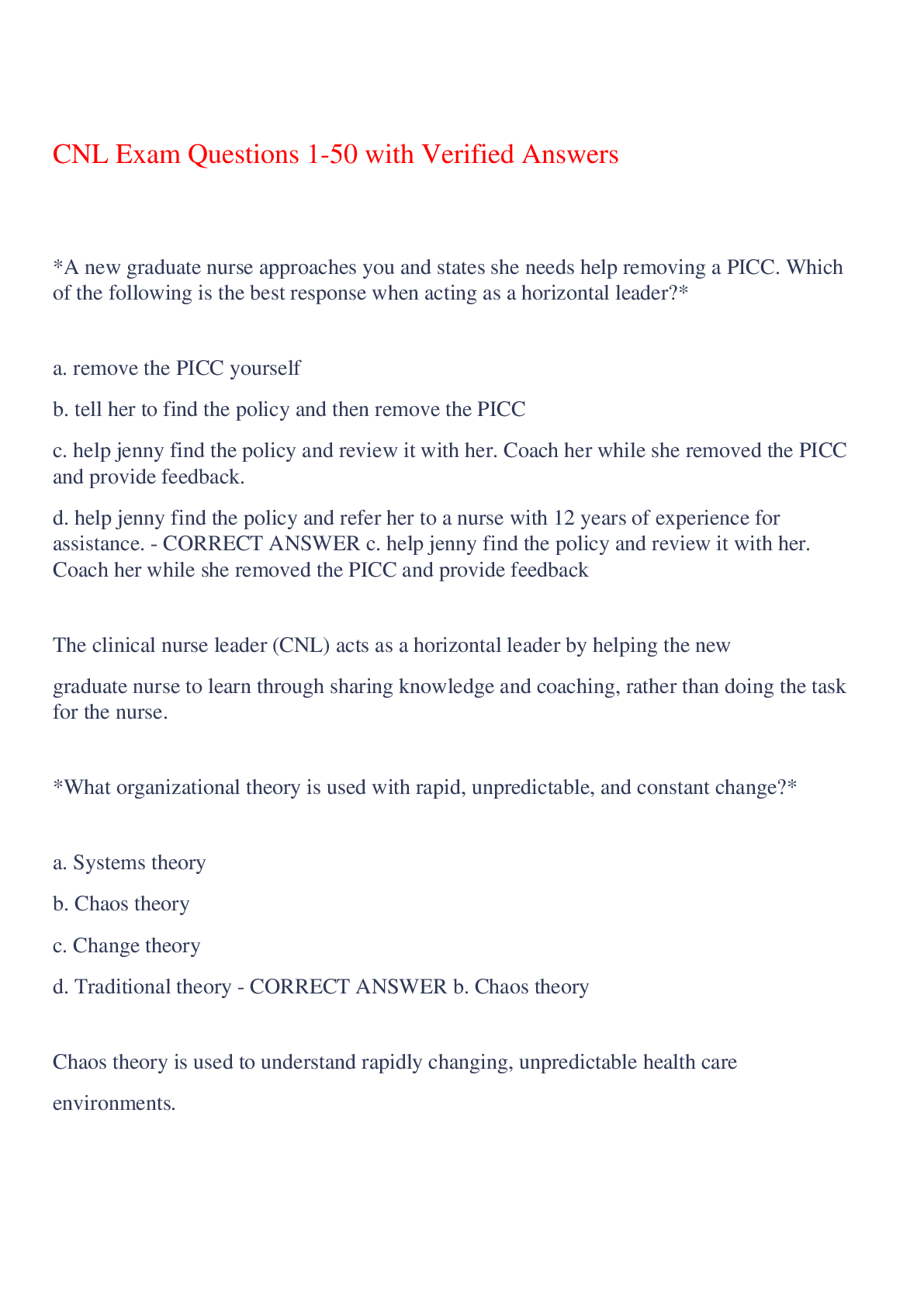
CNL Exam Questions 1-50 with Verified Answers
*A new graduate nurse approaches you and states she needs help removing a PICC. Which of the following is the best response when acting as a horizontal leader?*
a. remove the PICC yourself
b. tell her to find the policy and then remove the PICC
c. help jenny find the policy and review it with her. Coach her while she removed the PICC and provide feedback.
d. help jenny find the policy and refer her to a nurse with 12 years of experience for assistance. - CORRECT ANSWER c. help jenny find the policy and review it with her. Coach her while she removed the PICC and provide feedback
The clinical nurse leader (CNL) acts as a horizontal leader by helping the new
graduate nurse to learn through sharing knowledge and coaching, rather than doing the task for the nurse.
*What organizational theory is used with rapid, unpredictable, and constant change?*
a. Systems theory
b. Chaos theory
c. Change theory
d. Traditional theory - CORRECT ANSWER b. Chaos theory
Chaos theory is used to understand rapidly changing, unpredictable health care
environments.
*a 65 YO AA male was admitted to your microsystem with hyperglycemia. The patient has a history of HTN, gout, obesity, and smoking. The patient has a family history of DM and HTN. Which statement by the patient demonstrates his understanding of modifiable risk factors for DM?*
a. "As I get older, my risk for DM increases"
b. "I know that a family history of DM is a risk factor, so I will educate my children on DM prevention."
c. "I will keep a record of all my blood sugars to take to my doctor's appointments."
d. I will attend a smoking cessation class, because I know smoking increases my risk for DM." - CORRECT ANSWER d. I will attend a smoking cessation class, because I know smoking increases my risk for DM."
Modifiable risk factors are lifestyle factors that a person can alter in order to
prevent disease. Smoking cessation class is an intervention for modifying the risk factor of smoking.
*Your hospital is currently trialing the integration of the clinical nurse leader (CNL) role. At the end of the trial implementation period how can you, as the CNL, best illustrate the effectiveness of your role during this trial?*
a. Refer to increased patient satisfaction scores over the course of the trial
b. Present data that demonstrates the effect of the CNL and outcomes achieved over the course of the trial.
c. Present a list of projects and tasks completed over the course of the trial.
d. Refer to your performance review over the course of the trial. - CORRECT ANSWER B
The CNL should present the effect and outcomes to illustrate the importance of the
integration of his or her role. Increased patient satisfaction is not necessarily directly related to the CNL.
Presentation of projects and tasks completed does not address measurable outcomes. Performance review
of the individual does not indicate outcomes were affected.
*You are a CNL on an oncology unit. Recently, there has been an increase in the number of CAUTIs on your unit. After shadowing nurses and aides you observed a variety of* *practices, techniques, and expectations surrounding daily catheter care. Your hospital does not have a current policy or procedure regarding catheter care. As the CNL, what should you do next?*
a. review current evidence for catheter care practice and disseminate evidence to the staff
b.form an interdisciplinary team meeting to evaluate current hospital catheter care policies
c. create a rubric for educating patients and staff on catheter care
d. discuss with the unit manager the clinical issue and create a set of evidence-based unit expectations and practices for the unit. evaluate the need to address this issue with a hospital wide policy or procedure. - CORRECT ANSWER d. discuss with the unit manager the clinical issue and create a set of evidence-based unit expectations and practices for the unit. evaluate the need to address this issue with a hospital wide policy or procedure.
CNLs should gather and disseminate evidence to solve clinical problems;
however, that should not be the initial step. Further review of hospital practices and policies may come
after this issue is addressed. Creation of a rubric for educating patients and staff on catheter care may
come after reviewing evidence. The CNL should act to solve the clinical issue in the short term, and
evaluate the need for a larger policy to address gaps in practice hospital-wide.
*A 50 YO F with stage 3 COPD presents tot he ED with increased SOB. Based on these lab results, what is the acid-base disorder*
pH 7.25
PaCO2 50 mmHg
HCO3 22 mEq/L
PO2 75
SpO2 88%
Na + 136
BUN 18
a. uncompensated respiratory acidosis
b. metabolic acidosis
c. respiratory acidosis
d. uncompensated respiratory acidosis - CORRECT ANSWER a. uncompensated respiratory acidosis
Based on the clinical scenario, the pH is decreased (less than 7.35); therefore, the
patient has acidosis. The PaCO2 is elevated (more than 45 mmHg), which is also consistent with the pH.
The HCO3 is within normal limits, which suggests the kidneys are not compensating. COPD is commonly
associated with respiratory acidosis.
*A CNL evaluates a 17YO patient who has been a victim of rape. The patient has visible
bruising and a head laceration. After the CNL's assessment, law enforcement officials have contacted the CNL requesting* *information regarding the attack and the visible injuries seen during the visit. The CNL knows she must first:*
a. take pictures and complete the rape kit
b. provide law enforcement with records as requested
c. call the patient's parents first
d. explain to the patient in order to obtain consent for release of records - CORRECT ANSWER d. explain to the patient in order to obtain consent for release of records
Rationale: Legally, there must be consent from the patient to share information with law
enforcement and to abide by Health Insurance Portability and Accountability Act (HIPAA) regulations.
*A CNL in the NICU is collecting data on the hours worked weekly by the staff nurses. The CNL wants to see if there is a normal distribution of hours worked. What technique is the best to display the distribution of the data collected?*
a. run chart
b. fishbone chart
c. failure modes and effects analysis (FMEA) chart
d. histogram - CORRECT ANSWER d. histogram
Histogram is a graphical representation, showing a visual impression of the
distribution of data.
*Your peds onc unit is considering the implementation of a social/activity program for clients that would provide volunteer social interactions and age-appropriate activities to admitted clients. As the CNL for this unit, you recognize this intervention as a way to:*
a. Be helpful to the floor staff by distracting clients
b. Be a wasteful expenditure
c. meet the psychosocial needs of clients
d. prevent poor client experience rating on d/c surveys. - CORRECT ANSWER c. meet the psychosocial needs of clients
While social interaction and activities may provide distraction to clients and
prevent poor client experiences, such a program would most importantly meet the holistic needs of young
clients that may otherwise be neglected during a lengthy hospital stay. They also act to integrate such
services with the medical care being delivered, meeting the CNL's call to develop and integrate services
across settings in a holistic manner.
*When assessing a new microsystem, the CNL will often use a tool known as the "5 Ps." As a CNL, you recognize the "5 Ps" to include are:*
A. Purpose, patients, process, patterns, professionals
B. Patients, providers, policies, patterns, prevention
C. Purpose, patients, providers, patterns, prevention
D. Patients, process, professionals, policies, patterns - CORRECT ANSWER A. Purpose, patients, process, patterns, professionals
*Mr. J is an 80YO who lives alone. He had fallen and was found by his neighbors. Mr. J has a history of multiple falls, CHF, MI,DM, and asthma. Mr. J is admitted to the hospital with a hip fracture. Using an interdisciplinary approach, who should the CNL include in the plan of care initially?*
A. Clinical care manager, medical social worker, clinical nutritionist, CNL, and physician
B. Clinical care manager, medical social worker, clinical nutritionist, physical therapist, registered nurse, CNL, and physician
C. Speech therapist, clinical care manager, medical social worker, CNL, registered nurse, and nursing supervisor
D. Clinical care manager, medical social worker, CNL, registered nurse, and nurse manager - CORRECT ANSWER B. Clinical care manager, medical social worker, clinical nutritionist, physical therapist, registered nurse, CNL, and physician
An interdisciplinary team is composed of many disciplines who work together
toward a patient's and family's common goals, such as safe discharge coordination. Learning to advocate for clients occurs by communicating effectively with other interdisciplinary team members, including nurses in other settings. The opportunity to learn and work in an interdisciplinary team will provide the best opportunity to give patients the best outcome.
*As the CNL on a telemetry unit, you are performing a root cause analysis (RCA) due to the high volume of CAUTIs over the last 6 months. Realizing that the Centers for Medicare & Medicaid are on a pay-for-performance basis, you develop a CAUTI task force in an effort to reduce cost. This is an example of which of the following?*
A. Implementing cost reduction and savings
B. Anticipating risk and designing plans of care to improve outcomes
C. Evaluating the effect of the health care financing on care access and patient outcomes
D. Applying basic business and economic principles to the microsystem - CORRECT ANSWER B. Anticipating risk and designing plans of care to improve outcomes
CNLs must have the ability to critically evaluate and anticipate risks to client
safety; this is a critical component role.
*You notice a trend of increased central line bloodstream infection (CLBSI) on your unit. You conduct a literature search and, after critiquing and synthesizing the available evidence, you find that central line bundles have been shown to decrease CLBSI. You want to implement this bundle on your unit, and plan to evaluate the effect of this change. Which of the following best describes this process?*
A. Plan-Do-Study-Act (PDSA)
B. Research
C. Process improvement
D. Evidence-based practice (EBP) - CORRECT ANSWER D. Evidence-based practice (EBP)
EBP involves applying the best available research evidence, clinical expertise,
and patient preferences to improve a clinical outcome.
*A CNL rounds with Dr. Camper on a Spanish-speaking patient. The CNL asks the physician to call an interpreter, but the MD states that it is not necessary because the patient's daughter speaks English. However, the CNL insists and ensures an interpreter is present. What CNL role was fulfilled?*
A. Educator
B. Team manager
C. Clinician
D. Client advocate - CORRECT ANSWER D. Client advocate
Client advocacy is a hallmark of the CNL's role. As a client advocate, the CNL
assumes accountability for the delivery of high-quality care, including the evaluation of care outcomes and provision of leadership in improving care.
*During the policy formulation phase, all of the following are correct except:*
A. Possible solutions are offered.
B. Political circumstances are considered.
C. A problem is identified.
D. Policy decisions are adjusted to accommodate changing circumstances or needs. - CORRECT ANSWER D. Policy decisions are adjusted to accommodate changing circumstances or needs.
Policy formulation is the development of effective and acceptable courses of
action in order to address what has been placed on the policy agenda. This should include the following
characteristics: (a) The problem is identified, (b) possible solutions are offered, (c) political
circumstances are considered, and (d) policy makers, stakeholders, and legislative staff are involved.
*The unit implemented bedside reporting 6 months ago, but the change has not been sustained. As a CNL, you begin to participate in bedside reporting and provide constructive, immediate feedback to the nurses for improvement. What best describes this situation?*
A. Mentoring
B. Transformational leadership
C. Coaching
D. Precepting - CORRECT ANSWER C. Coaching
The CNL coaches by evaluating team members and providing constructive
feedback. Mentoring is a long-term relationship between two individuals focused on clinical
advancement.
*Jane, a CNL, successfully implemented an evidence-based practice (EBP) project utilizing music therapy to help with pain control in sickle cell patients on a medical-surgical unit. Jane was asked by the CNO to implement the project within the medical division. What system will Jane be working in?*
A. Mesosystem
B. Macrosystem
C. Microsystem
D. Unit system - CORRECT ANSWER A. Mesosystem
The mesosystem encompasses multiple microsystems, such as a medical division
within a hospital.
*Judy has a family history of type 2 diabetes. After education, Judy knows she can help to prevent diabetes by maintaining a healthy weight, healthy eating habits, and daily physical activity. Judy is exhibiting what type of prevention strategies?*
A. Primary prevention
B. Secondary prevention
C. Tertiary prevention
D. Quaternary prevention - CORRECT ANSWER A. Primary prevention
The purpose of primary prevention is to prevent the onset of chronic illness,
focusing on healthy lifestyle habits and behaviors.
*You are a CNL on a surgical unit. Your unit has just hired several new graduate nurses. As the CNL, what is your role in relationship to these new team members?*
A. Provider of all clinical education
B. Evaluator for performance reviews
C. Coach and mentor
D. Individual with a hands-off approach to allow new nurses to develop skills independently - CORRECT ANSWER C. Coach and mentor
The role of the CNL is to mentor and support all nurses on the unit, especially new nurses. Although the CNL may act as an educator, he or she does not guide the education and training of nurses on the unit. The CNL is not a member of management and does not complete employee performance reviews. While the CNL may take a hands-off approach, he or she should still offer support and mentorship to his or her peers.
*You are the CNL on a surgical unit. You have noticed that readmission rates for your orthopedic patients have increased steadily over the last several months. Upon investigation, you find that patients are reporting that they do not believe they are receiving adequate education on postoperative wound management. As the CNL, you recognize that one way you can act to promote the health of your patients is:*
A. Provide direct, culturally appropriate education to all patients on your unit
B. Arrange post-op visits at the outpatient surgical clinic for all patients upon discharge
C. Educate the nursing staff regarding how they can evaluate patient health literacy, provide education at an appropriate level for each patient, and evaluate patient understanding of education provided
D. Discuss with pre-op staff beginning patient education much earlier in this hospital process - CORRECT ANSWER C. Educate the nursing staff regarding how they can evaluate patient health literacy, provide education at an appropriate level for each patient, and evaluate patient understanding of educationprovided
Although the CNL may do direct patient teaching, it may not be possible to
coordinate the discharge education for all patients on the unit; this would depend upon the patient's nurse.
Post-op visits are important follow-ups for patients, but do not need to be scheduled by the CNL.
Valuable teaching may occur preoperatively; however, demonstration of wound care and dressings cannot
occur until after the surgery. CNLs should educate nurses on how to best provide education to their
patients, and ensure that nurses understand how to evaluate health literacy.
*An 8-month-old presents to the ED with following symptoms: coughing, recurring respiratory infections, fatty stools, and failure to thrive. Upon examination, the infant's vitals are as follows: Temp 99.4°F, pulse 150, respirations 65, blood pressure 88/50 mmHg. A CNL in the ED receives a phone call from the laboratory stating that Staphylococcus aureus was found colonized in the patient's airway. As a CNL in the ED you know that the preceding symptoms and laboratory results are consistent with which of the following diseases?*
A. Asthma
B. Lobar pneumonia
C. Cystic fibrosis
D. Croup - CORRECT ANSWER C. Cystic fibrosis
Cough, recurring respiratory infections, fatty stool, and failure to thrive are all
symptoms of cystic fibrosis. Many children with cystic fibrosis have colonizing Staphylococcus aureus in their airways
*An elderly Chinese woman has just been diagnosed with terminal cancer. While discussing end-of-life care decisions with the family, patient, and CNL, the CNL notices there are conflicting viewpoints between the family and patient regarding advance directives. Which of these is the best answer regarding advance directives?*
A. In the Chinese culture, the family makes the decisions regarding end-of-life care in order not to burden the patient.
B. It is best not to fully inform the patient of his or her condition so that he or she will remain positive.
C. The patient has the right to enact his or her own advance directive to guide his or her medical treatments according to the Patient Self-Determination Act.
D. The interdisciplinary team has the most information on palliative care to make the best decision. - CORRECT ANSWER C. The patient has the right to enact his or her own advance directive to guide his or her medical treatments according to the Patient Self-Determination Act.
The Patient Self-Determination Act explains the patient's right to accept or the
right to refuse medical or surgical treatment. The patient is also entitled to receive information about the right to create his or her own advance directive.
*A CNL in the ED is auditing stroke patients' charts and the administration of tPA and notices that only 83% of patients who are eligible to receive tPA are receiving it. The CNL knows that the 83% administration rate is below the national benchmark. The CNL identifies that there is a time lag in MRI. The CNL creates a stroke team to develop a guideline implementation action plan to improve the process of timing of the MRI. What is the best tool utilized by the CNL in implementing change?*
A. Research study
B. Meta-analysis
C. Plan-Do-Study-Act (PDSA)
D. Standardize-Do-Study-Act (SDSA) - CORRECT ANSWER C. Plan-Do-Study-Act (PDSA)
PDSA is a model for quickly and easily testing ideas that could lead to
improvement, based on existing ideas, research, feedback, theory, reviews, audits, or evidence of what
has worked elsewhere.
*A group composed of unit-based council members was put on a task force to improve the discharge planning process because patients felt unprepared and rushed at discharge. A decision was made to create a discharge planning nurse position to educate patients the night before the discharge. Even though the new nurses did not like this solution, they deferred to the senior nurses of this group who were adamant about implementing this position. Which barrier to effective teamwork does this exemplify?*
A. Physical threats
B. Groupthink
C. Team dysfunction
D. Authority gradient - CORRECT ANSWER B. Groupthink
Groupthink is a phenomenon that occurs when group members try to minimize
conflict and reach consensus too early without fully vetting all ideas and consequences.
*You are a CNL on a peds unit. You are doing chart audits on attending physicians' daily charting and assessment notes and notice that a small number of attending physicians are not seeing patients daily. They are putting in discharge orders days prior to discharge. As a CNL, you know the hospital has a policy that attending physicians must see their patients every 24 hours. The CNL waits to see what happens during the next scheduled chart audits. What conflict resolution is demonstrated?*
A. Compromise
B. Accommodate
C. Compete
D. Avoidance - CORRECT ANSWER D. Avoidance
*Attending physicians have noted that on your unit nurse communication by telephone has been scattered, disjointed, lengthy, and often contains erroneous information. As the CNL, good interdisciplinary communication is a priority. To best address this issue, the CNL would:*
A. Wait to see if the issue persists
B. Encourage floor nurses to provide less information when calling physicians to limit the length and complexity of their calls
C. Ask physicians to provide their feedback directly to individual nurses
D. Refamiliarize staff nurses with the use of situation background assessment recommendation (SBAR), your hospital's communication standard - CORRECT ANSWER D. Refamiliarize staff nurses with the use of situation background assessment recommendation (SBAR), your hospital's communication standard
Rationale: While professionals should provide direct feedback to each other in a meaningful, constructive manner and limiting communication to key information is an important aspect of clear communication, the use of a standardized tool, already a standard at this hospital, would most readily help to guide nurses to communicate in a clear, concise, efficient manner to ensure high-quality communication between care team members.
*Quality improvement (QI) is a key function of the CNL. While QI efforts can yield many benefits in health care, as the CNL you recognize which of the following to be the most important potential effect of a nursing QI effort?*
A. Increased hospital cash flow/decreased expense
B. Increased competitiveness with other facilities
C. Reduction in lawsuits/liability
D. Improvement of nursing quality indicators - CORRECT ANSWER D. Improvement of nursing quality indicators
While a QI effort may yield any of these potential answers, only the improvement
of nursing quality indicators is patient centered.
*While assisting Dr. Smith with a central line insertion you notice she did not properly execute sterile technique. What is the most appropriate way to provide feedback?*
A. Stop Dr. Smith while she is talking to the patient and provide feedback
B. Ask Dr. Smith to stop the procedure so you can get her another central line insertion kit
C. Refer Dr. Smith to the policy and procedure manual and ask that she read the section on using aseptic technique
D. Debate with Dr. Smith at the bedside and tell her errors like this are the reason patients acquire hospital-acquired conditions - CORRECT ANSWER B. Ask Dr. Smith to stop the procedure so you can get her another central line insertion kit
The most important action is to protect the patient by providing another sterile
central line insertion kit.
*Which of the following is the best description of health care economics?*
A. Understanding run charts
B. Competence demonstrated by knowledge and ability to articulate federal, state, and private payer system regulations and issues, as well as the impact on organizations
C. Identifying the number of patient falls per patient day
D. The number of staff assigned to work on a given shift on a given day - CORRECT ANSWER B. Competence demonstrated by knowledge and ability to articulate federal, state, and private
payer system regulations and issues, as well as the impact on organizations
The CNL has a very powerful role to fill when it comes to economics and health
care finance. The CNL must understand finance to make the most appropriate decisions in regard to
services provided, by whom, and for the length of time.
*Amy, a nurse on your unit, is interested in implementing a project to improve health literacy and diabetes using follow-up phone calls. She asks the CNL for help in initiating the project. What would be her first step?*
A. Identify the clinical problem
B. Implement follow-up phone calls
C. Determine outcomes of the project
D. Review literature for evidence - CORRECT ANSWER A. Identify the clinical problem
According to the EBP process, identifying the clinical problem is the first step.
*Mrs. Jones, a patient with multiple comorbidities, has been hospitalized for over 3 months due to her recent stroke. During this period, she has not progressed and has had a trach and PEG tube placed. Two of the daughters refused to make her a DNR, while the son and husband want the patient to be a DNR. As a CNL, you are conflicted and want the best outcome for the patient. What is the best step for you to take?*
A. Find out if the patient has an advance directive or wants to be a DNR
B. Prevent the patient from being a DNR
C. Call the physician to make the decision
D. Make the patient a DNR according to the husband's wishes - CORRECT ANSWER A. Find out if the patient has an advance directive or wants to be a DNR
You, as the CNL, are acting as a client advocate. You are taking the next step to
ensure appropriate care is provided for the patient. You assume accountability for the delivery of high quality
care, including the evaluation of care outcomes and provision of leadership in improving care.
*Team coordination skills can help avoid all of the following except:*
A. Undefined team member roles
B. Poor membership involvement
C. Member conflict
D. Confusion regarding next steps - CORRECT ANSWER C. Member conflict
In most working groups, conflict arises at some point. In addition to sound team
coordination skills, the CNL must also possess effective conflict management skills.
*The CNL of the heart failure unit encourages the staff to earn advanced degrees, obtain certifications, and present and publish EBP projects. The CNL exhibits which type of leadership style?*
A. Relational leadership
B. Transactional leadership
C. Situational leadership
D. Transformational leadership - CORRECT ANSWER D. Transformational leadership
a transformational leader motivates others to higher performance.
*A CNL works in an inpatient unit that provides health care to medical-surgical patients. This best describes which of the following?*
A. Macrosystem
B. Mesosystem
C. Microsystem
D. Megasystem - CORRECT ANSWER C. microsystem
Rationale: The microsystem is used to describe the small, functional, frontline unit that
provides the most health care to the most people.
*M is a 45YO who is undergoing chemo for ovarian cancer. She complains of increased nausea, vomiting, and abdominal pain uncontrolled by medications prescribed by her oncologist. M expresses that she wants to continue chemotherapy, but she is unable to eat and maintain her weight due to her symptoms. She describes the pain as unbearable and at times she is unable to get out of bed. What would be the best step for the CNL to take next?*
A. Discuss code status and health care power of attorney with Maureen
B. Contact hospice care to arrange a meeting with Maureen
C. Call the physician and suggest a palliative care consult
D. Suggest alternative methods for pain relief such as meditation, healing touch, and aromatherapy - CORRECT ANSWER C. Call the MD and suggest a palliative care consult
Rationale: Palliative care focuses on improving the quality of life for individuals by concentrating on pain and symptom management, communication, and coordinated care. Palliative care would help M control symptoms of nausea, vomiting, and pain while she continues treatment.
*You are a CNL on a busy surgical unit. Recently, several nurses have reported confusion regarding their patients' d/c process. The nurses stated that they were often unaware of all communications between the surgeon, discharge planners, social workers, and pharmacists. As a result, the nurses were often unaware of their patient discharge plans, status, and needs. As a CNL, how can you best improve this process?*
A. Educate nurses on how to access progress notes from other providers within the current electronic health record (EHR)
B. Discuss with each health care team member the clinical issue regarding the discharge process and suggest the creation of a daily interdisciplinary team meeting
C. Communicate to the surgeons the nurses' concerns, and advocate for the nurses' needs for communication in their role
D. Assume responsibility for the coordination of all discharge needs for patients on the unit - CORRECT ANSWER B. Discuss with each health care team member the clinical issue regarding the discharge
process and suggest the creation of a daily interdisciplinary team meeting
CNLs should advocate for the role of the professional nurse as an equal part of the
interdisciplinary team. Education for nurses on accessing progress notes does not address the issue of nurses not being communicated with as part of the team. Communication to surgeons may improve
communication to the nurse, but does not necessarily improve communication between each rovider
equally. The CNL should not assume all of the responsibility of patient discharge planning.
*How can the CNL best provide and educate staff on giving culturally competent care within the unit?*
A. Educate staff on assessment questions/phrases in the most common secondary language present in
the community or seen within the hospital
B. Educate staff on varying cultural perceptions and beliefs surrounding the concept of health
C. Provide an in-service on accessing patient education and handouts in another language
D. Ensure that nurses are assigned to the most culturally appropriate patients currently on the unit - CORRECT ANSWER B. Educate staff on varying cultural perceptions and beliefs surrounding the concept of health
Nurses should never attempt to use a family member or their own limited ability
for conversation in another language; a certified medical interpreter should be used. An in-service on
accessing education in multiple languages would likely be very useful to staff, but is not as good an
intervention as education on cultural differences. Staffing and patient assignment should not be based on
only cultural associations; individual preferences may also need to be considered.
*A 40-year-old postpartum patient with chronic HTN and gestational DM who is gravida 5para 4 is transferred from L&D to the postpartum unit with LR at 125 mL/hr. * *Upon assessment of the patient, the nurse notices the patient's fundus is three fingerbreathsabove umbilicus and to the right of midline and her bladder is palpable. The nurse also notes moderate to heavy bleeding and a full bladder and notifies the CNL. As a CNL, the most important nursing intervention is to:*
A. Encourage the nurse to massage the fundus and heplock the patient
B. Encourage the nurse to call the physician stat to order Methergine (methylergonovine maleate)
C. Encourage the nurse to monitor the patient over the next hour because there are no risk factors for
a postpartum hemorrhage
D. Encourage the nurse to straight catherize the patient to decrease the likelihood of a
postpartum hemorrhage - CORRECT ANSWER D. Encourage the nurse to straight catherize the patient to decrease the likelihood of a
postpartum hemorrhage
The patient is at risk for a hemorrhage due to being a multipara and having a full
bladder. Methergine is contraindicated in patients with hypertension.
*A 6-year-old boy is in critical condition following a car accident. The patient has head trauma and internal bleeding. The patient's parents have stated multiple times that they are Jehovah's Witnesses and do not want their son to receive blood. The CNL knows that the blood transfusion is needed immediately and could save the boy's life. Which of the following statements is the best thing for the CNL to do?*
A. Listen to the parents, as U.S. minors have no legal rights and remain under parental jurisdiction
B. Obtain a court order in the best interest of the child to receive blood, based on the
avoidance of physical harm
C. Based on religious beliefs, do not give blood
D. Follow the physician's decision to give blood since the physician's decision overrides the parental decision - CORRECT ANSWER B. Obtain a court order in the best interest of the child to receive blood, based on the avoidance of physical harm
The child's interests as well as the state policies outweigh the parental rights to refuse medical treatment for a minor. A court order is needed to enforce this.
*The group known as "Maternal Child Health" has many subunits such as pediatrics, well baby nursery, NICU, and maternity. This collection of units belongs to which system?*
A. Microsystem
B. Mesosystem
C. Macrosystem
D. Megasystem - CORRECT ANSWER B. mesosystem
A mesosystem is a collection of other microsystems that facilitate processes.
*Which stage of Lewin's change theory involves explaining that the current situation must change?*
A. Unfreezing
B. Adoption
C. Evaluation
D. Change - CORRECT ANSWER A. Unfreezing
Unfreezing is a process that involves finding a method of making it possible for
people to let go of an old pattern that was counterproductive in some way.
*A client with complex behavior concerns is getting ready to be discharged to a skilled nursing facility. However, the client has expressed that he wishes to stay in the hospital and not be discharged. As the CNL, your best action would be to:*
A. Inform the patient and his or her family that they must go and remaining on the unit is not an option
B. Advocate letting the client stay on the unit one extra day, then discharge tomorrow
C. Identify the client's concerns and collaborate with the care team to see they are addressed
D. Ask the family to help encourage the client to discharge to the skilled nursing facility - CORRECT ANSWER C. Identify the client's concerns and collaborate with the care team to see they are addressed
Clients can often experience apprehension when changing care settings.
Identifying specific concerns and working rapidly to ensure they are addressed in collaboration with other
members of the care team can greatly reduce a client's hesitation. Additionally, such collaboration
ensures other members of the care team are aware of the clients' concerns, possibly providing additional
information and insight regarding the clients and their care needs
*A healthy work environment is an important factor in supporting ongoing quality and safety. As the CNL, you recognize that the hallmarks of a healthy work environment include all of the following except:*
A. Skilled communication
B. Upward mobility
C. Effective decision making
D. Appropriate staffing - CORRECT ANSWER B. Upward mobility
Upward mobility is not a hallmark of a healthy work environment or area of focus for the CNL.
*While rounding on your cohort of patients, you are informed by one of your patients that she does not have health care insurance. As a CNL, you know that interdisciplinary communication is very important. What member of the team is most effective in helping with this matter?*
A. The care management team: medical social worker, clinical case manager (CCM), and medical team
B. Pastoral care
C. The business office of the hospital
D. Nursing staff - CORRECT ANSWER Answer A—Rationale: The case management team works closely with the medical team to ensure that
patients have the means to pay for their medication.
*Who can function as an important ally to the CNL in engaging frontline staff in a major initiative?*
A. Content expert
B. Unit champion
C. Initiative sponsor
D. Senior leadership - CORRECT ANSWER B. Unit champion
B is the best answer because as a CNL implementing a major initiative, you want
individuals who will help advocate and support your initiative. A champion is someone who fights or
speaks publicly in support of a person, belief, cause, or initiative.
*Which of the following best utilizes the PICOT method of developing a clinical question?*
A. Will a preoperative class for coronary artery bypass graft (CABG) surgery patients decrease anxiety?
B. What is the effect of early mobility in patients 65 years and older on length of stay?
C. Will the implementation of quiet time and employee education of harmful effects of noise reduce peak levels and improve patient satisfaction of patients on a medical-telemetry unit over a 1-month period?
D. Will the use of secret shoppers increase compliance with hand washing and PPE in a large hospital in the Southeast? - CORRECT ANSWER C. Will the implementation of quiet time and employee education of harmful effects of noise reduce peak levels and improve patient satisfaction of patients on a medical-telemetry unit over a 1-month period?
C is the best choice as it addresses the population, intervention, outcome, and time
period.
*Which of the following is the best example of a CNL protecting patient autonomy?*
A. The CNL ensures the patient understands how to use an incentive spirometer.
B. The CNL ensures the patient has all information and understands the procedure forEGD/colonoscopy scheduled for the morning.
C. The CNL discusses the plan of care for treatment of pneumonia with the daughter and the doctor.
D. The CNL closes the door to protect the patient's privacy when discussing her diagnosis. - CORRECT ANSWER B. The CNL ensures the patient has all information and understands the procedure for
esophagogastroduodenoscopy (EGD)/colonoscopy scheduled for the morning.
Answer B—Rationale: The CNL protects patients' autonomy by keeping them well informed and ensuring
they understand their decision about their plan of care.
*You are a CNL on a surgical unit. Your manager has asked you to review and update the current patient skin prep procedure as needed. After reviewing the evidence, you determine the current surgical skin prep does not match current evidence suggesting a need for chlorhexidine gluconate wipes. At your next meeting with your manager, how do you best advocate for change?*
A. Provide a list of resources for the new CHG skin prep, costs, and available vendors
B. Interpret the evidence of effectiveness of the CHG wipes prep and the related patient outcomes for patients receiving this skin prep; present the findings and suggest how this could be best used to change practice on the unit
C. Present feedback from the nursing staff on the current practices on the unit
D. Alert the manager that there is a discrepancy between the current practice and evidence, and await further instructions before proceeding - CORRECT ANSWER B. Interpret the evidence of effectiveness of the CHG wipes prep and the related patient
outcomes for patients receiving this skin prep; present the findings and suggest how this could be best used to change practice on the unit
Answer B—Rationale: As the CNL, you should assess evidence, interpret research for policy makers or stakeholders, and offer suggestions for improvement to practice. Providing a list of resources to the manager does not create buy-in for the change. Feedback from nurses does not address evidence. CNLs should always provide suggestions for practice improvement.
*The new hospital CNO works hard to cultivate a shared vision of leaders and followers motivating each other toward their highest potential. This is an example of which type of leadership?*
A. Transformational leadership
B. Transactional leadership
C. Situational leadership
D. Hierarchical leadership - CORRECT ANSWER Answer A—Rationale: A transformational leader believes that leaders and followers motivate each other toward the end goal of developing followers into leaders. This is accomplished by leading and motivating by example.
*The CNL's role is to lead frontline staff in line with the organization's core competencies. Which of the following best describes how a CNL can promote a high-performing clinical microsystem?*
A. Support an atmosphere for learning and redesign supported by continuous monitoring of care, use of benchmarking, and frequent tests of change
B. Promote a microsystem that is in silo from the community and does not cross professional boundaries
C. Encourage staff to provide opinions and feedback, though the manager will make the final decision
D. Promote engagement by sharing positive outcomes with the staff and having celebrations, but keep negative outcomes confidential in order to keep the staff from feeling defeated - CORRECT ANSWER A. Support an atmosphere for learning and redesign supported by continuous monitoring of care, use of benchmarking, and frequent tests of change
Answer A—Rationale: The CNL can promote high quality in high-performing clinical microsystems by providing a supportive atmosphere for continuous process improvement.
[Show More]