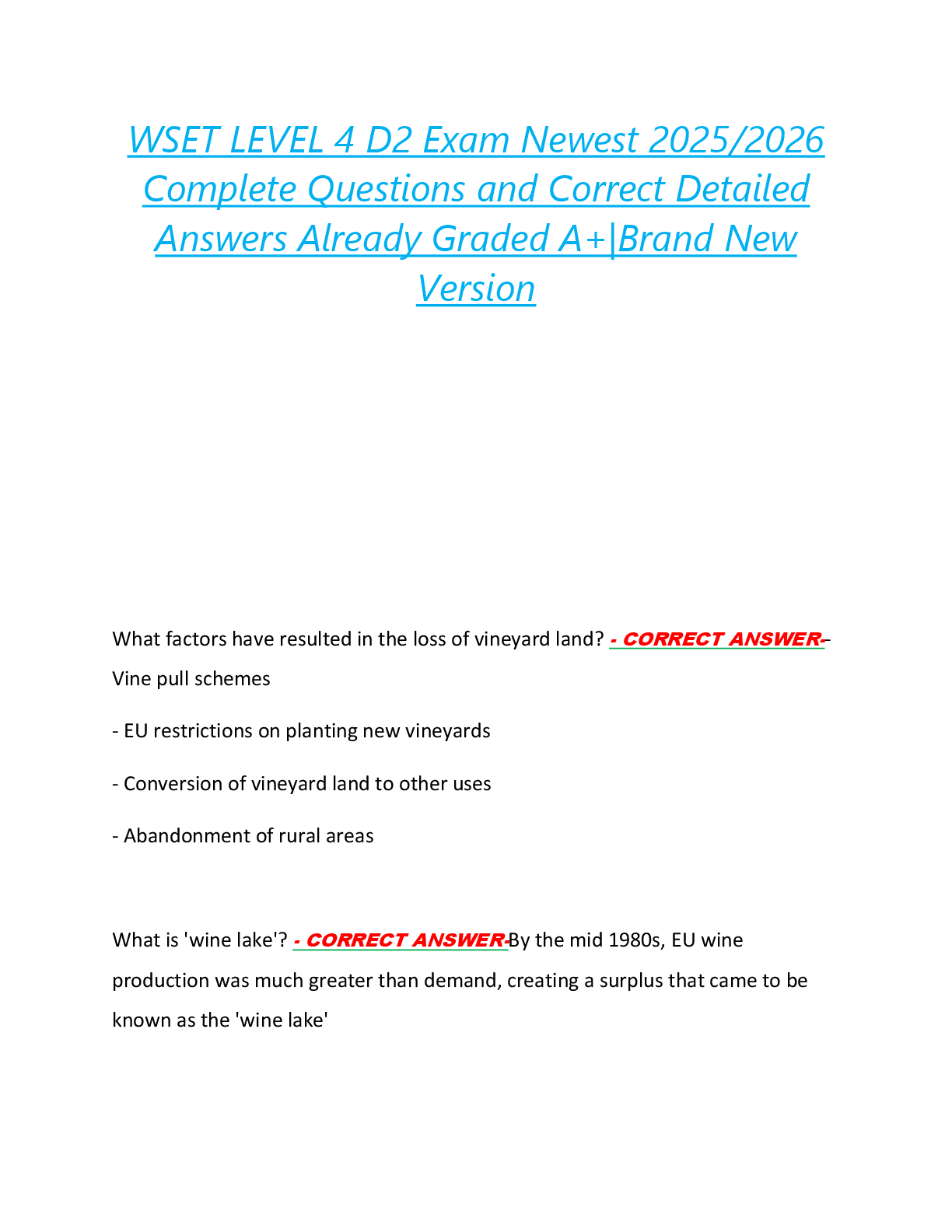
Y1 SAP Exam 97 Questions with Verified Answers,100% CORRECT
Document Content and Description Below
Y1 SAP Exam 97 Questions with Verified Answers Describe the bio-psycho-social model and its impact on health and healthcare - CORRECT ANSWER focuses on the hollistic care of medicine by combining b ... iological components with psychological components eg lonliness and social components eg living conditions treats the person and not the illness lending to patient centred medicine Describe the concept of patient centred medicine and the importance of patients being at the centre of medical practice and health care - CORRECT ANSWER to integrate diagnosis of diease with the understanding of a patients own experince of life and illness. It focuses on an individuals needs and concerns facillitates shared decision making and makes the patient feel confident in their treatment Describe the role of family, doctors and other health and social care professionals in the care of a patient [SAP] - CORRECT ANSWER multidisciplinary team - helps to treat all aspects of illness (biopsychosocial model) Describe the four principle approach to bioethics and its limitations - CORRECT ANSWER autonomy - patients have the right to chose their own treatment and should be actively involved in decision making beneficience- having the best outcome for the patient in mind at all times non-maleficience - do no harm justice - actions must be legal and respect the human rights of patients eg treating everyone fairly limitations are that some of the pillars may counteract each other making it hard to know which decision to make Describe the principle features of deontological, utilitarian and virtue ethics and the ethics of care - CORRECT ANSWER deontological - intentions matter , ethical decisions are good if they are made on a basis of some rules ( rules are based on the recognition of duties ) however always following rules can also have negative consequences utalitarianism - focuses on consequences and if the consequences produce happiness , we should try to produce the greatest amount of hapiness should happiness be all that matters? virtue ethics - focus on role models rather than consequences or rules care ethics-the right conduct emerges from a caring relationship Describe the relevance of ethics to medicine - CORRECT ANSWER we need to be able to sytematise , defend and recommend concepts of right and wrong behaviour to get the best outcome for patients under our care Recognise preconceptions and assumptions that may underpin discussions and arguments in ethical debate - CORRECT ANSWER religion health beliefs social background upbringing culture education level Describe the role and functions of the General Medical Council (GMC) - CORRECT ANSWER the GMC has statutory power to regulate medicine in the uk and provides ethical guidence decide which doctors are qualified to work in the UK oversee UK medical education and training set the standards doctors need to follow throughout their careers where necessary, take action to prevent a doctor from putting the safety of patients, or the public's confidence in doctors, at risk List the "Duties of a Doctor" as defined by the GMC - CORRECT ANSWER Knowledge, skills and performance Make the care of your patient your first concern. Provide a good standard of practice and care. Keep your professional knowledge and skills up to date. Recognise and work within the limits of your competence. Safety and quality Take prompt action if you think that patient safety, dignity or comfort is being compromised. Protect and promote the health of patients and the public. Communication, partnership and teamwork Treat patients as individuals and respect their dignity. Treat patients politely and considerately. Respect patients' right to confidentiality. Work in partnership with patients. Listen to, and respond to, their concerns and preferences. Give patients the information they want or need in a way they can understand. Respect patients' right to reach decisions with you about their treatment and care. Support patients in caring for themselves to improve and maintain their health. Work with colleagues in the ways that best serve patients' interests. Maintaining trust Be honest and open and act with integrity. Never discriminate unfairly against patients or colleagues. Never abuse your patients' trust in you or the public's trust in the profession. Define reflection and explain the importance of reflection in clinical practice - CORRECT ANSWER reflection is thinking about clinical experiences and learning from them important as it can help develop actions to improve practice helps to develop self awareness and helps to deal with uncertainty identifies opportunities to improve patients safety in organisations Describe the experiential learning cycle and three stage model of reflection - CORRECT ANSWER three stage model of reflection- what? experiences and thoughts at the time, so what? why is this relevant now what? how can i improve in the future experiential learning cycle - 1. Concrete Experience - a new experience or situation is encountered, or a reinterpretation of existing experience. 2. Reflective Observation of the New Experience - of particular importance are any inconsistencies between experience and understanding. 3. Abstract Conceptualization reflection gives rise to a new idea, or a modification of an existing abstract concept (the person has learned from their experience). 4. Active Experimentation - the learner applies their idea(s) to the world around them to see what happens. Describe the professional responsibilities and standards of professional behaviour expected of medical students - CORRECT ANSWER must behave professionally both in and outside of medical school. Describe the factors that influence fitness to practise as a doctor, and the implications for studying medicine - CORRECT ANSWER conviction or caution drug or alchohol misusen agressive/ violent behaviour persistant inappropriate attitide cheating or plagiarising dishonesty / fraud unprofessional behaviour health concrtns eg not following medical advice may have to undergo fitness to practice and be removed from the couse/struck off Describe the role of fitness to practise in context of professionalism and General Medical Council policy - CORRECT ANSWER FTP is used if there are concerns about an individuals behaviour that may break the GMC policy and it is used to keep patient safety the top priority Describe the basic structure of the Calgary-Cambridge framework - CORRECT ANSWER initiating the session - establiship rapport and identifying reasons for cosultation gathering information - explore the pateints problems and understand the pateints perspective physical examination explanation and planning - providing the correct amount and type of info shared decision making closing the session Describe the benefits of good communication to the healthcare professional and the patient - CORRECT ANSWER patient - allows correct consent to be given increases concordance with treatment direct theraputic effects helps to gather all the information needed healthcare professionals - helps handovers to run efficiently increases patient safety amd reduces the number of errors Discuss the communication challenges facing health care at the present time - CORRECT ANSWER technology - eg diagnosis without seeing pateint increased socio-cultural diversity - eg language and expectations aging population - eg hearing impairments increased expectation of patient involvement can creat challenging conversations eg end of life care Discuss the variety of contexts in which communication takes place in health care - CORRECT ANSWER doctor pateint doctor to other healthcare professionals Describe when hand washing should be performed in clinical practice - CORRECT ANSWER 5 moments of hand hygiene before patient contact before aspectic technique after body fluid exposure after pateint contact after contact with patient surroundings Describe the concept and importance of consent and confidentiality in medicine - CORRECT ANSWER consent - the principle that a person must give their permission before the recieve any type of medical treatment, exam or test. must be voluntary consent , informed and the patient must have capacity confidentiality - information that is confdential must be kept private both are important to preserve the trust between pateints and doctors Describe the content of the GMC's ethical guidance - CORRECT ANSWER good medical practice confidentiality and consent shared decision maing leadership and management Describe how to care for your hands in order to reduce risk of transmission of infection - CORRECT ANSWER keep hands moisturised to stop and cracks in skin no nail polish short nails List the most frequently missed areas of the hands during hand hygiene - CORRECT ANSWER the sides of the little finger and thumb wrists Describe interprofessional education - CORRECT ANSWER students from two or more professions in health and social care learn together during all or part of their professional training with the object of cultivating collaborative practice for providing client-or patient-centered health care. Describe stereotyping and professional prejudices and the impact of these on interprofessional working - CORRECT ANSWER people may be sterotypes for reasons such as race gender background age etc the impact of these on interprofessional working can put a strain on professional relationshops and make people feel uncomfortable and can ultimately compromise patient care Describe the changing nature of health and social care boundaries - CORRECT ANSWER Describe the principles of interprofessional education in terms of improving teamwork and patient care - CORRECT ANSWER practices communication skills and allows teamwork to generate the best patient centred medicine Describe the main sources of demographic information available in the UK, and other countries - CORRECT ANSWER uk - public health england nomis global WHO Describe correct and safe disposal of waste within the clinical environment - CORRECT ANSWER all sharps must be disposed of in the sharps bin , needles must ne removed without touching the needle clinical waste must be disposed of in the clinical waste bin Describe how to measure and record blood pressure - CORRECT ANSWER ensure arm is at the levl of the heart remove clothing inflate cuff until pulse vanishes inflate and extra 30mmhg redice cuff pressure slowly until pulse is felt again this is estimated systolic fully deflate cuff put stethescope over brachial artery and inflate to 30mmhg above estimated sytolic let pressure out slowly - systolic is 1st korotkoff sound diastolic is 5th record time and date name which arm position of patient systolic/diastolic Describe key patient safety and health and safety issues relevant to venepuncture - CORRECT ANSWER clean area and do not repalpate consent , allergies , arm preference release tornique first before needle bevel must be up , 15-30 degree angle apply cotton wool Describe the rate, rhythm, volume and character of relevant pulses on examination - CORRECT ANSWER rate - how fast rhythm - regular/irregular volume ( brachial ) - weak or strong character - waveform or shape of pulse Describe the recommended procedures for dealing with accidental needle stick injuries and blood spill - CORRECT ANSWER if needlestick injury - encourage bleedinfg wash witn soap and water attend occpational health spills - clean up wearing gloves and inform colleagues Describe the significance of the following abnormal findings: radio-radial delay; radio-femoral delay; presence of an arterial bruit - CORRECT ANSWER radio-radial delay can mean narrowing of the aorta or a tear radio-femoarl delay - coartication of the aorta bruit - obstriction in artery eg atheroma Record and document your findings with respect to pulse and blood pressure - CORRECT ANSWER Describe a range of question types that may be used when gathering information - CORRECT ANSWER open questions - cannot be answered by yes or no closed - answered yes or no clarifying questions - check statements which may be vague probing questions - looking more in depth eg how does that make ypu feel statement questiosn Describe and apply the basic skills of 'active listening' - CORRECT ANSWER nonverbal behaviour faciliatory response allows the patient time to respond picking up on verbal and non-verbal cues Describe the importance of non-verbal communication - CORRECT ANSWER importance - allows the patient to feel comfortable and listened to so may give up more important informarion theraputic benefits Describe the non-verbal cues and gestures used in transmitting messages and interpreting behaviour - CORRECT ANSWER posture touch body movements facial expressions eye contact vocal Calculate the volume of distribution, half-life, clearance and loading dose of a drug - CORRECT ANSWER volume of distribution is the dose / conc of drug in plasma ( C0) may need to extrapolate graph to get C0 ( initial conc of drug in plasma) half life - look time taken for conc to half clearance - the volume of plasma cleared per unit of time loading dose = vd x desired steady state plasma Define health inequalities and discuss trends in health inequalities - CORRECT ANSWER health inequalities are the sytematic differences in health between different socio-economic groups eg north south divide most perived areas have the lowest lifespan Describe how social class can classified - CORRECT ANSWER social class is a group of people of similar status cam be determined by socio-economic status , based on wealth social life and activities or neighbourhood deprovation Describe the main explanations for the relationship between social class and health - CORRECT ANSWER social determinants - the conditions in which people are born work and grow affect health behavioural culture explanation- main cause of inequality os the difference in health realted behaviour due to health beliefs and what is culturally acceptable economic material explanation - income levels determine heath inequalities as they enable acess to schools trasnport etc and lower exposure to risk psychosocial explanation - how social inequality makes people feel and the biological conequences eg stress in work place Describe the causes, underlying pathophysiology and clinical consequences of various forms of arteriosclerosis - CORRECT ANSWER arteriosclerosis is the thickening and loss of elasticity to the small arteries, restricting bloof flow due to hypertension smoking etc it maye present as weakness, facia or lower limb numbness, confision , bisual problems atherosclerosis is a form of arteriosclerosis with the development of fatty plaques as part of the inflammatory response mockenbergs arteriosclerosis is clacific sclerosis mostly in the elderly hyperplastic affects medium and large arteries hyaline is the deposition of homogenous hyaline in small arteriesn Describe the main types of aneurysms and describe the main pathogenic mechanisms, morphological features and clinical course - CORRECT ANSWER aneurysm is a localised permanent dilation od the artery a fake aneurysm is a blood filled space around a blood vessel dissecting aneurysm - intimal tear so blood can move into the muscle wall forming a dissection can be caused by atherosclerosis hypertension atheroma clinical course - must be monitored very closely and surgery Describe the pathophysiology of hypertension particularly in end stage organ damage [ - CORRECT ANSWER hypertension can weaken the vessel walls of the eye , kidney and brain causing retiinopathy and renal failure it can cause arteriosclerosis whic can cause an thrombus/embolus causinf MI and ischaemia and the increased afterload can cause heart failure Describe the main clinical effects of atheroma - CORRECT ANSWER aneurysm and rupture thrombus embolus critical stenosis cam cause acute cornory syndromes and stable angina also acute limb ischaemia Describe the principles and process of clinical reasoning - CORRECT ANSWER process by which we gather information from the patient and use or own knowlege to come up with a hypothesis we then seek confirmation with examination and investigations may need to do this step multiple times then make management decisions important to have differential diagnosis and think about thw worst case scenario Describe the ways used to explore the patient perspective, for example, the patients ideas, concerns, expectations, feelings and impact - CORRECT ANSWER ICE ICE BABY Describe how the basic BLS technique may be modified to protect casualty and rescuer from potential harm - CORRECT ANSWER may do compression only CPR Describe and identify the appropriate anatomical locations for connecting an individual to electrocardiogram (ECG) recording equipment - CORRECT ANSWER left leg left arm right arm Describe the diagnostic value of electrocardiograms (ECGs) in the detection of arrhythmias, heart block, ischaemic heart disease, myocardial infarction and hypertrophy - CORRECT ANSWER check ecg interpretation notes ( case 2 ) Define patient self-care and describe the key elements and impact on a patient's health - CORRECT ANSWER self care - the actions that individuals take for themselves on behalf of and with others in order to develop protect maintian and improve health and wellbeing Describe and apply the concepts of illness and disease - CORRECT ANSWER disease is an organic patholofy/abnormality illness is a subjective expreience of ill health to a patient and those around them Describe how patients define their own health referenced to medical, functional and idealist models of health - CORRECT ANSWER medical model - absence of disease , illness and injury functional ( social) - the ability ot function in a normal social role idealistic model - sate of complete physical , mental and social wellbeing most people see health as functional Describe the factors that influence consulting behaviour and demonstrate their association with the iceberg of health - CORRECT ANSWER frequency/ seriousness of symptoms not a good indicator of when a pateint will present triggers ro consult interpersonal crisis percieved interference w social relationships sanctioning percieved interference w vocational/physical activity temproralising of symptoms Describe the significance of health (or lay) beliefs to consulting behaviour and their link to the patients' perspective - CORRECT ANSWER patient will decide to seek help when it seems rational to them and their own health beliefs eg when they feel it is possible to adress the problem with a positive expectation of the outocme when they feel like they can take the proposed action Describe causes and consequences of myocardial infarction - CORRECT ANSWER STEMI caused by complete occlusion eg due to thromobotic reupture NSTEMI - incomplete vascular occlusion eg may be caused by atheroma thrombosis embolus spasm vasculititis Describe the causes and pathophysiology of hypoxic damage in the heart - CORRECT ANSWER caused by vascular occlusion of the BV and can be caused by atheroma thrombosis embolus spasm etc can cause ischaemic heard disease and can cause part of the muscle to infarct Describe the epidemiology and pathophysiology of ischaemic heart disease - CORRECT ANSWER can be chronic ischamic heart disease and be silent/stable/variant angina or acute coronary syndrom - unstable angina , stemi nstemi epidemiology is that its a big killer in developed countires and is more prevelant in men Describe the main causes of valvular heart disease and the clinical consequences - CORRECT ANSWER mitral and aortic valve disease are the most common the main causes are mitral - mv prolapse due to degeneration , L V dilation , rheumatic heart disease and infective endocarditis can cause heart failure and atrial fibrillation aortic valve disease - caused by infective endocarditis , rheumatic HD , congenital defects , calcification and bicuspid valve can cause left ventricular hypertrophy which can cause ischaemia and HF Describe the pathogenesis, aetiological agents and clinical manifestations of infective endocarditis - CORRECT ANSWER often caused by staph aureus bacteria enters blood and when it reaches the heart it can colonise a thrombus this causes an infective vegetation which protects the bacteria from blood as more of the clot is formed can cause a septic emboli can damage heart valves can cause general symptoms of infection and can also cause janeway lesions and splinter hameorrages Describe the cause and pathophysiology of left and right sided heart failure do a mindmap and compare to poster - CORRECT ANSWER List the cardinal symptoms of heart disease - CORRECT ANSWER shortness of breath oedema syncope palpitations chest pain Describe and identify arrhythmias and the different degrees of heart block from electrocardiogram (ECG) recordings look at notes - CORRECT ANSWER Describe the electrocardiogram (ECG) changes that occur in hypertrophy - CORRECT ANSWER tall R waves deep s waves inverted t waves Describe the electrocardiogram (ECG) changes that occur in ischaemic heart disease - CORRECT ANSWER ST depression inversion of t waves ( similar to NSTEMI) Describe the electrocardiogram (ECG) changes that occur in myocardial infarction - CORRECT ANSWER ST elevation - STEMI Describe the pathogenesis, morphological features and clinical course of cardiomyopathy do mindmap and compare to poster - CORRECT ANSWER Describe the imaging techniques used in cardiovascular disease, e.g. echocardiography and coronary angiography - CORRECT ANSWER echo - ultrasound of heart can see parts of the muscle not contracting well, hypertrophy etc coronary angiooraphy can see an occlusions in the coronary artery Describe the main advantages and disadvantages of MRI, ultrasound, plain radiography and CT scans Describe the principles and clinical use of MRI, ultrasound, plain radiography and CT scans in clinical radiology - CORRECT ANSWER check against case 2 self directed imaging notes Explain the limitations of applying clinical trial data to individual patients - CORRECT ANSWER different clinical trials may have different outcomes may not be able to apply all clinical trials to all patients eg demographics / location Describe a variety of different models of the doctor-patient relationship and their influence on decision making - CORRECT ANSWER mutualistic - both doctor and patient have an important tole in decision making paternalistic - doctor had more important role in decision making , often used in emergency situations where the patient cannot be consulted consumerist - patient has expectations about healthcare and has the most control in the decision making often used in private healthcare defualt - both patient and doctor are passive in decision making Describe the reasons for involving patients in decision making about their treatment - CORRECT ANSWER increases compliance with treatment allows the healthcare professional to tailor the treatment to the patient both feel supported and impowered to make informed choices Describe the causes and underlying pathophysiology and clinical consequences of chronic kidney disease - CORRECT ANSWER causes of CKD: hypertension can causes thickening of the renal artery causinf reduced bloof flow to the kidney by activating RAAS and leading problems with the filtration barrier diabetic nephropathy - hyperglycaemia can cause damage to the kidney isachaemia of renal tissue consequences: accumulation of uremic toxins: fatigue, anorexia,itch, pericarditis , vit d deficiency , can increase blood pressure anaemia as epo not made Describe the causes and underlying pathophysiology and clinical consequences of acute kidney injury - CORRECT ANSWER causes: pre renal - eg dehydration and low blood volume , hypotension , heart failure intrinsic - glomerularnephritis - nephrotic/nephritic syndrome also tuberointerstitial eg infections sepsis post renal - occulsion eg clots stones and enlarged prostate clinical consequences eg acidbase disorders , ion disorders same as ckd List the cardinal symptoms relating to kidney disease - CORRECT ANSWER swelling /fluid retention shortness of breath fatigue confusion nausea decreased urine output Describe the causes and effects of hyperkalaemia and hypokalaemia - CORRECT ANSWER check against poster Describe and apply the concept of clinical uncertainty - CORRECT ANSWER 3 types of uncertainty - lakc of knowledge uncertainty of how to interact and intrinsic uncertainty to do with the world around us and how little control we have Describe the signs and symptoms of anaemia - CORRECT ANSWER symptoms- fatigue lethargy breathlesness palpitations fainting signs - pallor tachycardia fast breathinh hypotension Describe and interpret the blood indices and other blood tests relevant to anaemia - CORRECT ANSWER do seminar anaemia sheet Describe the characteristic features of benign neoplasms and malignant neoplasms - CORRECT ANSWER benign = slow growth rate , no invasion of tissue , well differentiated , exophytic growth malignant = fast growth poor differentiation invasion endophytic growth Describe the criteria that should be met before implementing a screening test - CORRECT ANSWER the disease must be an important well understoof health problem with a detectable risk factor and a long latent period the screening must be valid, acceptable and reliable the diagnosis and treatment must be agreed upon and cost effective with adequate facillities to meet demand the programme must decrease mortality and have staffing and facillities and must allow patiens to malke an informed choice Describe the causes, pathology and clinical features of colonic carcinoma - CORRECT ANSWER genetic mutations can cause colon cancer some risk factors can increase the chance : over 65 FH IBS type 2 diabetes unhealthy lifestyle often no symptoms but can present as anaemia especially RHS LHS rectal bleeding and bowel occlusion is common Describe the different clinical features of the different types of diabetes mellitus - CORRECT ANSWER type 1 : presents in young people and often in acute situation , often no complications no family history type 2 : may not have synptoms and may present because and with complications family history #older and obesity secondary diabetes - from medication possible pancreatic illness/surgery monogenic - eg neonatal and often develops before 25, runs in family gestational - diagnosed in pregancy Describe the pathology of diabetes mellitus and the long term complications of the disease - CORRECT ANSWER long term complications microvascular - retinipathy, neuropathy nephropathy, erectile disfunction CDV- stroke , hypertension CVD PVD absent foot pulses Describe the role of health psychology approaches in understanding a patients experience of health and illness - CORRECT ANSWER Describe communicable and non-communicable disease at the population and global level - CORRECT ANSWER most common cause of female death is cancer and male is heart conditions communicable disease are a larger cause of death in developing countires Describe the importance, and challenges, of public involvement in health care decision making including shared decision making - CORRECT ANSWER important as it can help to prevent illness and increase quality of life and decrease burden on NHS challenges are that it has a high cost and time hard to know who to target Describe the models of health education and behaviour change - CORRECT ANSWER health education is enhancing learning experiences that enable people to increase theit control of the determnants of health and health behaviours to improve their health stati=us behaviour change is precontemplation contemplation decision action and maintainence Describe the role of Public Health in the planning and evaluation of health services - CORRECT ANSWER Describe the factors that form health beliefs and the impact they can have on health seeking behaviour - CORRECT ANSWER percieved barriers vs benefits percieved threat self efficacy cues to action Describe the role of doctors in promoting health as well as managing illness and disease - CORRECT ANSWER role as a doctor is to understand a patients health belief understand where they are in the cycle of change and then used shared decision making to come up with and action plan Describe how to assess a patient's readiness to change a health-related behaviour, identify appropriate interventions that may be offered and apply these to obesity, smoking and alcohol consumption - CORRECT ANSWER goal setting is a useful tool pointing patients to support eg self helf groups apps fitness groups and repeat consulations Describe the consequences of over-nutrition - CORRECT ANSWER increases the risk of typ2 2 diabetes , sleep apnoea CHD, hypertension , osteoathritis cancer , fertility impairment Describe how health systems are structured and function differently across the globe - CORRECT ANSWER private - out of pocket or health insurnace tax based - comes from 1 pot, government funded social health insunrance- many pools that people pay into Discuss the essential components of a health system, using the World Health Organisation - CORRECT ANSWER service delivery healthworkforce health infromation systems acess to essential medicine financing leadership/governance [Show More]
Last updated: 2 years ago
Preview 1 out of 20 pages
Buy this document to get the full access instantly
Instant Download Access after purchase
Buy NowInstant download
We Accept:

Reviews( 0 )
$9.00
Can't find what you want? Try our AI powered Search
Document information
Connected school, study & course
About the document
Uploaded On
Oct 18, 2023
Number of pages
20
Written in
All

Additional information
This document has been written for:
Uploaded
Oct 18, 2023
Downloads
0
Views
72