Chapter 08: Anti-Infectives: Antibacterial Drugs
Workman & LaCharity: Understanding Pharmacology: Essentials for Medication Safety, 2nd Edition
MULTIPLE CHOICE
BASIC CONCEPTS
1. Which type of bacteria cause in
...
Chapter 08: Anti-Infectives: Antibacterial Drugs
Workman & LaCharity: Understanding Pharmacology: Essentials for Medication Safety, 2nd Edition
MULTIPLE CHOICE
BASIC CONCEPTS
1. Which type of bacteria cause infection when a patient’s immune system is impaired?
a. Pathogenic
b. Nonpathogenic
c. Gram-negative
d. Opportunistic
2. What does the term “virulence” mean?
a. Bacteria that do not cause infection or systemic disease
b. How easily a bacterium can be killed by antibiotic therapy
c. How well bacteria can invade and spread within the body
d. How many different types of bacteria an antibiotic can kill
3. What is the main feature of an opportunistic infection?
a. It usually leads rapidly to sepsis.
b. Children are not susceptible to this type of infection.
c. It is most often caused by pathogenic microorganisms.
d. It is only found in people who are immunosuppressed.
DIF: Cognitive Level: Remembering REF: p. 115
4. Which problem is a sign or symptom of an allergic or anaphylactic response to an antibacterial drug?
a. Diarrhea
b. Hair loss
c. High blood pressure
d. Swelling of the face or lips
5. Which drug category includes the penicillins?
a. Protein synthesis inhibitors
b. Cell wall synthesis inhibitors
c. DNA synthesis inhibitors
d. Metabolism inhibitors
6. Which drug is a first-generation cephalosporin?
a. Cefepime (Maxipime)
b. Cefotaxime (Claforan)
c. Cefoxitin (Mefoxin)
d. Cefazolin (Kefzol)
7. Which two drug types have almost identical chemical structures?
a. Aminoglycosides and “sulfa drugs”
b. Macrolides and fluoroquinolones
c. Penicillins and cephalosporins
d. Tetracyclines and penicillins
8. Which drug is most often used to treat ear infections in children?
a. Imipenem (Primaxin)
b. Amoxicillin (Amoxil)
c. Vancomycin (Vancocin)
d. Sulfamethoxazole/trimethoprim (Bactrim)
9. Which protein synthesis inhibitors can raise the pressure inside the brain?
a. Aminoglycosides
b. Macrolides
c. Lincosamides
d. Tetracyclines
10. Which drug can cause tooth discoloration when given to young children?
a. Aminoglycosides
b. Macrolides
c. Lincosamides
d. Tetracyclines
11. Which antibacterial drugs are most likely to cause severe skin reactions?
a. Erythromycins and aminoglycosides
b. Sulfonamides and trimethoprim
c. Penicillins and cephalosporins
d. Macrolides and tetracyclines
12. Which side effect of fluoroquinolones is more likely to occur among older adults?
a. Fever
b. Hair loss
c. Tendon rupture
d. Low blood pressure
13. Which condition is most likely to lead to antibacterial drug resistance?
a. Having a parent with antibacterial drug resistance
b. Receiving prolonged antibacterial drug therapy
c. Taking an antibacterial drug for the very first time
d. Being allergic to a specific antibacterial drug
ADVANCED CONCEPTS
14. Which question would you be sure to ask a patient after giving any antibacterial drug?
a. “Are you allergic to any foods or medications?”
b. “Have you noticed any changes in your ability to remember things?”
c. “Do you know how to check your blood pressure and heart rate?”
d. “How many bowel movements do you have each day and what are they like?”
15. Why is it important to avoid killing off normal flora with antibacterial drugs?
a. Normal flora can help provide protection against the development of pathogenic infections.
b. Normal flora result in opportunistic infections while other bacteria result in pathogenic infections.
c. When normal flora are not present, the immune system is suppressed, increasing the risk for infection.
d. When normal flora are not present, the immune system is overactive, increasing the risk for autoimmune diseases.
16. How are bactericidal drugs different from bacteriostatic drugs?
a. Bacteriostatic drugs are more likely to cause an allergic response than bactericidal drugs.
b. Bacteriostatic drugs work only on bacteria, whereas bactericidal drugs are effective against other types of organisms.
c. Bactericidal drug actions result in killing the bacteria, whereas bacteriostatic drugs only slow bacterial growth.
d. Bactericidal drugs require assistance from the patient’s immune system to be effective, whereas bacteriostatic drugs are effective even when function is poor.
17. The patient with an elevated temperature is prescribed antibacterial therapy to be taken at home. The prescribed drug is amoxicillin (Amoxil) 250 mg three times a day. What would you teach the patient about dosing intervals for this drug?
a. “Take the drug three times a day with meals.”
b. “Take the drug every 8 hours throughout the day.”
c. “Take the drug when you first get up, at lunch time, and with your evening meal.”
d. “Take the drug every 6 hours while you are awake.”
18. A patient has a bacterial infection, but the causative organism is not known. Which type of antibacterial drug will most likely be prescribed?
a. Narrow-spectrum
b. Limited-spectrum
c. Extended-spectrum
d. Broad-spectrum
19. Which statement made by a patient prescribed to take antibiotic therapy for a wound infection indicates a correct understanding of the therapy?
a. “If my temperature is normal for 3 days in a row, the infection is gone and I can stop taking the drug.”
b. “If my temperature goes above 100° F for 2 days, I should double the dose of the drug.”
c. “Even if I feel completely well, I should take the drug exactly as prescribed until it is gone.”
d. “I should notify my prescriber to change the medication if I develop diarrhea while taking this drug.”
20. A patient with a respiratory bacterial infection asks why a sputum sample is being collected before starting antibacterial drug therapy. What is your best response?
a. “Drug therapy for lung infections works better when less sputum is present.”
b. “A sputum sample will help us determine what bacteria is causing your infection.”
c. “The test will determine whether you already have any damage in your lung tissues.
d. “The dosage of your antibacterial drug is determined by the organism that is causing your infection.”
21. A patient receiving antibiotics for 3 days reports a skin rash over the chest, back, and arms. What is your first action?
a. Ask the patient whether he or she has ever developed a rash while taking another drug.
b. Reassure the patient that many people have this expected reaction to antibiotic therapy.
c. Ask the patient whether the rash itches, burns, or causes other types of discomfort.
d. Document the report as the only action.
22. A patient who has been on antibiotic therapy for 3 weeks has a cottage cheese–like coating on the teeth, gums, and roof of the mouth. What your best action?
a. Take a specimen and send it to the laboratory for culture.
b. Hold the dose and notify the prescriber immediately.
c. Document this expected finding as the only response.
d. Assist the patient to perform frequent mouth care
23. What is the most important action needed when a patient is first started on an intravenous (IV) antibacterial drug?
a. Check the IV site every 4 hours for redness around the site and the presence of cordlike veins.
b. Check the drip rate every hour to ensure that the proper blood drug level is maintained.
c. Assess the patient’s pulse, blood pressure, and respiratory effect every 15 minutes.
d. Assess the patient’s white blood cell count daily to determine drug effectiveness.
24. A patient experiences facial angioedema after receiving a dose of a new antibacterial drug. Which assessment should be performed first?
a. Airway adequacy
b. Peripheral lung sounds
c. Rate and depth of respirations
d. Symmetry of respiratory movement
25. A patient with a bacterial infection has been placed on antibacterial therapy. Which assessment finding in the patient indicates that the therapy is effective?
a. Red blood cell count is 4,500,000 cells/mm3.
b. White blood cell (WBC) count is 8000 cells/mm3.
c. Wound drainage is thick and yellow.
d. Temperature is 102.4° F.
26. A patient is having an anaphylactic reaction to an intravenous (IV) antibacterial drug. Which action should you perform first?
a. Discontinue the IV therapy immediately and place the patient in shock position.
b. Hold the next dose and notify the prescriber immediately.
c. Discontinue the IV therapy and restart it at a different site.
d. Discontinue the drug and maintain the IV access.
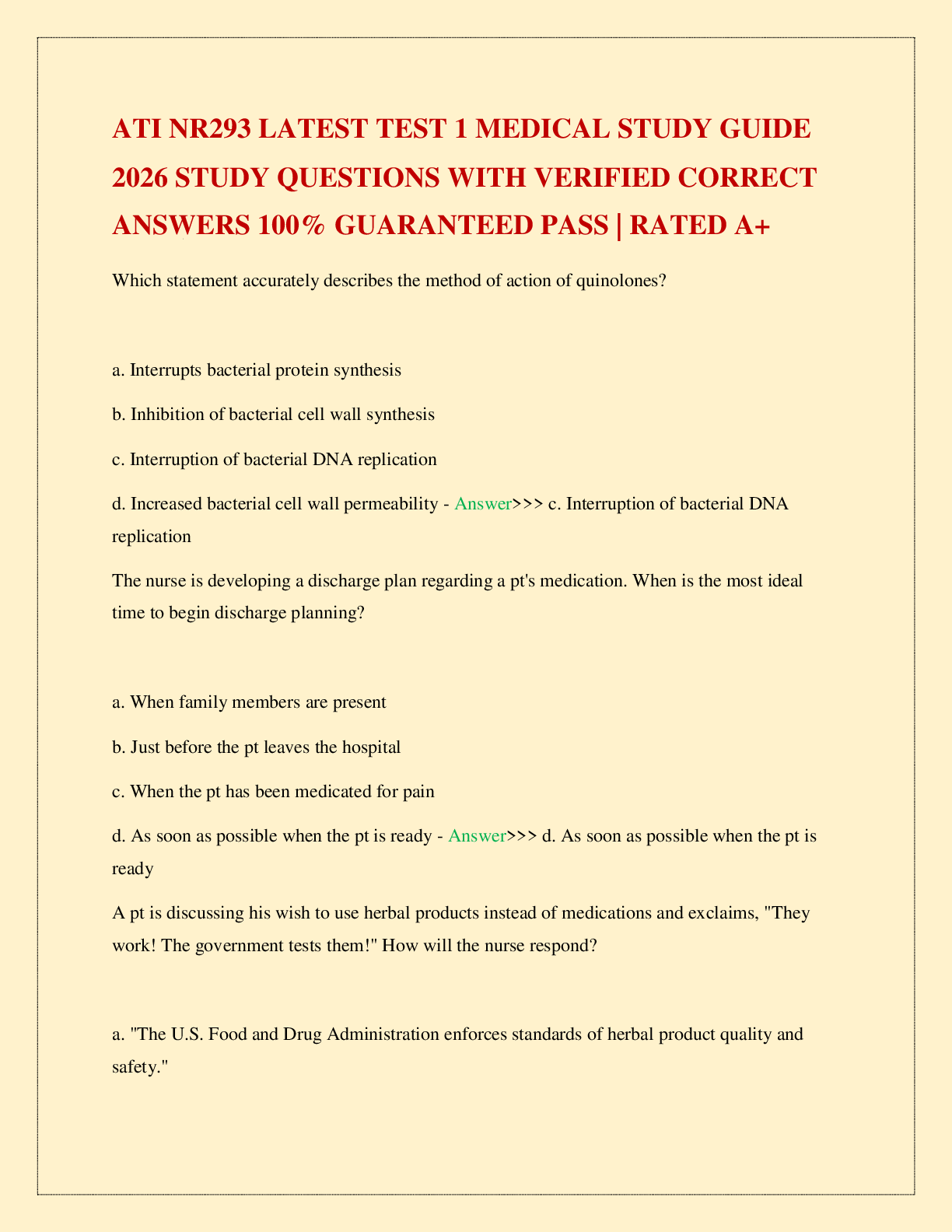
27. Which antibacterial drug kills bacteria by binding to cell wall proteins and preventing them from being incorporated into cells walls?
a. Levofloxacin (Levaquin)
b. Minocycline (Vectrin)
c. Vancomycin (Vancocin)
d. Gentamicin
28. A patient who has been prescribed cephalexin (Keflex) reports having a severe allergic reaction to penicillin in the past. What is your best first response or action?
a. Reassure the patient that Keflex is not penicillin.
b. Place an allergy alert band on the patient’s wrist.
c. Notify the prescriber immediately before the first Keflex dose.
d. Highlight this important information in the patient’s medical record.
29. A patient who has been prescribed amoxicillin (Amoxil) 250 mg orally every 8 hours asks if a higher dose of the drug just once a day can be taken instead. What is your best response?
a. “Taking this drug every 8 hours helps keep the blood level of the drug high enough to affect the bacteria.”
b. “Giving the drug at regular intervals over a 24-hour period helps prevent side effects.”
c. “Let me contact your prescriber and ask whether the drug can be given once a day.”
d. “When given once a day, the dose is higher so allergic reactions are more common.”
30. A woman who is breastfeeding is prescribed amoxicillin/clavulanic acid (Augmentin) 250 mg every 8 hours to treat a bacterial infection. What should you teach her?
a. “This drug does not pass into breast milk so continue to breastfeed while you are taking this drug.”
b. “This drug passes into breast milk but has no side effects so it is safe to continue breastfeeding.”
c. “This drug passes into breast milk and may cause your child to develop an allergy to this drug.”
d. “This drug does not pass into breast milk but you might want to avoid breastfeeding while taking it.”
31. Which side effect should you monitor for when a child is prescribed penicillin V potassium 250 mg twice daily?
a. Gastrointestinal upset
b. Decreased urine output
c. Allergic reaction
d. Constipation
32. A patient who has been prescribed oral cephalexin (Keflex) also takes aluminum hydroxide (Mylanta) 1 hour after each meal. When should you give this drug?
a. Give the two drugs at the same time to prevent GI upset.
b. Give the cephalexin 1 hour before the aluminum hydroxide.
c. Give the aluminum hydroxide 1 hour before the cephalexin.
d. Give the aluminum hydroxide 4 hours after the cephalexin.
33. A patient is to receive penicillin G benzathine (Bicillin LA) 2,400,000 units intramuscularly. The drug on hand is penicillin G benzathine 600,000 units/mL. How many milliliters should your nurse prepare for the correct dose?
a. 0.25
b. 0.5
c. 2
d. 4
34. A patient is to receive ticarcillin (Ticar) 3 g by intravenous piggyback. The solution you have is ticarcillin 200 mg/mL. How many milliliters of this solution will you add to the piggyback bag to make a dose of 3 g?
a. 3 mL
b. 5 mL
c. 10 mL
d. 15 mL
35. A patient prescribed vancomycin (Vancocin) has developed redness on the face, neck, chest, back, and arms. The family asks the nurse if the drug should be stopped because of this response. What is your best answer?
a. “Yes, these problems indicate an allergic reaction.”
b. “Yes, these side effects eventually lead to difficulty breathing.”
c. “No, these uncomfortable problems are an expected drug side effect.”
d. “No, the problems are caused by the presence of the infection and are not related to the drug.”
36. A patient is to receive linezolid (Zyvox) 300 mg orally. You have on hand linezolid tablets of 600 mg/tablet. How many tablets will you give for a 300 mg dose?
a. 3 tablets
b. 2 tablets
c. 1 tablet
d. 0.5 tablet
37. A patient is prescribed intravenous ertapenem (Invanz). Which question is most important to ask before giving the first dose of this drug?
a. “Do you have a hearing problem or any trouble with your ears?”
b. “Do you take medications for seizures?”
c. “Are you allergic to sulfa drugs?”
d. “Have you ever had asthma?”
38. An older patient is prescribed azithromycin (Zithromax) 500 mg on the first day and 250 mg for days 2 through 5. For which drug also prescribed for this patient would you notify the prescriber?
a. Digoxin (Lanoxin)
b. Atorvastatin (Lipitor)
c. Atenolol (Tenormin)
d. Furosemide (Lasix)
39. A patient is receiving intravenous gentamicin. Which change in condition do you report to the prescriber immediately?
a. Temperature increases from 38° C to 39° C.
b. Blood pressure decreases from 132/80 to 118/66.
c. Total 24-hour urine output decreases from 2100 to 1100 mL.
d. White blood cell (WBC) count decreases from 11,000/mm3 to 8500/mm3.
40. A patient taking erythromycin reports experiencing nausea and upset stomach. What is your best action?
a. Hold the drug and notify the prescriber immediately.
b. Ensure that the drug is given with or after food.
c. Ask if the patient has any drug allergies.
d. Document the report as the only action.
41. After starting to take clindamycin (Cleocin) 150 mg every 8 hours, which laboratory results are important for you to monitor?
a. Potassium
b. Sodium
c. Creatinine
d. Red blood cells
42. An older adult patient is prescribed amikacin (Amikin). Which assessment technique is most important to perform daily?
a. Asking about numbness in fingers and toes
b. Measuring calf circumference of both legs
c. Checking the mouth for open sores
d. Asking about ringing in the ears
43. For which patient with a bacterial infection do you question a prescription for tetracycline (Tetracon)?
a. 35-year-old patient with AIDS
b. 16-year-old patient with severe acne
c. 65-year-old patient with hypertension
d. 25-year-old patient taking oral contraceptives
44. An older adult patient has been prescribed oral erythromycin tablets. Which precaution is most important to teach?
a. “Take this drug with food or right after eating to reduce intestinal side effects.”
b. “Avoid driving or operating dangerous equipment while taking this drug.”
c. “Take your pulse daily and notify your prescriber if it becomes irregular.”
d. “Wear a hat and sunscreen when outdoors.”
45. A patient is prescribed minocycline (Dynacin) 750 mg orally. What should you do before giving the first dose?
a. Check that the patient is not allergic to penicillin or sulfa drugs.
b. Use a new IV administration set to administer the drug.
c. Hold the dose and contact the prescriber.
d. Give the drug with milk or food.
46. Why should tetracycline drugs be avoided during pregnancy and lactation?
a. Tetracycline crosses the placenta and causes brain hemorrhage in the fetus.
b. The fetal and newborn liver cannot metabolize the drug and anemia results.
c. The fetus and newborn are more likely to have allergic reactions to tetracycline.
d. The drug interferes with tooth enamel development causing permanently stained teeth.
47. The patient who is receiving intravenous (IV) penicillin is prescribed to also receive intravenous doxycycline (Doxy). Which action is most important for nurse to implement?
a. Use IV tubing for doxycycline that has never come into contact with penicillin.
b. Use a glass container for the tetracycline and a plastic container for the penicillin.
c. Infuse the doxycycline only into a central line and the penicillin into a peripheral line.
d. Administer doxycycline with sterile saline and administer the penicillin with sterile water.
48. An older adult patient is prescribed linezolid (Zyvox) 500 mg oral suspension. The drug on hand is 100 mg/5 mL. How many milliliters should you prepare for the correct dose?
a. 2
b. 10
c. 25
d. 50
49. Which laboratory blood test result for a patient taking clarithromycin (Biaxin) and warfarin (Coumadin) should you report immediately to the prescriber?
a. Potassium 3.6 mEq/L
b. Sodium 134 mEq/L
c. Blood urea nitrogen (BUN) 21 mg/dL
d. International normalized ratio (INR) 4.6
50. Which statement made by a patient prescribed to take azithromycin (Zithromax) indicates that additional teaching is needed?
a. “To avoid nausea, I will take my medicine along with food.”
b. “I will use another form of birth control along with my oral contraceptives.”
c. “Since I only have to take this drug once a day, it will be easy to remember.”
d. “To help get rid of the infection, I will spend 30 minutes each day out in the sun.”
51. Why must sulfonamide drugs be avoided during the last trimester of pregnancy and lactation?
a. The drug crosses the placenta and causes brain hemorrhage in the fetus.
b. The fetal and newborn liver cannot metabolize the drug and jaundice results.
c. The fetus and newborn are more likely to have allergic reactions to sulfonamides.
d. The drug interferes with tooth enamel development causing permanently stained teeth.
52. A patient is taking trimethoprim (Primsol) 200 mg orally once a day. For which adverse effect will you monitor?
a. GI bleeding
b. Kidney failure
c. Anaphylaxis
d. Angioedema
53. Which laboratory blood test result for a patient taking trimethoprim/sulfamethoxazole (Septra) should you report immediately to the prescriber?
a. Red blood cells (RBCs) 2.2 million/mm3
b. International normalized ratio (INR) 1.6
c. White blood cells (WBCs) 6000/mm3
d. Sodium 134 mEq/L
54. Which precaution is most important to teach a patient who has been prescribed sulfisoxizole (Gantrisin)?
a. Evenly space this drug throughout the 24-hour day.
b. Take the drug 1 hour before or 2 hours after a meal.
c. Drink at least 3 L of liquids throughout the day.
d. Stop the drug immediately if diarrhea develops.
55. A patient is to receive trimethoprim/sulfamethoxazole (Septra) intravenously. The drug is mixed in 250 mL of D5W and is to be administered over 90 minutes. With a drop factor of 15 gtt/mL, how many drops per minute is the correct infusion rate?
a. 10
b. 20
c. 30
d. 40
56. A patient taking ciprofloxacin (Cipro) reports pain and burning on urination. What is your best action?
a. Notify the prescriber that the patient’s urinary tract infection is not responding to the drug.
b. Remind the patient that the pain is related to the body eliminating the infectious bacteria.
c. Instruct the patient to drink a full glass of water with each drug dose and increase fluids.
d. Ask the patient whether blood or pus is also present in the urine.
57. A 75-year-old patient taking levofloxacin (Levaquin) reports all of the following new problems. For which problem do you advise the patient to stop taking the drug immediately and notify the prescriber?
a. Having to get up at night to urinate
b. Swelling and pain in the right wrist
c. Feeling the heart pound after drinking coffee
d. Feeling light-headed when changing positions rapidly
58. Why must fluoroquinolone drugs be avoided during pregnancy, lactation, and childhood?
a. The drug damages muscles, tendons, and bones in the fetus and growing children.
b. The fetal and newborn liver cannot metabolize the drug, leading to anemia and jaundice.
c. The fetus and newborn are more likely to have allergic reactions to fluoroquinolones.
d. The drug interferes with tooth enamel development causing permanently stained teeth.
59. A patient is prescribed an oral fluoroquinolone drug. Which precaution should you follow when administering this drug?
a. Give this drug with food.
b. Give a full glass of water to drink with this drug.
c. Give the drug before meals.
d. Give the drug with a glass of milk.
MULTIPLE RESPONSE
ADVANCED CONCEPTS
1. A patient is being discharged home on antibacterial drug therapy. What instructions should you teach the patient about allergic reactions? (select all that apply)
a. “Notify your prescriber immediately if you vomit.”
b. “Stop taking the drug if you develop hives or a rash.”
c. “If you notice diarrhea be sure to stop taking the drug.”
d. “Continue taking the drug even if you feel well because it is fighting the infection.”
e. “Call 911 if you experience difficulty with breathing.”
f. “Avoid drinking caffeinated beverages with the drug.”
2. A patient is prescribed azithromycin (Zithromax) 500 mg on the first day and 250 mg for days 2 through 5. Which side effects will you watch for after the patient starts taking this drug? (select all that apply)
a. Increased appetite
b. Abdominal pain
c. Constipation
d. Nausea
e. Sun sensitivity
f. Weight gain
3. A patient is prescribed ciprofloxacin (Cipro) 500 mg every 8 hours. Which are common side effects of this drug? (select all that apply)
a. Rash
b. Flatulence
c. Muscle pain
d. Photosensitivity
e. Joint pain
f. Headache
[Show More]