Acute Care Exam 2|116 Questions with Verified Answers
The nurse prepares to conduct a general survey on an adult patient. Which assessment is performed first while the nurse initiates the nurse-patient relationship?
...
Acute Care Exam 2|116 Questions with Verified Answers
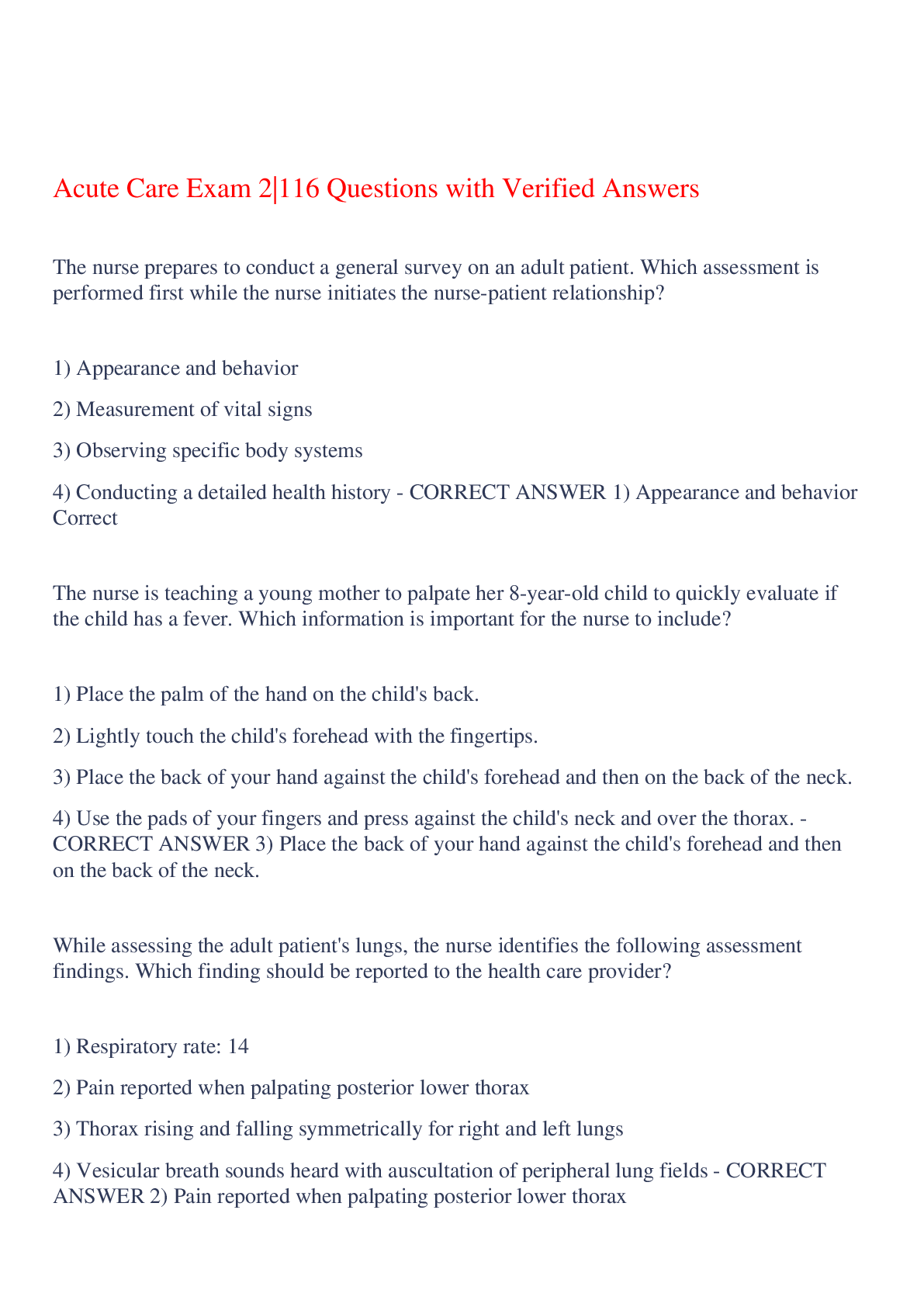
The nurse prepares to conduct a general survey on an adult patient. Which assessment is performed first while the nurse initiates the nurse-patient relationship?
1) Appearance and behavior
2) Measurement of vital signs
3) Observing specific body systems
4) Conducting a detailed health history - CORRECT ANSWER 1) Appearance and behavior Correct
The nurse is teaching a young mother to palpate her 8-year-old child to quickly evaluate if the child has a fever. Which information is important for the nurse to include?
1) Place the palm of the hand on the child's back.
2) Lightly touch the child's forehead with the fingertips.
3) Place the back of your hand against the child's forehead and then on the back of the neck.
4) Use the pads of your fingers and press against the child's neck and over the thorax. - CORRECT ANSWER 3) Place the back of your hand against the child's forehead and then on the back of the neck.
While assessing the adult patient's lungs, the nurse identifies the following assessment findings. Which finding should be reported to the health care provider?
1) Respiratory rate: 14
2) Pain reported when palpating posterior lower thorax
3) Thorax rising and falling symmetrically for right and left lungs
4) Vesicular breath sounds heard with auscultation of peripheral lung fields - CORRECT ANSWER 2) Pain reported when palpating posterior lower thorax
The nurse is teaching a young female patient to practice good skin health. Which information is important for the nurse to include?
1) Avoid sunbathing between 3 PM and 7 PM.
2) Oral contraceptives and antiinflammatories make the skin more sensitive to the sun.
3) Call the health care provider for the presence of a mole on an arm or leg that appears uniformly brown.
4) Wear sunscreen with an SPF of 30 or greater if using a sunlamp or tanning parlor. - CORRECT ANSWER 2) Oral contraceptives and antiinflammatories make the skin more sensitive to the sun.
As a nurse prepares to provide morning care and treatments, it is important to question a patient about a latex allergy before which intervention? (Select all that apply.)
1) Applying adhesive tape to anchor a nasogastric tube
2) Inserting a rubber Foley catheter into the patient's bladder
3) Providing oral hygiene using a standard toothbrush and toothpaste
4) Giving an injection using plastic syringes with rubbercoated plungers
5) Applying a transparent wound dressing - CORRECT ANSWER 1) Applying adhesive tape to anchor a nasogastric tube
2) Inserting a rubber Foley catheter into the patient's bladder
4) Giving an injection using plastic syringes with rubbercoated plungers
The nurse is assessing a patient who returned 3 hours ago from a cardiac catheterization, during which the large catheter was inserted into the patient's femoral artery in the right groin. Which assessment finding would require immediate follow-up?
1) Palpation of a femoral pulse with a heart rate of 76
2) Auscultation of a heart murmur over the left thorax
3) Identification of mild bruising at the catheter insertion site
4) Palpation of a right dorsalis pedis pulse with strength of +1 - CORRECT ANSWER 4) Palpation of a right dorsalis pedis pulse with strength of +1
The patient reports having a sore throat, coughing, and sneezing. While performing a focused assessment, which finding supports the patient's reported symptoms related to upper respiratory infection?
1) Buccal mucosa is moist and dark pink.
2) Respiratory rate is 18, rhythm is even.
3) Retropharyngeal lymph nodes are enlarged and firm.
4) Inspection with a tongue depressor on the posterior tongue causes gagging. - CORRECT ANSWER 3) Retropharyngeal lymph nodes are enlarged and firm.
The nurse is teaching a patient with poor arterial circulation about checking blood flow in the legs. Which information should the nurse include? (Select all that apply.)
1) A normal pulse on the top of the foot indicates adequate blood flow to the foot.
2) To locate the dorsalis pedis pulse, take the fingers and palpate behind the knee
3) When there is poor arterial blood flow, the leg is generally warm to the touch.
4) Loss of hair on the lower leg indicates a long-term problem with arterial blood flow. - CORRECT ANSWER 1) A normal pulse on the top of the foot indicates adequate blood flow to the foot.
4) Loss of hair on the lower leg indicates a long-term problem with arterial blood flow.
How should the patient be positioned to best palpate for lumps or tumors during an examination of the right breast?
1) Supine with both arms overhead with palms upward
2) Sitting with hands clasped just above the umbilicus
3) Supine with the right arm abducted and hand under the head and neck
4) Lying on the right side, adducting the right arm on the side of the body - CORRECT ANSWER 3) Supine with the right arm abducted and hand under the head and neck
The nurse is planning a staff education conference about abdominal assessment. Which point is important for the nurse to include?
1) The aorta can be felt using deep palpation in the upper abdomen near the midline
2) The patient should be sitting to best determine the contour and shape of the abdomen.
3) Always wear gloves when palpating the skin on the patient's abdomen.
4) Avoid palpating the abdomen if the patient reports any discomfort or feelings of fullness. - CORRECT ANSWER 1) The aorta can be felt using deep palpation in the upper abdomen near the midline
The nurse is teaching a patient how to perform a testicular self-examination. Which statement by the nurse is correct?
1) "The testes are normally round and feel smooth and rubbery."
2) "The best time to do a testicular self-examination is before your bath or shower."
3) "Perform a testicular self-examination weekly to detect signs of testicular cancer."
4) "Since you are over 40 years old, you are in the highest risk group for testicular cancer." - CORRECT ANSWER 1) "The testes are normally round and feel smooth and rubbery."
The patient is assessed for range of joint movement. He or she is unable to move the right arm above the shoulder. How should the nurse document this finding?
1) Patient was not able to flex arm at shoulder.
2) Extension of right arm is limited.
3) Patient's abduction of right arm was limited to 100 degrees.
4) Internal rotation of right arm is limited to less than 90 degrees. - CORRECT ANSWER 3) Patient's abduction of right arm was limited to 100 degrees.
ID: 41140170
The nurse plans to assess the patient's abstract reasoning. Which task should the nurse ask the patient to perform?
1) "Tell me where you are."
2) "What can you tell me about your illness?"
3) "Repeat these numbers back to me: 7...5...8."
4) "What does this mean: 'A stitch in time saves nine? ' " - CORRECT ANSWER 4) "What does this mean: 'A stitch in time saves nine? ' "
The nurse teaches a patient about cranial nerves to help explain why the patient's right side of the mouth droops instead of moving up into a smile. What nerve does the nurse explain to the patient?
1) VII — Facial
2) V — Trigeminal
3) XII — Hypoglossal
4) XI— Spinal accessory - CORRECT ANSWER 1) VII — Facial
The nurse is planning to teach the student nurse how to assess the hydration status of an older adult. Which techniques are appropriate for this situation? (Select all that apply.)
1) Inspect the lips and mucous membranes to determine if they are moist.
2) Pinch the skin on the back of the hand to see if the skin tents.
3)Check the patient's pulse and blood pressure.
4) Weigh the patient daily. - CORRECT ANSWER 1) Inspect the lips and mucous membranes to determine if they are moist
3)Check the patient's pulse and blood pressure
4) Weigh the patient daily
The nurse is having difficulty reading a physician's order for a medication. He or she knows that the physician is very busy and does not like to be called. What is the most appropriate next step for the nurse to take?
1) Call a pharmacist to interpret the order
2) Call the physician to have the order clarified
3) Consult the unit manager to help interpret the order
4) Ask the unit secretary to interpret the physician's handwriting - CORRECT ANSWER 2) Call the physician to have the order clarified
The patient has an order for 2 tablespoons of Milk of Magnesia. How much medication does the nurse give him or her?
2 mL
5 mL
16 mL
30 mL - CORRECT ANSWER 30 mL
A nurse is administering eardrops to an 8-year-old patient with an ear infection. How does the nurse pull the patient's ear when administering the medication?
1) Outward
2) Back
3) Upward and back
4) Upward and outward - CORRECT ANSWER 4) Upward and outward
A patient is to receive cephalexin (Kefl ex) 500 mg PO. The pharmacy has sent 250-mg tablets. How many tablets does the nurse administer?
½ tablet
1 tablet
1 ½ tablets
2 tablets - CORRECT ANSWER 2 tablets
A nurse is administering medications to a 4-year-old patient. After he or she explains which medications are being given, the mother states, "I don't remember my child having that medication before." What is the nurse's next action?
1) Give the medications
2) Identify the patient using two patient
3) Withhold the medications and verify the medication orders
4) Provide medication education to the mother to help her better understand her child's medications - CORRECT ANSWER 3) Withhold the medications and verify the medication orders
A patient is transitioning from the hospital to the home environment. A home care referral is obtained. What is a priority in relation to safe medication administration for the discharge nurse?
1) Set up the follow-up appointments with the physician for the patient.
2) Ensure that someone will provide housekeeping for the patient at home.
3) Ensure that the home care agency is aware of medication and health teaching needs.
4) Make sure that the patient's family knows how to safely bathe him or her and provide mouth care. - CORRECT ANSWER 3) Ensure that the home care agency is aware of medication and health teaching needs.
A nursing student takes a patient's antibiotic to his room. The patient asks the nursing student what it is and why he should take it. Which information does the nursing student include when replying to the patient?
1) Only the patient's physician can give this information.
2) The student provides the name of the medication and a description of its desired effect.
3) Information about medications is confidential and cannot be shared.
4) He has to speak with his assigned nurse about this. - CORRECT ANSWER 2) The student provides the name of the medication and a description of its desired effect.
The nurse is administering a sustained-release capsule to a new patient. The patient insists that he cannot swallow pills. What is the nurse's next best course of action?
1) Ask the prescriber to change the order
2) Crush the pill with a mortar and pestle
3) Hide the capsule in a piece of solid food
4) Open the capsule and sprinkle it over pudding - CORRECT ANSWER 1) Ask the prescriber to change the order
The nurse takes a medication to a patient, and the patient tells him or her to take it away because she is not going to take it. What is the nurse's next action?
1) Ask the patient's reason for refusal
2) Explain that she must take the medication
3) Take the medication away and chart the patient's refusal
4) Tell the patient that her physician knows what is best for her - CORRECT ANSWER 1) Ask the patient's reason for refusal
The nurse receives an order to start giving a loop diuretic to a patient to help lower his or her blood pressure. The nurse determines the appropriate route for administering the diuretic according to:
1) Hospital policy.
2) The prescriber's orders.
3) The type of medication ordered.
4) The patient's size and muscle mass. - CORRECT ANSWER 2) The prescriber's orders.
A patient is receiving an intravenous (IV) push medication. If the drug infiltrates into the outer tissues, the nurse:
1) Continues to let the IV run.
2) Applies a warm compress to the infiltrated site.
3) Stops the administration of the medication and follows agency policy.
4) Should not worry about this because vesicant filtration is not a problem. - CORRECT ANSWER 3) Stops the administration of the medication and follows agency policy.
If a patient who is receiving intravenous (IV) fluids develops tenderness, warmth, erythema, and pain at the site, the nurse suspects:
Sepsis.
Phlebitis.
Infiltration.
Fluid overload. - CORRECT ANSWER Phlebitis.
After seeing a patient, the physician gives a nursing student a verbal order for a new medication. The nursing student first needs to:
1) Follow ISMP guidelines for safe medication abbreviations.
2) Explain to the physician that the order needs to be given to a registered nurse.
3) Write down the order on the patient's order sheet and read it back to the physician.
4) Ensure that the six rights of medication administration are followed when giving the medication. - CORRECT ANSWER 2) Explain to the physician that the order needs to be given to a registered nurse.
A nurse accidentally gives a patient a medication at the wrong time. The nurse's first priority is to:
1) Complete an occurrence report.
2) Notify the health care provider.
3) Inform the charge nurse of the error.
4) Assess the patient for adverse effects. - CORRECT ANSWER 4) Assess the patient for adverse effects.
Review the following nursing diagnoses and identify the diagnoses that are stated correctly. (Select all that apply.)
1) Anxiety related to fear of dying
2) Fatigue related to chronic emphysema
3) Need for mouth care related to inflamed mucosa
4) Risk for infection - CORRECT ANSWER 1) Anxiety related to fear of dying
4) Risk for infection
A nurse reviews data gathered regarding a patient's pain symptoms. The nurse compares the defining characteristics for acute pain with those for chronic pain and in the end selects acute pain as the correct diagnosis. This is an example of the nurse avoiding an error in:
1) Data collection.
2) Data clustering.
3) Data interpretation.
4) Making a diagnostic statement. - CORRECT ANSWER 3) Data interpretation.
The nursing diagnosis readiness for enhanced communication is an example of a(n):
1) Risk nursing diagnosis.
2) Actual nursing diagnosis.
3) Health promotion nursing diagnosis
4) Wellness nursing diagnosis. - CORRECT ANSWER 3) Health promotion nursing diagnosis
In the following examples, which nurses are making nursing diagnostic errors? (Select all that apply.)
1) The nurse who listens to lung sounds after a patient reports "difficulty breathing"
2) The nurse who considers conflicting cues in deciding which diagnostic label to choose
3) The nurse assessing the edema in a patient's lower leg who is unsure how to assess the severity of edema
4) The nurse who identifies a diagnosis on the basis of a single defining characteristic - CORRECT ANSWER 3) The nurse assessing the edema in a patient's lower leg who is unsure how to assess the severity of edema
4) The nurse who identifies a diagnosis on the basis of a single defining characteristic
A nurse is reviewing a patient's list of nursing diagnoses in the medical record. The most recent nursing diagnosis is diarrhea related to intestinal colitis. This is an incorrectly stated diagnostic statement, best described as:
1) Identifying the clinical sign instead of an etiology.
2) Identifying a diagnosis based on prejudicial judgment.
3) Identifying the diagnostic study rather than a problem caused by the diagnostic study.
4) Identifying the medical diagnosis instead of the patient's response to the diagnosis. - CORRECT ANSWER 4) Identifying the medical diagnosis instead of the patient's response to the diagnosis.
Review the following list of nursing diagnoses and identify those stated incorrectly. (Select all that apply.)
1) Acute pain related to lumbar disk repair
2) Sleep deprivation related to difficulty falling asleep
3) Constipation related to inadequate intake of liquids
4) Potential nausea related to nasogastric tube insertion - CORRECT ANSWER 1) Acute pain related to lumbar disk repair
2) Sleep deprivation related to difficulty falling asleep
4) Potential nausea related to nasogastric tube insertion
The nurse completed the following assessment: 63-year-old female patient has had abdominal pain for 6 days. She reports not having a bowel movement for 4 days, whereas she normally has a bowel movement every 2 to 3 days. She has not been hospitalized in the past. Her abdomen is distended. She reports being anxious about upcoming tests. Her temperature was 37° C, pulse 82 and regular, blood pressure 128/72. Which of the following data form a cluster, showing a relevant pattern? (Select all that apply.)
1) Vital sign results
2) Abdominal distention
3) Age of patient
4) Change in bowel elimination pattern
5) Abdominal pain
6) No past history of hospitalization - CORRECT ANSWER 2) Abdominal distention
4) Change in bowel elimination pattern
5) Abdominal pain
The nurse in a geriatric clinic collects the following information from an 82-year-old patient and her daughter, the family caregiver. The daughter explains that the patient is "always getting lost." The patient sits in the chair but gets up frequently and paces back and forth in the examination room. The daughter says, "I just don't know what to do because I worry she will fall or hurt herself." The daughter states that, when she took her mother to the store, they became separated, and the mother couldn't find the front entrance. The daughter works part time and has no one to help watch her mother. Which of the data form a cluster, showing a relevant pattern? (Select all that apply.)
1) Daughter's concern of mother's risk for injury
2) Pacing
3) Patient getting lost easily
4) Daughter working part time
5) Getting up frequently - CORRECT ANSWER 2) Pacing
3) Patient getting lost easily
5) Getting up frequently
Which of the following are examples of collaborative problems? (Select all that apply.)
1) Nausea
2) Hemorrhage
3) Wound infection
4) Fear - CORRECT ANSWER 2) Hemorrhage
3) Wound infection
Two nurses are having a discussion at the nurses' station. One nurse is a new graduate who added, "Patient needs improved bowel function related to constipation" to a patient's care plan. The nurse's colleague, the charge nurse says, "I think your diagnosis is possibly worded incorrectly. Let's go over it together." A correctly worded diagnostic statement is:
1) Need for improved bowel function related to change in diet.
2) Patient needs improved bowel function related to alteration in elimination.
3) Constipation related to inadequate fluid intake.
4) Constipation related to hard infrequent stools. - CORRECT ANSWER 3) Constipation related to inadequate fluid intake.
The following nursing diagnoses all apply to one patient. As the nurse adds these diagnoses to the care plan, which diagnoses will not include defining characteristics?
1) Risk for aspiration
2) Acute confusion
3) Readiness for enhanced coping
4) Sedentary lifestyle - CORRECT ANSWER 1) Risk for aspiration
A female patient reports that she is experiencing burning on urination, frequency, and urgency. The nurse notes that a clean-voided urine specimen is markedly cloudy. The probable cause of these symptoms and findings is:
Cystitis.
Hematuria.
Pyelonephritis.
Dysuria. - CORRECT ANSWER Cystitis.
A male patient returned from the operating room 6 hours ago with a cast on his right arm. He has not yet voided. Which action would be the most beneficial in assisting the patient to void?
1) Suggest he stand at the bedside
2) Stay with the patient
3) Give him the urinal to use in bed
4) Tell him that, if he doesn't urinate, he will be catheterized - CORRECT ANSWER 1) Suggest he stand at the bedside
Elimination changes that result from inability of the bladder to empty properly may cause which of the following? (Select all that apply.)
1) Incontinence
2) Frequency
3) Urgency
4) Urinary retention
5) Urinary tract infection - CORRECT ANSWER 1) Incontinence
2) Frequency
3) Urgency
4) Urinary retention
5) Urinary tract infection
An older male patient states that he is having problems starting and stopping his stream of urine and he feels the urgency to void. The best way to assist this patient is to:
1) Help him stand to void.
2) Place a condom catheter.
3) Have him practice Credé's method.
4) Initiate Kegel exercises. - CORRECT ANSWER 4) Initiate Kegel exercises.
Since removal of the patient's Foley catheter, the patient has voided 50 to 100 mL every 2 to 3 hours. Which action should the nurse take first?
1) Check for bladder distention
2) Encourage fluid intake
3) Obtain an order to recatheterize the patient
4) Document the amount of each voiding for 24 hours - CORRECT ANSWER 1) Check for bladder distention
To minimize the patient experiencing nocturia, the nurse would teach him or her to:
1) Perform perineal hygiene after urinating.
2) Set up a toileting schedule.
3) Double void.
4) Limit fluids before bedtime. - CORRECT ANSWER 4) Limit fluids before bedtime.
A patient with a Foley catheter carries the collection bag at waist level when ambulating. The nurse tells the patient that he or she is at risk for: (Select all that apply.)
1) Infection.
2) Retention.
3) Stagnant urine.
4) Reflux of urine. - CORRECT ANSWER 1) Infection.
4) Reflux of urine.
The patient is incontinent, and a condom catheter is placed. The nurse should take which action?
1) Secure the condom with adhesive tape
2) Change the condom every 48 hours
3) Assess the patient for skin irritation
4) Use sterile technique for placement - CORRECT ANSWER 3) Assess the patient for skin irritation
The nurse directs the NAP to remove a Foley catheter at 1300. The nurse would check if the patient has voided by:
1400.
1600
1700.
2300. - CORRECT ANSWER 1700.
The postoperative patient has difficulty voiding after surgery and is feeling "uncomfortable" in the lower abdomen. Which action should the nurse implement first?
1) Encourage fluid intake
2) Administer pain medication
3) Catheterize the patient
4) Turn on the bathroom faucet as he tries to void - CORRECT ANSWER 4) Turn on the bathroom faucet as he tries to void
The patient is to have an intravenous pyelogram (IVP). Which of the following apply to this procedure? (Select all that apply.)
1) Note any allergies.
2) Monitor intake and output.
3) Provide for perineal hygiene.
4) Assess vital signs.
5) Encourage fluids after the procedure. - CORRECT ANSWER 1) Note any allergies.
5) Encourage fluids after the procedure.
The nurse assesses that the patient has a full bladder, and the patient states that he or she is having difficulty voiding. The nurse would teach the patient to:
1) Use the double-voiding technique.
2) Perform Kegel exercises.
3) Use Credé's method.
4) Keep a voiding diary. - CORRECT ANSWER 3) Use Credé's method.
The patient states that she "loses urine" every time she laughs or coughs. The nurse teaches the patient measures to regain urinary control. The nurse recognizes the need for further teaching when the patient states:
1) "I will perform my Kegel exercises every day."
2) "I joined weight watchers."
3) "I drink two glasses of wine with dinner."
4) "I have tried urinating every 3 hours." - CORRECT ANSWER 3) "I drink two glasses of wine with dinner."
The nurse notes that the patient's Foley catheter bag has been empty for 4 hours. The priority action would be to:
1) Irrigate the Foley.
2) Check for kinks in the tubing.
3) Notify the health care provider.
4) Assess the patient's intake. - CORRECT ANSWER 2) Check for kinks in the tubing.
During the nursing assessment a patient reveals that he has diarrhea and cramping every time he has ice cream. He attributes this to the cold nature of the food. However, the nurse begins to suspect that these symptoms are associated with:
1) Food allergy.
2) Irritable bowel.
3) Lactose intolerance.
4) Increased peristalsis. - CORRECT ANSWER 3) Lactose intolerance.
When assessing a 55-year-old patient who is in the clinic for a routine physical, the nurse instructs the patient about the need to obtain a stool specimen for guaiac fecal occult blood testing (gFOBT):
1) If patient reports rectal bleeding.
2) When there is a family history of polyps.
3) As part of a routine examination for colon cancer.
4) If a palpable mass is detected on digital examination. - CORRECT ANSWER 3) As part of a routine examination for colon cancer.
Which of the following medications listed in a patient's medication history possibly causes gastrointestinal bleeding? (Select all that apply.)
1) Aspirin
2) Cathartics
3) Antidiarrheal opiate agents
4) Nonsteroidal antiinflammatory drugs (NSAIDs) - CORRECT ANSWER 1) Aspirin
4) Nonsteroidal antiinflammatory drugs (NSAIDs)
Nurses discourage patients from straining on defecation primarily because it causes: (Select all that apply.)
1) Pain.
2) Impaction.
3) Hemorrhoids
4) Dysrhythmias - CORRECT ANSWER 3) Hemorrhoids
4) Dysrhythmias
A cleansing enema is ordered for a 55-year-old patient before intestinal surgery. The nurse understands that the maximum amount of fluid given is:
1) 150 to 200 mL.
2) 200 to 400 mL.
3) 400 to 750 mL.
4) 750 to 1000 mL. - CORRECT ANSWER 4) 750 to 1000 mL.
A patient starts to experience pain while receiving an enema. The nurse notes blood in the return fluid and rectal bleeding. What action does the nurse take first?
1) Administers pain medication
2) Slows down the rate of instillation
3) Tells the patient to breathe slowly and relax
4) Stops the instillation and obtains vital signs - CORRECT ANSWER 4) Stops the instillation and obtains vital signs
A patient is admitted for lower gastrointestinal (GI) bleeding. What color of stool does the nurse anticipate the patient to have?
Red
Black
Green
Orange - CORRECT ANSWER Red
The nurse is caring for a patient with a colostomy. Which intervention is most important?
1) Cleansing the stoma with hot water
2) Inserting a deodorant tablet in the stoma bag
3) Selecting a bag with an appropriate-size stoma opening
4) Wearing sterile gloves while caring for the stoma - CORRECT ANSWER 3) Selecting a bag with an appropriate-size stoma opening
The nurse understands that, when comparing nasogastric tubes used for gastric decompression, a Salem sump is specifically designed to:
1) Minimize the risk of a bowel obstruction.
2) Ensure drainage of the intestines.
3) Prevent gastric mucosal damage.
4) Promote resting the gut. - CORRECT ANSWER 3) Prevent gastric mucosal damage.
Before collecting a stool sample for occult blood, the nurse instructs the nursing assistive personnel to:
1) Ask the patient to void.
2) Wash the patient's perineum.
3) Secure a sterile, specimen container.
4) Plan to collect the first specimen of the day. - CORRECT ANSWER 1) Ask the patient to void.
The nurse is taking a health history of a newly admitted patient with a diagnosis Rule/out bowel obstruction. Which of the following is the priority question to ask the patient?
1) Describe your bowel movements.
2) How often do you have a bowel movement?
3) When was the last time you moved your bowels?
4) Do you routinely use stool softeners, laxatives, or enemas? - CORRECT ANSWER 3) When was the last time you moved your bowels?
The nurse is caring for a 78-year-old man with diarrhea. Of the following problems, which is the most important to consider?
Malnutrition
Dehydration
Skin breakdown
Incontinence - CORRECT ANSWER Dehydration
The nurse recognizes which patient needs to use a fracture pan for a bowel movement?
1) The patient who is obese
2) The patient experiencing confusion
3) The patient on bed rest
4) A patient recovering from hip surgery - CORRECT ANSWER 4) A patient recovering from hip surgery
An older adult has limited mobility as a result of a surgical repair of a fracture hip. During assessment you note that the patient cannot tolerate lying flat. Which of the following assessment data support a possible pulmonary problem related to impaired mobility? (Select all that apply.)
1) B/P = 128/84
2) Respirations 26 per minute on room air
3) HR 114
4) Crackles heard on auscultation
5) Pain reported as 3 on scale of 0 to 10 after medication - CORRECT ANSWER 2) Respirations 26 per minute on room air
3) HR 114
4) Crackles heard on auscultation
A patient has her call bell on and looks frightened when you enter the room. She has been on bed rest for 3 days following a fractured femur. She says, "It hurts when I try to breathe, and I can't catch my breath." Your first action is to:
1) Call the health care provider to report this change in condition.
2) Give the patient a paper bag to breathe into to decrease her anxiety.
3) Assess her vital signs, perform a respiratory assessment, and be prepared to start oxygen.
4) Explain that this is normal after such trauma and administer the ordered pain medication. - CORRECT ANSWER 3) Assess her vital signs, perform a respiratory assessment, and be prepared to start oxygen.
The nurse puts elastic stockings on a patient following major abdominal surgery. The nurse teaches the patient that the stockings are used after a surgical procedure to:
1) Prevent varicose veins.
2) Prevent muscular atrophy.
3) Ensure joint mobility and prevent contractures.
4) Promote venous return to the heart. - CORRECT ANSWER 4) Promote venous return to the heart.
A nurse is teaching a community group about ways to minimize the risk of developing osteoporosis. Which of the following statements made by a woman in the audience reflects a need for further education?
1) "I usually go swimming with my family at the YMCA 3 times a week."
2) "I need to ask my doctor if I should have a bone mineral density check this year."
3) "If I don't drink milk at dinner, I'll eat broccoli or cabbage to get the calcium that I need in my diet."
4) "I'll check the label of my multivitamin. If it has calcium, I can save money by not taking another pill. " - CORRECT ANSWER 4) "I'll check the label of my multivitamin. If it has calcium, I can save money by not taking another pill. "
The patient at greatest risk for developing multiple adverse effects of immobility is a:
1) 1-year-old child with a hernia repair.
2) 80-year-old woman who has suffered a hemorrhagic cerebrovascular accident (CVA).
3) 51-year-old woman following a thyroidectomy.
4) 38-year-old woman undergoing a hysterectomy. - CORRECT ANSWER 2) 80-year-old woman who has suffered a hemorrhagic cerebrovascular accident (CVA).
An older adult who was in a car accident and fractured his femur has been immobilized for 5 days. Which nursing diagnosis is related to patient safety when the nurse assists this patient out of bed for the first time?
1) Chronic pain
2) Impaired skin integrity
3) Risk for ineffective cerebral tissue perfusion
4) Risk for activity intolerance - CORRECT ANSWER 4) Risk for activity intolerance
A patient had a left-sided cerebrovascular accident 3 days ago and is receiving 5000 units of heparin subcutaneously every 12 hours to prevent thrombophlebitis. The patient is receiving enteral feedings through a small-bore nasogastric (NG) tube because of dysphagia. Which of the following symptoms requires the nurse to call the health care provider immediately?
1) Pale yellow urine
2) Unilateral neglect
3) Slight movement noted on the R side
4) Coffee ground-like aspirate from the feeding tube - CORRECT ANSWER 4) Coffee ground-like aspirate from the feeding tube
A home care nurse is preparing the home for a patient who is discharged to home following a left-sided stroke. The patient is cooperative and can ambulate with a quad-cane. Which of the following must be corrected or removed for the patient's safety? (Select all that apply.)
1) The rubber mat in the walk-in shower
2) The three-legged stool on wheels in the kitchen
3) The braided throw rugs in the entry hallway and between the bedroom and bathroom
4) The night-lights in the hallways, bedroom, and bathroom
5) The cordless phone next to the patient's bed - CORRECT ANSWER 2) The three-legged stool on wheels in the kitchen
3) The braided throw rugs in the entry hallway and between the bedroom and bathroom
The nurse is caring for a patient whose calcium intake must increase because of high risk factors for osteoporosis. The nurse would recommend which of the following menus?
1) Cream of broccoli soup with whole wheat crackers and tapioca for dessert
2) Hamburger on soft roll with a side salad and an apple for dessert
3) Low-fat turkey chili with sour cream and fresh pears for dessert
4) Chicken salad on toast with tomato and lettuce and honey bun for dessert - CORRECT ANSWER 1) Cream of broccoli soup with whole wheat crackers and tapioca for dessert
Before transferring a patient from the bed to a stretcher, which assessment data does the nurse need to gather? (Select all that apply.)
1) Patient's weight
2) Patient's level of cooperation
3) Patient's ability to assist
4) Presence of medical equipment
5) 24-hour calorie intake - CORRECT ANSWER 1) Patient's weight
2) Patient's level of cooperation
3) Patient's ability to assist
4) Presence of medical equipment
A patient of any age can develop a contracture of a joint when:
1) The adductors muscles are weakened as a result of immobility.
2) The muscle fibers become shortened because of disuse.
3) The calcium-to-phosphorus ratio becomes disrupted.
4) There is a deficiency in vitamin D. - CORRECT ANSWER 2) The muscle fibers become shortened because of disuse.
ID: 41167578
Immobilized patients are at risk for impaired skin integrity. Which of the following interventions would reduce this risk? (Select all that apply.)
1) Repositioning patient every 1 to 2 hours while awake
2) Using an objective, valid scale to assess patient's risk for pressure ulcer development
3) Using a device to relieve pressure when patient is seated in chair
4) Teaching patient how to shift weight at regular intervals while sitting in a chair
5) A good rule is: the higher the risk for skin breakdown, the shorter the interval between position changes - CORRECT ANSWER 2) Using an objective, valid scale to assess patient's risk for pressure ulcer development
3) Using a device to relieve pressure when patient is seated in chair
4) Teaching patient how to shift weight at regular intervals while sitting in a chair
5) A good rule is: the higher the risk for skin breakdown, the shorter the interval between position changes
Which of the following indicates that additional assistance is needed to transfer the patient from the bed to the stretcher?
1) The patient is 5 feet 6 inches and weighs 120 lbs.
2) The patient speaks and understands English.
3) The patient received an injection of morphine 30 minutes ago for pain.
4) You feel comfortable handling a patient of his size and with his level of cooperation. - CORRECT ANSWER 3) The patient received an injection of morphine 30 minutes ago for pain.
A patient with left-sided weakness asks his nurse, "Why are you walking on my left side? I can hold on to you better with my right hand." What would be your best therapeutic response?
1) "Walking on your left side lets me use my right hand to hold on to your arm. In case you start to fall, I can still hold you."
2) "Would you like me to walk on your right side so you feel more secure?"
3) "Either side is appropriate, but I prefer the left side. If you like, I can have another nurse walk with you who will hold you on the right side."
4) "By walking on your left side I can support you and help keep you from injury if you should start to fall. By holding your waist I would protect your shoulder if you should start to fall or faint. - CORRECT ANSWER 4) "By walking on your left side I can support you and help keep you from injury if you should start to fall. By holding your waist I would protect your shoulder if you should start to fall or faint.
Which is an outcome for a patient diagnosed with osteoporosis?
1) Maintain serum level of calcium.
2) Maintain independence with activities of daily living (ADLs).
3) Reduce supplemental sources of vitamin D.
4) Reverse bone loss through dietary manipulation. - CORRECT ANSWER 2) Maintain independence with activities of daily living (ADLs).
While doing an admission assessment, the nurse notes clubbing of the patient's fingers. Based on this finding, the nurse will question the patient about which disease process?
1) Endocarditis
2) Acute kidney injury
3) Myocardial infarction
4) Chronic thrombophlebitis - CORRECT ANSWER 1) Endocarditis
While admitting a patient with pericarditis, the nurse will assess for what manifestations of this disorder?
1) Pulsus paradoxus
2) Prolonged PR intervals
3) Widened pulse pressure
4) Clubbing of the fingers - CORRECT ANSWER 1) Pulsus paradoxus
The nurse conducts a complete physical assessment on a patient admitted with infective endocarditis. Which finding is significant?
1) Respiratory rate of 18 and heart rate of 90
2) Regurgitant murmur at the mitral valve area
3) Heart rate of 94 and capillary refill time of 2 seconds
4) Point of maximal impulse palpable in fourth intercostal space - CORRECT ANSWER 2) Regurgitant murmur at the mitral valve area
When caring for a patient with infective endocarditis, the nurse will assess the patient for which vascular manifestations (select all that apply)?
1) Osler's nodes
2) Janeway's lesions
3) Splinter hemorrhages
4) Subcutaneous nodules
5) Erythema marginatum lesions - CORRECT ANSWER 1) Osler's nodes
2) Janeway's lesions
3) Splinter hemorrhages
What nursing action should the nurse prioritize during the care of a patient who has recently recovered from rheumatic fever?
1) Teach the patient how to manage his or her physical activity.
2) Teach the patient about the need for ongoing anticoagulation.
3) Teach the patient about the need for continuous antibiotic prophylaxis.
4) Teach the patient about the need to maintain standard infection control procedures. - CORRECT ANSWER 3) Teach the patient about the need for continuous antibiotic prophylaxis.
The patient with pericarditis is complaining of chest pain. After assessment, which intervention should the nurse expect to implement to provide pain relief?
1) Corticosteroids
2) Morphine sulfate
3) Proton pump inhibitor
4) Nonsteroidal antiinflammatory drugs - CORRECT ANSWER 4) Nonsteroidal antiinflammatory drugs
A 25-year-old patient with a group A streptococcal pharyngitis does not want to take the antibiotics prescribed. What should the nurse tell the patient to encourage the patient to take the medications and avoid complications of the infection?
1) "The complications of this infection will affect the skin, hair, and balance."
2) "You will not feel well if you do not take the medicine and get over this infection."
3) "Without treatment, you could get rheumatic fever, which can lead to rheumatic heart disease."
4) "You may not want to take the antibiotics for this infection, but you will be sorry if you do not." - CORRECT ANSWER 3) "Without treatment, you could get rheumatic fever, which can lead to rheumatic heart disease."
The patient had a history of rheumatic fever and has been diagnosed with mitral valve stenosis. The patient is planning to have a biologic valve replacement. What protective mechanisms should the nurse teach the patient about using after the valve replacement?
1) Long-term anticoagulation therapy
2) Antibiotic prophylaxis for dental care
3) Exercise plan to increase cardiac tolerance
4) Take β-adrenergic blockers to control palpitations. - CORRECT ANSWER 2) Antibiotic prophylaxis for dental care
An 80-year-old patient with uncontrolled type 1 diabetes mellitus is diagnosed with aortic stenosis. When conservative therapy is no longer effective, the nurse knows that the patient will need to do or have what done?
1) Aortic valve replacement
2) Take nitroglycerin for chest pain.
3) Open commissurotomy (valvulotomy) procedure
4) Percutaneous transluminal balloon valvuloplasty (PTBV) procedure - CORRECT ANSWER 4) Percutaneous transluminal balloon valvuloplasty (PTBV) procedure
The patient had myocarditis and is now experiencing fatigue, weakness, palpitations, and dyspnea at rest. The nurse assesses pulmonary crackles, edema, and weak peripheral pulses. Sinoatrial tachycardia is evident on the cardiac monitor. The Doppler echocardiography shows dilated cardiomyopathy. What collaborative and nursing care of this patient should be done to improve cardiac output and the quality of life? (Select all that apply.)
1) Decrease preload and afterload.
2) Relieve left ventricular outflow obstruction.
3) Control heart failure by enhancing myocardial contractility.
4) Improve diastolic filling and the underlying disease process.
5) Improve ventricular filling by reducing ventricular contractility - CORRECT ANSWER 1) Decrease preload and afterload.
3) Control heart failure by enhancing myocardial contractility.
A nurse is caring for a patient with a diagnosis of deep venous thrombosis (DVT). The patient has an order to receive 30 mg enoxaparin (Lovenox). Which injection site should the nurse use to administer this medication safely?
1) Buttock, upper outer quadrant
2) Abdomen, anterior-lateral aspect
3) Back of the arm, 2 inches away from a mole
4) Anterolateral thigh, with no scar tissue nearby - CORRECT ANSWER 2) Abdomen, anterior-lateral aspect
The nurse is preparing to administer a scheduled dose of enoxaparin (Lovenox) 30 mg subcutaneously. What should the nurse do to administer this medication correctly?
1) Remove the air bubble in the prefilled syringe.
2) Aspirate before injection to prevent IV administration.
3) Rub the injection site after administration to enhance absorption.
4) Pinch the skin between the thumb and forefinger before inserting the needle. - CORRECT ANSWER 4) Pinch the skin between the thumb and forefinger before inserting the needle.
The nurse is admitting a 68-year-old preoperative patient with a suspected abdominal aortic aneurysm (AAA). The medication history reveals that the patient has been taking warfarin (Coumadin) on a daily basis. Based on this history and the patient's admission diagnosis, the nurse should prepare to administer which medication?
Vitamin K
Cobalamin
Heparin sodium
Protamine sulfate - CORRECT ANSWER Vitamin K
The nurse is caring for a patient who has been receiving warfarin (Coumadin) and digoxin (Lanoxin) as treatment for atrial fibrillation. Because the warfarin has been discontinued before surgery, the nurse should diligently assess the patient for which complication early in the postoperative period until the medication is resumed?
1) Decreased cardiac output
2) Increased blood pressure
3) Cerebral or pulmonary emboli
4) Excessive bleeding from incision or IV sites - CORRECT ANSWER 3) Cerebral or pulmonary emboli
The nurse is reviewing the laboratory test results for a 68-year-old patient whose warfarin (Coumadin) therapy was terminated during the preoperative period. The nurse concludes that the patient is in the most stable condition for surgery after noting which INR (international normalized ratio) result?
1.0
1.8
2.7
3.4 - CORRECT ANSWER 1.0
The nurse would determine that a postoperative patient is not receiving the beneficial effects of enoxaparin (Lovenox) after noting what during a routine shift assessment?
1) Generalized weakness and fatigue
2) Crackles bilaterally in the lung bases
3) Pain and swelling in lower extremity
4) Abdominal pain with decreased bowel sounds - CORRECT ANSWER 3) Pain and swelling in lower extremity
The nurse is caring for a patient with a recent history of deep vein thrombosis (DVT). The patient now needs to undergo surgery for appendicitis. The nurse is reviewing the laboratory results for this patient before administering an ordered dose of vitamin K. The nurse determines that the medication is both safe to give and is most needed when the international normalized ratio (INR) is which result?
1.0
1.2
1.6
2.2 - CORRECT ANSWER 2.2
A postoperative patient asks the nurse why the physician ordered daily administration of enoxaparin (Lovenox). Which reply by the nurse is most appropriate?
1) "This medication will help prevent breathing problems after surgery, such as pneumonia."
2) "This medication will help lower your blood pressure to a safer level, which is very important after surgery."
3) "This medication will help prevent blood clots from forming in your legs until your level of activity, such as walking, returns to normal."
4) "This medication is a narcotic pain medication that will help take away any muscle aches caused by positioning on the operating room table." - CORRECT ANSWER 3) "This medication will help prevent blood clots from forming in your legs until your level of activity, such as walking, returns to normal."
The nurse is caring for a preoperative patient who has an order for vitamin K by subcutaneous injection. The nurse should verify that which laboratory study is abnormal before administering the dose?
1) Hematocrit (Hct)
2) Hemoglobin (Hgb)
3) Prothrombin time (PT)
4) Partial thromboplastin time (PTT) - CORRECT ANSWER 3) Prothrombin time (PT)
The nurse is caring for a newly admitted patient with vascular insufficiency. The patient has a new order for enoxaparin (Lovenox) 30 mg subcutaneously. What should the nurse do to correctly administer this medication?
1) Spread the skin before inserting the needle.
2) Leave the air bubble in the prefilled syringe.
3) Use the back of the arm as the preferred site.
4) Sit the patient at a 30-degree angle before administration. - CORRECT ANSWER 2) Leave the air bubble in the prefilled syringe.
What is a priority nursing intervention in the care of a patient with a diagnosis of chronic venous insufficiency (CVI)?
1) Application of topical antibiotics to venous ulcers
2) Maintaining the patient's legs in a dependent position
3) Administration of oral and/or subcutaneous anticoagulants
4) Teaching the patient the correct use of compression stockings - CORRECT ANSWER 4) Teaching the patient the correct use of compression stockings
A patient with varicose veins has been prescribed compression stockings. How should the nurse teach the patient to use these?
1) "Try to keep your stockings on 24 hours a day, as much as possible."
2) "While you're still lying in bed in the morning, put on your stockings."
3) "Dangle your feet at your bedside for 5 minutes before putting on your stockings."
4) "Your stockings will be most effective if you can remove them for a few minutes several times a day." - CORRECT ANSWER 2) "While you're still lying in bed in the morning, put on your stockings."
Assessment of a patient's peripheral IV site reveals that phlebitis has developed over the past several hours. Which intervention should the nurse implement first?
1) Remove the patient's IV catheter.
2) Apply an ice pack to the affected area.
3) Decrease the IV rate to 20 to 30 mL/hr.
4) Administer prophylactic anticoagulants. - CORRECT ANSWER 1) Remove the patient's IV catheter.
A 62-year-old Hispanic male patient with diabetes mellitus has been diagnosed with peripheral artery disease (PAD). The patient is a smoker and has a history of gout. What should the nurse focus her teaching on to prevent complications for this patient?
Gender
Smoking
Ethnicity
Co-morbidities - CORRECT ANSWER Smoking
What medications should the nurse expect to include in the teaching plan to decrease the risk of cardiovascular events and death for PAD patients (select all that apply)?
1) Ramipril (Altace)
2) Cilostazol (Pletal)
3) Simvastatin (Zocor)
4) Clopidogrel (Plavix)
5) Warfarin (Coumadin)
6) Aspirin (acetylsalicylic acid) - CORRECT ANSWER 1) Ramipril (Altace)
3) Simvastatin (Zocor)
6) Aspirin (acetylsalicylic acid)
A female patient with critical limb ischemia has had peripheral artery bypass surgery to improve her circulation. What care should the nurse provide on postoperative day 1?
1) Keep the patient on bed rest.
2) Assist the patient with walking several times.
3) Have the patient sit in the chair several times.
4) Place the patient on her side with knees flexed. - CORRECT ANSWER 2) Assist the patient with walking several times.
A patient was just diagnosed with acute arterial ischemia in the left leg secondary to atrial fibrillation. Which early clinical manifestation must be reported to the physician immediately to save the patient's limb?
Paralysis
Paresthesia
Crampiness
Referred Pain - CORRECT ANSWER Paresthesia
A 40-year-old man tells the nurse he has a diagnosis for the color and temperature changes of his limbs but can't remember the name of it. He says he must stop smoking and avoid trauma and exposure of his limbs to cold temperatures to get better. This description should allow the nurse to ask the patient if he has which diagnosis?
1) Buerger's disease
2) Venous thrombosis
3) Acute arterial ischemia
4) Raynaud's phenomenon - CORRECT ANSWER 1) Buerger's disease
A male patient was admitted for a possible ruptured aortic aneurysm, but had no back pain. Ten minutes later his assessment includes the following: sinus tachycardia at 138, BP palpable at 65 mm Hg, increasing waist circumference, and no urine output. How should the nurse interpret this assessment about the patient's aneurysm?
1) Tamponade will soon occur.
2) The renal arteries are involved.
3) Perfusion to the legs is impaired.
4) He is bleeding into the abdomen. - CORRECT ANSWER 4) He is bleeding into the abdomen.
The patient had aortic aneurysm repair. What priority nursing action will the nurse use to maintain graft patency?
1) Assess output for renal dysfunction.
2) Use IV fluids to maintain adequate BP.
3) Use oral antihypertensives to maintain cardiac output.
4) Maintain a low BP to prevent pressure on surgical site - CORRECT ANSWER 2) Use IV fluids to maintain adequate BP.
When the patient is being examined for venous thromboembolism (VTE) in the calf, what diagnostic test should the nurse expect to teach the patient about first?
1) Duplex ultrasound
2) Contrast venography
3) Magnetic resonance venography
4) Computed tomography venography - CORRECT ANSWER 1) Duplex ultrasound
The patient reports tenderness when she touches her leg over a vein. The nurse assesses warmth and a palpable cord in the area. The nurse knows the patient needs treatment to prevent which sequelae?
1) Pulmonary embolism
2) Pulmonary hypertension
3) Post-thrombotic syndrome
4) Venous thromboembolism - CORRECT ANSWER 4) Venous thromboembolism
The patient has CVI and a venous ulcer. The unlicensed assistive personnel (UAP) decides to apply compression stockings because that is what these patients always have ordered. What assessment by the nurse would cause the application of compression stockings to harm the patient?
1) Rest pain
2) High blood pressure
3) Elevated blood sugar
4) Dry, itchy, flaky skin - CORRECT ANSWER 1) Rest pain
[Show More]