HST 1100 Module 3 - The Civilization of the Greeks Unit 1: The Ancient World
Document Content and Description Below
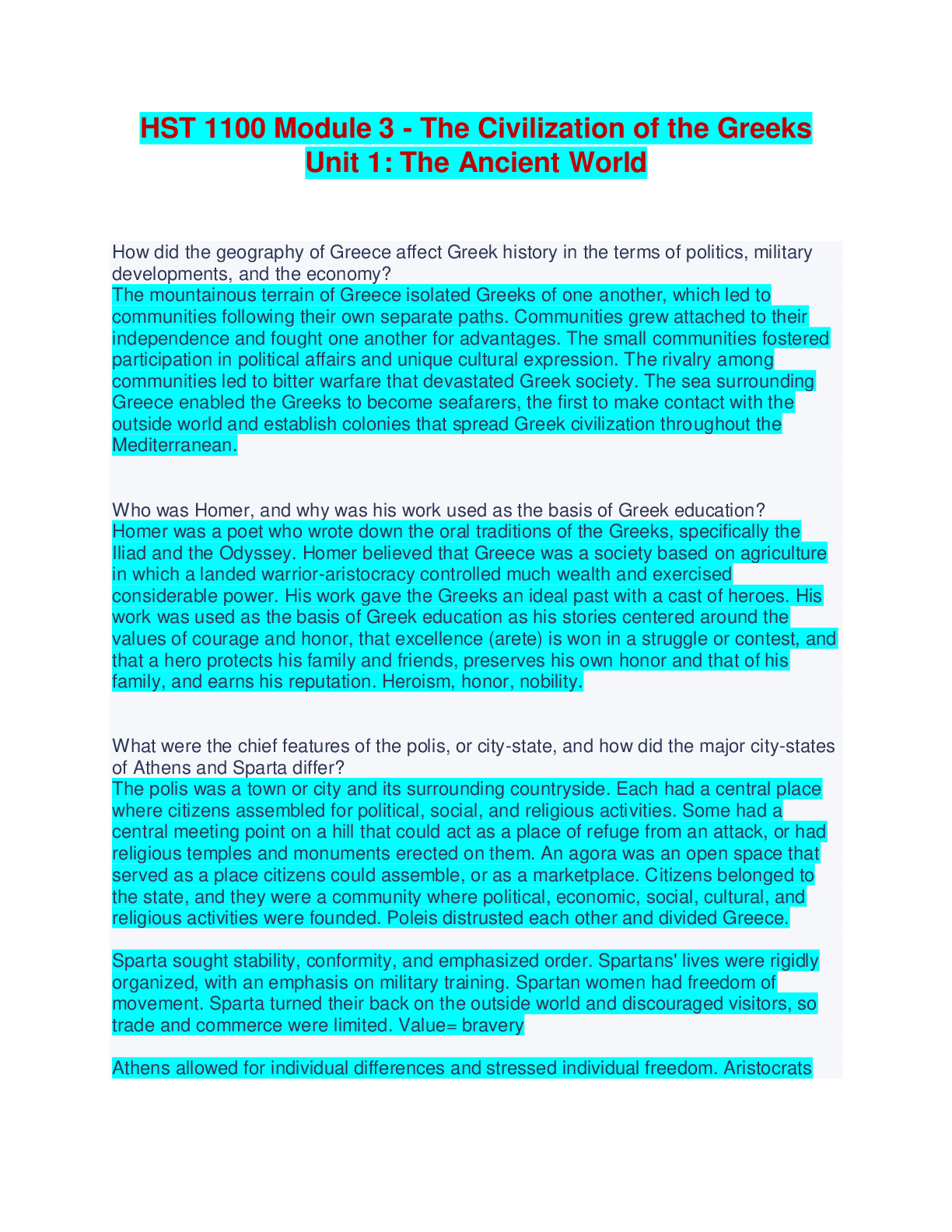
HST 1100 Module 3 - The Civilization of the Greeks Unit 1: The Ancient World How did the geography of Greece affect Greek history in the terms of politics, military developments, and the economy? Th ... e mountainous terrain of Greece isolated Greeks of one another, which led to communities following their own separate paths. Communities grew attached to their independence and fought one another for advantages. The small communities fostered participation in political affairs and unique cultural expression. The rivalry among communities led to bitter warfare that devastated Greek society. The sea surrounding Greece enabled the Greeks to become seafarers, the first to make contact with the outside world and establish colonies that spread Greek civilization throughout the Mediterranean. Who was Homer, and why was his work used as the basis of Greek education? Homer was a poet who wrote down the oral traditions of the Greeks, specifically the Iliad and the Odyssey. Homer believed that Greece was a society based on agriculture in which a landed warrior-aristocracy controlled much wealth and exercised considerable power. His work gave the Greeks an ideal past with a cast of heroes. His work was used as the basis of Greek education as his stories centered around the values of courage and honor, that excellence (arete) is won in a struggle or contest, and that a hero protects his family and friends, preserves his own honor and that of his family, and earns his reputation. Heroism, honor, nobility. What were the chief features of the polis, or city-state, and how did the major city-states of Athens and Sparta differ? The polis was a town or city and its surrounding countryside. Each had a central place where citizens assembled for political, social, and religious activities. Some had a central meeting point on a hill that could act as a place of refuge from an attack, or had religious temples and monuments erected on them. An agora was an open space that served as a place citizens could assemble, or as a marketplace. Citizens belonged to the state, and they were a community where political, economic, social, cultural, and religious activities were founded. Poleis distrusted each other and divided Greece. Sparta sought stability, conformity, and emphasized order. Spartans' lives were rigidly organized, with an emphasis on military training. Spartan women had freedom of movement. Sparta turned their back on the outside world and discouraged visitors, so trade and commerce were limited. Value= bravery Athens allowed for individual differences and stressed individual freedom. [Show More]
Last updated: 2 years ago
Preview 1 out of 4 pages
Buy this document to get the full access instantly
Instant Download Access after purchase
Buy NowInstant download
We Accept:

Also available in bundle (1)
Click Below to Access Bundle(s)

HST 1100 MODULE 1 - 12 EXAMS BUNDLE
HST 1100 MODULE 1 - 12 EXAMS BUNDLE
By Ajay25 2 years ago
$45
12
Reviews( 0 )
$9.00
Can't find what you want? Try our AI powered Search
Document information
Connected school, study & course
About the document
Uploaded On
Oct 24, 2023
Number of pages
4
Written in
All

Additional information
This document has been written for:
Uploaded
Oct 24, 2023
Downloads
0
Views
77