CHPN MISC Exam 21 Questions with Verified Answers
Spironolactone - CORRECT ANSWER What medication would you take for ascites?
Patient has been optimal he treated and is not a candidate for surgical procedure. Pat
...
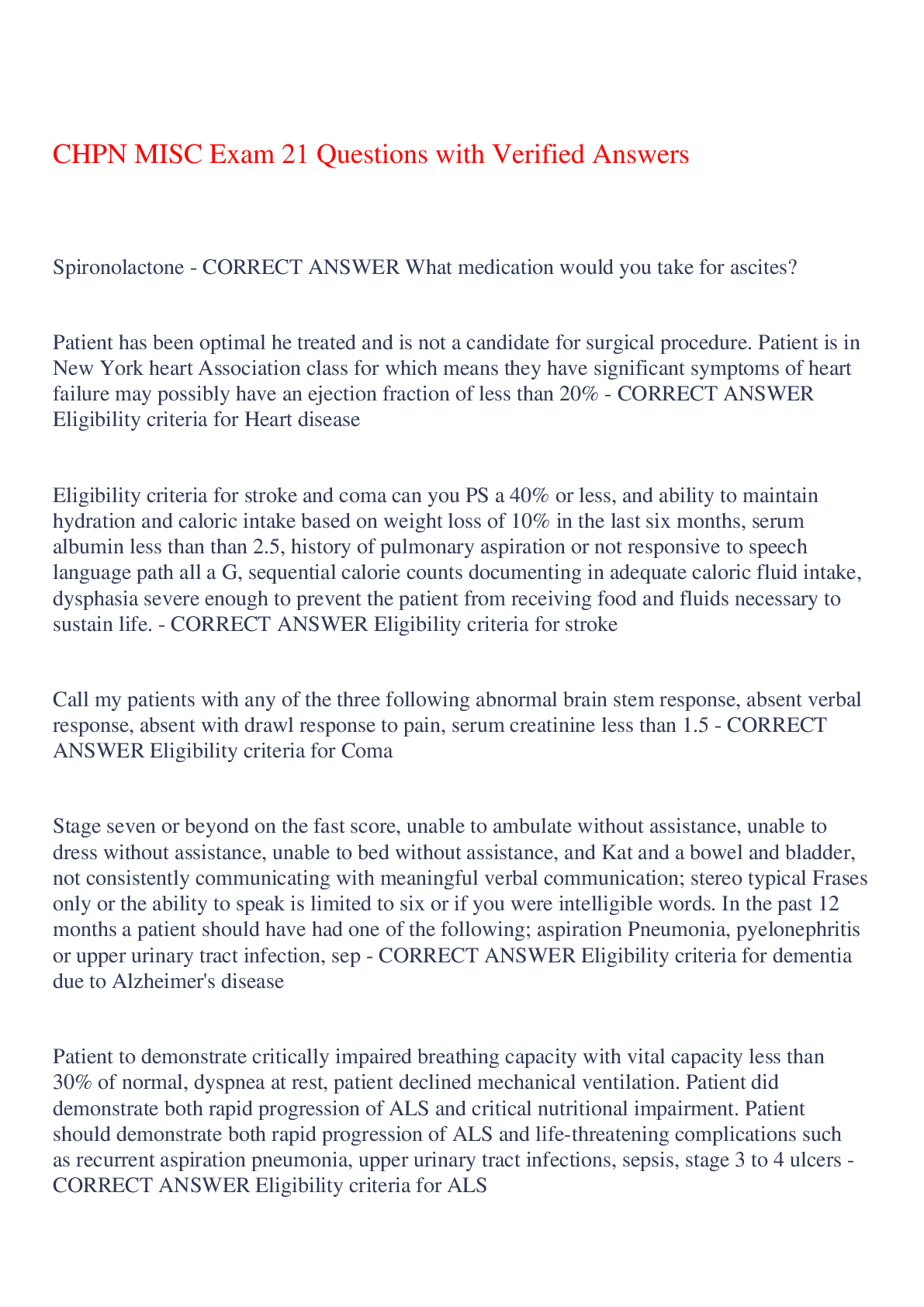
CHPN MISC Exam 21 Questions with Verified Answers
Spironolactone - CORRECT ANSWER What medication would you take for ascites?
Patient has been optimal he treated and is not a candidate for surgical procedure. Patient is in New York heart Association class for which means they have significant symptoms of heart failure may possibly have an ejection fraction of less than 20% - CORRECT ANSWER Eligibility criteria for Heart disease
Eligibility criteria for stroke and coma can you PS a 40% or less, and ability to maintain hydration and caloric intake based on weight loss of 10% in the last six months, serum albumin less than than 2.5, history of pulmonary aspiration or not responsive to speech language path all a G, sequential calorie counts documenting in adequate caloric fluid intake, dysphasia severe enough to prevent the patient from receiving food and fluids necessary to sustain life. - CORRECT ANSWER Eligibility criteria for stroke
Call my patients with any of the three following abnormal brain stem response, absent verbal response, absent with drawl response to pain, serum creatinine less than 1.5 - CORRECT ANSWER Eligibility criteria for Coma
Stage seven or beyond on the fast score, unable to ambulate without assistance, unable to dress without assistance, unable to bed without assistance, and Kat and a bowel and bladder, not consistently communicating with meaningful verbal communication; stereo typical Frases only or the ability to speak is limited to six or if you were intelligible words. In the past 12 months a patient should have had one of the following; aspiration Pneumonia, pyelonephritis or upper urinary tract infection, sep - CORRECT ANSWER Eligibility criteria for dementia due to Alzheimer's disease
Patient to demonstrate critically impaired breathing capacity with vital capacity less than 30% of normal, dyspnea at rest, patient declined mechanical ventilation. Patient did demonstrate both rapid progression of ALS and critical nutritional impairment. Patient should demonstrate both rapid progression of ALS and life-threatening complications such as recurrent aspiration pneumonia, upper urinary tract infections, sepsis, stage 3 to 4 ulcers - CORRECT ANSWER Eligibility criteria for ALS
Patient should have disabling dyspnea at rest, poorly or unresponsive to bronchodilators, resulting in decreased functional capacity. Documentation of forced expiratory volume in one second. Progression of end-stage pulmonary disease as evidenced by increased visit to the emergency room, pulmonary infections, respiratory failure, increasing physician visits, documentation Of cereal decrease of FEVE greater than 40 mL per year is objective evidence for disease progression but Is not necessary to - CORRECT ANSWER Eligibility criteria for pulmonary disease
Acute renal failure- The patient is not seeking dialysis or renal transplant. Creatinine clearance less than 10 mL per minute based on measurement or calculation or less than 15 mL per minute with comorbidity of congestive heart failure or diabetes. Serum creatinine greater than eight. Call morbid conditions including mechanical ventilation, Malignancy, chronic lung disease, advanced cardiac disease, advanced liver disease, sepsis, HIV, albumin less than 3.5, cachexia, platelet count less than 2 - CORRECT ANSWER Eligibility for renal disease
Prothrombin time prolonged more than five seconds over control, or international normalized ratio I and our greater than 1.5. Serum albumin less than 2.5 g/dL. And stage liver disease is present and the patient shows at least one of the following: ascites, spontaneous bacterial peritonitis, hepato-renal syndrome, hepatic encephalopathy, refractory to treatment, recurrent variceal bleeding . - CORRECT ANSWER Hospice eligibility for liver disease
CD4 count less than 25 cells per millimeter or persistent viral load greater than 100,000 copies per milliliter, plus one of the following; CNS lymphoma, untreated or persistent despite treatment wasting loss of at least 10% of lean body mass, mile bacterium Ivan complex, bacteremia, progressive multifocal leukoencephalopathy, systemic lYmphoma, visceral Kaposi sarcoma unresponsive to therapy, Renal failure in the absence of dialysis, crypto beryllium infection, toxoplasmosis. Decreased performa - CORRECT ANSWER Hospice eligibility criteria for HIV
NSAID Cox 2 inhibitor.Typically prescribed for arthritis, menstrual pain, joint pain, rheumatoid arthritis, bone/joint pain. This medication is an increased risk for cardiovascular event or gastrointestinal bleeding - CORRECT ANSWER Celecoxib - Celebrex.
Gabapentin, pre-Gabalin, carbamazepine, phenytoin, valproic acid including clonazepam Maybe used in combination for neuropathic pain - CORRECT ANSWER Antiepileptics
Desipramine and nortriptyline Maybe used as adjuvant therapy for neuropathic pain - CORRECT ANSWER Trycyclic antidepressants
- CORRECT ANSWER Serotonin selective reuptake inhibitor's
Serotonin selective reuptake inhibitor's - CORRECT ANSWER Serotonin norepinephrine reuptake inhibitor's Include Venlafaxine and duloxetine both use for treating depression, hot flashes, and neuropathic pain.
Antiepileptic drugs, antidepressants, local anesthetics, corticosteroids - CORRECT ANSWER Adjuvant analgesics
lidocaine - CORRECT ANSWER Local anesthetic
Dexamethasone and prednisones can sometimes be used for cerebral Edema, spinal cord compression, bone pain, neuropathic pain, visceral pain - CORRECT ANSWER Corticosteroids
Lorazepam - CORRECT ANSWER Anxiolytics
Fluoxetine, peroxetine - CORRECT ANSWER SSRI selective serotonin Reuptake inhibitor's
Inhibits opioid induced decrease gastrointestinal motility and delay and gastrointestinal transit time; given subcutaneously and toast according to weight. - CORRECT ANSWER Methylnaltrexone
[Show More]