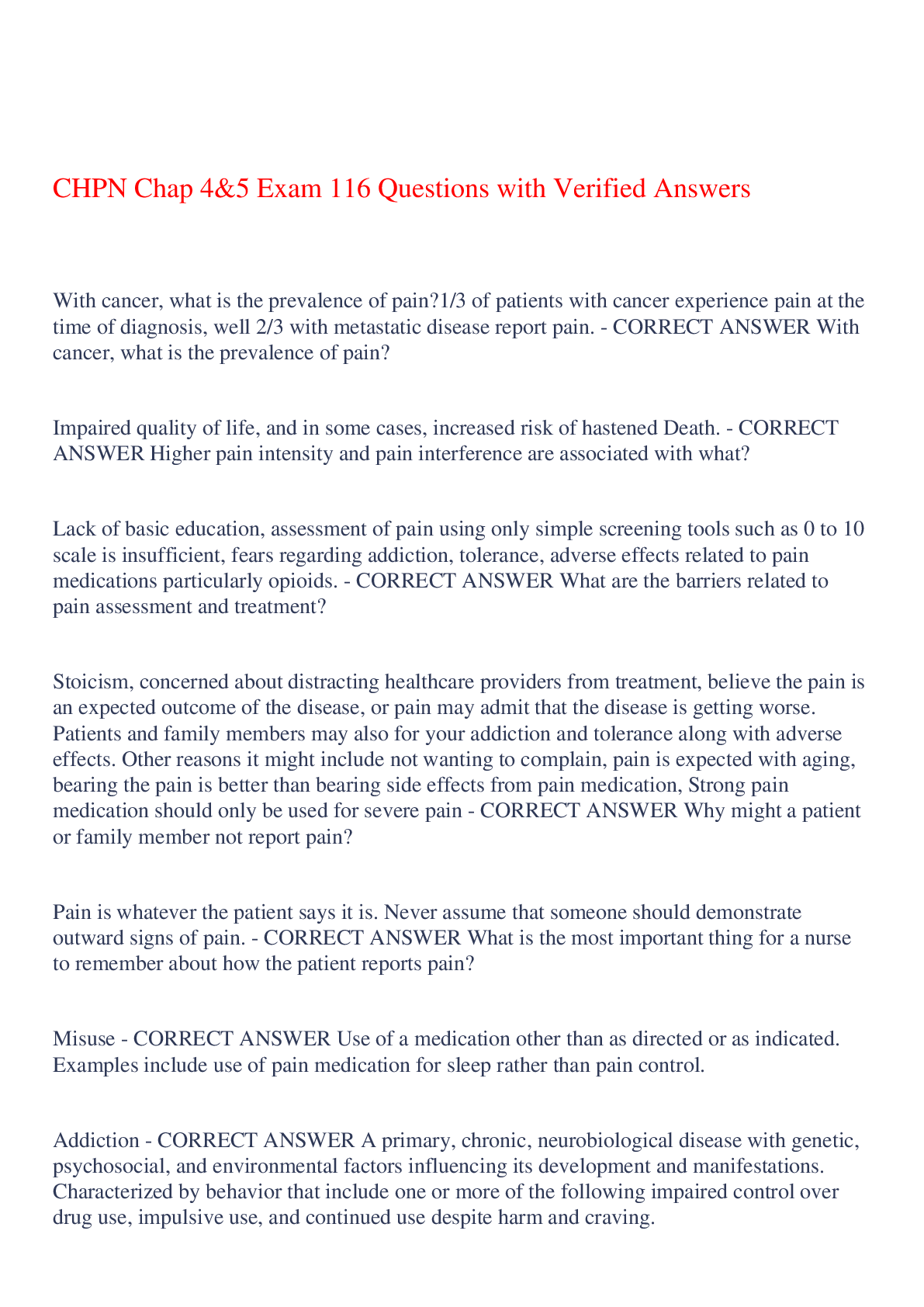
CHPN Chap 4&5 Exam 116 Questions with Verified Answers
With cancer, what is the prevalence of pain?1/3 of patients with cancer experience pain at the time of diagnosis, well 2/3 with metastatic disease report pain.
...
CHPN Chap 4&5 Exam 116 Questions with Verified Answers
With cancer, what is the prevalence of pain?1/3 of patients with cancer experience pain at the time of diagnosis, well 2/3 with metastatic disease report pain. - CORRECT ANSWER With cancer, what is the prevalence of pain?
Impaired quality of life, and in some cases, increased risk of hastened Death. - CORRECT ANSWER Higher pain intensity and pain interference are associated with what?
Lack of basic education, assessment of pain using only simple screening tools such as 0 to 10 scale is insufficient, fears regarding addiction, tolerance, adverse effects related to pain medications particularly opioids. - CORRECT ANSWER What are the barriers related to pain assessment and treatment?
Stoicism, concerned about distracting healthcare providers from treatment, believe the pain is an expected outcome of the disease, or pain may admit that the disease is getting worse. Patients and family members may also for your addiction and tolerance along with adverse effects. Other reasons it might include not wanting to complain, pain is expected with aging, bearing the pain is better than bearing side effects from pain medication, Strong pain medication should only be used for severe pain - CORRECT ANSWER Why might a patient or family member not report pain?
Pain is whatever the patient says it is. Never assume that someone should demonstrate outward signs of pain. - CORRECT ANSWER What is the most important thing for a nurse to remember about how the patient reports pain?
Misuse - CORRECT ANSWER Use of a medication other than as directed or as indicated. Examples include use of pain medication for sleep rather than pain control.
Addiction - CORRECT ANSWER A primary, chronic, neurobiological disease with genetic, psychosocial, and environmental factors influencing its development and manifestations. Characterized by behavior that include one or more of the following impaired control over drug use, impulsive use, and continued use despite harm and craving.
Tolerance - CORRECT ANSWER A state of adaption in which exposure to a drug induces changes that result in a diminution of one or more of the drugs affect overtime.
Physical dependence - CORRECT ANSWER A state of adaptation that is manifested by drug class specific withdrawal syndrome that can be produced by abrupt cessation, rapid dose reduction, decreasing blood level of the drug.
Anxiety, irritability, lacrimination, rhinorrhea, sweating, nausea, vomiting, diarrhea, abdominal cramps, insomnia, tachycardia, hypertension - CORRECT ANSWER Signs and symptoms of abstinence syndrome or withdrawl
Opioid pseudoaddiction - CORRECT ANSWER Patients develop certain behavioral characteristics of psychological dependence as a consequence of in adequate pain treatment. These patients are often described as difficult patient, chronic complainers, drug seekers. Patient will often resort to Bizzarre a dramatic behavior in attempt to prove their pain is real so pain medications are provided.
Double effect - CORRECT ANSWER And ethical principle that permits in action, intended to have a good effect, when there is a risk of also causing harmful affects, only when the intention was to produce the good effect. And example of this would be giving high does opioids at end of life to control pain, but may cause sedation.
Character - CORRECT ANSWER explanation of pain using words such as tingling, burning, sharp, shooting.
A change in the patient's behavior. - CORRECT ANSWER The gold standard for measuring effectiveness of pain interventions and patient's discomfort level.
Furrowed brow - CORRECT ANSWER Number one indicator of pain for a patient who is unresponsive.
Peripheral neuropathy that occurs from both the virus and the treatment. Late stage HIV is often associated with headaches from acute and chronic meningitis and chest pain from pneumonia - CORRECT ANSWER Most common pain syndrome seen in patients with HIV disease?
Chest pain caused by angina pectoris, respiratory syndrome's, third, panic attacks. - CORRECT ANSWER Most common pain seen with patients with cardiovascular disorders?
Somatic pain, visceral pain, referred pain - CORRECT ANSWER Types of nociceptive pain include
Somatic pain - CORRECT ANSWER Well localized, often described as deep, dull ache, musculoskeletal in nature. Examples include bone metastasis, inflammation of soft tissue, and tumor invasion
Visceral pain - CORRECT ANSWER Poorly localized; cramping, deep ache, pressure, often referred to as distant; examples include bowel obstruction resulting in Bowel spasms, cholecystitis, primary or metastatic tumors in the liver.
Pain from tumor involvement in the pancreas, lower esophagus, stomach, or retroperitoneal area may be referred to the back. Gallbladder or liver disease may produce referred pain in the back or right shoulder. Rectosigmoid involvement may result in pain and the sacrum a rectal area. - CORRECT ANSWER Examples of referred pain
Neuropathic pain - CORRECT ANSWER Sharp, burning, shooting, shock like; examples include spinal nerve root compression, tumor invasion of nerves, post herpetic neuralgia, or phantom limb pain
Gabapentin. Opioids relieve neuropathic pain but higher doses usually indicated. NSAIDs, acetaminophen aren't really beneficial - CORRECT ANSWER Medications to use and not to use for neuropathic pain
Decreased functional ability, including ability to walk him perform other basic activities of daily living, decreased strength and endurance, nausea, anorexia, insomnia, and impaired immune response - CORRECT ANSWER Physical effects of pain
Increased fear and anxiety, depression, hopelessness, despair, loss of control - CORRECT ANSWER Psychological effects of pain
Alteration in close relationships, isolation, inability to work, loss of self-esteem, self worth, increased caregiver burden - CORRECT ANSWER Social effects of pain
Increase suffering, reevaluation and perhaps doubt regarding past religious foundations and believes, questioning the meaning of suffering - CORRECT ANSWER Spiritual affects of pain
Ethnic minority, female, and elderly person is often receive less than optimal pain management in all settings. - CORRECT ANSWER Cultural issues regarding pain
Transmucosal - CORRECT ANSWER Route of drug administration. Buffalo or sublingual delivery. Provides rapid onset of action when product is lipophilic.
Fentanyl or Buprenorphine - CORRECT ANSWER Transdermal medication administration for patients with stable pain, onset of action 12 to 24 hours with first application and with each dose change some patients require a patch every 48 hours. Buprenorphine can be ordered as 7 day patch. Used for people with consistent and chronic pain and not acute pain.
Gabapentin, pregabalin, carbamazepine, phenytoin, clonazepam - CORRECT ANSWER Types of antiepileptic drugs Often used for people with neuropathic pain
Adjuvant analgesics such as antiepileptic drugs, antidepressants, corticosteroids, local anesthetics - CORRECT ANSWER Medication other than analgesics that are used in combination to enhance pain control
After three patches can be used to cover the painful area, package insert instructed to apply for 12 hours and then remove for 12 hours, but it is safe to leave in place for 18 to 24 hours at a time - CORRECT ANSWER Local anesthetics lidocaine patch instructions
Corticosteroids - CORRECT ANSWER This class of medication is often used in metastatic bone pain which can produce significant pain control along with increased energy, enhance mood and improved appetite. Also useful to relieve pain associated with liver metastasis and other visceral pain syndromes
Experts recommend reducing the dose by 25% to account for incomplete cross tolerance. If converting from the oral to the intervenous route it is not clear that the patient has reasonable absorption of this drug through the gastrointestinal system, reduce the dose by 25% however if you are converting from one drug for another in the patient is in severe pain, dose reduction is often not necessary. - CORRECT ANSWER Directions for converting from one opioid to another when patient's pain is well-controlled
If a patient had pain prior to becoming unresponsive, assume pain is still present - CORRECT ANSWER Pain in an unresponsive patient
Benzodiazepines, opioids, barbiturates, ketamine, propofol - CORRECT ANSWER Medications that can be used for palliative sedation at end-of-life with uncontrollable pain and suffering
Intramuscular, as it is considered painful. - CORRECT ANSWER Which route of pain medication is always avoided in comfort care?
Oral route is used whenever possible, or buccal, sublingual, rectal, and transdermal routes are always considered before parenteral routes. - CORRECT ANSWER Ideal routes for medication administration in comfort care
Long acting opioid's, which should also have a short acting as a PRN - CORRECT ANSWER Constant severe pain should be treated with what type of medication?
Rescue dose recommendations are 10% to 20% of the 24 hour dose every two hours as needed; always increase the rescue dose when the baseline dose is increased. - CORRECT ANSWER Rescue doses recommendations for use with long-acting opioid's
Increase the baseline dose when the patient needs more than three rescue doses in a 24 hour period. Unless pain is related to a specific activity. - CORRECT ANSWER How do you determine when the baseline dose should be increased?
Odynophagia - CORRECT ANSWER Pain with swallowing
Estimated 42% to 73% of stroke patients have dysphagia - CORRECT ANSWER Prevalence of dysphagia with stroke
An estimated 60% to 70% of patients who undergo radiation therapy for head and neck cancer have dysphagia - CORRECT ANSWER Prevalence of dysphagia with head and neck cancer related to radiation
20 to 40% - CORRECT ANSWER Prevalence of dysphagia with Parkinson's and other neurological diseases
It is suggested that up to 60% of nursing home residents experience some degree of dysphagia - CORRECT ANSWER Prevalence of dysphagia in the elderly in nursing homes
Obstructive and motor - CORRECT ANSWER Two types of dysphagia
Teach importance of excellent oral hygiene, avoid nicotine, alcohol, and caffeine, which increases vasospasm and have drying effects. Cool, Nonirritating foods and liquids maybe better tolerated. - CORRECT ANSWER Patient and family education related to dysphagia
Myoclonus, aka myoclonic jerks. - CORRECT ANSWER A movement disorder described as vocal or multifocal, sudden, brief, shock like, involuntary movements caused by muscle contractions arising from the central nervous system
Primary or generalized, focal or partial - CORRECT ANSWER Two types of seizures
Involves large parts of the brain include a grand maul and petite mall types. Usually loss of consciousness, general muscle contraction twitching that me last 1 to 2 minutes, may exhibit biting, incontinence, difficulty breathing - CORRECT ANSWER Primary or generalized seizures
Involve specific regions of the brain with symptoms that reflect the location of the disturbance. May have sensory, motor, or vision disturbances. May remain conscious or can experience loss of consciousness - CORRECT ANSWER Focal or partial seizures
Involuntary movements, which may not respond to reversal therapies - CORRECT ANSWER Extrapyramidal syndromes
Akathisia - CORRECT ANSWER Inability to sit still, pacing, agitation, restless movement
Dystonia - CORRECT ANSWER Slow, retarded movements
Tardive dyskinesia - CORRECT ANSWER Movement disorder characterized by involuntary movement and limbs, trunk, and or respiratory system. Most clinicians in psychiatry review as an antipsychotic related side effects and unrelated to the underlying disease for which the .antipsychotics were prescribed
Heart Failure, End Stage Renal Disease, and Hepatic Diseases. - CORRECT ANSWER Generalized Edema is most common in what diseases?
DVT, or Lymphatic Obstruction - CORRECT ANSWER Localized Edema is most commonly caused by what?
Pulmonary edema - CORRECT ANSWER Respiratory distress, pink, frothy sputum are symptoms of what?
Pleural effusion - CORRECT ANSWER May be asymptomatic, slower on set, dyspnea, chest pain, especially when breathing deeply a.k.a. pleuritic pain, fever, cough are all symptoms of what?
Face, neck, and upper extremity - CORRECT ANSWER Edema related to superior vena cava syndrome is shown in what area of the body?
Diuresis should be done slowly to avoid volume loss. Use a combination of furosemide and Spironolactactone, which balance potassium loss with retention and may reduce need for frequent laps. Fluid can be room removed with paracentesis and or drain placement - CORRECT ANSWER Treatment for abdominal Ascites
- CORRECT ANSWER A condition defined as chest pain or discomfort from inadequate blood flow to the heart muscle. Usually felt as tight, heavy, squeezing. Pain May also be felt in neck shoulders, jaws and arms.
Plaque accumulates in areas of damage to atrial walls and impedes blood flow to the heart - CORRECT ANSWER Angina related to coronary heart disease. What is happening that causes angina?
50% - CORRECT ANSWER What percentage of patients receiving end of life care experience dyspnea in the last three days of life?
COPD, reactive airways, cough/secretions, tumors, superior vena cava syndrome. - CORRECT ANSWER Examples of pulmonary obstructive diseases
Fibrosis, effusions, infections, kyphosis, obesity - CORRECT ANSWER Examples of pulmonary restrictive diseases
Observe for restlessness, accessory muscle use, paradoxical breathing pattern, grunting, nasal flaring, and look of fear. - CORRECT ANSWER How to assess dyspnea in a actively dying patient other than respiratory rate?
Elevating the head of bed and tripod position for comfort and optimal lung expansion - CORRECT ANSWER Positioning for respiratory comfort
Study show that handheld fans directed the face help with dyspnea, tripod positioning, pursed lips controlled breathing for patients with COPD, low salt diet and fluid restriction. Thoracentesis/drain placement to remove fluid in the lungs caused by plural effusion's. - CORRECT ANSWER Nonpharmacological interventions for dyspnea.
Plural effusion - CORRECT ANSWER Disparity between secretion and absorption of fluid in the plural space secondary to increased secretion, impaired absorption, or both, resulting in excessive fluid collection.
Amiodarone, beta blockers, methotrexate, nitrofurantoin, phenytoin. - CORRECT ANSWER Medications that may cause plural effusion
Decreased breath sounds on auscultation on the affected side, reduce transmission of the voice to the chest wall, and stony done this on percussion - CORRECT ANSWER Physical assessment of plural effusion
Almost 50%/half - CORRECT ANSWER What percentage of patient with metastatic disease will experience a plural effusion sometime during their disease?
Thoracentesis - CORRECT ANSWER Inserting a large bore needle into the effusion and drain into a vacuum container
- CORRECT ANSWER Severe constipation due to an obstruction.
Obstipation - CORRECT ANSWER Severe constipation due to an obstruction.
Opioids, and antacids, antiepileptics, anti-emetics, cancer chemotherapeutic agents, orally administered iron, tricyclic antidepressants. - CORRECT ANSWER Examples of medication that can cause constipation.
Be aware that constipation very significantly from patient to patient and the goal is to establish what is normal for each person - CORRECT ANSWER What to remember when assessing for constipation in different patients.
Encourage adequate time after breakfast since most powerful gastrocolic reflex occurs in the morning, provide privacy, avoid bedpans, correct positioning - provide footstool if needed or toilet seat with arms - CORRECT ANSWER How do you optimize toileting in regards to constipation?
Bulk laxatives such as fiber or methylcellulose because they work best with increased fluid intake. - CORRECT ANSWER What type of laxatives are not good for end-stage patients?
Ascites - CORRECT ANSWER The accumulation of excessive fluid in the peritoneal cavity
Portal hypertension - CORRECT ANSWER Obstruction of portal vessels causing leakage into the abdominal cavity.
Cirrhosis (75%), congestive heart failure, portal vein thrombosis, malignancy, Decreased osmotic oncotic pressure, pancreatitis, tuberculosis, bowel perforation, infectious process of the peritoneum. - CORRECT ANSWER Causes of portal hypertension
Haloperidol and prochlorperazine - CORRECT ANSWER Best anti-nausea/vomiting medication for opioid induced nausea
Ondansetron/Zofran - CORRECT ANSWER Best anti-nausea medication for chemo therapy related emesis
Functional incontinence which is loss of urine due to the inability of a patient to reach the toilet - CORRECT ANSWER What is the most common cause of urinary incontinence
It could lead to hemodynamic instability; if output reach is 500 mL, clamp catheter for about five minutes before further urine evacuation. - CORRECT ANSWER Why do we want to avoid too rapid diuresis when placing an indwelling urinary catheter?
Oxybutynin - CORRECT ANSWER Most common medication for bladder spasms
Advanced age, protein calorie malnutrition, cytokines released from injured tissue, immobility, friction and sheer, excessive moisture and soaps that can alter of skin pH increase vulnerability to infection - CORRECT ANSWER Risk factors for pressure ulcers
Stage one pressure ulcer - CORRECT ANSWER Non-blanchable intact skin, the heralding lesion of skin ulceration.
Stage 4 pressure ulcer. - CORRECT ANSWER Full thickness tissue loss. Exposed bone, tendon, or muscle present with slough or eschar. Often includes tunneling or undermining
Stage III pressure ulcer - CORRECT ANSWER Full thickness skin loss. Subcutaneous fat or slough visible but bone, tendon, and muscle are not exposed. May include undermining or tunneling
Partial thickness loss of dermis. Shallow with the red pink wound bed, with/without slough or blister - CORRECT ANSWER Stage two pressure ulcer
Maintains moist environment for low exudate wounds. Provide protective environment for healing and debridement - CORRECT ANSWER Hydrocolloid dressing's
For debridement in the presence of Slough and eschar - CORRECT ANSWER Hydrogels/xerogels
Opioids Like morphine and anxiolytics like Lorazepam. - CORRECT ANSWER Major medications to manage dyspnea in chronic lung conditions.
Muscle jerking ex: Parkinson's - CORRECT ANSWER Myoclonus
48 to 72 hours after the start of the dose - CORRECT ANSWER Opioid induced fatigue may resolve once patient develops a tolerance, typically how long does this take?
Cytopenias - CORRECT ANSWER Reductions in bone marrow blood cell components which can precipitate a systemic response?
Neutropenia - CORRECT ANSWER Reduction in white blood cells; decreases ability to respond to infections.
Anemia - CORRECT ANSWER Reductions in production or maturation of red blood cells; low hemoglobin; decreased oxygen carrying capacity that may cause increased dyspnea and fatigue
Pancytopenia - CORRECT ANSWER Reduction in all blood cells
Hepatic/Liver failure - due to inability to synthesize clotting factors - CORRECT ANSWER Which type of organ failure can cause risk of bleeding and hemorrhaging
When the CD4 T cell count is less than 200, Which indicates impaired immune status and increase susceptibility to infection's - CORRECT ANSWER At what point does HIV become end stage?
HIV, treatment such as chemotherapy, radiation, or antibiotics. Hematologic malignancy such as leukemia, myelomas, lymphomas. Anemia, or renal failure which reduces erythropoietin production predisposing patients to anemia - CORRECT ANSWER What are cytopenias caused by?
Shortness of breath, pleuritic chest pain, hemaptysis, and unexplained fever - CORRECT ANSWER Symptoms of a pulmonary embolism.
Change in level of arousal or cognitive function - CORRECT ANSWER The Hallmark change related to delirium
Altered sleep/wake cycles, mumbling speech, disturbance of memory and attention, perceptual disturbances with delusions or hallucinations - CORRECT ANSWER Signs and symptoms of delirium
Delirium tends to develop a very short period of time, hours to days, and tends to fluctuate over the course of a day, And is temporary - CORRECT ANSWER Primary difference between dementia and delirium
Symptoms include constant movement, hyper arousal, hyperalertness, hallucinations, delusions, disorientation, trying to get out of bed, removing clothing and IV lines and catheters, maybe misdiagnosed as anxiety restlessness - CORRECT ANSWER Hyperactive delirium
Reduced awareness of an interaction with surroundings. Common symptoms include hypoarousal hypoalert, lethargy, sedation, decreased psychomotor activity, impaired ability to sustain attention - CORRECT ANSWER Hypoactive delirium
Neuroleptics, for example haloperidol, chlorpromazine - CORRECT ANSWER First line of medication treatment for confusion, delirium, agitation, terminal agitation
New atypical neuroleptics such as olanzapine, quetiapine, risperidone - CORRECT ANSWER Which medications are not considered first line treatment for agitation, confusion, delirium....
Benzodiazepines, Due to the possibility of worsening of symptoms - CORRECT ANSWER Which medication should be avoided?
[Show More]