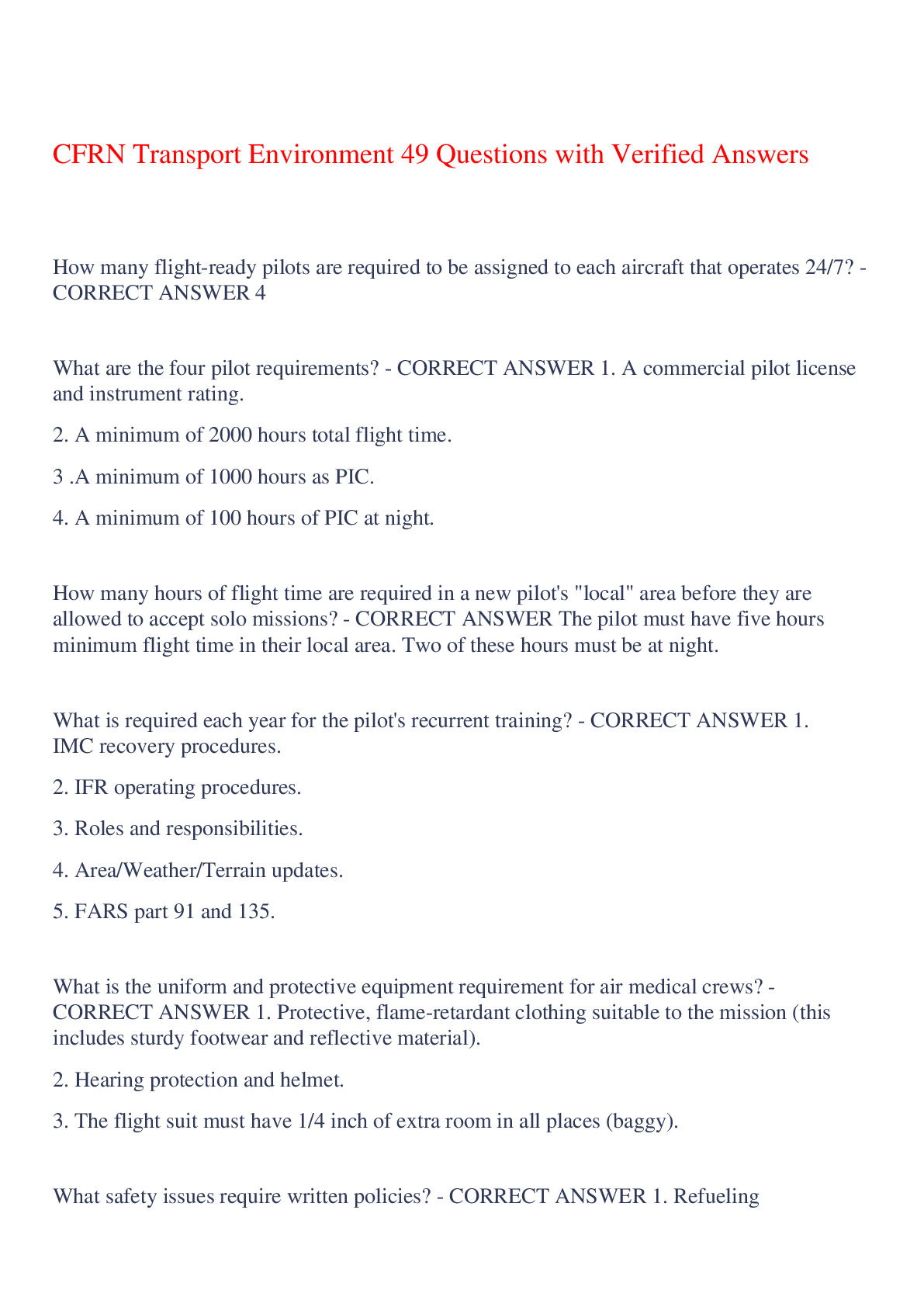
CFRN Transport Environment 49 Questions with Verified Answers
How many flight-ready pilots are required to be assigned to each aircraft that operates 24/7? - CORRECT ANSWER 4
What are the four pilot requirements?
...
CFRN Transport Environment 49 Questions with Verified Answers
How many flight-ready pilots are required to be assigned to each aircraft that operates 24/7? - CORRECT ANSWER 4
What are the four pilot requirements? - CORRECT ANSWER 1. A commercial pilot license and instrument rating.
2. A minimum of 2000 hours total flight time.
3 .A minimum of 1000 hours as PIC.
4. A minimum of 100 hours of PIC at night.
How many hours of flight time are required in a new pilot's "local" area before they are allowed to accept solo missions? - CORRECT ANSWER The pilot must have five hours minimum flight time in their local area. Two of these hours must be at night.
What is required each year for the pilot's recurrent training? - CORRECT ANSWER 1. IMC recovery procedures.
2. IFR operating procedures.
3. Roles and responsibilities.
4. Area/Weather/Terrain updates.
5. FARS part 91 and 135.
What is the uniform and protective equipment requirement for air medical crews? - CORRECT ANSWER 1. Protective, flame-retardant clothing suitable to the mission (this includes sturdy footwear and reflective material).
2. Hearing protection and helmet.
3. The flight suit must have 1/4 inch of extra room in all places (baggy).
What safety issues require written policies? - CORRECT ANSWER 1. Refueling
2. Oxygen
3. Latex allergies
4. Weather minimums
5. Cell phones
6. Night vision goggles
7. Safety committee
8. Minimal medical equipment
What are the requirements of the safety committee? - CORRECT ANSWER 1. They must meet once per quarter.
2 .They must represent all members of the air medical program.
What is the minimum medical equipment? - CORRECT ANSWER 1. There must be three restraints on the stretcher, three IV chambers and 2 sources of both suction and oxygen.
Who is responsible for the management of civilian EMS operations with regard to the aircraft, pilot, maintenance, and air space? - CORRECT ANSWER The FAA
FARS Part 91 - CORRECT ANSWER FARS 91 covers general aviation rules, alcohol and drug rules, child restraint requirements, the electronic device policy and equipment security.
PART 91 APPLIES WHEN THERE IS NO PATIENT ONBOARD; EVERYONE ON BOARD MUST WORK FOR THE SAME AIR MEDICAL COMPANY AS WELL.
FARS Part 135 - CORRECT ANSWER Part 135 covers rules for the PIC, aircraft, and passenger briefings.
PART 135 APPLIES WHEN THERE IS A THIRD PARTY ONBOARD.
Who is responsible for management of civilian radio systems and cell phone usage in the aircraft? - CORRECT ANSWER The FCC
During which phase of flight are cell phones prohibited? - CORRECT ANSWER Cell phones are prohibited while airborne.
What is the death rate among flight crew members? - CORRECT ANSWER 196/100,000/year
What is the number one type of air medical crashes? - CORRECT ANSWER CFIT (controlled flight into terrain)
What is Air Medical Resource Management (AMRM)? - CORRECT ANSWER AMRM is program that focuses on team communication and joint decision making. It emphasizes the danger of complacency and it demonstrates the advantage of distributing cockpit workload.
When do the most dangerous operations occur in the air medical industry? - CORRECT ANSWER The most dangerous air medical operations occur at night and in less than optimal weather conditions.
How large should a landing zone be at night? - CORRECT ANSWER 100 feet X 100 feet
Definitions:
1. VMC
2. IMC
3. VFR
4. IFR - CORRECT ANSWER 1. Visual meteorological conditions.
2. Instrument meteorological conditions.
3. Visual flight rules.
4. Instrument flight rules.
What are the weather minimums for flying VFR in VMC? - CORRECT ANSWER 1. Day - 500X1
2. Night - 800X2
What are the weather minimums for flying IFR in VMC? - CORRECT ANSWER 1. Day - 1000X1
2. Night - 1000X3
What is the number one cause air medical crashes? - CORRECT ANSWER Weather
What are the requirements to fly IFR? - CORRECT ANSWER 1. The Part 135 certificate must have an allowance for IFR flying.
2. The aircraft has to be IFR capable and current.
3. All of the IFR equipment must be up to date on maintenance.
4. The pilot has to be IFR rated and current in his or her IFR training.
What are the landing zone requirements when flying IFR? - CORRECT ANSWER You must have two potential landing zones and both must have ILS approaches.
What are the three landing emergencies? - CORRECT ANSWER 1. Land immediately.
2. Land as soon as possible.
3. Land as soon as practical.
What does land immediately mean? - CORRECT ANSWER The aircraft must be landed immediately in order to maximize passenger survival.
What does land as soon as possible mean? - CORRECT ANSWER The aircraft must be landed as soon as an adequate site can be found.
What does land as soon as practical mean? - CORRECT ANSWER The landing site is at the discretion of the pilot but he or she should not over-fly the nearest spot where he can get assistance.
What is the in-flight emergency landing procedure? - CORRECT ANSWER 1. Lay the patient flat and make sure the straps are secure.
2. Turn off the oxygen.
3. Secure your equipment.
4. Confirm your seatbelts are secure.
5. Put your helmet visor down.
6. Assume the crash position.
What are the two crash positions? - CORRECT ANSWER 1. If you have a lap belt only, lean forward and wrap your arms around your legs.
2. If you have a shoulder belt, cross your arms across your chest, put your feet in front of you, and hang on to your shoulder straps.
What are the post-crash procedures? - CORRECT ANSWER 1. Tune the radio to 121.5 and ensure the ELT has been activated.
2. If the ELT did not activate upon crashing, manually activate it.
3. Disengage the throttle, fuel, and battery (in that order).
4. Don't exit the aircraft until all aircraft motion is stopped.
5. Meet all crew members at 12 o'clock with the survival bag.
6. Secure shelter, fire, water, and food (in that order).
How many Gs are needed to activate the ELT? - CORRECT ANSWER 4
You should always be prepared to survive _____ hours after a crash using only the supplies in your aircraft and your survival skills. - CORRECT ANSWER 24
When driving Code 3, both _____ and _____ are required. - CORRECT ANSWER Lights, sirens
There must be communication between the flight crew and the communication center every _____ minutes during flight. This time is extended to _____ minutes during ground transports. - CORRECT ANSWER 15, 45
The _____ _____ of the program is not required to live in the same state the aircraft is operating in. - CORRECT ANSWER Medical Director
During initial training, all air medical crews must have at least _____ intubations. - CORRECT ANSWER 5
Specialty teams must respond within _____ minutes. - CORRECT ANSWER 45
What are the requirements of a helipad? - CORRECT ANSWER A helipad must have two approach paths, security, wind direction, an indicator device, and perimeter lighting.
How many hours of flying tine do fixed wing twin engine pilots need? - CORRECT ANSWER 500
How much fuel are ambulances required to have at all times? - CORRECT ANSWER 175 miles
What is required when flying off shore? - CORRECT ANSWER An aircraft flying off shore requires two engines and a raft / flotation device.
Transponder Codes
1. 7600
2. 1200
3. 121.5
4. 406 - CORRECT ANSWER 1. Communication failure
2. Standard squak for VFR conditions
3. Emergency locator transmission frequency
4. Satellite beacon for emergency information.
What is designed to enhance radio discipline and effective communication? - CORRECT ANSWER Standard radio operation procedures.
What is the most important factor that the transport nurse must consider when evaluating whether or not a parent may accompany a child on a transport? - CORRECT ANSWER Whether or not the aircraft has another passenger seat available.
Landing Zones:
1. Size
2. Scouting
3. Evaluation - CORRECT ANSWER 1. 75X75 feet day, 125X125 feet at night
2. High recon followed by low recon
3. Hazards, Obstructions, Terrain, Surface/Slope, Animals, Wind/Weather (HOTSAW).
After a ground ambulance accident, what are the crew's priorities? - CORRECT ANSWER Ensure the safety of all on board the vehicle, attend to any injuries, and contact help.
When should you never approach a helicopter? - CORRECT ANSWER During start up and shut down.
At a hazmat situation, where should the aircraft and crew be located? - CORRECT ANSWER Uphill and upwind.
[Show More]