CFRN Trauma Exam 123 Questions with Verified Answers
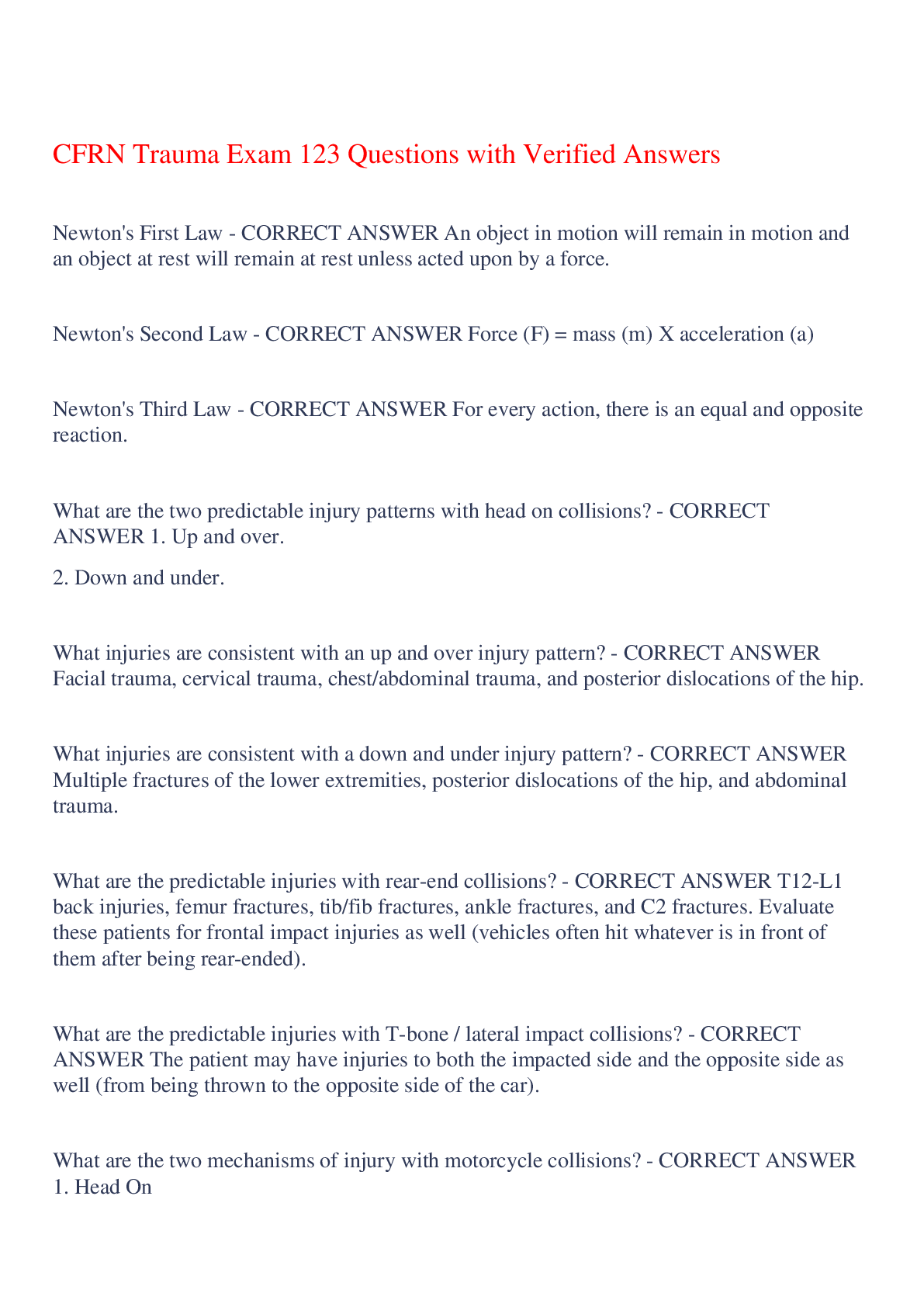
Newton's First Law - CORRECT ANSWER An object in motion will remain in motion and an object at rest will remain at rest unless acted upon by a force.
Newton's Se
...
CFRN Trauma Exam 123 Questions with Verified Answers
Newton's First Law - CORRECT ANSWER An object in motion will remain in motion and an object at rest will remain at rest unless acted upon by a force.
Newton's Second Law - CORRECT ANSWER Force (F) = mass (m) X acceleration (a)
Newton's Third Law - CORRECT ANSWER For every action, there is an equal and opposite reaction.
What are the two predictable injury patterns with head on collisions? - CORRECT ANSWER 1. Up and over.
2. Down and under.
What injuries are consistent with an up and over injury pattern? - CORRECT ANSWER Facial trauma, cervical trauma, chest/abdominal trauma, and posterior dislocations of the hip.
What injuries are consistent with a down and under injury pattern? - CORRECT ANSWER Multiple fractures of the lower extremities, posterior dislocations of the hip, and abdominal trauma.
What are the predictable injuries with rear-end collisions? - CORRECT ANSWER T12-L1 back injuries, femur fractures, tib/fib fractures, ankle fractures, and C2 fractures. Evaluate these patients for frontal impact injuries as well (vehicles often hit whatever is in front of them after being rear-ended).
What are the predictable injuries with T-bone / lateral impact collisions? - CORRECT ANSWER The patient may have injuries to both the impacted side and the opposite side as well (from being thrown to the opposite side of the car).
What are the two mechanisms of injury with motorcycle collisions? - CORRECT ANSWER 1. Head On
2. Side Impact
What injury patterns are consistent with a head on motorcycle collision? - CORRECT ANSWER This is an up and over injury pattern. The patient will have fractured femurs from hitting the handlebars and significant head and neck injuries from landing head first into the ground.
What injury patterns are consistent with a side impact motorcycle collision? - CORRECT ANSWER These patients will have open femur fractures, pelvic fractures, and broken ribs (the arm nearest the ground impacts the ribs causing a compression fracture).
What injury patterns are consistent with a roll-over collision? What injuries are consistent with partial ejection? - CORRECT ANSWER 1. The injury pattern is unpredictable in a roll-over crash. Roll-overs are the most lethal accidents.
2. Two common injuries with partial ejections are axial loading injuries and degloving / crush injuries.
What injuries are consistent with a lap belt restraint system? - CORRECT ANSWER Lap belts cause a "clasp knife effect" - the pelvis is held in place while the upper body sustains head, neck, facial, and chest trauma.
What injuries are consistent with a three point restraint system? - CORRECT ANSWER Injuries to the clavicles, head, and neck.
What injuries are consistent with a passive restraint system (air bag)? - CORRECT ANSWER Injuries include abrasions and fractures to the face and arms. Respiratory problems are also common due to the powder air bags are stored in. In pediatric patients, airbag deployment can cause a fatal head injury.
What makes agricultural incidents so deadly? - CORRECT ANSWER Agricultural accidents are usually unwitnessed. Also, there is often a delay in arrival of help due to their rural nature, and occasionally there is HAZMAT involvement.
What makes tractors so dangerous? - CORRECT ANSWER Tractors have a higher center of gravity so they are prone to roll-overs. End over end accidents have a greater potential for entrapment.
What injury patterns are predictable in ATV roll-over collisions? What type of ATV collisions are pediatric patients prone to? - CORRECT ANSWER 1. Crush injuries to lower extremities and head/chest/sternum/rib fractures from bouncing off the gas well.
2. Pediatric patients are prone to head on collisions with "up and over" injury patterns.
What type of injuries are common in snow-mobile accidents? - CORRECT ANSWER Hangman or "clothes line" injuries.
What type of injuries are most common in rapid vertical deceleration accidents? Who is at highest risk for these types of injuries? - CORRECT ANSWER 1. Children sustain head and axial loading injuries. Adults sustain a "lovers leap" pattern of injuries. "Loves leap" injuries are fractures of the feet/legs/hips/pelvis and axial loading injuries to the lumbar and cervical spine. Also included are vertical deceleration injuries to the abdominal organs and Colle's wrist fractures as the patient falls forward. 2. Adults and children under 5 are at highest risk for vertical deceleration injuries.
What factors should be considered in patients with implement / stab wounds? - CORRECT ANSWER 1. The area of body penetrated.
2. The blade length.
3. The angle of penetration.
What factors should be considered with firearm wounds? - CORRECT ANSWER 1. The type of weapon.
2. The caliber of bullet.
3. The distance from the weapon.
High energy / high velocity bullets travel at more than _____ feet per second. - CORRECT ANSWER 2000
_____ is the most important predictor of how severe the gunshot wound will be. - CORRECT ANSWER Velocity
The higher the velocity of the firearm, the worse the injury will be due to _____. - CORRECT ANSWER Cavitation
Any injury between the umbilicus and nipples is considered both a _____ injury and an _____ injury. - CORRECT ANSWER Chest, abdominal
Which bullets are most lethal?
a. bullets that exit the body; or
b. bullets that stay in the body? - CORRECT ANSWER b
What is a tumbling bullet? - CORRECT ANSWER A bullet that rotates on a 360 degree axis. These bullets cause the most tissue damage.
What is a yaw bullet? - CORRECT ANSWER Yaw bullets deviate 90 degrees from a straight path.
What are the three separate impacts of a blast injury? - CORRECT ANSWER 1. Primary impact - displacement of air around the radius of the blast.
2. Secondary impact - the victim is struck by shrapnel.
3. Tertiary impact - the victim impacts the ground or another object.
What internal organs are injured with the primary blast? - CORRECT ANSWER Air containing organs (tympanic membranes, esophagus, stomach, and intestines).
If a patient has both tympanic membranes ruptured in a blast, there is a _____% chance they have an internal life-threatening injury. - CORRECT ANSWER 50
What are the 7 tasks involved in managing a trauma scene? - CORRECT ANSWER 1. Establish the kill zone.
2. Claim a channel and notify all responding units of the kill zone.
3. Establish command.
4. Identify a staging area for responding units.
5. Identify and request needed resources.
6. Route resources to the scene.
7. Designate an area for triage and begin set up.
What are the three assessment parameters of START triage? - CORRECT ANSWER 1. Respiration
2. Perfusion
3. Mentation
What are the four levels of triage? - CORRECT ANSWER 0. Black - dead
1. Red - immediate
2. Yellow - delayed
3. Green - walking wounded
How are the level 3 / green patients identified? - CORRECT ANSWER "If you can hear my voice and are able to walk, walk to _____." All that obey you are level 3 / green.
RESPIRATION - CORRECT ANSWER 0/Black: Apneic despite 1 attempt to reposition airway or < 10 breaths / min.
1/Red: Begins to breathe after repositioning the airway or breathing < 10 or > 30 times per minute.
2/Yellow: Breathing between 10 and 30 times per minute; proceed to PULSE.
PULSE - CORRECT ANSWER 1/Red: Absent, weak, or irregular.
2/Yellow: Strong pulse; proceed to MENTATION.
MENTATION - CORRECT ANSWER 1/Red: Unconscious or cannot follow simple
commands.
2/Yellow: Follows simple commands.
All penetrating trunk injuries (neck to hips) should be triaged level _____. - CORRECT ANSWER 1 / Red
All rescuers injured on scene should be triaged level _____. - CORRECT ANSWER 1 / Red
What are the A, B, C, D, E, F, G, and H of trauma management? - CORRECT ANSWER A - airway
B - breathing
C - circulation
D - disability
E - expose
F - Fahrenheit
G - get vitals
H - head to toe
What are the three indications for intubation? - CORRECT ANSWER 1. Does the patient have the conscious ability to swallow?
2. Does the patient have an oxygenation / ventilation failure?
3. What is the patient's expected clinical course?
Breathing Assessment - CORRECT ANSWER Assess for adequate oxygenation (SpO2), ventilation (ETCO2) and problems with respiratory mechanics (pneumothorax, flail segment, pulmonary contusion, hemothorax, etc.).
Blood pressure does not fall until _____% of total blood volume is lost. - CORRECT ANSWER 30-40
Any patient with an initial heart rate of _____ or more needs a serious, immediate evaluation. - CORRECT ANSWER 100
If the patient is in circulatory collapse, but their injuries don't seem to suggest why, consider this injury. - CORRECT ANSWER Pericardial Tamponade
What are the five places where large amounts of blood can be lost? - CORRECT ANSWER 1. Chest
2. Abdomen
3. Muscles surrounding long bones
4. Retroperitoneum
5. Floor
How much blood can be lost with a fractured humerus? A fractured femur? - CORRECT ANSWER 1. 750ml
2. 1500ml
AMERICAN COLLEGE OF SURGEONS CLASSIFICATION OF BLOOD LOSS:
Class, percentage of blood loss, HR, BP - CORRECT ANSWER 1. 750ml, 15%, <100, normal
2. 750-1500, 15-30%, 100-120, normal
3. 1500-2000, 30-40%, 120-140, decreased
4. >2000, >40%, >140, decreased
Disability Assessment - CORRECT ANSWER 1. Brief neurologic exam
2. Pupil Assessment
3. CMS
What two things increase mortality significantly in patients with head injuries? - CORRECT ANSWER Hypotension, Hypoxia
What is involved in the Fahrenheit step of trauma management? - CORRECT ANSWER 1. Take the patient's temperature.
2. Keep the patient warm. Hypothermia causes coagulopathy.
What are the priorities with facial injuries? - CORRECT ANSWER 1. Airway / C-spine
2. Airway - considered difficult until proven otherwise
3. Consider an OG - blood in stomach causes vomiting
4. Wrap avulsed teeth in gauze saturated with NS
5. HOB > 30 degrees (to prevent increased ICP)
6. Never stick anything in the nose
What is a major complication of Le Forte fractures? - CORRECT ANSWER Le Forte fractures cause severe swelling that can result in trismus. Paralyze and intubate these patients early.
1. Le Forte 1
2. Le Forte 1
3. Le Forte 3 - CORRECT ANSWER 1. Fracture of the maxilla.
2. Fracture across the bridge of the nose and maxilla.
3. The entire midface is unstable.
TENSION PNEUMOTHORAX
1. Signs and symptoms
2. Treatment - CORRECT ANSWER 1. Severe respiratory distress, severe dyspnea, decreased or absent breath sounds, tracheal shift, JVD, increased CVP, and cyanosis.
2. Needle thoracostomy.
Where are the two proper places for a needle decompression? - CORRECT ANSWER 1. 2 IC space, midclavicular line
2. 5 IC space, midaxillary line
Where should a chest tube be placed? - CORRECT ANSWER 4, 5, 6 IC space anterior axillary line
Massive Hemothorax
1. Definition
2. Signs and symptoms
3. Treatment - CORRECT ANSWER 1. Initial blood loss of 1200 after initial chest tube placement or >250ml X 3 hours from a chest tube.
2. Decreased breath sounds, midline trachea, flat neck veins, altered mentation, and hypovolemic shock.
3. Chest tube, volume replacement, and intubation (PPV and PEEP tamponade the bleeding).
*Patients die from hemorrhage, not hypoxia.
Open Pneumothorax
1. Signs and symptoms
2. Treatment - CORRECT ANSWER 1. Sucking chest wound, respiratory distress, tachypnea, grunting, and shock.
2. Occlusive dressing taped on 3 sides and a chest tube. Once the chest tube is in place, tape the occlusive dressing on the 4th side.
Where are pediatric chest tubes placed? - CORRECT ANSWER 5th IC space midaxillary line
Flail Segment
1. Definition
2. Signs and symptoms
3. Treatment - CORRECT ANSWER 1. Two or more ribs broken in two or more places.
2. Paradoxical movement (if unconscious or intubated), respiratory distress, tachypnea, grunting, accessory muscle use, cyanosis, and severe chest pain.
3. Stabilize the flail segment from the inside with PPV and PEEP. Place the patient injured side down. Provide aggressive pain management to prevent shallow breathing (shallow breathing will allow the pulmonary contusion to expand).
What secondary injuries are common with flail segments? - CORRECT ANSWER Pulmonary contusions and myocardial contusions.
Cardiac Tamponade
1. Signs and symptoms
2. Treatment - CORRECT ANSWER 1. Early - sinus tachycardia and pulsus parodoxis. Treat with rapid fluid replacement.
2. Late - severe hypotension, profound circulatory failure, and Beck's triad. Treat with a pericardiocentesis.
What is Beck's Triad? - CORRECT ANSWER Narrowing pulse pressure, muffled heart tones, and distended neck veins.
Pericardiocentesis Procedure - CORRECT ANSWER Identify the xiphoid process. Puncture the skin just to the left of the xiphoid process and aim toward the inferior tip of the patient's scapula. Maintain negative pressure on the syringe. Watch for EKG changes during the procedure.
Myocardial Rupture
1. 2 outcomes
2. Treatment - CORRECT ANSWER 1. Immediate death or encapsulation.
2. Support ABCs, treat heart failure with short-acting medications that reduce afterload, prepare for pericardiocentesis and surgery.
Aortic Rupture
1. Signs and symptoms
2. Treatment - CORRECT ANSWER 1. Severe chest pain, severe midscapular pain, dyspnea, hypertension in the upper extremities, a harsh systolic murmur, and a widened mediastinum on chest x-ray.
2. Exploratory thoracotomy.
Myocardial Contusion
1. Signs and symptoms
2. Treatment - CORRECT ANSWER 1. Chest pain, T wave and ST segment changes, JVD, pulmonary edema, and dysrhythmias.
2. Treatment is similar to an MI (hemodynamic support).
Pulmonary Contusion
1. Signs and Symptoms
2. Treatment - CORRECT ANSWER 1. Dyspnea, tachypnea, anxiety, tachycardia, rales, and low SpO2 refractory to oxygen. A CXR will show patchy, irregular infiltrates.
2. Oxygen, intubation, and fluid restriction. These injuries worsen in severity over several hours.
Diaphragmatic Rupture
1. Signs and Symptoms
2. Treatment - CORRECT ANSWER 1. Difficulty breathing, cyanosis, bowel sounds in the chest (usually left side), a scaphoid abdomen, and abdominal/chest pain that radiates to the left shoulder.
2. Intubation, PPV, and insertion of an NG tube.
Tracheobronchial Disruption
1. Signs and Symptoms
2. Treatment - CORRECT ANSWER 1. Hemoptysis, difficulty breathing, subcutaneous air or mediastinal emphysema, and a persistent pneumothorax with an air leak.
2. Intubation, bilateral tube thoracotomies, and advancing the ET tube below the level of the injury.
Esophageal Perforation
1. Signs and Symptoms
2. Treatment - CORRECT ANSWER 1. Subcutaneous air, dyspnea, dysphagia, fever, hematemesis, and shock.
2. IV antibiotics and NG tube (blood pooling in the abdomen will cause vomiting which will exacerbate bleeding).
Partial Transection of the Aorta
1. Common with which injury?
2.. Signs and Symptoms
3. Treatment - CORRECT ANSWER 1. Fractures to the first three ribs
2. Severe chest pain, severe midscapular pain, dyspnea, hypertension in the upper extremities, a harsh systolic murmur, and a widened mediastinum on chest x-ray.
3. Evaluate BP on both of patient's arms. Treatment is surgical.
What is the order of assessment for an abdominal exam? - CORRECT ANSWER Inspect, auscultate, palpate, and perucuss.
What is the most sensitive test for detecting abdominal injuries? - CORRECT ANSWER CT scan
What is a FAST exam - CORRECT ANSWER A focused assessment sonography trauma exam is an ultrasound divided into four areas - the RUQ (Morrison's pouch), LUQ (spleen), sub-xiphoid area(pericardial tamponade / myocardial injury), and suprapubic area (pelvis and retroperitoneal space).
What is the most commonly injured organ? How is it graded? - CORRECT ANSWER 1. The spleen.
2. Grade 1-5 (grade 1 is the least severe).
What is the second most commonly injured organ? How is it graded? - CORRECT ANSWER 1. The liver.
2. Grade 1-6 (grade 1 is the least severe).
What is the third most commonly injured organ? What percentage of injuries to this organ are significant? - CORRECT ANSWER 1. The kidneys
2. 15%
What are the most commonly injured organs from penetrating trauma? What are the potential complications? - CORRECT ANSWER 1. The colon and small intestine.
2. Sepsis and peritonitis.
Approximately 18% of all MVA fatalities are due to an _____ injury. - CORRECT ANSWER Aortic
What are the two categories of pelvic fractures? - CORRECT ANSWER 1. Stable (closed)
2. Unstable (open)
What are the three types of unstable pelvic fractures? - CORRECT ANSWER 1. Anterior / Posterior Compression
2. Lateral Compression
3. Vertical Sheer
How much blood can the pelvis hold? - CORRECT ANSWER 4000ml (80% of total blood volume)
Which type of unstable pelvic fracture is the most deadly? - CORRECT ANSWER Vertical Sheer
What is the most common dislocation? - CORRECT ANSWER Posterior Hip
Compartment Syndrome - the 6 P's. - CORRECT ANSWER The 6 P's are pain disproportional to the injury (first sign), paresthesia, pallor, pressure (greater than 35-40mmHg), pulselessness (last sign), and paralysis.
What is the treatment for compartment syndrome? - CORRECT ANSWER Splinting, pain medication, skeletal muscle relaxants, cooling the extremity, maintaining the extremity in neutral position, and performing a fasciotomy (ideally within 6 hours of injury).
Crush Injuries
1. Death is due to?
2. Complications? - CORRECT ANSWER 1. A reperfusion injury or rhabdomyolysis / renal failure.
2. DIC, compartment syndrome, renal failure, and hyperkalemia.
7 Steps of Burn Management - CORRECT ANSWER 1. Manage the airway early.
2. Place and NG tube for stress ulcer prophylaxis.
3. Place a foley to measure urine output.
4. Consider the mechanism of the burn (cyanide, CO poisoning).
5. Rate the burn using the rule of 9's.
6. Cover the burns with dry dressings.
7. Watch for rhabdomyolysis and compartment syndrome.
Rule of 9's Adult - CORRECT ANSWER 1. Head 9%
2. Torso 18% front, 18% back
3. Arms 9% each
4. Legs 9% front, 9% back
5. Genitals 1%
Rule of 9's Pediatric - CORRECT ANSWER 1. Head 14%
2. Torso 18% front, 18% back
3. Arms 9% each
4. Legs 8% front, 8% back
How is resuscitation measured in the burn patient? - CORRECT ANSWER Urine output:
1. Adults - 30-50ml/hr or 0.5-1ml/kg/hr
2. Children 1-2ml/kg/hr
1. Parkland Formula
2. Modified Brooke Formula
3. Consensus Formula - CORRECT ANSWER 1. 4 X KG X %BSA
2. 2 X KG X %BSA
3. 2-4 X KG X BSA
Which two types of chemical burns should be neutralized? - CORRECT ANSWER 1. Hydrofluoric acid: neutralize by irrigating with copious amounts of water and placing 4X4s saturated with 10% CaCl on the burns.
2. Alkali metal: Place an oil based (not water) product on these burns to absorb the heat.
Acid burns cause which type of tissue destruction? - CORRECT ANSWER Coagulative necrosis. These buns are superficial - acids cannot penetrate deep into tissues.
Alkali burns cause what type of tissue destruction? - CORRECT ANSWER Saponification (dissolution of collagen and proteins).
Which type of burn is worse - acid or alkali? - CORRECT ANSWER Alkali
What are the two types of operations at a HAZMAT scene? - CORRECT ANSWER 1. Long term decision making (no victims)
2. Fast break (rescue operations needed)
What are fast break operations? - CORRECT ANSWER 1. Establish a hot zone.
2. Set up a two-step decontamination plan.
The severity of electrical injuries depends on _____. - CORRECT ANSWER Voltage
_____ currents are worse than _____ currents. - CORRECT ANSWER AC, DC
______ from massive tissue damage is the most serious complication of electrical burns. - CORRECT ANSWER Myoglobinuria
What urine output should be maintained in patients with electrical burns? - CORRECT ANSWER 100ml/hr in adults, 2-4ml/kg/hr in pediatric patients
What are the three mainstays of treatment for patients with electrical burns? - CORRECT ANSWER 1. Maintain urine output.
2. Administer osmotic diuretics.
3. Alkalinize the urine with sodium bicarb.
What is the trauma triad? - CORRECT ANSWER Hypothermia, acidosis, and coagulopathies.
What is the first priority after spinal immobilization in a patient with a Le Fort II fracture? - CORRECT ANSWER Reevaluation of the respiratory effort.
An abdominal film reveals free air in the peritoneal cavity. After initial stabilization, what should the flight nurse do next? - CORRECT ANSWER Insert a gastric tube.
During transport, a patient with a fracture to the right upper arm complains of new numbness to the right hand. What should the flight nurse do? - CORRECT ANSWER Realign the upper extremity.
What is the proper treatment for a ruptured globe? - CORRECT ANSWER Lightly patch both eyes.
Revised Trauma Score - CORRECT ANSWER This score evaluates GCS, respiratory rate, and SBP.
RTS = 0.9368 GCS + 0.7326 SBP + 0.2908 RR
An RTS score of 4 has a probability of survival of 60%.
Care for amputations - CORRECT ANSWER Control hemorrhage with a dry, sterile pressure dressing and elevate/immobilize the area.
If bleeding is not a problem, flush the wound with crystalloids prior to bandaging. Flush the amputated part, wrap it in dry sterile gauze and place it in a plastic bag/container. Then place the bag in another bag/container that contains ice. DO NOT USE DRY ICE.
What are the three types of inhalation injuries? - CORRECT ANSWER 1. Asphyxiation from CO inhalation.
2. Supraglottic injury (thermal).
3. Infraglottic injury (chemical).
What is the primary cause of death at burn scenes? - CORRECT ANSWER Inhalation injuries.
What are the signs and symptoms of CO inhalation? - CORRECT ANSWER Pink to cherry-red skin, tachycardia, tachypnea, headache, dizziness, and nausea. Give 100% oxygen.
When should you suspect a supraglottic injury?
What are the signs and symptoms? - CORRECT ANSWER 1. When the patient has facial burns, singed facial hair, or carbonaceous sputum present.
2. Redness/blistering of the posterior pharynx, stridor, wheezing, bronchorrhea, or any other sign of respiratory difficulty.
What are the signs and symptoms of an infraglottic injury?
What causes them? - CORRECT ANSWER 1. Increased pulmonary vascular resistance and pulmonary capillary permeability resulting in pulmonary edema. The patient will have hypoxemia that is resistant to oxygen. The onset of symptoms may occur up to 24 hours after the injury occurs.
2. Inhalation of the particulate byproducts of combustion.
Direct blunt trauma to the neck is the most common cause of? - CORRECT ANSWER Laryngotracheal Injuries
What are the signs and symptoms of penetrating neck injuries? - CORRECT ANSWER Bubbling from the wound, subcutaneous air, dysphonia, dyspnea, stridor, visible wounds, and swelling are all signs of penetrating neck injuries.
What percentage of vascular neck injuries are fatal? - CORRECT ANSWER 50
How are neck injuries treated? - CORRECT ANSWER Apply direct pressure with an occlusive dressing to prevent air embolism, place the patient in trendelenburg position, and transport them to a trauma center.
[Show More]



 Verified Questions and Answers Download to Score A.png)