NYS CFR Exam 133 Questions with Verified Answers
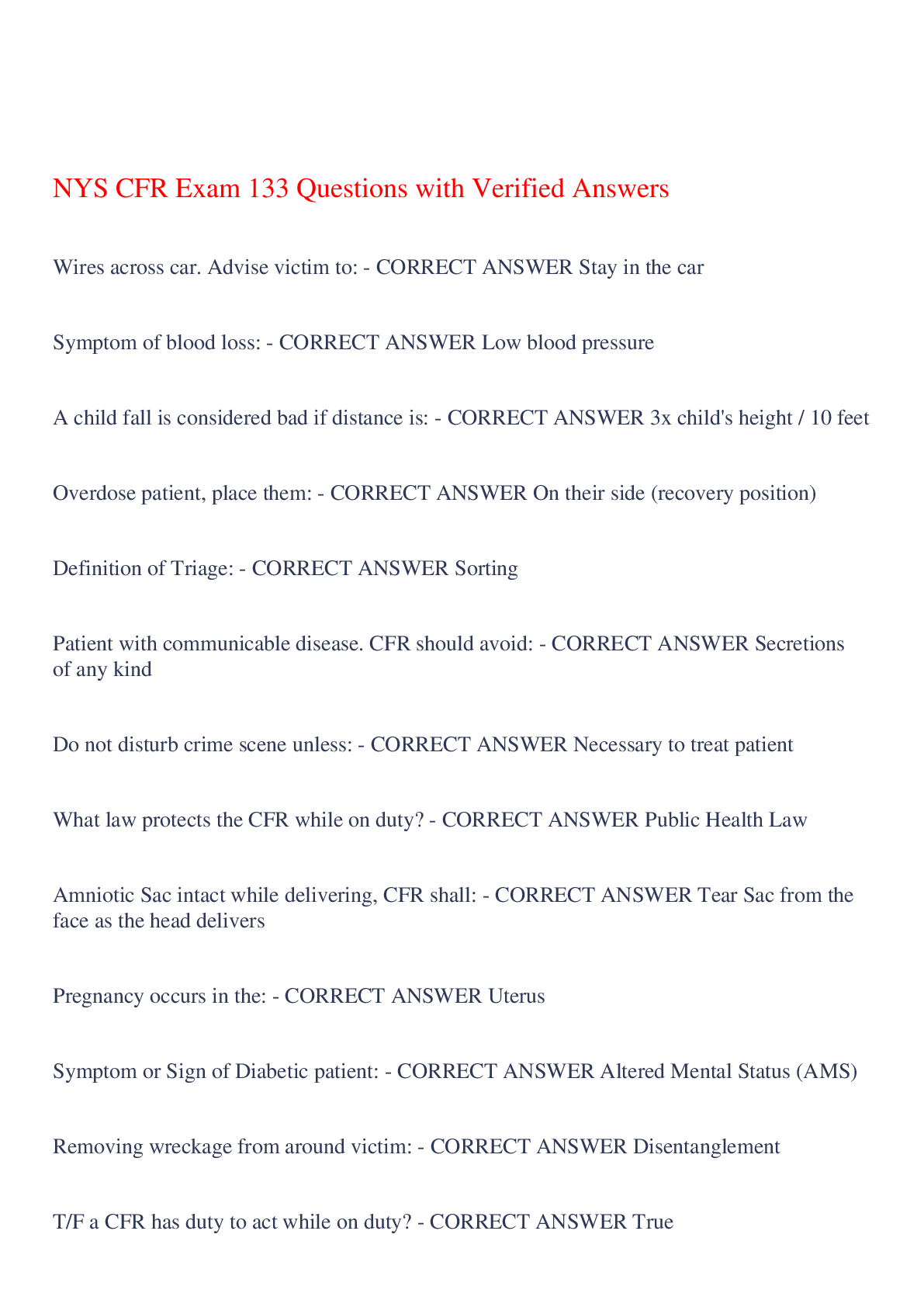
Wires across car. Advise victim to: - CORRECT ANSWER Stay in the car
Symptom of blood loss: - CORRECT ANSWER Low blood pressure
A child fall is considered bad if
...
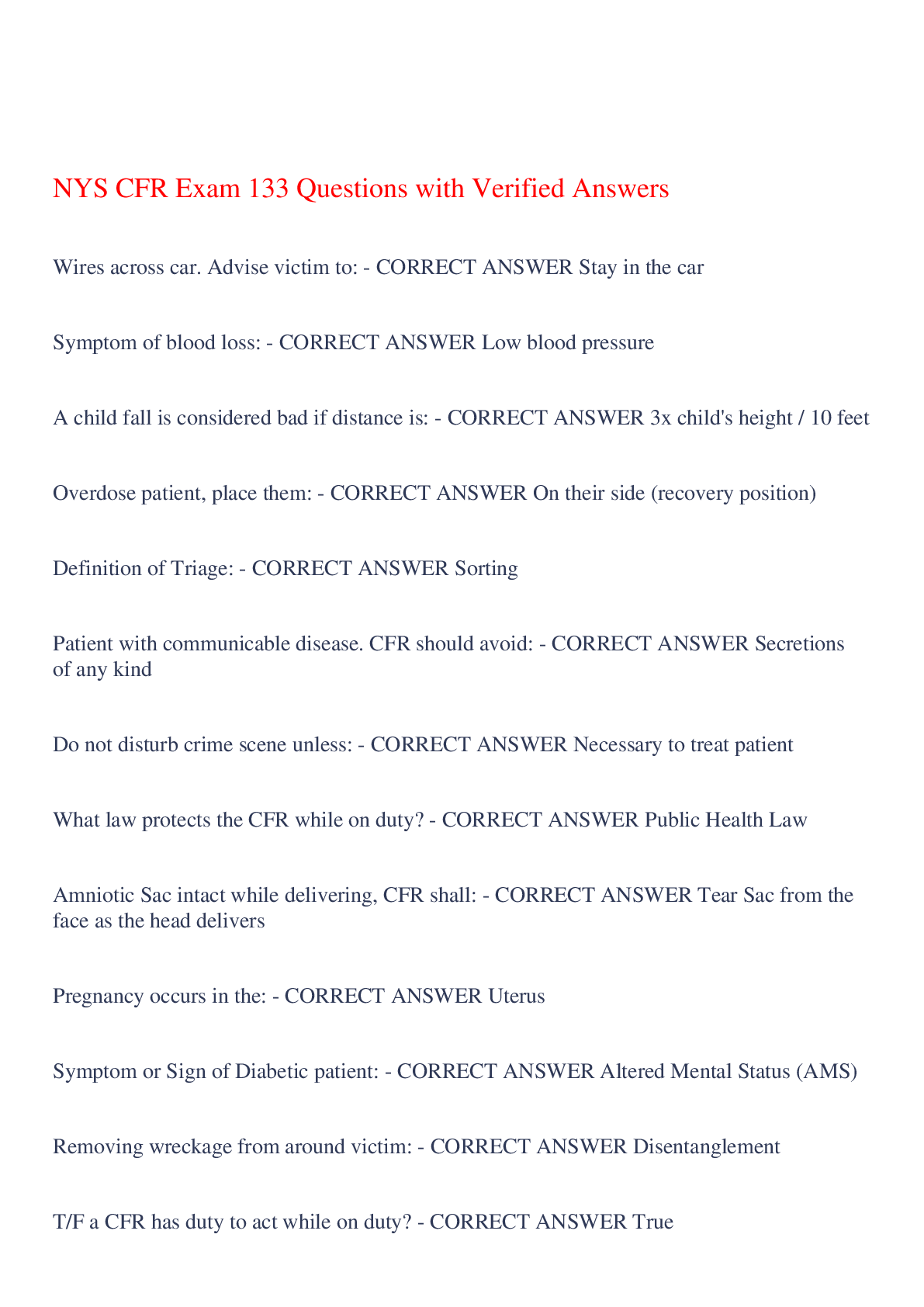
NYS CFR Exam 133 Questions with Verified Answers
Wires across car. Advise victim to: - CORRECT ANSWER Stay in the car
Symptom of blood loss: - CORRECT ANSWER Low blood pressure
A child fall is considered bad if distance is: - CORRECT ANSWER 3x child's height / 10 feet
Overdose patient, place them: - CORRECT ANSWER On their side (recovery position)
Definition of Triage: - CORRECT ANSWER Sorting
Patient with communicable disease. CFR should avoid: - CORRECT ANSWER Secretions of any kind
Do not disturb crime scene unless: - CORRECT ANSWER Necessary to treat patient
What law protects the CFR while on duty? - CORRECT ANSWER Public Health Law
Amniotic Sac intact while delivering, CFR shall: - CORRECT ANSWER Tear Sac from the face as the head delivers
Pregnancy occurs in the: - CORRECT ANSWER Uterus
Symptom or Sign of Diabetic patient: - CORRECT ANSWER Altered Mental Status (AMS)
Removing wreckage from around victim: - CORRECT ANSWER Disentanglement
T/F a CFR has duty to act while on duty? - CORRECT ANSWER True
Medical term for nosebleed: - CORRECT ANSWER Epistaxis
Arterial Bleed characteristics: - CORRECT ANSWER Spurting and Bright Red color
Place where gas exchange occurs in the lung: - CORRECT ANSWER Alveoli
Systolic blood pressure is: - CORRECT ANSWER Top number (then Diastolic)
Most common cause of airway obstruction in unresponsive patient: - CORRECT ANSWER Tongue
Method of ventilating person with Stoma: - CORRECT ANSWER Mask to Stoma
Preferred place to feel pulse on Infant: - CORRECT ANSWER Brachial
Signs of Shock: - CORRECT ANSWER Pale, Cool, Moist. Rapid Pulse. Anxiety
Superior: - CORRECT ANSWER Towards the Head
Most common spinal injury: - CORRECT ANSWER Cervical (Neck)
Cyanosis indicator: - CORRECT ANSWER Skin/Lips blue (lack of O2)
Most common cause of seizure in children: - CORRECT ANSWER Fever
Definition of a Stroke: - CORRECT ANSWER Sudden interruption of blood flow to a portion of the brain.
Neck laceration concern: - CORRECT ANSWER Air embolism (Occlusive dressing taped on 4 sides)
Crowning concern: - CORRECT ANSWER Delivery is imminent
Action if newborn is unresponsive: - CORRECT ANSWER Flick bottom of feet/Rub back
*Umbilical cord wrapped around neck: - CORRECT ANSWER Attempt to slip over head
Indirect Medical Control: - CORRECT ANSWER Protocols
Clinical Death: - CORRECT ANSWER Heart stops
Biological Death: - CORRECT ANSWER Brain death
Public Health Primary Strategies: - CORRECT ANSWER Prevention
Public Health Secondary Strategies: - CORRECT ANSWER Lessen Impact
CFR patient documentation responsibility: - CORRECT ANSWER Pre-hospital Care Report (PCR)
Best prevention method: - CORRECT ANSWER Hand washing
Hazmat incident position: - CORRECT ANSWER Uphill, Upwind, Upstream
Unresponsive patient without trauma positioning: - CORRECT ANSWER Recovery position
Scope of Practice/Care defined by: - CORRECT ANSWER NYS Public Health Laws
Standard of Care: - CORRECT ANSWER How you treat the patient
2 types of consent: - CORRECT ANSWER Informed (expressed) & Implied
Implied consent exists with: - CORRECT ANSWER Minors and AMS patients
T/F CFRs do NOT accept Refusals of Care: - CORRECT ANSWER True
T/F DNRs may be honored by CFRs: - CORRECT ANSWER True
Assault: - CORRECT ANSWER Fear of bodily harm (Verbal)
Battery: - CORRECT ANSWER Touching without consent
Lateral: - CORRECT ANSWER Away from midline
Medial: - CORRECT ANSWER Towards midline
Anterior: - CORRECT ANSWER Towards the front of the body
Posterior: - CORRECT ANSWER Towards the back of the body
Superior: - CORRECT ANSWER Towards the head
Inferior: - CORRECT ANSWER Towards the feet
Proximal: - CORRECT ANSWER Towards the trunk of the body
Distal: - CORRECT ANSWER Away from the trunk of the body
Anatomical Position: - CORRECT ANSWER Stand erect, facing observer, arms at sides, palms facing forward
Supine: - CORRECT ANSWER Lying face up
Prone: - CORRECT ANSWER Lying face down
Shock Position: - CORRECT ANSWER Lying supine with legs elevated
Right Lateral Recumbent: - CORRECT ANSWER Lying on patient's right side
Left Lateral Recumbent: - CORRECT ANSWER Lying on patient's left side
Recovery Position: - CORRECT ANSWER Lying on left side
Hyper- : - CORRECT ANSWER Above normal
Hypo- : - CORRECT ANSWER Below normal
Hemo- : - CORRECT ANSWER Blood
Tachy- : - CORRECT ANSWER Rapid
Brady- : - CORRECT ANSWER Slow
Rescue breath contains ___% O2? - CORRECT ANSWER 16% O2 Exhaled by Rescuer
Oxygenated blood flows from lungs to: - CORRECT ANSWER Left Atria
Atria: - CORRECT ANSWER Receive blood
Ventricles: - CORRECT ANSWER Pump blood away from heart
Arteries: - CORRECT ANSWER Blood vessels that carry blood away from the heart
Veins: - CORRECT ANSWER Blood vessels that carry blood back to the heart
Function of White Blood Cells: - CORRECT ANSWER Fight infection
How many pairs of ribs? - CORRECT ANSWER 12
How many spinal vertebrae? - CORRECT ANSWER 33
Preferred method for opening airway uninjured patient: - CORRECT ANSWER Head-tilt chin-lift
Method for opening airway patient with spinal injury: - CORRECT ANSWER Jaw thrust
T/F Do not use an NPA if head trauma is suspected: - CORRECT ANSWER True
OPA sizing: - CORRECT ANSWER Corner of lips to earlobe
or, Center of lips to angle of jaw
Patient begins to gag after OPA insertion, you should: - CORRECT ANSWER Remove OPA anatomically
Which nostril should the NPA be inserted in? - CORRECT ANSWER Right Nostril first
Minimum suction: - CORRECT ANSWER 300 mmHg
Suction time: - CORRECT ANSWER Adult 15 seconds
Child 10 seconds
Infant 5 seconds
"on the way out"
Most effective ventilation device for single rescuer: - CORRECT ANSWER Mouth-to-Mask (Pocket Face Mask)
Infant open airway: - CORRECT ANSWER Neutral spine
Rescue breathing for adults: - CORRECT ANSWER 1 breath every 5-6 seconds
Rescue breathing for child/infant: - CORRECT ANSWER 1 breath every 3-5 seconds
Choking adult/child: - CORRECT ANSWER Abdominal thrusts
Choking infant: - CORRECT ANSWER Back slaps/chest thrusts
Pulse check for adult/child: - CORRECT ANSWER Carotid
Pulse check for infant: - CORRECT ANSWER Brachial
CPR compression site adult/child: - CORRECT ANSWER Lower half of breastbone
CPR compression site infant: - CORRECT ANSWER Just below nipple line
CPR compression technique adult: - CORRECT ANSWER 2 hands interlaced
CPR compression technique child: - CORRECT ANSWER Heel of one hand
or, 2 hands interlaced
CPR compression technique infant: - CORRECT ANSWER 2 fingers
or, 2 thumbs with hands encircling
CPR compression depth adult: - CORRECT ANSWER At least 2", but no more than 2.4"
CPR compression depth child: - CORRECT ANSWER At least 1/3 depth of chest
or, 2"
CPR compression depth infant: - CORRECT ANSWER At least 1/3 depth of chest
or, 1.5"
CPR compression rate: - CORRECT ANSWER 100-120/min
CPR compression/ventilation ratio adult: - CORRECT ANSWER 30:2
CPR compression/ventilation ratio child: - CORRECT ANSWER 30:2 One rescuer
15:2 Two rescuers
CPR compression/ventilation ratio infant: - CORRECT ANSWER 30:2 One rescuer
15:2 Two rescuers
Rescue breathing intubated: - CORRECT ANSWER 1 breath every 6 seconds
Primary assessment: - CORRECT ANSWER Immediately correct life-threatening injuries
Secondary assessment: - CORRECT ANSWER Treat non life-threatening injuries as time permits
Reassessment for stable patient: - CORRECT ANSWER Every 15 minutes
Reassessment for unstable patients: - CORRECT ANSWER Every 5 minutes
Angina, definition and treatment: - CORRECT ANSWER Lack of O2 to the heart
Treat by resting
Acute Myocardial Infarction definition: - CORRECT ANSWER Blockage of a coronary artery (Heart attack)
T/F AMS is common after a seizure: - CORRECT ANSWER True
Stroke assessment: - CORRECT ANSWER Facial droop, arm drift, abnormal speech
Hypoglycemia: - CORRECT ANSWER Low blood sugar
Nerve agent signs and symptoms: - CORRECT ANSWER "SLUDGEM"
Open chest wound treatment: - CORRECT ANSWER Occlusive dressing taped on 3 sides. If patient's condition deteriorates, burp occlusive dressing.
Open neck wound treatment: - CORRECT ANSWER Occlusive dressing taped on 4 sides
Abdominal evisceration treatment: - CORRECT ANSWER Moist dressing, dry dressing, occlusive dressing taped on 4 sides. (Do not attempt to replace organs)
Partial thickness burn considered critical when it covers how much % of body? - CORRECT ANSWER Greater than 10%
Burn percentage rule: - CORRECT ANSWER Rule of Nines
Eye flush time: - CORRECT ANSWER 20 minutes
Tourniquet placement: - CORRECT ANSWER 3" above wound, proximal
or, High and Tight
Tourniquet operation: - CORRECT ANSWER Turn until bleeding stops
Number of AED shocks prior to transport: - CORRECT ANSWER 3
If unable to slip umbilical cord over baby's head: - CORRECT ANSWER Clamp and cut
T/F Do not suction newborn unless there is an airway obstruction or ventilation is required: - CORRECT ANSWER True
Umbilical cord clamp positions: - CORRECT ANSWER First 8-10"
Second 3" towards mother
Prolapse umbilical cord, danger and treatment: - CORRECT ANSWER Compression of cord will cut off blood and oxygen to newborn. Cover with moist dressing.
Newborn's heart rate drops below 60 BPM: - CORRECT ANSWER Begin CPR
Pediatric assessment triangle: - CORRECT ANSWER Appearance, work of breathing, circulation to the skin
Hypoperfusion: - CORRECT ANSWER Shock
How long should you assess pulse in patient with hypothermia? - CORRECT ANSWER 30-45 seconds
How do you transport a spinal injury patient over rough terrain? - CORRECT ANSWER Long board, moving in direction of long axis of the body (towards head or feet)
[Show More]