NURS 310 HESI Review - Questions, Answers and Rationales A female nurse who sometimes tries to save time by putting medications in her uniform pocket to deliver to clients, confides that after arriving home she found a
...
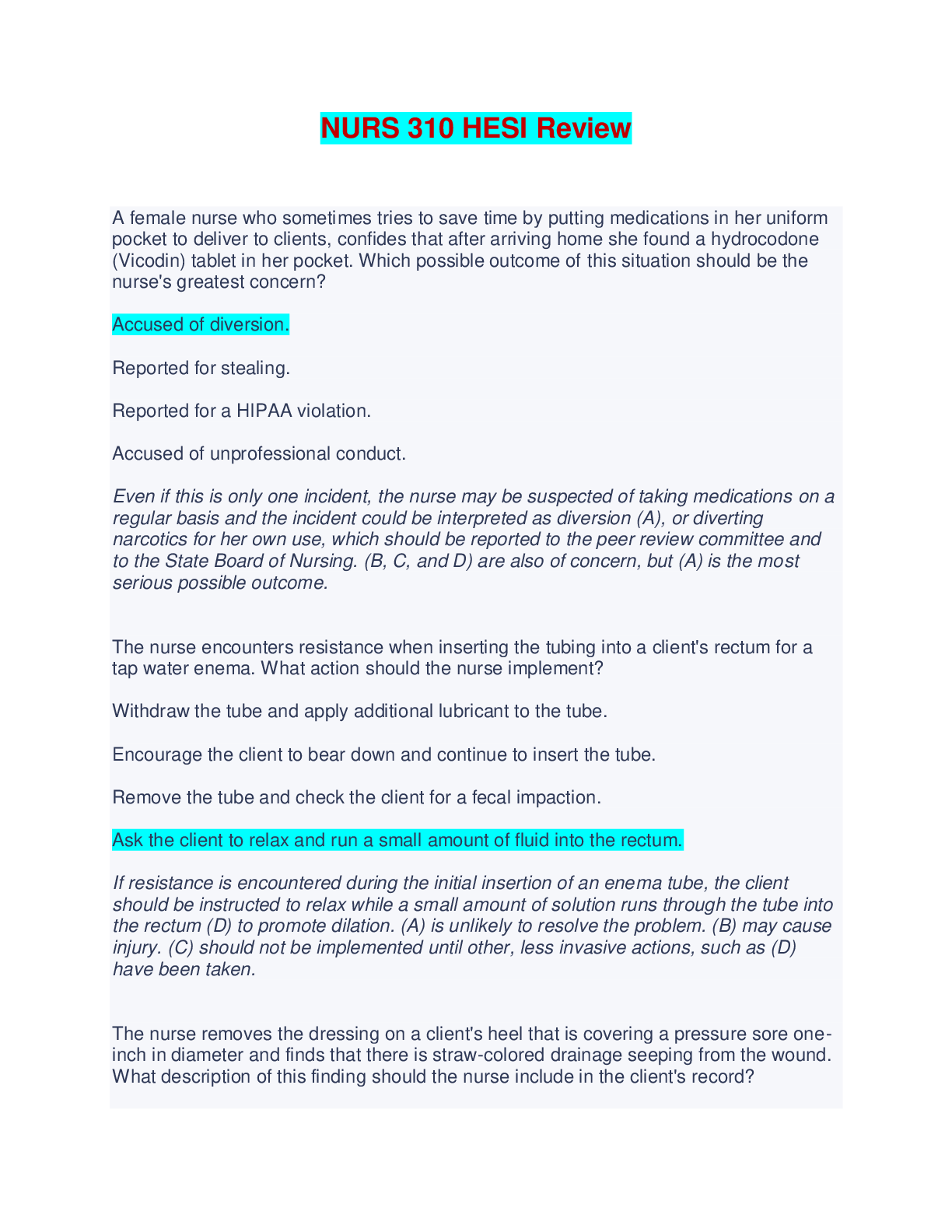
NURS 310 HESI Review - Questions, Answers and Rationales A female nurse who sometimes tries to save time by putting medications in her uniform pocket to deliver to clients, confides that after arriving home she found a hydrocodone (Vicodin) tablet in her pocket. Which possible outcome of this situation should be the nurse's greatest concern? Accused of diversion. Reported for stealing. Reported for a HIPAA violation. Accused of unprofessional conduct. Even if this is only one incident, the nurse may be suspected of taking medications on a regular basis and the incident could be interpreted as diversion (A), or diverting narcotics for her own use, which should be reported to the peer review committee and to the State Board of Nursing. (B, C, and D) are also of concern, but (A) is the most serious possible outcome. The nurse encounters resistance when inserting the tubing into a client's rectum for a tap water enema. What action should the nurse implement? Withdraw the tube and apply additional lubricant to the tube. Encourage the client to bear down and continue to insert the tube. Remove the tube and check the client for a fecal impaction. Ask the client to relax and run a small amount of fluid into the rectum. If resistance is encountered during the initial insertion of an enema tube, the client should be instructed to relax while a small amount of solution runs through the tube into the rectum (D) to promote dilation. (A) is unlikely to resolve the problem. (B) may cause injury. (C) should not be implemented until other, less invasive actions, such as (D) have been taken. The nurse removes the dressing on a client's heel that is covering a pressure sore one-inch in diameter and finds that there is straw-colored drainage seeping from the wound. What description of this finding should the nurse include in the client's record? Stage 1 pressure sore draining sero-sanguineous drainage. Pressure sore at bony prominence with exudate noted. One-inch pressure sore draining serous fluid. Pressure sore on heel with a small amount of purulent drainage. A middle-aged woman who enjoys being a teacher and mentor feels that she should pass down her legacy of knowledge and skills to the younger generation. According to Erikson, she is involved in what developmental stage? Generativity. Ego integrity. Identification. Valuing wisdom. After a client has been premedicated for surgery with an opioid analgesic, the nurse discovers that the operative permit has not been signed. What action should the nurse implement? Notify the surgeon that the consent form has not been signed. Read the consent form to the client before witnessing the client's signature. Determine if the client's spouse is willing to sign the consent form. Administer an opioid antagonist prior to obtaining the client's signature. Once a client has been premedicated for surgery with any type of sedative, legal informed consent is not possible, so the nurse must notify the surgeon (A). (B, C, and D) are not legally viable options for ensuring informed consent. When preparing to administer an intravenous medication through a central venous catheter, the nurse aspirates a blood return in one of the lumens of the triple lumen catheter. Which action should the nurse implement? Flush the lumen with the saline solution and administer the medication through the lumen. Determine if a PRN prescription for a thrombolytic agent is listed on the medication record. Clamp the lumen and obtain a syringe of a dilute heparin solution to flush through the tubing. Withdraw the aspirated blood into the syringe and use a new syringe to administer the medication. A client with Raynaud's disease asks the nurse about using biofeedback for self-management of symptoms. What response is best for the nurse to provide? The responses to biofeedback have not been well established and may be a waste of time and money. Biofeedback requires extensive training to retrain voluntary muscles, not involuntary responses. Although biofeedback is easily learned, it is most often used to manage exacerbation of symptoms. Biofeedback allows the client to control involuntary responses to promote peripheral vasodilation. The nurse is preparing to give a client dehydration IV fluids delivered at a continuous rate of 175 ml/hour. Which infusion device should the nurse use? Portable syringe pump. Cassette infusion pump. Volumetric controller. Nonvolumetric controller. A cassette pump (B) should be used to accurately deliver large volumes of fluid over longer periods of time with extreme precision, such as ml/hour. A syringe pump (A) is accurate for low-dose continuous infusion of low-dose medication at a basal rate, but not large fluid volume replacement. Volumetric (C) and nonvolumetric (D) controllers count drops/minute to administer fluid volume and are inherently inaccurate because of variation in drop size.
[Show More]