NURS 302 HESI Review - Questions, Answers and Rationales Which finding should the nurse identify as an indication of carbon monoxide poisoning in a client who experienced a burn injury during a house fire? Pulse oximet
...
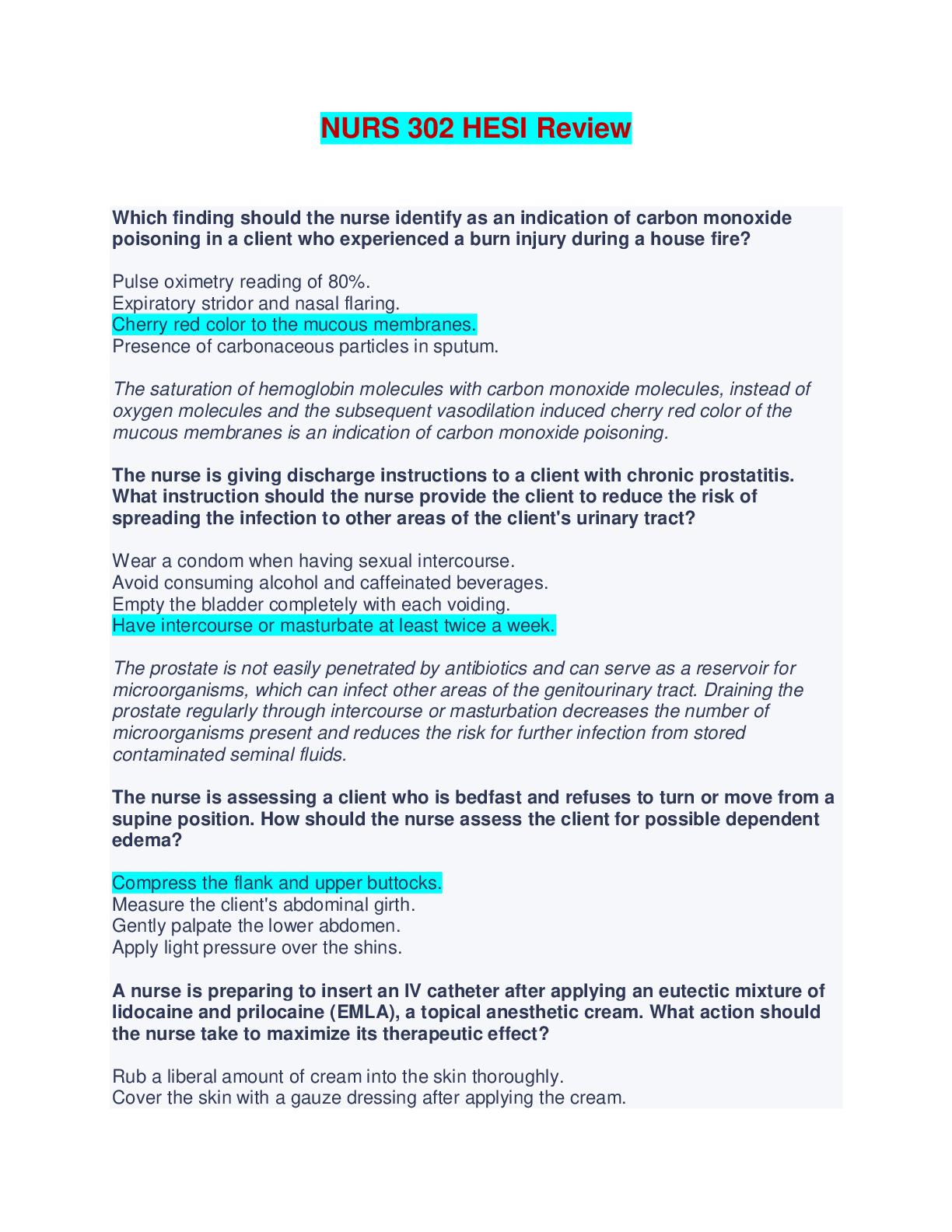
NURS 302 HESI Review - Questions, Answers and Rationales Which finding should the nurse identify as an indication of carbon monoxide poisoning in a client who experienced a burn injury during a house fire? Pulse oximetry reading of 80%. Expiratory stridor and nasal flaring. Cherry red color to the mucous membranes. Presence of carbonaceous particles in sputum. The saturation of hemoglobin molecules with carbon monoxide molecules, instead of oxygen molecules and the subsequent vasodilation induced cherry red color of the mucous membranes is an indication of carbon monoxide poisoning. The nurse is giving discharge instructions to a client with chronic prostatitis. What instruction should the nurse provide the client to reduce the risk of spreading the infection to other areas of the client's urinary tract? Wear a condom when having sexual intercourse. Avoid consuming alcohol and caffeinated beverages. Empty the bladder completely with each voiding. Have intercourse or masturbate at least twice a week. The prostate is not easily penetrated by antibiotics and can serve as a reservoir for microorganisms, which can infect other areas of the genitourinary tract. Draining the prostate regularly through intercourse or masturbation decreases the number of microorganisms present and reduces the risk for further infection from stored contaminated seminal fluids. The nurse is assessing a client who is bedfast and refuses to turn or move from a supine position. How should the nurse assess the client for possible dependent edema? Compress the flank and upper buttocks. Measure the client's abdominal girth. Gently palpate the lower abdomen. Apply light pressure over the shins. A nurse is preparing to insert an IV catheter after applying an eutectic mixture of lidocaine and prilocaine (EMLA), a topical anesthetic cream. What action should the nurse take to maximize its therapeutic effect? Rub a liberal amount of cream into the skin thoroughly. Cover the skin with a gauze dressing after applying the cream. Leave the cream on the skin for 1 to 2 hours before the procedure. Use the smallest amount of cream necessary to numb the skin surface. The nurse is caring for a client with a small bowel obstruction. The client is vomiting foul smelling fecal-like material. What action should the nurse implement? Administer antiemetics every 2 to 3 hours. Position on the left side with knees drawn up. Encourage ice chips sparingly. Give IV fluids with electrolytes. When the bowel is obstructed, electrolytes and fluids are not absorbed, so parenteral fluids with sodium chloride, bicarbonate, and potassium should be administered to prevent electrolyte imbalance and dehydration. A female client with type 2 diabetes mellitus reports dysuria. Which assessment finding is most important for the nurse to report to the healthcare provider? Suprapublic pain and distention. Bounding pulse at 100 beats/minute. Fingerstick glucose of 300 mg/dl. Small vesicular perineal lesions. A male client with chronic atrial fibrillation and a slow ventricular response is scheduled for surgical placement of a permanent pacemaker. The client asks the nurse how this device will help him. How should the nurse explain the action of a synchronous pacemaker? Ventricular irritability is prevented by the constant rate setting of pacemaker. Ectopic stimulus in the atria is suppressed by the device usurping depolarization. An impulse is fired every second to maintain a heart rate of 60 beats per minute. An electrical stimulus is discharged when no ventricular response is sensed. The artificial cardiac pacemaker is an electronic device used to pace the heart when the normal conduction pathway is damaged or diseased, such as a symptomatic dysrhythmias like atrial fibrillation with a slow ventricular response. Pacing modes that are synchronous (impulse generated on demand or as needed according to the patient's intrinsic rhythm) send an electrical signal from the pacemaker to the wall of the myocardium stimulating it to contract when no ventricular depolarization is sensed. Client with osteoarthritis receives a prescription for Naproxen (Naprosyn). Which potential side effect should the nurse provide to the client about this medication? Sensitivity to sunlight. Muscle fasciculations. Increased urinary frequency. Gastrointestinal disturbance. Prostaglandin synthesis inhibitors such as naproxen can have gastrointestinal side effects such as nausea and gastric burning. It is recommended that this drug be taken with food to avoid gastrointestinal upset.
[Show More]