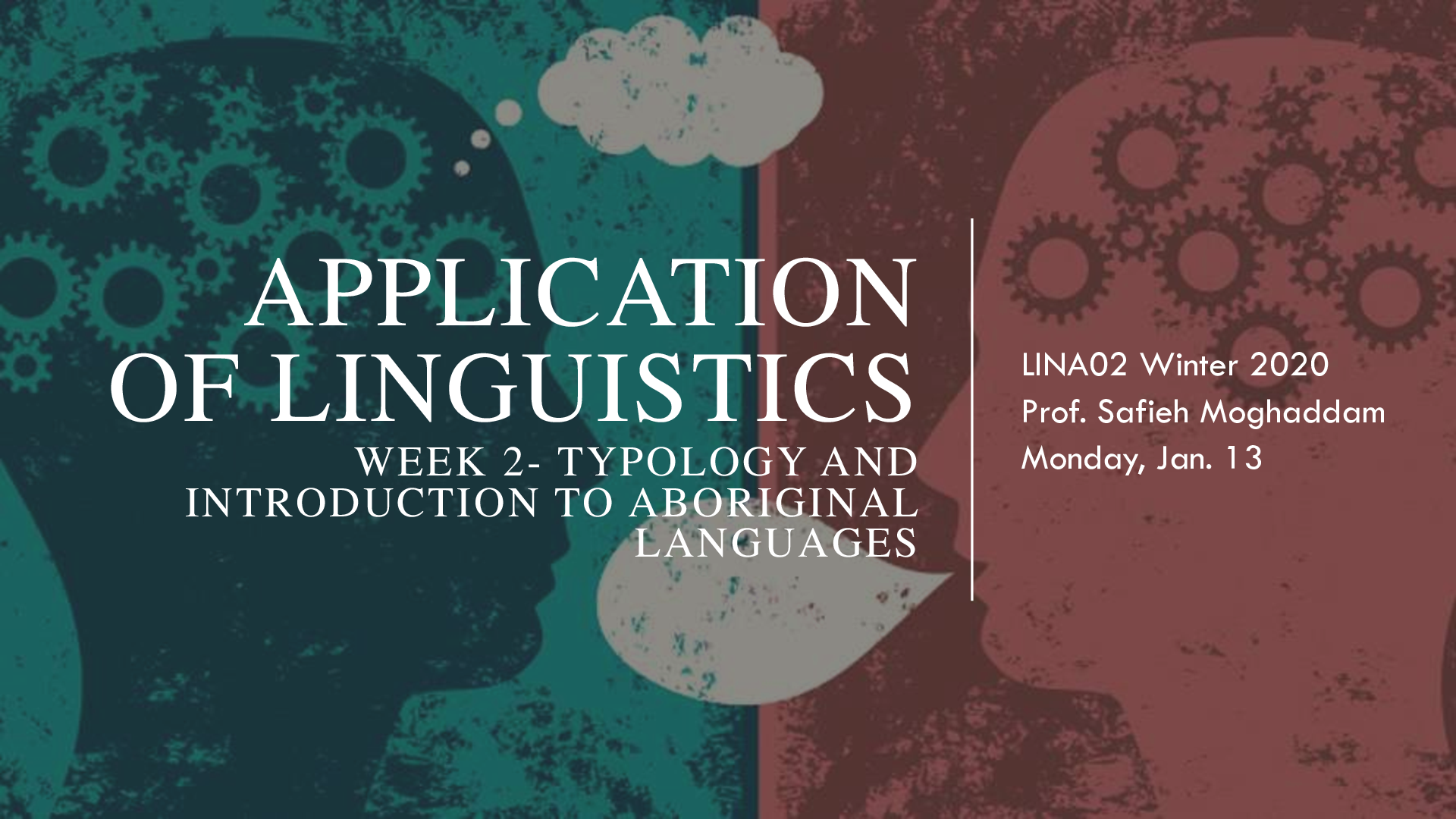
Monday, Jan. 13RECALL: TYPOLOGICAL CLASSIFICATION
• Typological classification categorizes languages by looking at
similarities in linguistic structures
• i.e. phonology, morphology, and syntax
• We are trying to ide
...
Monday, Jan. 13RECALL: TYPOLOGICAL CLASSIFICATION
• Typological classification categorizes languages by looking at
similarities in linguistic structures
• i.e. phonology, morphology, and syntax
• We are trying to identify linguistic universals
• Structural characteristics which occur in most or all languages
• Allow us to make predictions about other languages (possible and
impossible)LINGUISTIC UNIVERSALS
• Absolute Universals:
• Occur in ALL languages
• Universal Tendencies:
• Occur in MOST languages
• Implicational Universals:
• If X then Y (but not if Y then X)
• Having one characteristic will imply the presence of another feature
• Typically, a marked (a less common) structure implies the existence of an
unmarked (a common) structureUNIVERSALS EXAMPLES
• Absolute Universals: All languages have Z
•e.g. All languages have vowels and consonants
• Universal Tendencies: Most languages have Y
•e.g. Most languages have at least one liquid
• Implicational Universals: If a language has X, it probably has Y
•e.g. If a language has affricates, it has fricativesMARKEDNESS
• Unmarked characteristics are more common
• Marked features are more complex and less common
• Thus, whenever we see a marked feature, we also often see an
unmarked counterpartTYPOLOGY: MORPHOLOGY
Recall:
• Words: freestanding units of meaning that are comprised of one or
more morphemes
• Morpheme: the smallest meaningful unit of languageMORPHOLOGICAL TYPOLOGY
Languages are generally classified into four morphological types:
1. Isolating (analytic)
2. Agglutinating
3. Fusional (inflectional)
4. PolysyntheticMORPHOLOGICAL TYPOLOGY
Isolating languages:
Mandarin
Ta ba shu mai le
He ObjMark book buy past
‘He bought the book’
Ta chao le yígecài hen xiang
he cook past a dish very delicious
‘He cooked a dish that was very delicious’MORPHOLOGICAL TYPOLOGY
• Notice that Isolating languages have an almost 1-to-1 morphemeto-word ratio (perfect analytic = 1-to-1)
• Words in isolating languages are often unaffixed, bare roots
• Bound morphemes (morphemes that cannot stand alone) are very
infrequent
• Notice that in Mandarin an object marker (‘ba’) is an independent,
free-standing wordMORPHOLOGICAL TYPOLOGY
Agglutinating languages:
Turkish
el ‘the hand’ elimde ‘in my hand’
elim ‘my hand’ ellerim ‘my hands’
eller ‘the hands’ ellerimde ‘in my hands’
How do we break down Turkish words into morphemes (root + affixes)?
What is the meaning associated with each morpheme?
el = hand, -im = possessive (my, her), -ler = plural, -de = locationMORPHOLOGICAL TYPOLOGY
• In Agglutinating languages, each affix represents a single piece
of grammatical information
• More-or-less one-to-one matching between morphemes and meaning
• A much higher morpheme-to-word ratio (more affixes in a word)MORPHOLOGICAL TYPOLOGY
Fusional languages:
Russian
Singular Plural
Nominative nog-a nog-i
Dative nog-e nog-am
Instrumental nog-oj nog-ami
noga ‘leg, foot’, feminine noun
Does the approach we used with Turkish work for Russian?MORPHOLOGICAL TYPOLOGY
• Fusional languages have affixes that express multiple bits of
grammatical information at the same time
• There is almost no one-to-one match between morphemes and
meaning
• Higher morpheme-to-word ratioMORPHOLOGICAL TYPOLOGY
Polysynthetic languages:
Greenlandic Eskimo
illu- mi- niip- puq (illuminiippuq)
House his be-in 3Sg-Ind
‘He is in his own house’
tuttu- si- vuq (tuttusivuq)
Caribou come-across 3Sg-Ind
‘He saw a caribou’MORPHOLOGICAL TYPOLOGY
• Polysynthetic languages often have a single word (long string of
roots and affixes) representing meanings that are associated with
whole sentences in other languages
• Often verb + object (and sometimes subject) are inflected onto
the verbMORPHOLOGY: IMPLICATIONAL UNIVERSALS
• If a language has inflectional affixes, it will also have derivational
affixes
• if a word has both derivational and inflectional affixes, the
derivational affix is closer to the rootTYPOLOGY: SYNTAX
Word Order:
The basic units of word order are Subject (S), Object (O) and Verb (V)
All six possible orders are attested:WORD ORDER
• SOV, SVO, and VSO
= ~95% languages
• The commonality?
• Subject precedes Object
http://wals.info/chapter/81IMPLICATIONAL UNIVERSALS
• Languages with Verb Object (VO) order always have
prepositions, not postpositions
Italian
Prepositions
dalla casa
from-the house
‘from the house’
dalla casa
from the houseIMPLICATIONAL UNIVERSALS
• Languages with OV order have postpositions
Guugu Yimidhirr (Australia)
Postpositions
yuwaal ngahn
beach from
‘from the beach’IMPLICATIONAL UNIVERSALS
In OV languages, PPs appear before the verb
Japanese
Taro-ga [nichiyoubi ni] tsuita
Taro-NOM [Sunday on] arrived
‘Taro arrived on Sunday’ Taro-ga nichiyoubi ni tsuitaIMPLICATIONAL UNIVERSALS
In VO languages, PPs follow verbs
English
Susan ate [at home].
Susan ate at homeIMPLICATIONAL UNIVERSALS
In OV languages, Possessor + Noun
Japanese
Yuki-no ringo
Yuki-GEN apple
‘Yuki’s book’IMPLICATIONAL UNIVERSALS
In VO languages, Noun + Possessor
Russian
kniga Olg-i
book Olga-GEN
‘Olga’s book’HEAD-FINAL VS HEAD-INITIAL
OV languages = Head-Final VO languages = Head-Initial
Navajo EnglishREFERENCES
Matthew S. Dryer. 2013. Order of Subject, Object and Verb. In: Dryer, Matthew S. &
Haspelmath, Martin (eds.) The World Atlas of Language Structures Online. Leipzig:
Max Planck Institute for Evolutionary Anthropology. (Available online at
http://wals.info/chapter/81)
Statistics Canada. 2016 Census of Population.
https://www150.statcan.gc.ca/n1/pub/11-627-m/11-627-m2017035-eng.htm
https://www12.statcan.gc.ca/census-recensement/2016/as-sa/98-200-
x/2016022/98-200-x2016022-eng.cfm
[Show More]


![Preview of eBook [PDF] The Origins of Language: An Introduction to Evolutionary Linguistics | ISBN: 9](https://browseimages.nyc3.digitaloceanspaces.com/paper-images/2025/Jan/31/6CC5mXg72025-01-31-11-14679d2f20bcd1c.png)
![Preview of eBook [PDF] An Introduction to Forensic Phonetics and Forensic Linguistics 1st Edition | I](https://browseimages.nyc3.digitaloceanspaces.com/paper-images/2025/Jan/31/uE8NK3Fl2025-01-31-09-36679d182882289.png)