NRS 429 Exam 3 - Questions and Answers Negligence careless neglect, often resulting in injury Malpractice professional misconduct or unreasonable lack of skill Personal liability each person's responsibility and account
...
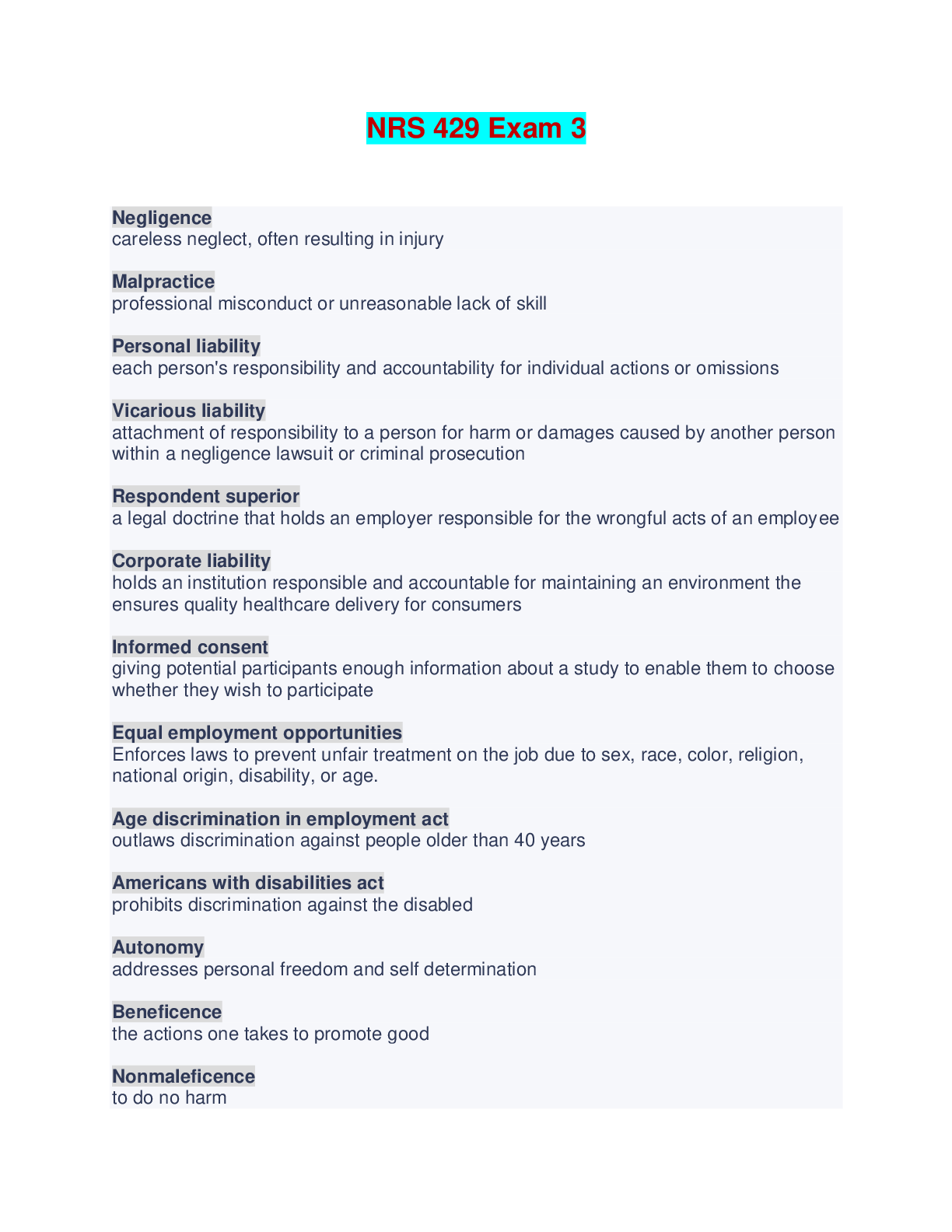
NRS 429 Exam 3 - Questions and Answers Negligence careless neglect, often resulting in injury Malpractice professional misconduct or unreasonable lack of skill Personal liability each person's responsibility and accountability for individual actions or omissions Vicarious liability attachment of responsibility to a person for harm or damages caused by another person within a negligence lawsuit or criminal prosecution Respondent superior a legal doctrine that holds an employer responsible for the wrongful acts of an employee Corporate liability holds an institution responsible and accountable for maintaining an environment the ensures quality healthcare delivery for consumers Informed consent giving potential participants enough information about a study to enable them to choose whether they wish to participate Equal employment opportunities Enforces laws to prevent unfair treatment on the job due to sex, race, color, religion, national origin, disability, or age. Age discrimination in employment act outlaws discrimination against people older than 40 years Americans with disabilities act prohibits discrimination against the disabled Autonomy addresses personal freedom and self determination Beneficence the actions one takes to promote good Nonmaleficence to do no harm Veracity telling the truth and demands that trust be told completely Justice treating all persons equally and fairly Parentalism -allows one person to make partial decisions for another -most frequently demand to be negative or undesirable Fidelity keeping ones promises or commitments Moral distress occurs when the individual knows the right thing to do but organizational constraints make it difficult to take the right course of action Interprofessional communication effective when healthcare providers communicate with each other and with patients and their families in an open, collaborative, respectful manner Handoff communication verbal and written exchange of pertinent information during transitions of care Intrapersonal conflict occurs within a person when confronted with the need to think or act in a way that seems at odds with one's sense of self Interpersonal conflict focus on the difference of opinion, priority, or approach with others Organizational conflict arises when discord exists about policies and procedures, personnel code of conduct, or accepted norms of behavior and patterns of communication Frustration, conceptualization, action, outcomes stages of conflict Frustration (stage of conflict)
[Show More]