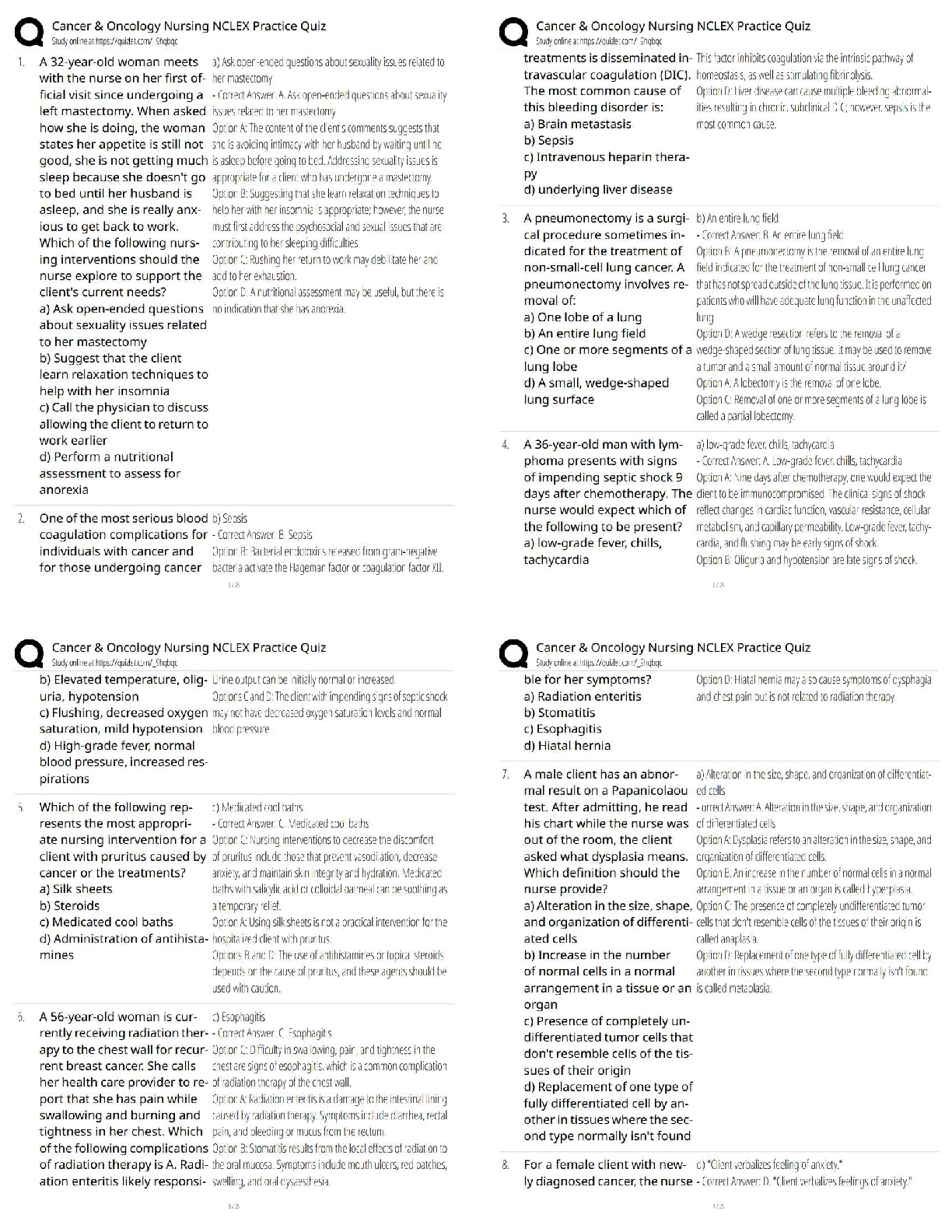
In this nursing test bank, review cancer and oncology nursing
concepts with these NCLEX practice questions. Test your
competence in the assessment, diagnosis, and nursing
management of patients with cancer. This quiz
...
In this nursing test bank, review cancer and oncology nursing
concepts with these NCLEX practice questions. Test your
competence in the assessment, diagnosis, and nursing
management of patients with cancer. This quiz aims to help
student nurses grasp and master the concepts of oncology nursing.
Cancer & Oncology Nursing
NCLEX Practice Quizzez
Included topics in this NCLEX practice questions (with rationales)
for cancer and oncology nursing are oncology nursing, Hodgkin’s
disease, lung cancer, nursing care of patients undergoing
chemotherapy, brachytherapy, laryngeal cancer, colon cancer, and
more! This nursing test bank includes 170 practice questions
divided into four parts.
Quizzes included in this guide are:
1. Cancer and Oncology Nursing NCLEX Practice | Quiz #1: 50
Questions
2. Cancer and Oncology Nursing NCLEX Practice | Quiz #2: 50
Questions
3. Cancer and Oncology Nursing NCLEX Practice | Quiz #3: 50
Questions
4. Cancer and Oncology Nursing NCLEX Practice | Quiz #4: 50
Questions
Quiz guidelines:
ADVERTISEMENTS
1. Comprehend each item. Read and understand each question before
choosing the best answer. The exam has no time limit so that you
can make sense of each item at your own pace.
2 Review your answers Once you’re done with all the questions you’ll
2. Review your answers. Once you re done with all the questions, you ll
be redirected to the Quiz Summary table, where you’ll be able to
review which questions you’ve answered or may have skipped.
Review your answers once more before pressing the Finish
Quiz button.
3. Read the rationales. After you have reviewed your answers, click on
the Finish Quiz button to record your answers and show your score.
Click on the View Questions button to review the quiz and read
through the rationales for each question.
4. Let us know your feedback! Comment us your thoughts, scores,
ratings, and questions about the quiz in the comments section
below.
1. Question
When the nurse is administering a vesicant chemotherapeutic
agent intravenously, an important consideration is to
A. Stop the infusion if swelling is observed at the site
B. Infuse the medication over a short period
C. Administer the chemotherapy through a small-bore catheter
D. Hold the medication unless a central venous line is available
Incorrect
Correct Answer: A. Stop the infusion if swelling is observed at the
site
Option A: Swelling at the site may indicate extravasation, and the IV
should be stopped immediately.
Option B: The medication should generally be given slowly to avoid
irritation of the vein.
tat o o t e e .
Option C: The size of the catheter is not as important as
administration of vesicants into a running IV line to allow dilution of
the chemotherapy drug.
Option D: These medications can be given through peripheral lines,
although central vascular access devices (CVADs) are preferred.
2. Question
A chemotherapeutic agent known to cause alopecia is prescribed
for a patient. To maintain the patient’s self-esteem, the nurse plans
to
A. Suggest that the patient limit social contacts until regrowth
of the hair occurs
B. Encourage the patient to purchase a wig or hat and wear it
once hair loss begins
C. Have the patient wash the hair gently with a mild shampoo
to minimize hair loss
D. Inform the patient that hair loss will not be permanent and
that the hair will grow back
[Show More]