Date of Completion
Jul 02, 2020 3:35 PM
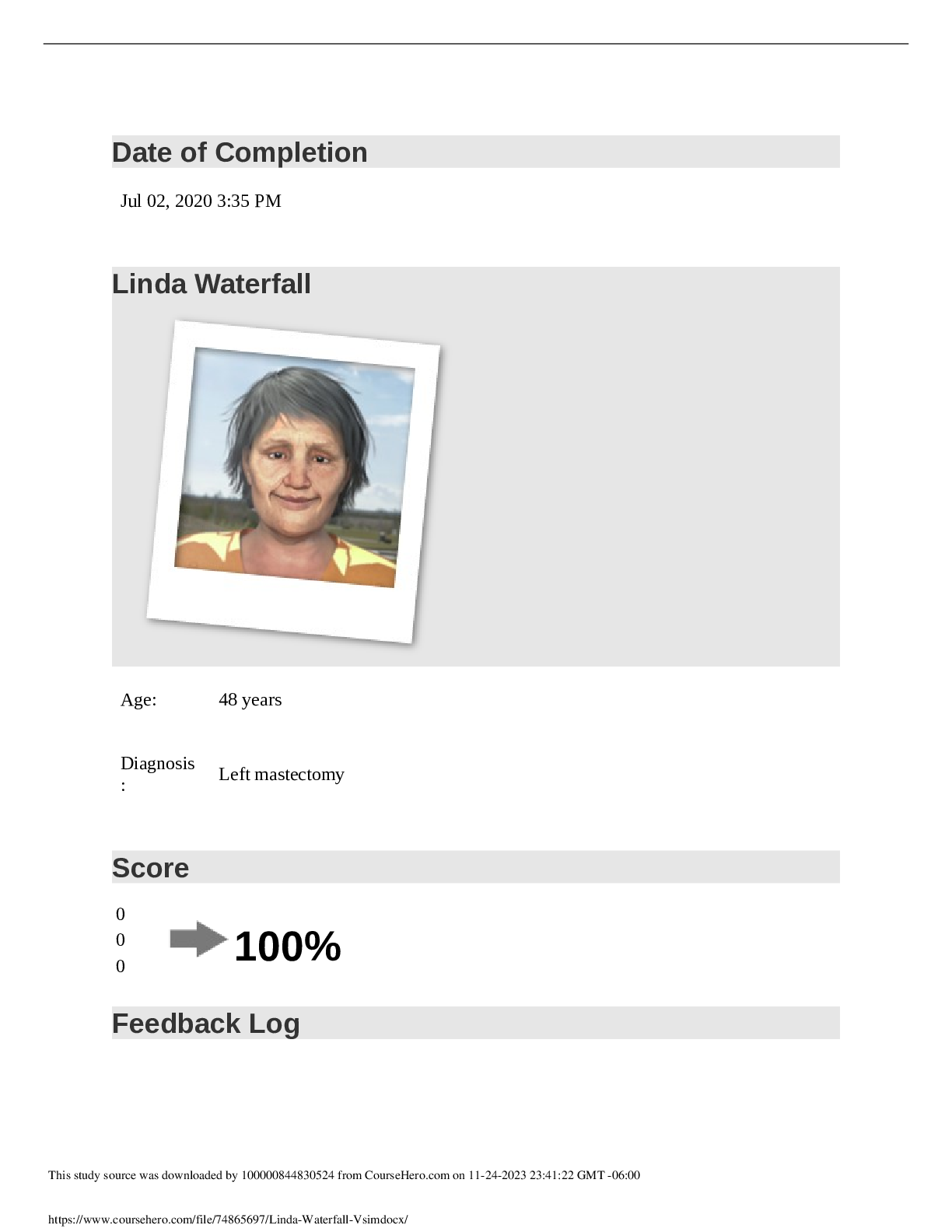
Linda Waterfall
Age: 48 years
Diagnosis
:
Left mastectomy
Score
0
0
0 100%
Feedback Log
This study source was downloaded by 100000844830524 from CourseHero.com on 11-24
...
Date of Completion
Jul 02, 2020 3:35 PM
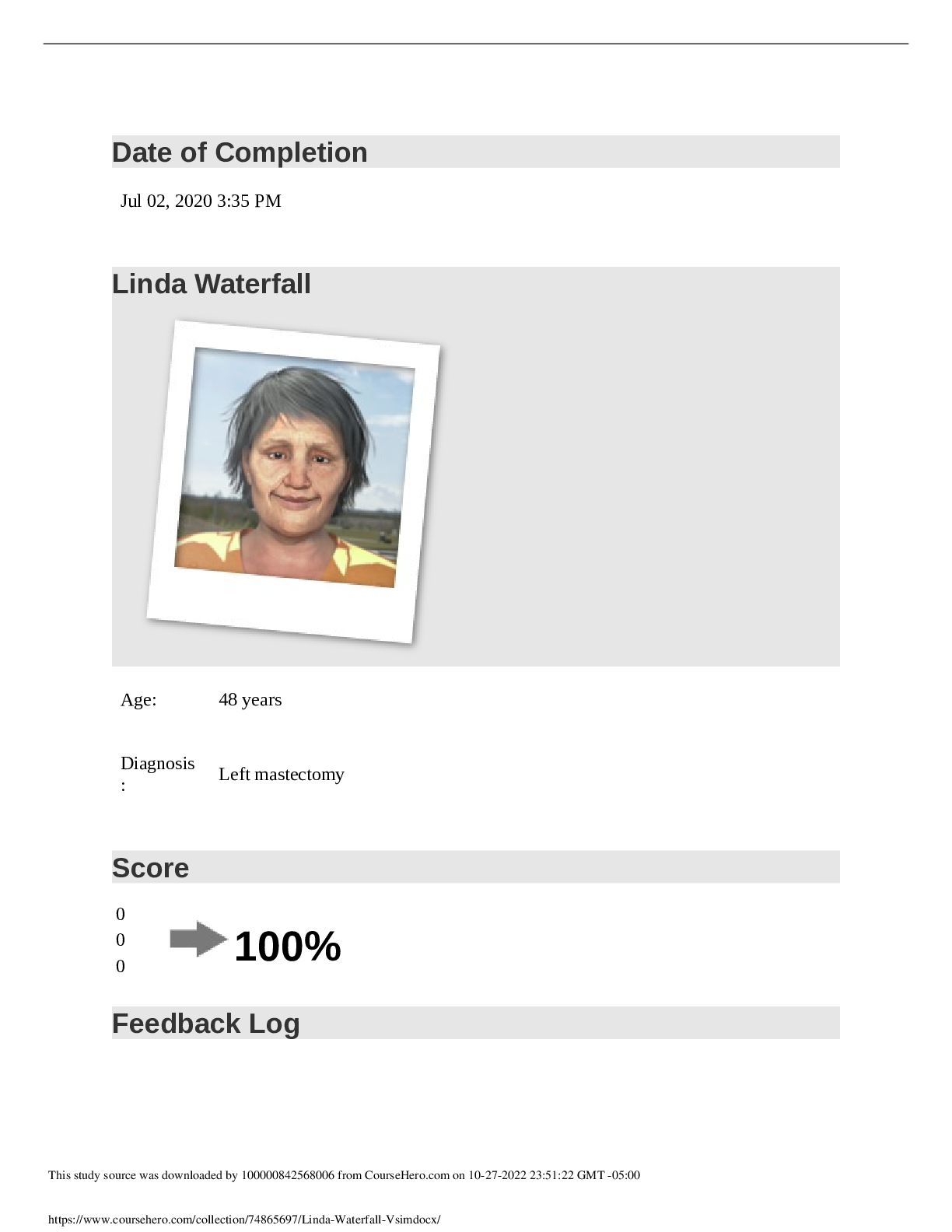
Linda Waterfall
Age: 48 years
Diagnosis
:
Left mastectomy
Score
0
0
0 100%
Feedback Log
This study source was downloaded by 100000844830524 from CourseHero.com on 11-24-2023 23:41:22 GMT -06:00
https://www.coursehero.com/file/74865697/Linda-Waterfall-Vsimdocx/
0:00 Patient
0:00 You checked scene safety. It was correct to check scene safety in order to
maintain your own safety.
0:06 You introduced yourself.
0:28 You asked the patient: Is it OK for your cousin to be here, while we talk? It was
correct to let the patient give her consent for letting her cousin be a part of the
interview.
0:44 The patient said: Alice! Don't leave me! Nurse, she said she wanted some
coffee.\nYou answered: Mrs. Waterfall, I will stay with you if Alice wants to get
some coffee. \nYou used the therapeutic technique of offering self.
0:45 You washed your hands.
0:50 You identified the patient.
1:17 You assessed the respiration.
1:47 You checked the pulse oximetry.
2:03 You checked the radial pulse.
2:30 You measured the blood pressure.
2:47 You measured the temperature.
3:04 You auscultated the lung sounds.
3:22 You auscultated the heart sounds.
3:42 You asked the patient: Can you tell me a little bit more about what's going on
with you today? It was appropriate to ask the patient what was going on with her
to get an understanding of this.
4:04 The patient said: I had a horrible morning! I could not find my bag, then I broke a
glass, and I could not get in touch with my father. My life is falling apart!\nYou
answered: You must be feeling as if everything is out of your control. \nYou used
the therapeutic technique of translating to feelings.
4:05 You asked the patient: Over the past year, when did you feel your best? It was
This study source was downloaded by 100000844830524 from CourseHero.com on 11-24-2023 23:41:22 GMT -06:00
https://www.coursehero.com/file/74865697/Linda-Waterfall-Vsimdocx/
appropriate to ask the patient about when she felt her best.
4:22 The patient said: You are trying to kill me by making me go through this surgery
without it. All of you are out to get me. You want me to die!\nYou answered: Ms.
Waterfall, I am your nurse and I'm here to help you. \nYou used the therapeutic
technique of giving information.
4:33 You asked the patient: Do you have any difficulty with your breathing? The
patient said: Yes. I feel I can't breathe.
4:48 You asked the patient: Do you have chest pain? The patient said: No, I don't have
chest pain.
6:14 You asked the patient: Have you had any changes in your appetite over the past
month? The patient said: My appetite has been about the same.
6:23 You asked the patient: Have you lost or gained weight over the past month? The
patient said: No, I am about the same weight.
6:32 You asked the patient: Tell me about any changes you have had in your sleep
over the past few weeks? The patient said: When I am anxious I have a hard time
sleeping. Recently this has been the case.
6:48 You asked the patient: Approximately how many hours of sleep do you get each
night? The patient said: I sleep about 7 hours a night.
6:56 You asked the patient: Do you have energy to do the normal activities necessary
to get through the day? The patient said: Yes, I have no trouble with energy once
I get up in the morning.
7:39 You assessed the patient's IV.
8:06 You checked the patient's skin.
8:32 You asked the patient: I would like to ask you a series of questions about how
you are feeling to help me better understand how together we can start to plan
your care. These are questions I ask all of the patients I see. May I ask you these
questions?
9:00 The patient said: All of this talking, it's just a waste of time.\nYou answered: Do
you feel that no one understands your feelings? \nYou used the therapeutic
technique of verbalizing the implied.
9:06 You supported the patient about religous beliefs.
9:12 You supported the patient about medicine bundle.
9:25 You supported the patient in taking deep breaths.
This study source was downloaded by 100000844830524 from CourseHero.com on 11-24-2023 23:41:22 GMT -06:00
https://www.coursehero.com/file/74865697/Linda-Waterfall-Vsimdocx/
9:41 You supported the patient about treatment.
9:51 You supported the patient's cousin about family relations.
10:07 You asked the patient: Do you have any thoughts or wishes to harm or kill
yourself? The patient said: No.
10:15 You asked the patient: Do you have any thoughts or wishes to harm anybody
else? The patient said: No.
10:20 You asked the patient: Can you tell me what a desired outcome of treatment
would be for you?
10:32 The patient said: Do you think I should have this surgery?\nYou answered: Do
you think you should? \nYou used the therapeutic technique of giving reflection.
This response encourages the patient to make decisions independently.
10:43 You asked the patient: How do you understand your problems?
11:11 The patient said: There was so much going on this morning. I was trying to get
my things together and waiting on Alice. I can't believe I left it at home.\nYou
answered: Go back over your morning. What led up to Alice arriving at your
home? \nYou used the therapeutic technique of placing the event in time or
sequence.
11:17 You asked the patient: Do you find that you worry more than others?
11:32 The patient said: Without my medicine bundle, I won't make it.\nYou answered:
Are you feeling hopeless? \nYou used the therapeutic technique of translating to
feelings.
11:49 You asked the patient: Are you frightened of anything?
12:01 The patient said: I'm not sure what to do.\nYou answered: Go on. \nYou used the
therapeutic technique of offering general leads.
12:09 You supported the patient in taking deep breaths.
12:36 You educated about possibilities and advocated for the patient.
13:15 You called the provider.
13:27 You educated about discharge plans.
Generally, anxiety is divided into four levels:lt;/p>lt;p>lt;ul>lt;li>Mild: Mild
anxiety may increase the person's sensory perceptions. The person is alert and
can see, hear, and understand what is happening around him or
her.lt;/li>lt;li>Moderate: Perception is narrowed. The person may benefit from
This study source was downloaded by 100000844830524 from CourseHero.com on 11-24-2023 23:41:22 GMT -06:00
https://www.coursehero.com/file/74865697/Linda-Waterfall-Vsimdocx/
the guidance of others. The person may experience difficulty concentrating, a
change in voice pitch or volume, or trembling.lt;/li>lt;li>Severe: The person may
be unable to attend to events even when they are pointed out by others.
Generally, the person experiences distorted perceptions, a sense of impending
doom, a rapid heart rate, and rapid breathing.lt;/li>lt;li>Panic: The person may be
unable to focus, want to flee, feel paralyzed by fear, or be completely withdrawn
or extremely agitated.lt;/li>lt;/ul>lt;/p>lt;p>De-escalation techniques for patients
with anxiety include the following: speaking while positioned directly in the
patient’s field of vision; sitting down and asking the patient to sit down; giving
the patient concrete directions; and keeping a clear, calm voice. As the patient
calms, breathing exercises may be used.lt;/p>lt;p>It is important to be able to
distinguish between an anxiety attack and a heart attack. Physiologic concerns
should always be initially ruled out, as symptoms of panic and a heart attack are
often indistinguishable.lt;/p>lt;p>Although it is important to never assume that
an individual has a certain belief system based on his or her culture, assessing a
patient’s spiritual beliefs is vital. This case illustrates how greatly a person’s
spiritual beliefs can influence his or her health outcomes.lt;/p>
You got 100%
This study source was downloaded by 100000844830524 from CourseHero.com on 11-24-2023 23:41:22 GMT -06:00
https://www.coursehero.com/file/74865697/Linda-Waterfall-Vsimdocx/
Powered by TCPDF (www.tcpdf.org)
[Show More]