ABFM ITE 2018 Exam Questions and Answers (Graded A+)
1. A 68-year-old male presents to your office with a 2-day history of headache, muscle aches, and chills. His wife adds that his temperature has been up to 104.1°F an
...
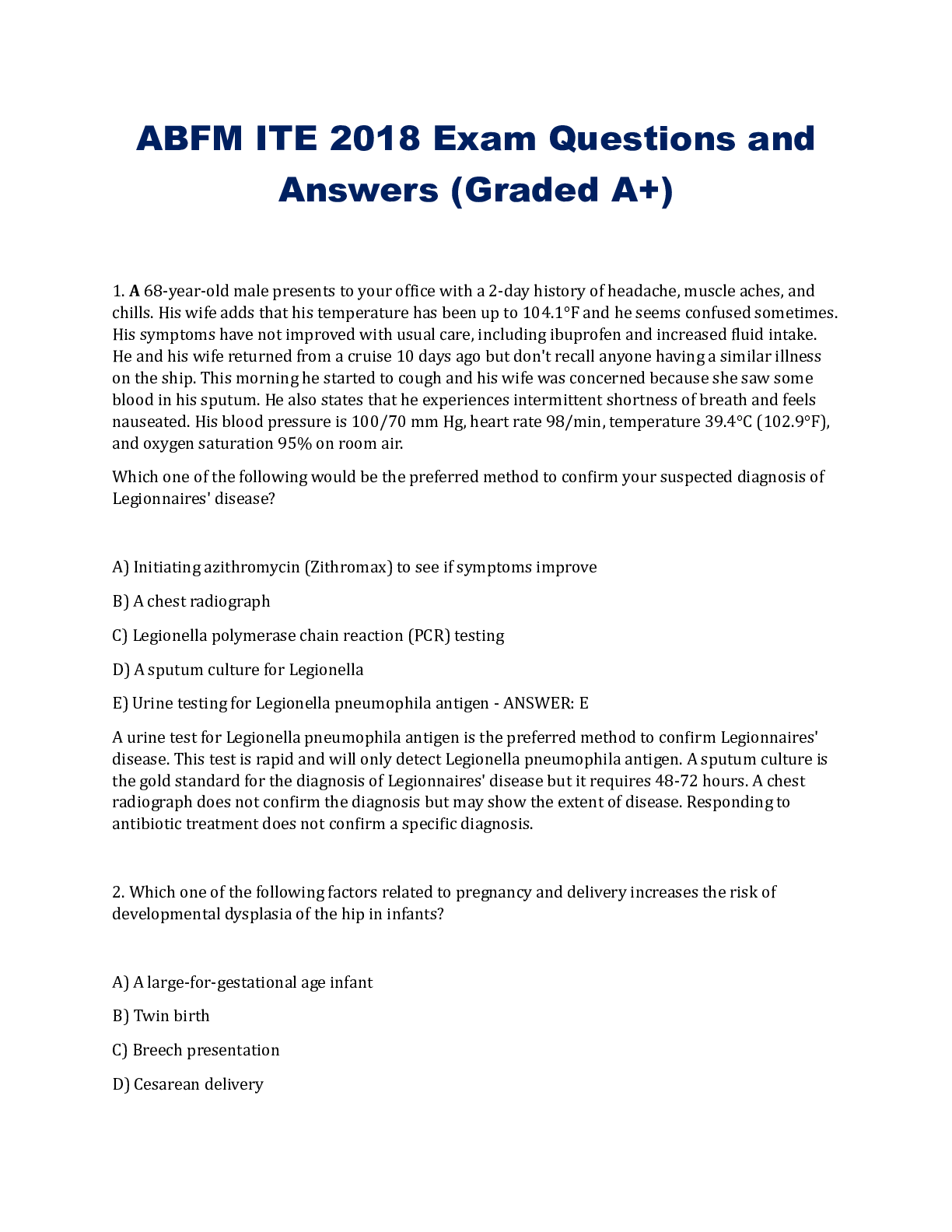
ABFM ITE 2018 Exam Questions and Answers (Graded A+)
1. A 68-year-old male presents to your office with a 2-day history of headache, muscle aches, and chills. His wife adds that his temperature has been up to 104.1°F and he seems confused sometimes. His symptoms have not improved with usual care, including ibuprofen and increased fluid intake. He and his wife returned from a cruise 10 days ago but don't recall anyone having a similar illness on the ship. This morning he started to cough and his wife was concerned because she saw some blood in his sputum. He also states that he experiences intermittent shortness of breath and feels nauseated. His blood pressure is 100/70 mm Hg, heart rate 98/min, temperature 39.4°C (102.9°F), and oxygen saturation 95% on room air.
Which one of the following would be the preferred method to confirm your suspected diagnosis of Legionnaires' disease?
A) Initiating azithromycin (Zithromax) to see if symptoms improve
B) A chest radiograph
C) Legionella polymerase chain reaction (PCR) testing
D) A sputum culture for Legionella
E) Urine testing for Legionella pneumophila antigen - ANSWER: E
A urine test for Legionella pneumophila antigen is the preferred method to confirm Legionnaires' disease. This test is rapid and will only detect Legionella pneumophila antigen. A sputum culture is the gold standard for the diagnosis of Legionnaires' disease but it requires 48-72 hours. A chest radiograph does not confirm the diagnosis but may show the extent of disease. Responding to antibiotic treatment does not confirm a specific diagnosis.
2. Which one of the following factors related to pregnancy and delivery increases the risk of developmental dysplasia of the hip in infants?
[Show More]




 Questions and Answers Complete Exam Solution.png)
.png)
 QUESTIONS AND ANSWERS WITH COMPLETE SOLUTION GRADED A.png)
 A GRADED.png)
.png)