Gerontology Exam 3 Study Guide
1. What is the difference between Gerontology and geriatrics?
a. Gerontology - study of aging and older adults
i. Multidisciplinary
ii. Focus: healthy and successful aging
iii. Address
...
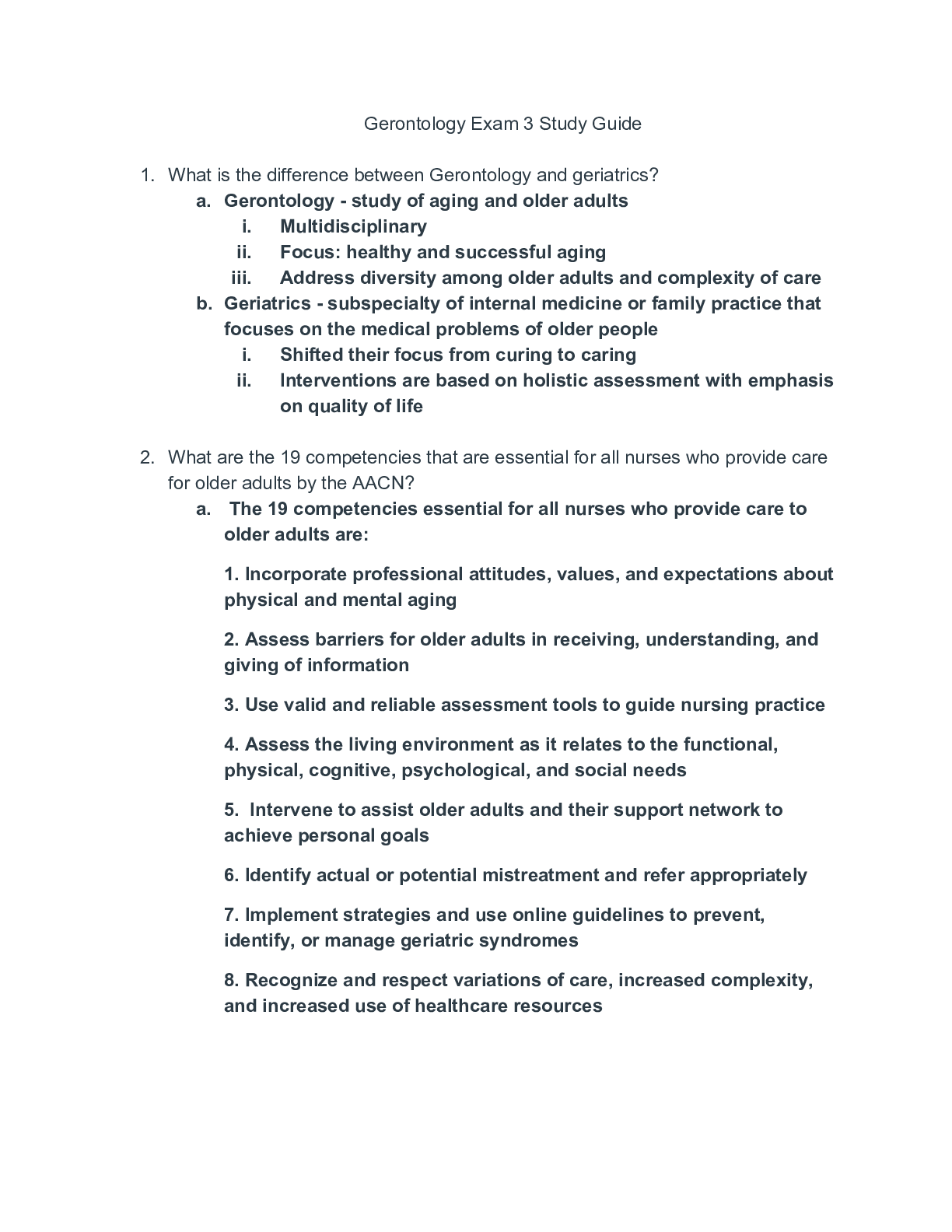
Gerontology Exam 3 Study Guide
1. What is the difference between Gerontology and geriatrics?
a. Gerontology - study of aging and older adults
i. Multidisciplinary
ii. Focus: healthy and successful aging
iii. Address diversity among older adults and complexity of care
b. Geriatrics - subspecialty of internal medicine or family practice that
focuses on the medical problems of older people
i. Shifted their focus from curing to caring
ii. Interventions are based on holistic assessment with emphasis
on quality of life
2. What are the 19 competencies that are essential for all nurses who provide care
for older adults by the AACN?
a. The 19 competencies essential for all nurses who provide care to
older adults are:
1. Incorporate professional attitudes, values, and expectations about
physical and mental aging
2. Assess barriers for older adults in receiving, understanding, and
giving of information
3. Use valid and reliable assessment tools to guide nursing practice
4. Assess the living environment as it relates to the functional,
physical, cognitive, psychological, and social needs
5. Intervene to assist older adults and their support network to
achieve personal goals
6. Identify actual or potential mistreatment and refer appropriately
7. Implement strategies and use online guidelines to prevent,
identify, or manage geriatric syndromes
8. Recognize and respect variations of care, increased complexity,
and increased use of healthcare resources
9. Recognize the complex interaction of acute and chronic
comorbidities of physical and mental conditions and associated
treatments
10. Compare models of care that promote safe, quality physical and
mental health care for older adults, such as PACE and NICHE
11. Facilitate ethical, non-coercive decision making by older adults
and/or families/caregivers for maintaining everyday living, treatment,
initiating advanced directives, and implementing EOL care
12. Promote adherence to the practice of restraint-free care
13. Integrate leadership and communication techniques that foster
discussion and reflection on the impact of care
14. Facilitate safe and effective transitions across levels of care for
older adults
15. Plan patient centered care with consideration of mental and
physical health and well being of formal and informal caregivers
16. Advocate for timely and appropriate palliative and hospice care
of older adults with physical and cognitive impairments
17. Implement and monitor strategies to prevent risk and promote
quality and safety in the nursing care of older adults
18. Utilize resources and/or programs to promote functional,
physical, and mental wellness
19. Integrate relevant theories and concepts included in liberal
education into the delivery of patient-centered care.
3. Why do you think fewer prevention and screening are given to older adults
rather than other populations?
a. screening programs focus on detecting the disease before it has
progressed to a serious or fatal stage. One major factor would be
chronological age. It is more likely that younger adults would not
have a disease that has progressed to a harmful stage than an older
adult. Thus, people figure it would be more cost effective to focus
screening efforts on the younger population.
b. misconceptions that older adults are less responsive to health
promotion interventions and that preventive services are less
effective after the onset of chronic illness.
[Show More]