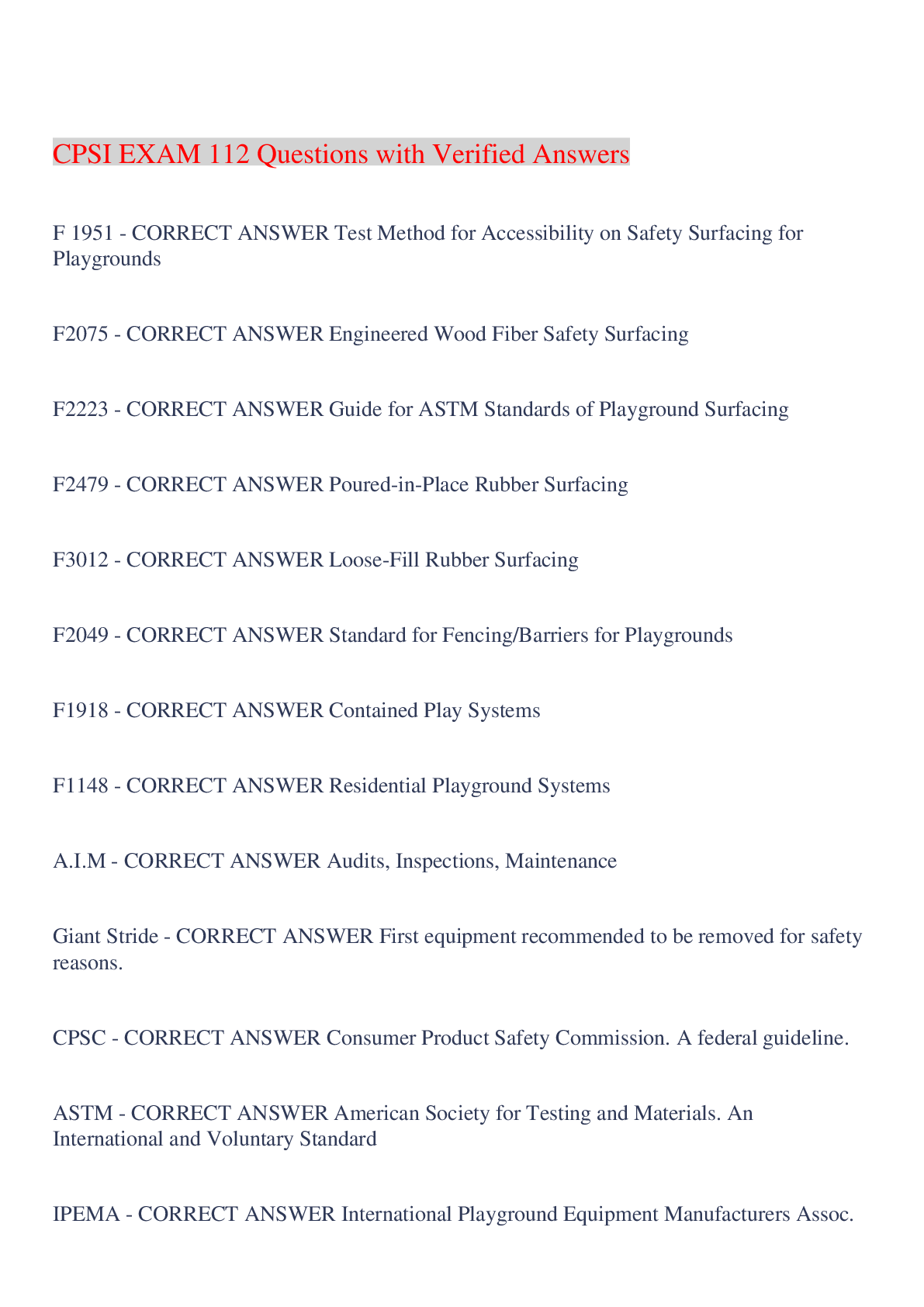
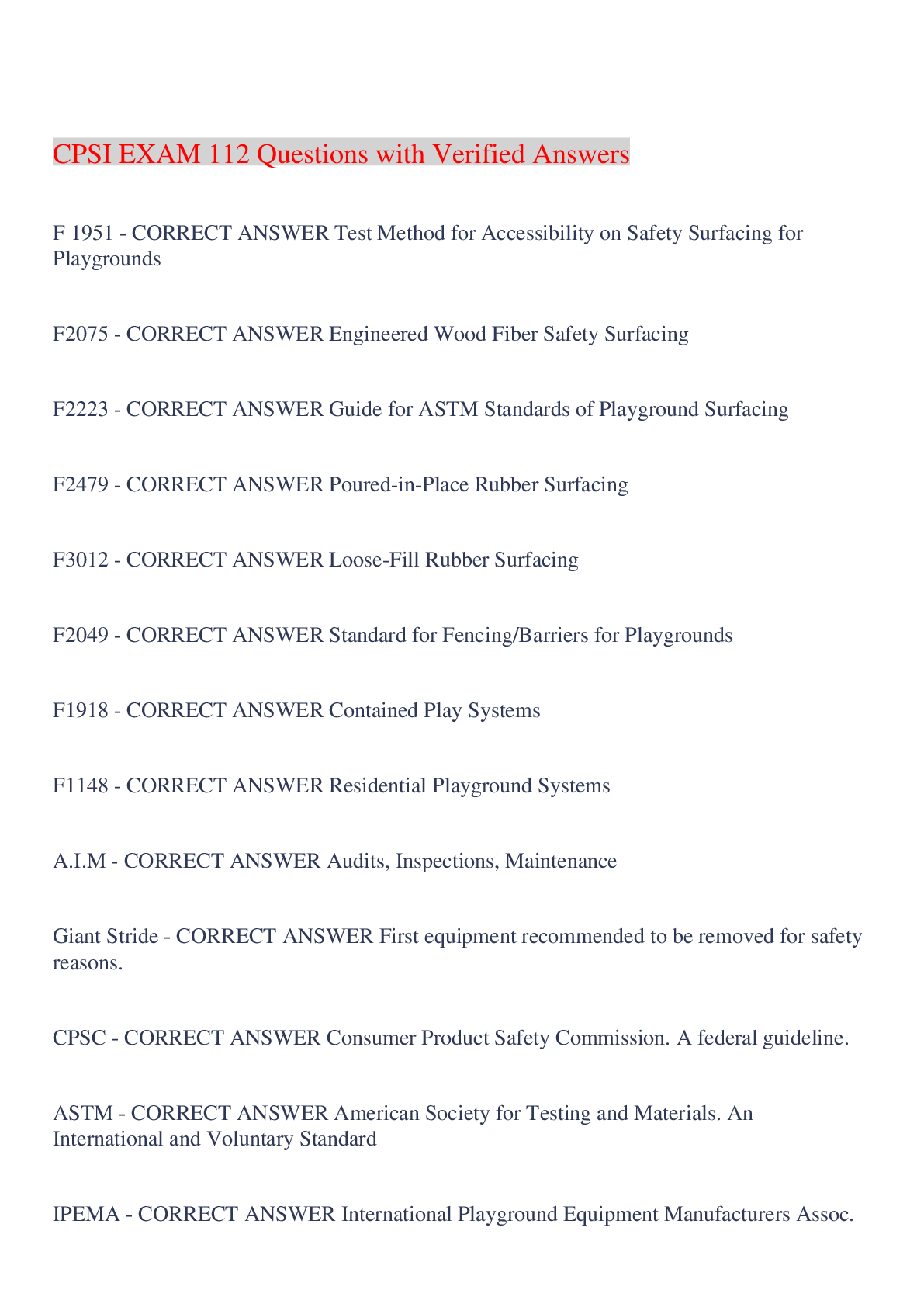
CPSI EXAM 112 Questions with Verified Answers
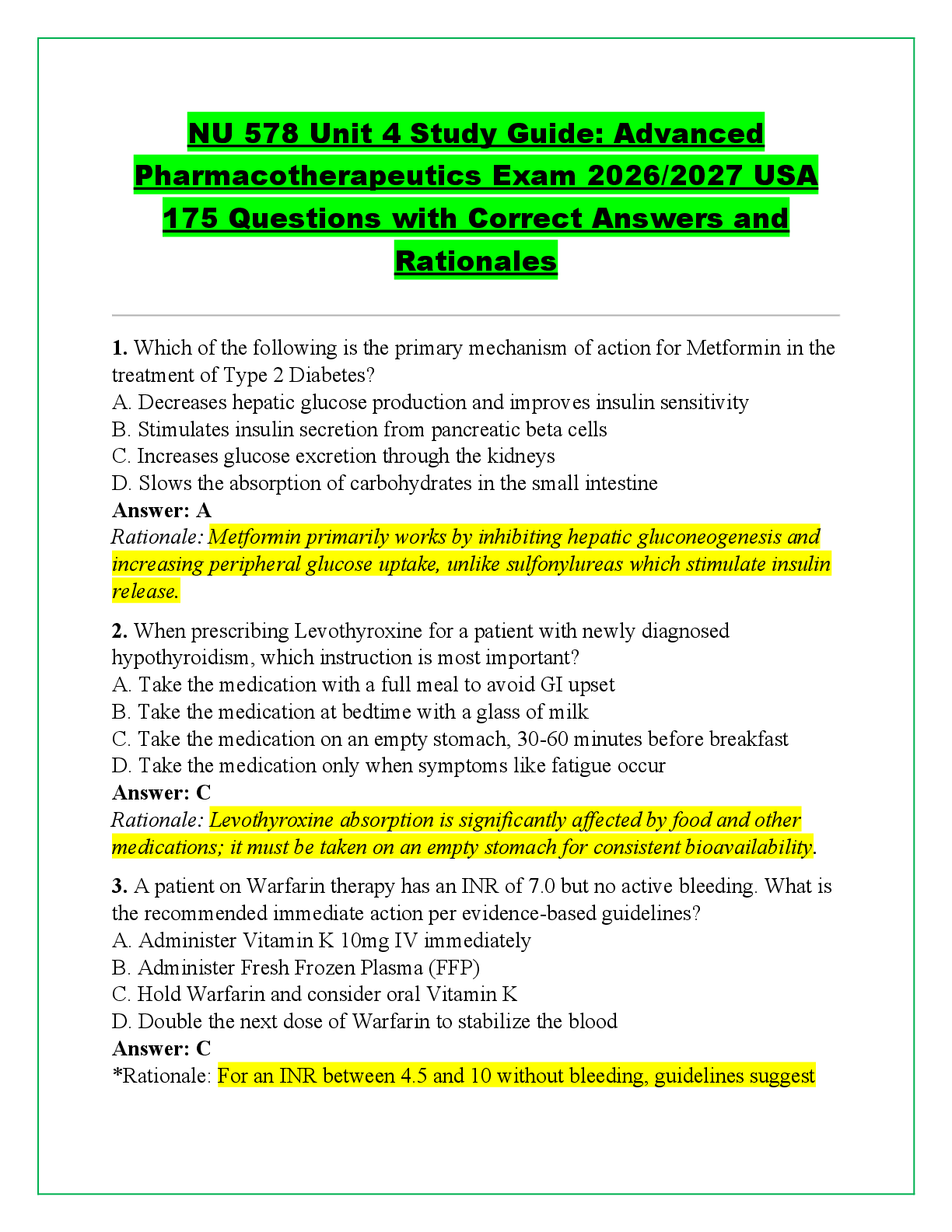
F 1951 - CORRECT ANSWER Test Method for Accessibility on Safety Surfacing for Playgrounds
F2075 - CORRECT ANSWER Engineered Wood Fiber Safety Surfacing
F2223 - CORRE
...
CPSI EXAM 112 Questions with Verified Answers
F 1951 - CORRECT ANSWER Test Method for Accessibility on Safety Surfacing for Playgrounds
F2075 - CORRECT ANSWER Engineered Wood Fiber Safety Surfacing
F2223 - CORRECT ANSWER Guide for ASTM Standards of Playground Surfacing
F2479 - CORRECT ANSWER Poured-in-Place Rubber Surfacing
F3012 - CORRECT ANSWER Loose-Fill Rubber Surfacing
F2049 - CORRECT ANSWER Standard for Fencing/Barriers for Playgrounds
F1918 - CORRECT ANSWER Contained Play Systems
F1148 - CORRECT ANSWER Residential Playground Systems
A.I.M - CORRECT ANSWER Audits, Inspections, Maintenance
Giant Stride - CORRECT ANSWER First equipment recommended to be removed for safety reasons.
CPSC - CORRECT ANSWER Consumer Product Safety Commission. A federal guideline.
ASTM - CORRECT ANSWER American Society for Testing and Materials. An International and Voluntary Standard
IPEMA - CORRECT ANSWER International Playground Equipment Manufacturers Assoc.
F 1292-17 - CORRECT ANSWER Impact Attenuation of Surfacing Materials Within the USe Zone of Playground Equipment
Entanglement - CORRECT ANSWER Most common cause of playground fatalities
Falls - CORRECT ANSWER Most common cause of injury on public playgrounds
Priority 1 Hazard - CORRECT ANSWER A readily accessible hazard that would cause an accident which would result in: Death, Brain Damage, Permanent Paralysis, Loss of Vision, Loss of Limb, Loss of Speech, Organ Destruction
F 1487 - CORRECT ANSWER Standards Specs for Playgrounds for Public Use
Range of Users - CORRECT ANSWER 5th percentile 2 year old to 95th percentile 12 year old
72 inches - CORRECT ANSWER Distance for use zone perimeter at which F1487 does not apply to benches, shade structures, litter barrels, drinking fountains and containment borders
Pre-school - CORRECT ANSWER Ages 2-5
School Age - CORRECT ANSWER Ages 5-12
Toddlers - CORRECT ANSWER 6-23 month
7 inches - CORRECT ANSWER For overhead swinging rings the length of the chain must not exceed ____________________________.
15 inches - CORRECT ANSWER The overall length of rings and chains should not exceed ____________________________________.
Log Rolls, Track Rides, Vertical Sliding Poles, Spiral Slides > 360 degrees - CORRECT ANSWER Play equipment not recommended for preschool users.
84 inches - CORRECT ANSWER There must be no obstructions within __________________ above each designated playing surface, use zone and pivot point of swings
1978 - CORRECT ANSWER Year that lead paint was banned
50 lbs - CORRECT ANSWER Amount of force required to push a probe through a completely bounded non-rigid opening
55 degrees - CORRECT ANSWER Angle on a fish or wedge probe
24 inches - CORRECT ANSWER Height above protective surfacing at which an opening is exempt
Projection - CORRECT ANSWER A part of playground equipment that extends or juts out beyond the adjacent surface
Protrusion - CORRECT ANSWER projections that can spike, pierce or stab a child, enter an eye socket, or bruise and internal organ
4 - CORRECT ANSWER Number of gauges used to identify projections
.12 inches (1/8th) - CORRECT ANSWER projections greater than ________________ are not allowed within the 21 inch slide non-entanglement zone
More than 2 - CORRECT ANSWER number of exposed threads to be considered an entanglement hazard
.04 inches - CORRECT ANSWER S-hook gap should be no greater than __________________
1/8th inch - CORRECT ANSWER Vertical projection gauge thickness
3/16th inch - CORRECT ANSWER Size of roller slide test probe
5/16th inch - CORRECT ANSWER Size of Merry go round test probe
5/8th inches - CORRECT ANSWER Size of crush and shear probe
.62 inches - CORRECT ANSWER Minimum size of flexible hand gripping components
3/4 inches - CORRECT ANSWER Minimum insertion depth of partially bounded opening probe
.95 inches - CORRECT ANSWER Minimum diameter of rigid hand gripping components and handrails
1.5 inches - CORRECT ANSWER Inside diameter of middle projection gauge
1.55 inches - CORRECT ANSWER Maximum diameter of rigid and flexible handgripping components
1.875 - CORRECT ANSWER Neck width of partially bounded opening probe
3 inches - CORRECT ANSWER Length of partially bounded neck probe
3 inches - CORRECT ANSWER Inside diameter of large projection gauge
3.5 inches - CORRECT ANSWER Torso probe thickness
4 inches - CORRECT ANSWER Minimum insertion depth of torso probe
8.5 inches - CORRECT ANSWER Shoulder width of partially bounded opening probe
9 inches - CORRECT ANSWER Diameter of head probe
12 inches - CORRECT ANSWER Maximum distance between stepping forms for 2-5 year olds
15 inches - CORRECT ANSWER Maximum clear opening without a top horizontal guardrail
18 inches - CORRECT ANSWER Maximum distance between forms for 5-12 year olds
20 inches - CORRECT ANSWER Maximum height without guardrails for 2-5 year olds
20 inches - CORRECT ANSWER Maximum height difference of guardrails on upper platform for 2-5 year olds
21 inches - CORRECT ANSWER Slide entanglement zone
23 inches - CORRECT ANSWER Maximum height for lower guardrail for children ages 2-5
28 inches - CORRECT ANSWER Maximum height of lower guard rail for children ages 5-12
29 inches - CORRECT ANSWER Maximum height of upper rail for children ages 2-5
29 inches - CORRECT ANSWER Minimum height of upper barrier rail for children ages 2-5
30 inches - CORRECT ANSWER Maximum height without barriers for ages 2-5
30 inches - CORRECT ANSWER Maximum height without guardrails for ages 5-12
38 inches - CORRECT ANSWER Minimum height of upper rail on guardrails for children 5-12
38 inches - CORRECT ANSWER Minimum height of upper rail for barriers for children ages 5-12
72 inches - CORRECT ANSWER Minimum use zone for sitting rocking/swinging equipment
72 inches - CORRECT ANSWER Minimum side use zone for rotating swing support structure
72 inches - CORRECT ANSWER Slide exit region use zone
72 inches - CORRECT ANSWER minimum use zone for to-fro swing support structure
72 inches - CORRECT ANSWER Clearance area without rigid structural components for vertical rotating equipment
72 inches - CORRECT ANSWER Clearance area without rigid structural components for vertical rotating equipment <20 inches
Y + 72 inches - CORRECT ANSWER Minimum non overlapping use zone for rotating swing
84 inches - CORRECT ANSWER minimum non overlapping use zone for standing rocking equipment
96 inches - CORRECT ANSWER Slide exit region - maximum use zone
108 inches - CORRECT ANSWER Maximum use zone overlap for adjacent play structures >30 inches high
108 inches - CORRECT ANSWER Use for vertical rotating equipment when height of rotating or adjacent equipment is > 30 inches
108 inches - CORRECT ANSWER Use zone for vertical rotating equipment with maximum dimension > 20 inches measured from axis of rotation to the outermost perimeter and which exceed the speed limitation
Impact Attenuation - CORRECT ANSWER The ability of a surface to reduce and dissipate the energy of a falling body
Critical Height - CORRECT ANSWER the fall height below which a life-threatening head injury would not be expected to occur. No value shall exceed 200 g-max or 1,000 HIC
Fall height - CORRECT ANSWER the vertical distance between the highest designated play surface on a piece of equipment and the protective surfacing beneath it
G-Max - CORRECT ANSWER The maximum acceleration of a missile (head) during impact
HIC (Head Injury Criteria) - CORRECT ANSWER a measure of the impact severity that combines both the time and energy of an impact
Not exceeding 200 g's - CORRECT ANSWER G-Max Threshold
Not exceeding 1000 - CORRECT ANSWER HIC Benchmark
Equal or exceed - CORRECT ANSWER The critical height of the protective surfacing must __________________________________ the fall height of the equipment
Height of the platform to the protective surfacing - CORRECT ANSWER Fall height for elevated platforms
Maximum height of the structure to the protective surfacing - CORRECT ANSWER Fall height for upper body equipment
Distance between the highest designated play surface and the protective surfacing - CORRECT ANSWER Fall height for vertical rotating equipment
Distance between the highest designated play surface and the protective surfacing - CORRECT ANSWER Fall height for horizontal rotating equipment
Maximum attainable height of any part to the protective surfacing - CORRECT ANSWER Fall height for seesaws
Maximum height of the seat or designated play surface to the protecting surfacing - CORRECT ANSWER Fall height for spring rocking equipment
60 inches below the highest portion of the pole to the protective surfacing - CORRECT ANSWER Fall Height for sliding poles
Exempt - CORRECT ANSWER Ground level play devices or structures used in a standing or seating position with feet on the ground are ____________________________________ from fall heights
Surface System - CORRECT ANSWER All materials that contribute to the impact absorption to minimize the likelihood of a life-threatening injury
Loose Fill System - CORRECT ANSWER A surface system consisting of small, independent moveable particles
Unitary System - CORRECT ANSWER A surface system consisting of one or more components bound together
Composite System - CORRECT ANSWER A surface system including both loose-fill and unitary components
Beneath/immediately adjacent - CORRECT ANSWER The area ______________________ and ___________________________________________ _________________________________ to a play structure or equipment that is designated for unrestricted circulation around the equipment
True - CORRECT ANSWER True or false The area where a ramp or elevated walkway connects to the perimeter is exempt from surfacing requirements
True - CORRECT ANSWER True or Fales Nothing can be closer than 72 inches from any play structure
108 inches - CORRECT ANSWER If either structure in a use zone is > 30 inches they may partially overlap to ________________________________________
< or = 30 inches - CORRECT ANSWER If both structures are _______________________________________ in height they may share the use zone
72 inches - CORRECT ANSWER Minimum exit region for slides up to 72 inches
Equal to height of slide - CORRECT ANSWER Exit region for slides greater than 72 inches but less or equal to than 96 inches
96 inches - CORRECT ANSWER Exit region for slides greater than or equal to 96 inches is __________________________________________________
Composite structure - CORRECT ANSWER Two or more play structures attached or functionally linked, to create one integral unit that provides more than one play activity.
Non-compliant/Compliant - CORRECT ANSWER The purpose of a safety audit is to identify __________________________ and _________________________________________ conditions
Standard of Care - CORRECT ANSWER When non-compliant conditions have been corrected a ___________________________________________________ has been achieved.
Safety, Function and Asthetics - CORRECT ANSWER The three functions of inspections and maintenance
Extent of use - CORRECT ANSWER #1 use factor is ________________________________________
[Show More]